Circuit Breaker Types: MCB, MCCB, ACB, RCCB and RCBO Explained
How MCBs, MCCBs, ACBs, RCCBs and RCBOs differ, which IEC standard each follows, what trip curves and breaking capacities mean, and which breaker goes where in a Gulf installation.
Low-voltage circuit breakers come in five types. MCBs protect final circuits up to 125 A. MCCBs cover feeders from about 100 A to a few thousand amps. ACBs serve main incomers up to 6,300 A. RCCBs detect earth leakage only, and RCBOs add overcurrent protection to the same device. Choose by the standard, the trip curve, the breaking capacity at the point of installation and the ambient temperature. Then shortlist circuit breaker suppliers in the UAE against those four points.
This guide is for designers, MEP contractors and maintenance engineers who specify, approve or replace breakers. It covers the standard behind each type, B, C and D curves, Icu and Ics, selectivity and residual current types. For the switchboards, panel brands and approvals that these breakers sit inside, see our guide to switchgear and panel brands in the UAE and Saudi Arabia. Buyers in the Kingdom can compare circuit breaker suppliers in Saudi Arabia.
The five breaker types at a glance
The product standard each type is built to fixes its rating limits and test method.
Type
What it does
Product standard (current edition)
Scope limits in the standard
Typical place in the system
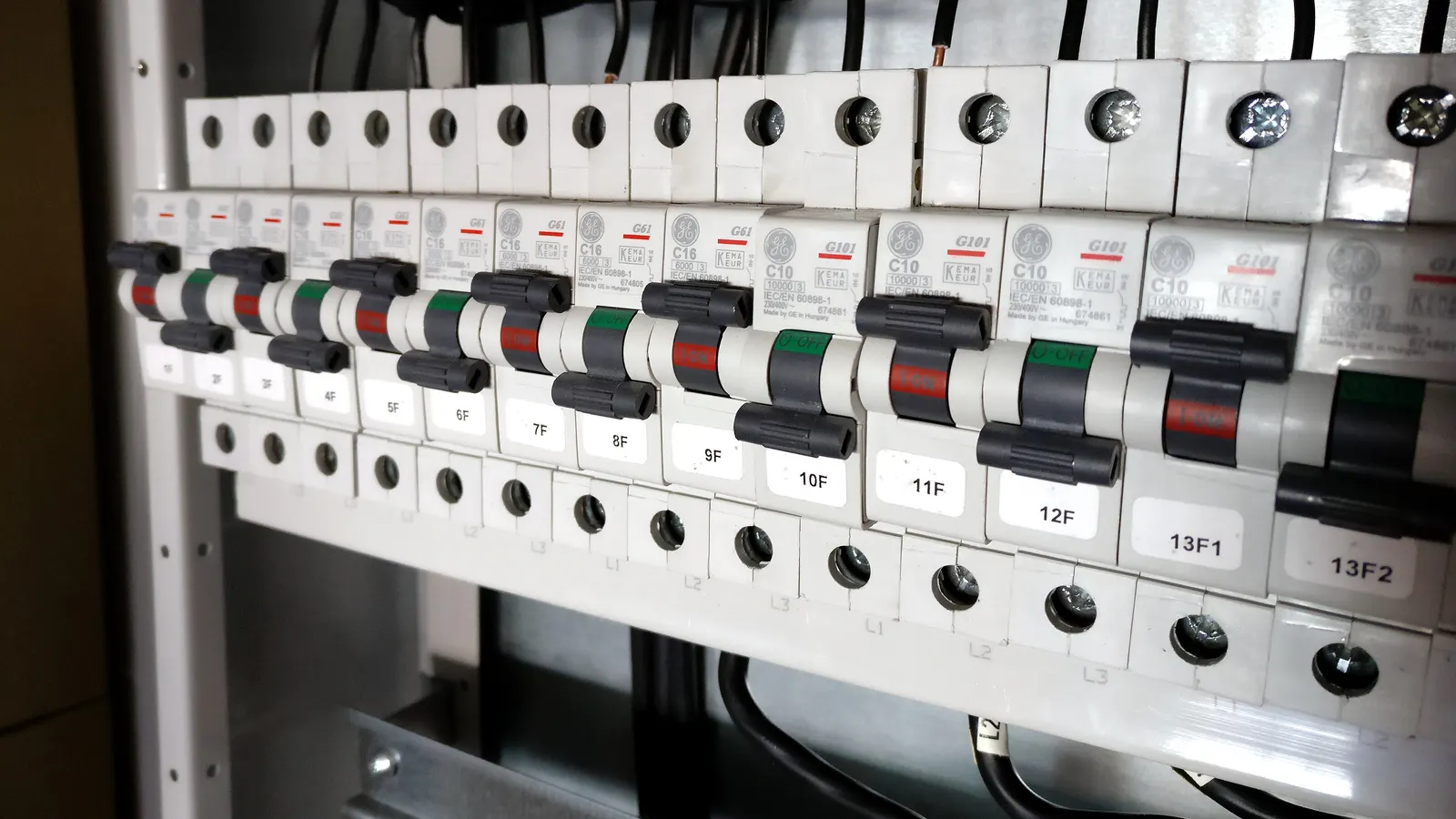
MCB (miniature circuit breaker)
Overload and short-circuit protection, fixed setting
IEC 60898-1:2015+AMD1:2019 (household and similar); many MCBs are also certified to IEC 60947-2
Up to 440 V AC between phases, 125 A, 25,000 A short-circuit capacity
Trips on earth leakage only; no overcurrent protection
IEC 61008-1:2024
Up to 440 V AC, 125 A
Upstream of a group of MCBs
RCBO (RCD with overcurrent protection)
Earth leakage plus overload and short-circuit protection in one device
IEC 61009-1:2024
Up to 440 V AC, 125 A, 25,000 A short-circuit capacity
Individual final circuits
IEC 60898-1 itself excludes breakers that protect motors, breakers whose current setting the user can adjust, DC breakers and breakers with residual current tripping (covered by IEC 61009). Anything outside those limits falls under IEC 60947-2, which is why MCCBs and ACBs are built to it.
Note the recent revisions: IEC 60947-2 reached its sixth edition in September 2024 (replacing 2016 plus its 2019 amendment), and IEC 61008-1 and IEC 61009-1 their fourth editions in November 2024 (replacing the 2010 editions and amendments). Specifications quoting older editions should be updated.
MCBs: trip curves B, C and D
An MCB has two trip elements. A thermal element, usually a bimetal strip, responds slowly to overloads. A magnetic element trips within milliseconds when the current passes a set multiple of the rated current (In). The letter on the breaker tells you that magnetic threshold. ABB's technical article on trip curves gives the bands:
B: trips at 3 to 5 times rated current, the most sensitive of the three.
C: trips at 5 to 10 times rated current. Suitable for medium inrush currents.
D: trips at 10 to 20 times rated current. Suitable for high starting currents, such as transformers and motors.
K and Z also exist: K at 10 to 14 times (motors and transformers), Z at 2 to 3 times (sensitive loads such as semiconductor devices).
The standard sets only the limits of each band; the manufacturer decides where within it the product trips. Two practical points follow. First, ABB notes that a fast B curve can see motor or transformer inrush as a fault, so the fix for tripping on switch-on is often a C or D curve rather than a larger rating. Second, a D-curve breaker may need up to 20 times its rating to trip instantly, against up to 5 times for a B curve, so changing B to D on an existing circuit is a design change: the designer must confirm the fault current at the end of the cable is still high enough, not treat it as a like-for-like swap.
Thermal trip limits and ambient temperature
Schneider Electric's FAQ on its Acti9 iC60 range sets out the two sets of conventional currents. Under IEC 60898-1 the breaker must not trip at 1.13 times In and must trip at 1.45 times In within the conventional time of one hour, tested at a 30 °C reference temperature. Under IEC 60947-2 the figures are 1.05 and 1.30 times In, and the manufacturer sets the reference temperature. Schneider gives 50 °C as the reference for its MCBs certified to both standards and 40 °C for those certified to IEC 60947-2 only, and notes that the reference temperature for the rated current must be printed on the device.
This matters in the Gulf, where the air inside a board in a plant room or outdoor kiosk can be well above 30 °C. A breaker carries less than its nameplate current above its reference temperature, so it can trip on load on a hot afternoon. Ask the supplier which reference temperature the offered MCB is calibrated at, and use the manufacturer's derating table for the temperature inside the enclosure, not the room.
MCCBs and ACBs: adjustable protection for feeders and incomers
Above 125 A, or wherever you need adjustable settings, you move to IEC 60947-2 devices. Schneider Electric's UAE site lists its ComPacT MCCBs from 100 A to 3,200 A and its MasterPact ACBs up to 6,300 A. Hager lists hw+ ACBs for projects up to 6,000 A. Mitsubishi Electric groups its range into ACBs, MCCBs, ELCBs and MCBs.
The trip unit is what you are really specifying. Thermal-magnetic units have a fixed or limited adjustment. Electronic trip units let the engineer set separate functions, and ABB's selectivity paper refers to them by letter: L (protection against overload), S (protection against delayed short-circuit) and I (instantaneous short-circuit protection). If the coordination study needs a short-time delay on a feeder so that downstream devices clear first, the breaker must have the S function; an MCCB with only L and I settings cannot provide it.
Icu (rated ultimate short-circuit breaking capacity), under IEC 60947-2, is the highest fault current the breaker can interrupt. It must be at least the prospective short-circuit current at the point where the breaker is installed.
Ics (rated service short-circuit breaking capacity) is the fault current the breaker can interrupt and still remain in service. IEC 60947-2 expresses it as 25, 50, 75 or 100% of Icu. Schneider notes that for MCBs Ics is usually 50 to 100% of Icu and that the exact figure is in each product's catalogue. Where continuity matters, such as hospital or data centre feeders, ask for Ics equal to 100% of Icu at your system voltage.
Rated short-circuit capacity is the figure used for household-type MCBs under IEC 60898-1, which caps it at 25,000 A. MCBs certified to both standards also carry IEC 60947-2 values; read the datasheet for both.
Utilisation category A or B. Schneider places its Compact NSX, Compact NS and EasyPact MCCBs in category A and its MasterPact ACBs in category B, and states that for category B breakers Ics always equals Icu, while some category A breakers also reach Ics of 100% of Icu. ACBs also carry a rated short-time withstand current, Icw, which becomes the selectivity limit when the ACB's instantaneous function is switched off (see selectivity below).
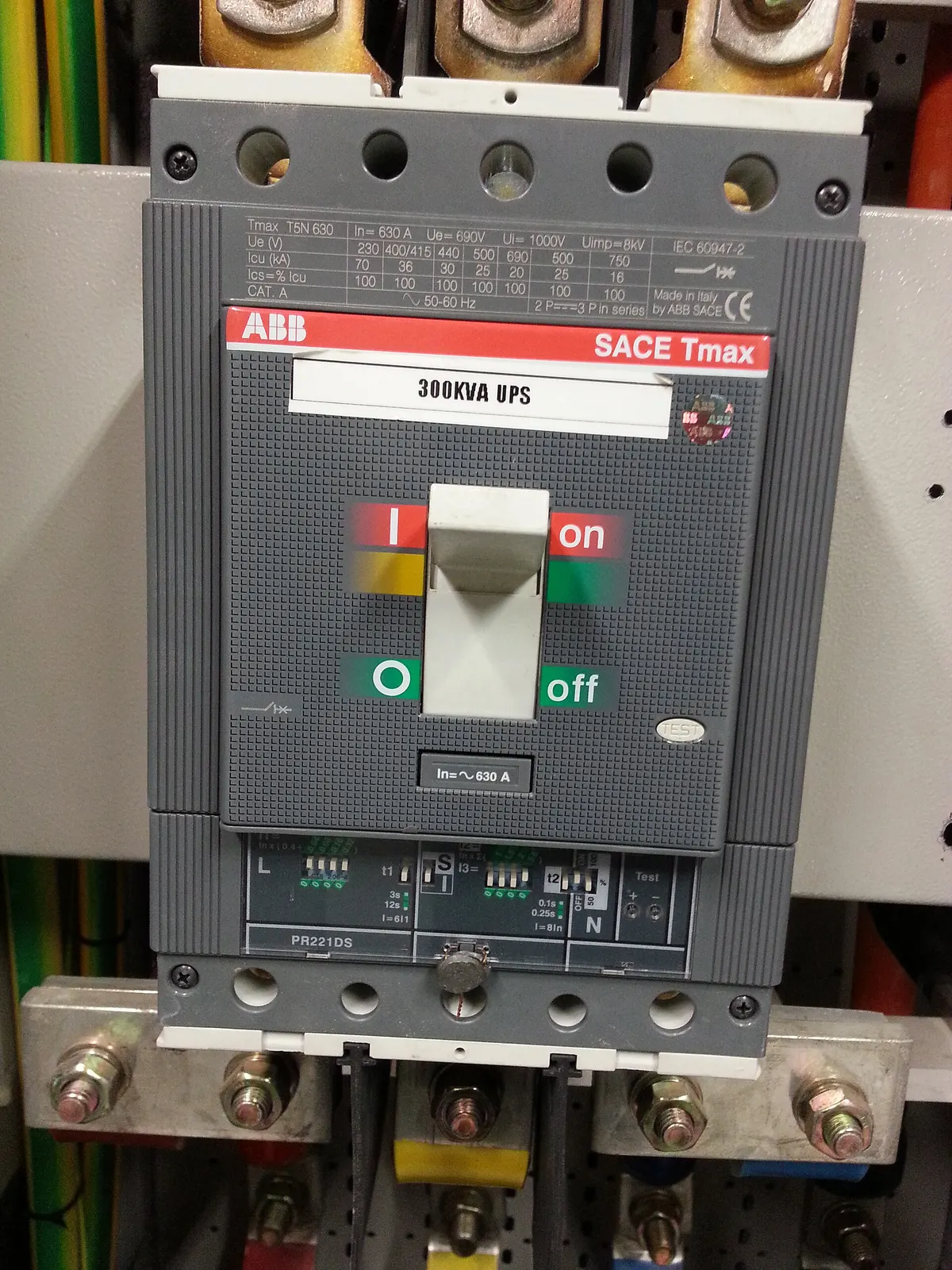
Breaking capacity varies with voltage. The 630 A breaker in the photo above, for example, lists an Icu of 36 kA at 400/415 V and 20 kA at 690 V on its plate. Always read the column for your system voltage.
Selectivity: making the right breaker trip
Selectivity means that when a fault occurs, only the breaker nearest to it opens and the rest of the installation stays energised. ABB's technical paper on LV selectivity quotes the IEC 60947-2 definitions:
Total selectivity: the load-side device clears the fault without the supply-side device tripping. Between a pair of breakers, ABB treats selectivity up to the lower of the two Icu values as total.
Partial selectivity: selectivity holds only up to a limit current, Is. If the prospective fault current at that point is below Is, the pair is still selective in practice.
The same paper describes the techniques. Time-current selectivity makes the upstream breaker trip slower than the downstream one across the overload range. Current selectivity uses different instantaneous thresholds and is often only partial unless a transformer or long cable sits between the two breakers. Time selectivity uses the delayed short-circuit function (S): the upstream breaker waits long enough for the downstream one to clear the fault. ABB notes that with the upstream ACB's instantaneous function switched off, the selectivity limit equals that ACB's Icw. Energy selectivity relies on the maker's tested tables. Zone selectivity uses a signal wire or bus between trip units so that only the breaker immediately upstream of the fault trips.
Each manufacturer publishes coordination tables for its own breaker combinations, so mixing brands between an incomer and its feeders can leave you without published values. Ask for the tables or a coordination study covering every breaker pair.
RCCB, RCBO and ELCB: residual current protection
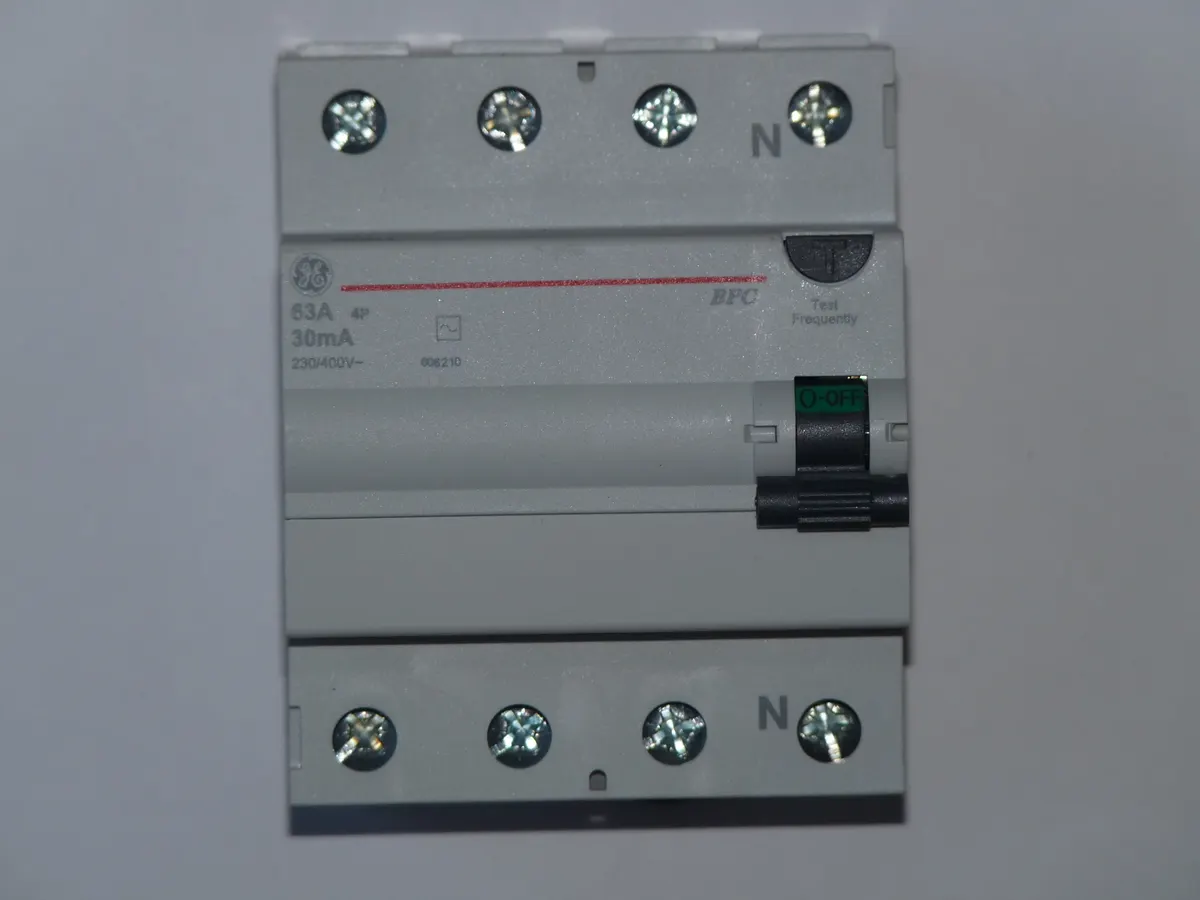
A residual current device compares line and neutral currents; if some current leaks to earth, the imbalance trips it. An RCCB does only this; it needs an MCB or fuse upstream or downstream for overcurrent protection. An RCBO combines the RCD and the MCB, so each circuit trips on its own and a fault on one does not take out a whole group.
Sensitivity: 30 mA or 300 mA
Schneider Electric's guidance on choosing RCCB sensitivity gives 30 mA for protection against electric shock by direct contact and 300 mA for protection against fire due to leakage current. Where 30 mA protection is mandatory is set by the wiring regulations your utility applies and the consultant's specification.
Type AC, A, F and B
The type letter describes which current waveforms the device will detect.
Type
Detects
Standard
AC
Sinusoidal AC residual current
IEC 61008-1 or IEC 61009-1
A
Sinusoidal AC plus pulsating DC residual current
IEC 61008-1 or IEC 61009-1
F
As type A, plus composite residual currents, for installations supplied through frequency inverters
IEC 62423 with IEC 61008-1 or IEC 61009-1
B
Alternating sinusoidal residual currents up to 1,000 Hz, plus pulsating and smooth DC residual currents
IEC 62423 with IEC 61008-1 or IEC 61009-1
Type F and type B requirements are set out in IEC 62423:2009, which applies in addition to IEC 61008-1 and IEC 61009-1 rather than replacing them. A type AC device is only defined for sinusoidal AC leakage, so match the type to the load and follow the equipment maker's instructions on which RCD type it needs.
The term ELCB covers two different things. Historically it meant a voltage-operated earth leakage breaker that sensed a rise in voltage on metalwork relative to a separate earth electrode. Those devices largely fell out of favour after current-sensing RCDs arrived. They can only detect faults on metalwork connected to them, and a broken wire in the fault-to-load section disables them. Today, many manufacturers use "ELCB" for a current-operated breaker with earth leakage protection; Mitsubishi Electric, for example, lists ELCBs that provide overload, short-circuit and earth-leakage protection. When a drawing says ELCB, ask the designer to state the product standard, sensitivity and type letter.
Which breaker goes where
Main incomer: category B ACB with the delayed short-circuit (S) function, Icu and Icw at least equal to the switchboard fault level.
Large feeders and bus couplers: ACB or large-frame MCCB, set for selectivity with the incomer.
Sub-mains to boards and MCCs: MCCB with adjustable trip, Ics at or near 100% of Icu where continuity matters.
Final circuits: MCB of the right curve, or an RCBO where each circuit needs its own 30 mA protection rather than sharing an RCCB.
Brands that make each type
All of these brands list full LV breaker ranges; compare them on rating, curve, breaking capacity and selectivity data, not on name. Schneider Electric lists ComPacT MCCBs from 100 A to 3,200 A, MasterPact ACBs up to 6,300 A and the dual-rated Acti9 iC60 MCB family. ABB publishes trip curve guidance and coordination tables between its moulded case and miniature breakers. Hager lists MCBs, RCCBs, RCBOs, MCCBs and hw+ ACBs up to 6,000 A in its Middle East catalogue. Mitsubishi Electric lists ACBs, MCCBs, ELCBs and MCBs, with RCCBs and RCBOs in its MCB family. For Eaton, Legrand, Siemens, LS Electric, Chint and others, the main switchgear guide sets out what each group makes.
UAE and Saudi rules for breakers
UAE: MoIAT regulates low-voltage electrical products; confirm with the supplier and certifying body whether your breakers are in scope, and see our guide to ECAS and EQM product conformity. The utility's wiring regulations and your consultant's specification decide where RCD protection is required and at what sensitivity, so check them before you fix the board schedule.
Saudi Arabia: imported breakers go through SABER under SASO technical regulations, as the main guide explains. For SEC-connected projects or a client's plant, check the approved manufacturer list, which can fix the brand, standard and breaking capacity. LV switchgear suppliers in Saudi Arabia can usually supply the breakers and boards together.
Circuit breaker RFQ checklist
Breaker type and product standard with edition (IEC 60898-1, IEC 60947-2:2024, IEC 61008-1:2024 or IEC 61009-1:2024).
Rated current, number of poles and system voltage.
For MCBs: curve (B, C or D), short-circuit capacity and reference temperature.
For MCCBs and ACBs: Icu and Ics at your voltage, category, Icw for ACBs, trip unit functions (L, S, I), fixed or draw-out.
For RCDs: sensitivity and type (AC, A, F or B).
Prospective fault current at each board, and selectivity tables for each breaker pair.
Temperature inside the enclosure and the derating at that temperature.
Conformity certificates for the country and the brand on the approved list.
Send that list with the single-line diagram and you can post a requirement on ListGCC for breaker suppliers in the UAE and Saudi Arabia to quote.
What is the difference between B, C and D curve MCBs?
The letter sets the magnetic trip threshold. ABB's technical article gives B as 3 to 5 times rated current, C as 5 to 10 times, and D as 10 to 20 times. ABB describes C as suited to medium inrush currents and D to high starting currents, such as transformers and motors. A higher curve needs a higher fault current to trip instantly, so check it against the circuit design.
Which is better, RCCB or ELCB?
If ELCB means the old voltage-operated device, an RCCB is the better choice, because it senses any current leaking to earth rather than only voltage on connected metalwork. Many manufacturers now use ELCB for current-operated earth leakage breakers, which work like RCCBs or RCBOs. Ask for the standard, sensitivity and type letter so you know which device is being offered.
What do Icu and Ics mean on a breaker?
Icu is the rated ultimate short-circuit breaking capacity: the highest fault current the breaker can interrupt. Ics is the rated service breaking capacity: the fault current it can interrupt and still remain in service, stated as 25, 50, 75 or 100% of Icu under IEC 60947-2. Both must be read at your system voltage. Where downtime is costly, ask for Ics equal to Icu.
Do circuit breakers need derating in the Gulf?
Often, yes. IEC 60898-1 tests MCBs at a 30 °C reference temperature, and IEC 60947-2 lets the manufacturer set its own reference, such as 40 or 50 °C. Inside a hot enclosure the breaker carries less than its nameplate current and may trip on load. Ask for the reference temperature and use the manufacturer's derating table for the temperature inside the board.
Which RCD type do I need for a variable speed drive?
IEC 62423 defines two types for these circuits. Type F is for installations supplied through frequency inverters and adds composite residual currents to type A. Type B goes further, detecting AC residual currents up to 1,000 Hz and smooth DC as well as pulsating DC. Type AC is only defined for sinusoidal leakage. Confirm the required type in the drive manufacturer's installation instructions.
How VRF and chilled water systems differ, where VRF runs out of capacity, refrigerant safety in small rooms, part-load and high ambient ratings, district cooling as a third option, and an RFQ checklist.
Where LV ends and MV begins, how GIS and AIS differ in size, cost and maintenance, what SF6 rules mean for Gulf buyers, how ring main units work and how to read an MV datasheet.
Wall split, ducted split, package or window unit: how they differ, what Saudi and UAE efficiency rules require of each, how they cope at 46°C, and which suits villas, offices and warehouses.