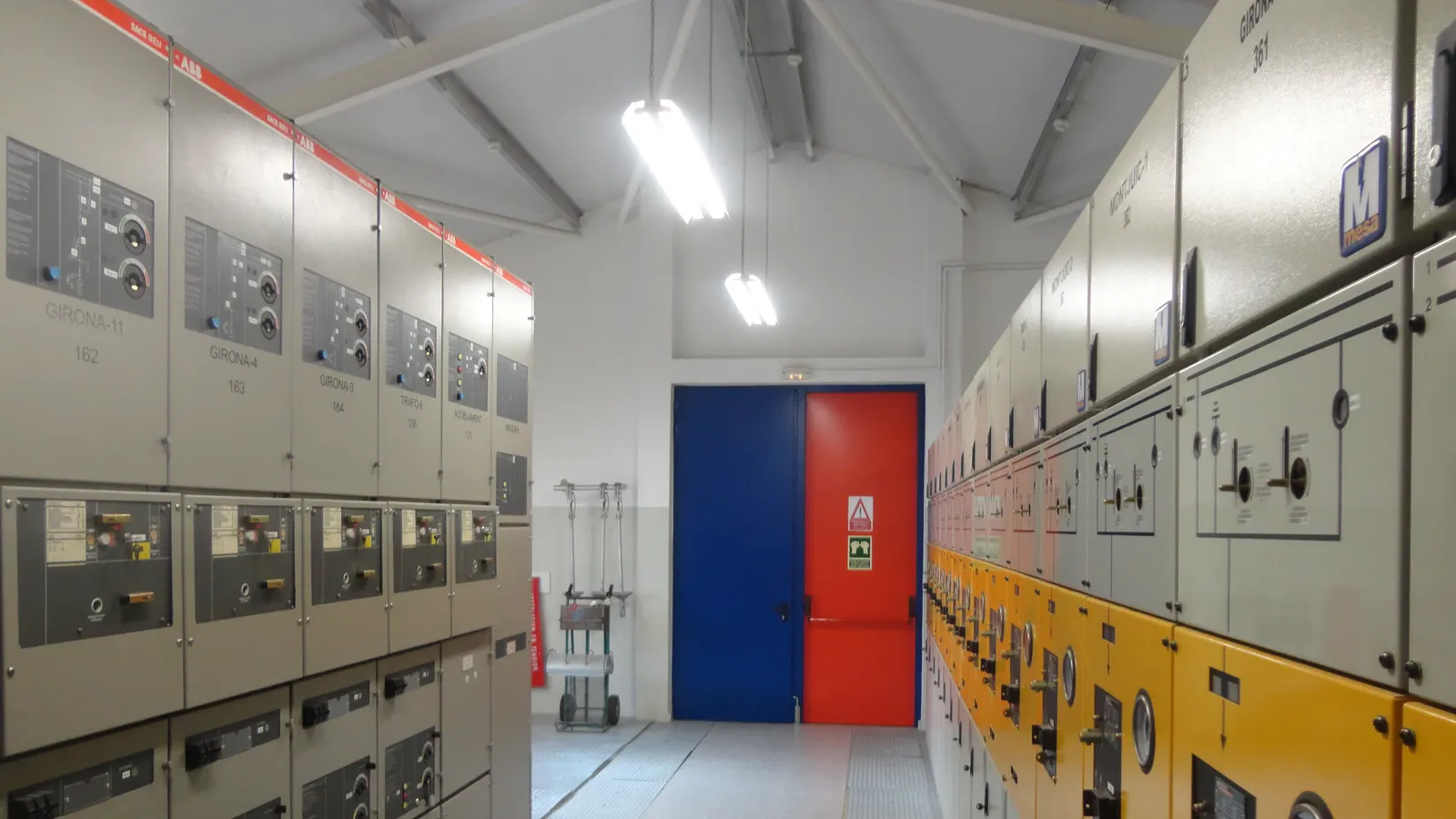
How main, sub-main and final distribution boards differ, when IEC 61439-3 or 61439-2 applies, how to rate the incomer and busbar, and what to specify for ways, IP rating, heat and labelling.
A distribution board (DB, or "DB box") splits an incoming supply into final circuits, each with its own breaker or fuse, in one enclosure. Choose it by role (main, sub-main or final), phases (three-phase TPN or single-phase SPN), incomer and busbar rating, number of ways plus spares, IP rating and the standard it is verified to. Then compare distribution board suppliers in the UAE against that list, not on price per way alone.
This guide is for MEP designers, electrical contractors and facility engineers who specify, buy or replace distribution boards in offices, villas, retail, hospitals and plant rooms. It covers board types, the IEC 61439-3 limits that decide which standard applies, ratings, ways, IP codes, labelling, heat and testing. Large switchboards, panel brands and approvals are covered in our guide to switchgear and panel brands in the UAE and Saudi Arabia. Buyers in the Kingdom can compare distribution board suppliers in Saudi Arabia.
Main, sub-main and final distribution boards
The Wikipedia article on distribution boards defines one as dividing an electrical power feed into subsidiary circuits, with a fuse or breaker for each circuit in a common enclosure. It notes that the main distribution board in an installation will normally also provide the main switch, and that larger installations often use subsidiary distribution boards. Boards may also be designated for three-phase or single-phase supply, and for normal or emergency power.
MCCB or switch-disconnector incomer, MCCB or MCB feeders
Final distribution board (DB)
SMDB
Lighting, small power, local equipment
Isolator or MCCB incomer, MCBs, RCCBs, RCBOs
Consumer unit
Utility supply or DB
Circuits in a dwelling
Main switch, RCDs, MCBs or RCBOs
Emergency or essential DB
Generator-backed or UPS-backed supply
Life safety and critical loads
As for final DBs, kept separate from normal supply
The names vary by consultant (MDB, SMDB, DB, LP, PP), so the schedule matters more than the label. What does matter is that each level is coordinated with the one above, so that a fault trips the nearest device. Our guide to circuit breaker types explains trip curves, breaking capacity and selectivity between levels.
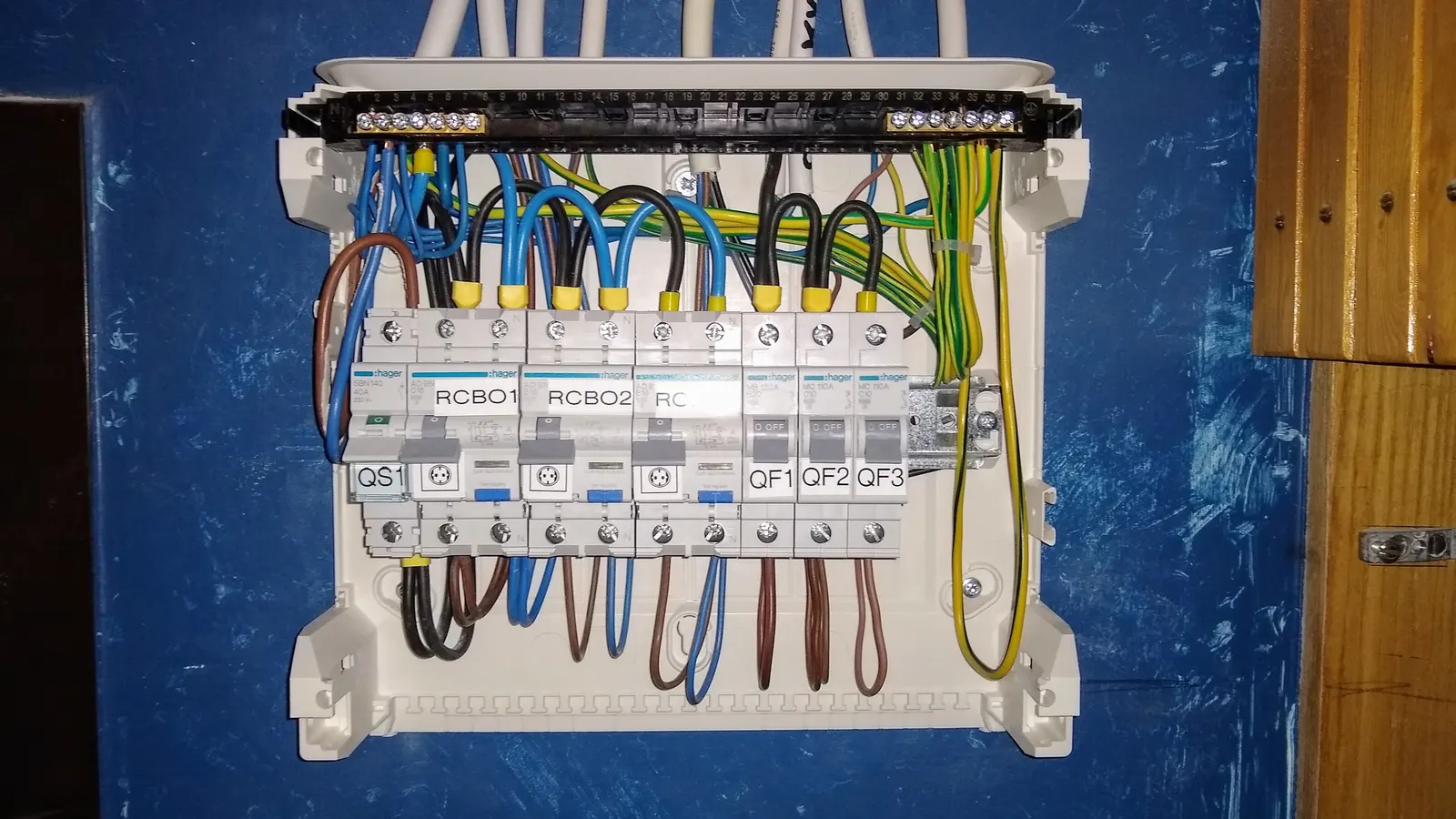
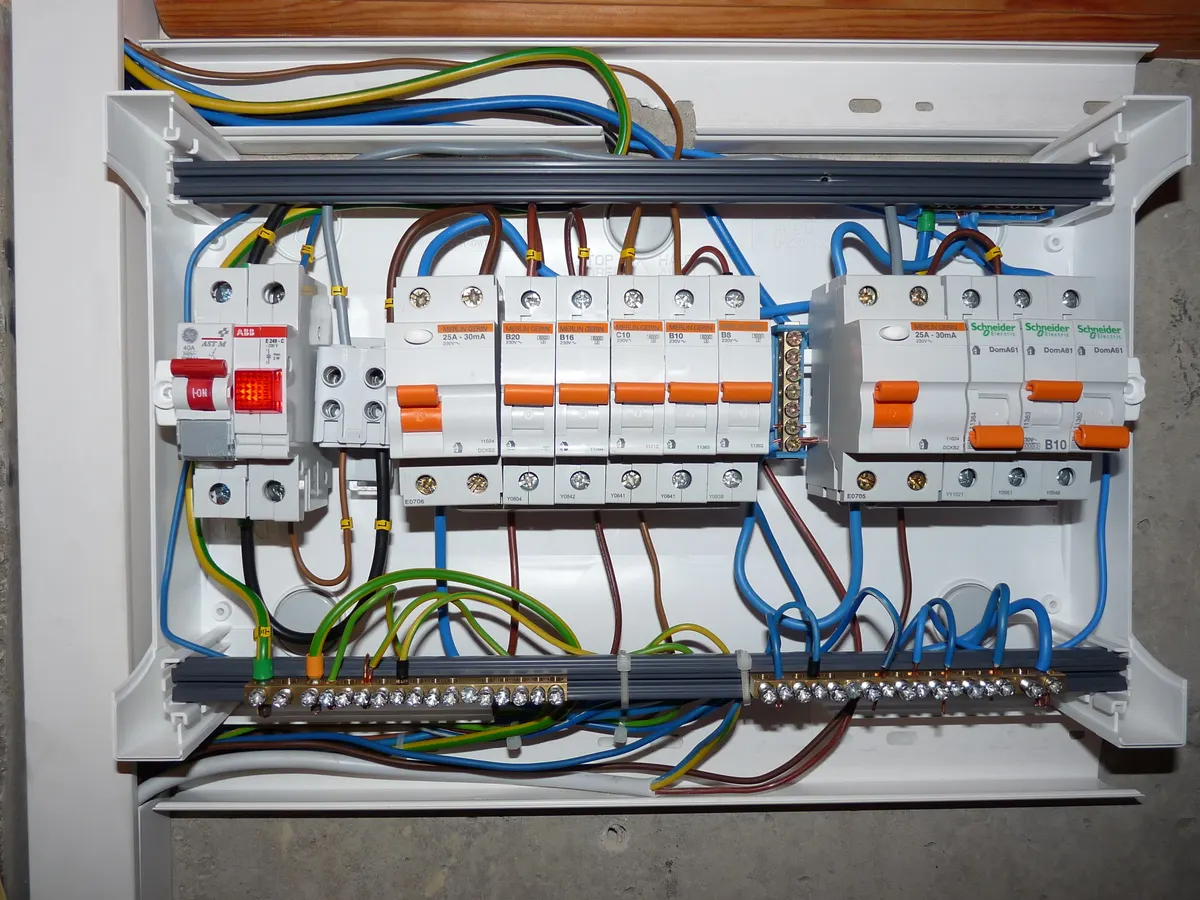
A consumer unit with its cover removed: a main isolator, two 30 mA residual current devices each protecting a group of MCBs, and neutral and earth bars along the bottom. Photo: Dmitry G, CC BY-SA 3.0, via Wikimedia Commons
Which standard applies: IEC 61439-3 or IEC 61439-2
This is the point many specifications get wrong. IEC 61439-3:2024, the second edition published in March 2024, covers distribution boards intended to be operated by ordinary persons (DBOs), for example for switching and replacing fuse-links, including in household use. Its limits are:
nominal voltage to earth not exceeding 300 V AC;
outgoing circuits rated not more than 125 A, with protective devices to listed standards such as IEC 60898-1 for MCBs;
a rated current of the assembly (InA) not exceeding 250 A;
enclosed, stationary assemblies for indoor or outdoor use.
A board outside those limits, such as a 400 A sub-main board with MCCB feeders, or a board operated only by skilled persons, is a power switchgear and controlgear assembly under IEC 61439-2. Both parts are read with IEC 61439-1.
The 2024 edition of Part 3 replaced the 2012 edition. It removed the old type A and type B DBO categories, added an annex on DBOs in a prosumer's installation, and added an annex on rated current when a board has an additional supply in parallel, such as solar PV. If your specification still asks for "type A" or "type B" boards, update it.
TPN or SPN, and rating the incomer and busbar
In Gulf catalogues three-phase boards are listed as TPN boards (Hager's Invicta TPN range is one example), and single-phase boards are often listed as SPN. The choice follows the load: three-phase boards for mixed loads, HVAC equipment and larger buildings, single-phase boards for small premises and local circuits. On three-phase boards, plan the circuit allocation so single-phase loads are balanced across the phases.
Each phase is fed along its own busbar. Rate the board on three numbers:
Incomer rating: the isolator, MCCB or RCD at the top of the board, sized for the maximum demand of the board and coordinated with the upstream device.
Busbar rating: the current the busbar can carry in the enclosure at your ambient. For DBOs under Part 3, the assembly rating is at most 250 A.
Short-circuit rating: the prospective fault current at the board's location, which every device and the busbar must withstand. Boards close to a transformer see far higher fault levels than final boards at the end of long sub-main cables.
Manufacturers publish board ratings by range. Lucy Electric, for example, lists a sub-mains distribution board at 400 V and 630 A, with direct connection or a fused incomer, and multi-service distribution boards at 315 A. Schneider Electric lists PrismaSeT G for distribution up to 630 A. Above these sizes you are into switchboards built to IEC 61439-2.
Ways, spare ways and future load
A "way" is a position on the board for one single-pole device; three-phase devices use three. Wikipedia gives 6 to 24 ways as a typical range for a new domestic consumer unit, while commercial TPN boards run larger. Set the number of ways from the circuit schedule, then add spare capacity:
specify spare ways as a percentage of used ways, or as a fixed number per board, and state whether spares are to be fitted with breakers or left blank;
check that the busbar and incomer have the current capacity to supply the spare ways, not just the space;
allow space in the enclosure and gland plate for the extra cables.
Spare ways cost little at the tender stage. Adding a second board later because the first is full costs much more, especially in fitted-out offices and retail units.
IP ratings for distribution boards
The IP code, defined in IEC 60529, gives the degree of protection of the enclosure in two digits. The first digit is protection against solids: 2 for fingers and objects larger than 12.5 mm, 4 for wires and objects larger than 1 mm, 5 for dust-protected, 6 for dust-tight. The second digit is protection against water: 1 for vertically dripping water, 3 for spraying water up to 60° from vertical, 4 for splashing from any direction, 5 for water jets from a 6.3 mm nozzle and 6 for powerful jets from a 12.5 mm nozzle.
Wikipedia notes that new British distribution boards generally have the live parts enclosed to IP2X. For Gulf conditions:
Air-conditioned electrical rooms and ceiling voids: a lower rating can be enough, but state it in the schedule rather than leaving it to the supplier.
Plant rooms, car parks and warehouses: dust-protected (5) or better, and a second digit suited to wash-down or condensation.
Outdoor and rooftop: a dust- and jet-protected rating, sun shading, and a UV-resistant enclosure. IEC 61439-1:2020 includes verification of resistance to ultraviolet radiation among its design verification items.
A higher IP rating also traps heat, which leads to the next point.
Every breaker gives off heat at load, and a closed board in a hot plant room or an outdoor kiosk can run well above the room temperature. Two effects follow. The busbar and enclosure ratings, verified under IEC 61439, assume a reference ambient (the main guide sets out the 40 °C maximum and 35 °C daily mean and the Gulf temperatures above them). And MCBs are calibrated at a reference temperature, 30 °C for IEC 60898-1 testing according to Schneider Electric, so they carry less current when the air inside the board is hotter.
In the specification:
state the design ambient for each board location;
ask for the board's rated current at that ambient and the MCB derating applied;
avoid fully loading every way of a densely packed board; group heavily loaded circuits on separate boards where possible;
keep outdoor boards out of direct sun or give them a sun shield.
Labelling and circuit charts
IEC 61439-1 includes marking among the items covered by design verification, but circuit identification on site is the contractor's job and is easy to leave until the end. A good specification asks for:
a board designation label matching the single-line diagram and the board schedule;
a label on the board stating where it is fed from;
each outgoing way identified on the device or label strip;
a typed circuit chart inside the door listing each circuit, its rating, curve, cable size and the area it serves, including RCD grouping;
warning labels where a board has more than one supply, such as a solar PV or generator input.
Check the utility's and authority's own labelling requirements before handover.
Testing and inspection
Factory-built boards come with routine verification under IEC 61439-1, which covers protection, clearances, protective circuits, wiring, mechanical operation, dielectric properties and function. Our guide to type-tested switchboards and panel builders lists the clause 11 checks and what a routine test certificate should show.
After installation, the electrical contractor tests the circuits under the wiring regulations that apply to the project, typically including insulation resistance, protective conductor continuity, polarity, earth fault loop impedance and RCD operation, and the utility or authority inspects as its rules require. Keep the test results with the circuit chart; facility teams need them for later periodic inspection.
Brands and ranges
Hager lists, in its Middle East catalogue, Invicta DIN rail boards and vega D boards, Invicta TPN boards and panel boards, enclosed MCCB boards, VT consumer units and Orion plus enclosures. Lucy Electric lists sub-mains and multi-service distribution boards, cut-outs and outdoor distribution cabinets for utility and building supplies. Schneider Electric lists PrismaSeT G distribution up to 630 A among its panel building systems. Other makers in ListGCC's distribution board category include ABB, Siemens, Eaton, Legrand, Larsen and Toubro, Havells and Gewiss; compare their boards on the same ratings and standards. Saudi buyers can see Hager in Saudi Arabia.
UAE and Saudi rules
UAE: MoIAT regulates low-voltage electrical products, and our guide to ECAS and EQM conformity explains the route; confirm which board components are in scope with the supplier. The utility's wiring regulations (DEWA in Dubai, and the relevant distribution company elsewhere) and the consultant's specification set the remaining requirements; check them before fixing the board schedule.
Saudi Arabia: imported boards and devices are registered through SABER under SASO technical regulations, as the main guide explains, and the client's specification governs the installation. Check the client's approved list for board and breaker makes.
Distribution board RFQ checklist
Board schedule: designation, location, fed from, single-line diagram reference.
Standard: IEC 61439-3:2024 for boards within its limits, otherwise IEC 61439-2:2020.
Phases and earthing system (TPN or SPN), incomer type and rating, busbar rating at the design ambient.
Prospective short-circuit current at the board and the breaking capacity required of every device.
Number of ways used and spare, breaker make, curve and rating for each way, RCD type and sensitivity.
IP rating, indoor or outdoor, surface or flush mounting, cable entry top or bottom.
Design ambient and derating method.
Labelling and circuit chart requirements.
Routine test certificate, conformity certificates and approved make status.
With the schedule ready, you can post a requirement on ListGCC and receive quotes from distribution board makers and suppliers in the UAE and Saudi Arabia.
A distribution board is an enclosure that divides an incoming electrical supply into separate circuits, each protected by its own breaker or fuse. Main boards also carry the main switch and feed sub-main boards, which in turn feed final boards for lighting, sockets and equipment. In the UAE and Saudi Arabia boards are built to the IEC 61439 series.
What is the difference between a DB and an MDB?
The main distribution board (MDB) takes the supply from the transformer, utility intake or main switchboard and feeds the sub-main and final boards. A final DB feeds individual circuits through MCBs and RCDs. MDBs carry larger incomers, often MCCBs or ACBs, and higher fault levels, and usually fall under IEC 61439-2 rather than IEC 61439-3.
What does TPN and SPN mean on a distribution board?
They are the catalogue names used in the Gulf for three-phase boards (TPN) and single-phase boards (SPN). A TPN board has a busbar for each of the three phases plus neutral and feeds three-phase and single-phase circuits; an SPN board serves single-phase circuits only. Choose TPN for buildings with three-phase supply and HVAC loads.
Which IP rating does a distribution board need?
It depends on the location. Under IEC 60529, the first digit is protection against solids (5 dust-protected, 6 dust-tight) and the second against water (4 splashing, 5 and 6 jets). Indoor air-conditioned rooms need less; plant rooms, car parks and outdoor locations in the Gulf need dust and water protection, plus sun and UV protection outdoors.
Is a consumer unit the same as a distribution board?
A consumer unit is a type of distribution board used mainly in dwellings, usually single-phase, with a main switch, RCD protection and MCBs or RCBOs. Under IEC 61439-3 it is a distribution board intended to be operated by ordinary persons, limited to 125 A outgoing circuits and 250 A for the assembly.
How many spare ways should a distribution board have?
There is no single rule in the IEC standards; the consultant's specification usually sets it. A common approach is to specify spare ways as a percentage of used ways and to confirm that the incomer and busbar can carry the extra load, not just provide the space. Leaving no spares often means adding a second board later.
How VRF and chilled water systems differ, where VRF runs out of capacity, refrigerant safety in small rooms, part-load and high ambient ratings, district cooling as a third option, and an RFQ checklist.
Where LV ends and MV begins, how GIS and AIS differ in size, cost and maintenance, what SF6 rules mean for Gulf buyers, how ring main units work and how to read an MV datasheet.
Wall split, ducted split, package or window unit: how they differ, what Saudi and UAE efficiency rules require of each, how they cope at 46°C, and which suits villas, offices and warehouses.