VRF vs Chiller Systems: Which for Your Building in the UAE and Saudi Arabia?
How VRF and chilled water systems differ, where VRF runs out of capacity, refrigerant safety in small rooms, part-load and high ambient ratings, district cooling as a third option, and an RFQ checklist.
Choose a VRF system when the building has many zones with different occupancy and its load can be split across several outdoor units with refrigerant pipe runs inside the maker's limits. Choose a chilled water plant when the building is large or tall, needs central control and redundancy, or connects to district cooling. Compare VRF and VRV system suppliers in the UAE only after checking refrigerant safety for the smallest room served.
This guide is for MEP consultants, developers and facility managers deciding between variable refrigerant flow (VRF, which Daikin sells as VRV) and a chiller-based system for offices, hotels, residential towers, schools and malls in the UAE and Saudi Arabia. Our main guide to chillers and air conditioning brands and efficiency rules covers system types, refrigerants and the brands; this article goes deeper on the VRF versus chiller decision only.
How VRF and chilled water systems differ
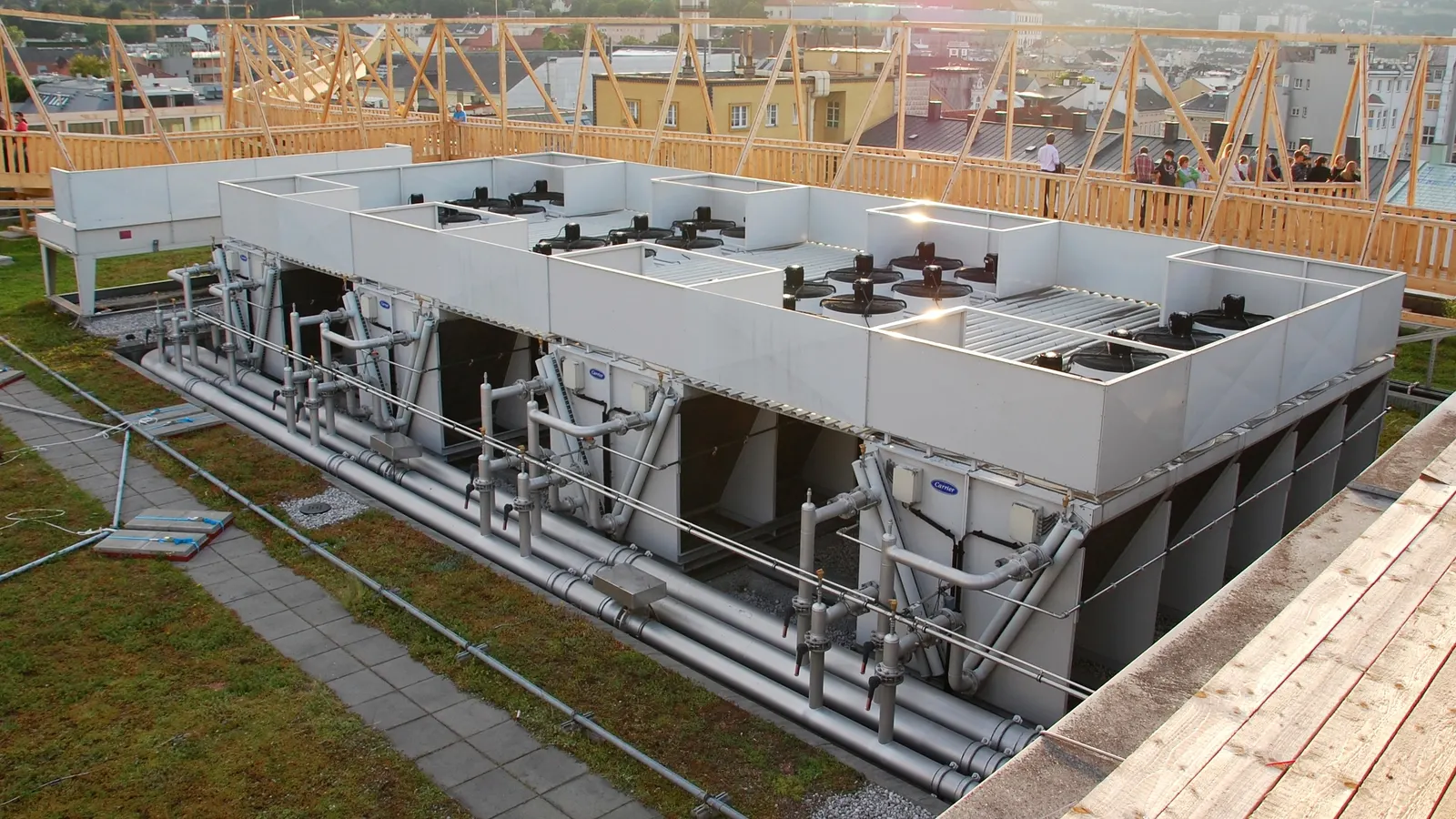
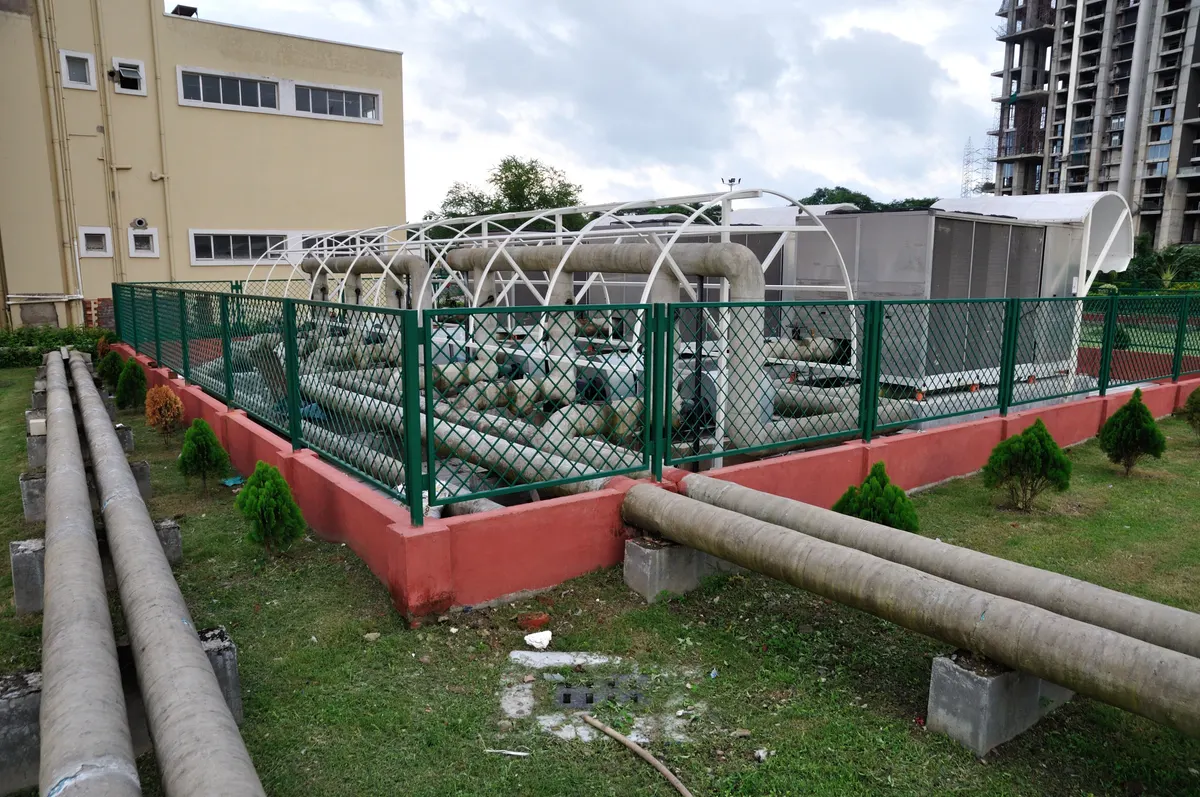
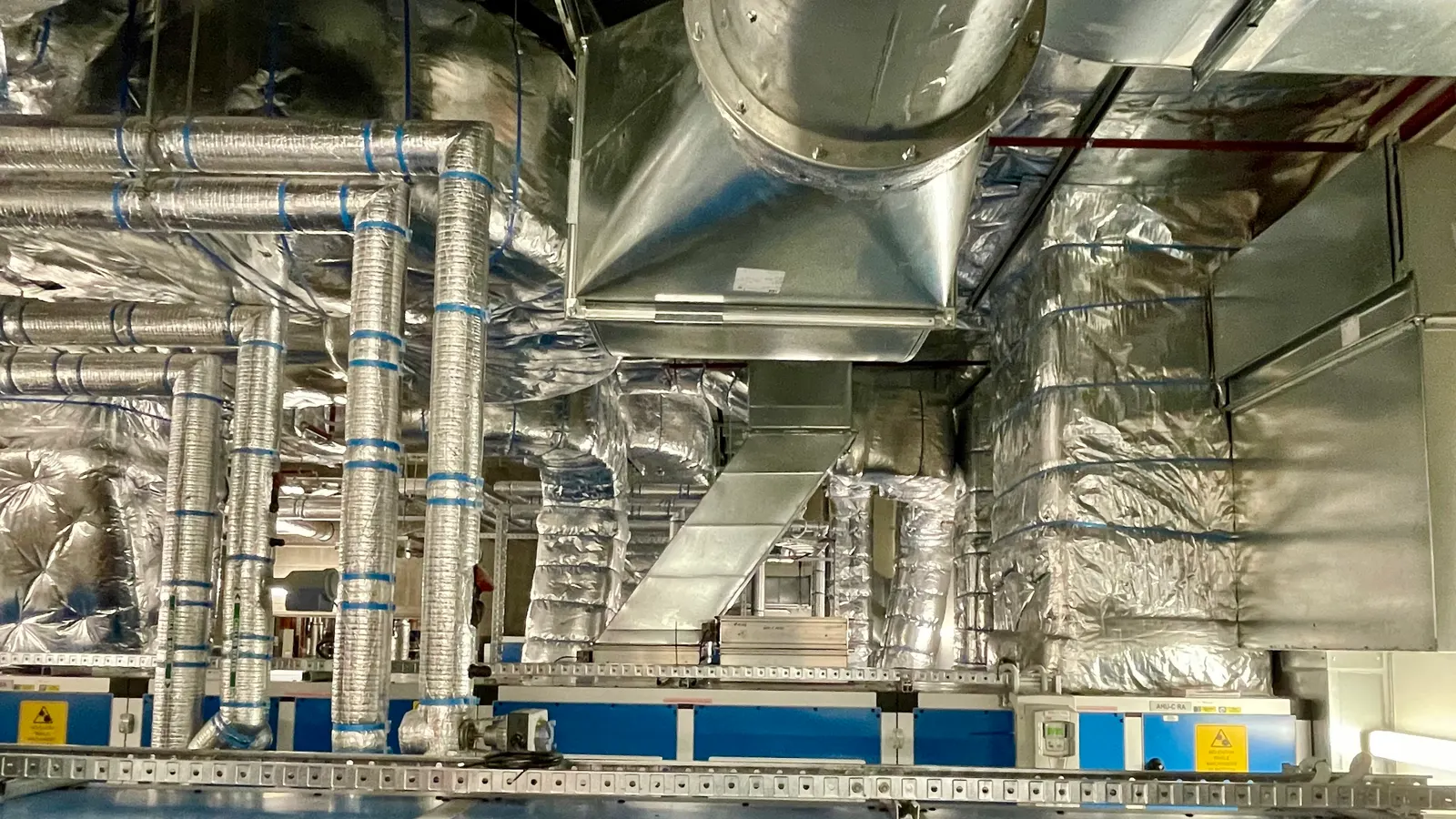
Both systems serve many rooms from central equipment. The difference is the fluid that carries the cooling. A VRF system pipes refrigerant from outdoor units on the roof to indoor units in each room, and varies the refrigerant flow to match each zone. A chiller system cools water in a plant, pumps it through the building to air handling units and fan coil units, and keeps the refrigerant inside the chiller.
Question
VRF / VRV
Chilled water (chiller plant)
What travels through the building?
Refrigerant, in copper pipes to every indoor unit
Water, in insulated steel or plastic pipes; refrigerant stays in the plant
Size of one system
Limited by the outdoor unit capacity, number of indoor units and pipe length per refrigerant circuit
One plant can serve a whole building or campus; chillers come in sizes up to thousands of tons
Plant space
Outdoor units on roof or podium; no plant room
Chiller plant room or roof yard, pumps, and cooling towers if water-cooled
Zoning
Every indoor unit has its own control
Zoned at the AHU and fan coil level through valves and controls
Refrigerant in occupied rooms
Yes, in every indoor unit and pipe route
No
Fresh air
Needs a separate fresh air system, often a dedicated outdoor air unit
Usually handled by the AHUs on the same chilled water
Where VRF runs out: capacity and pipe-length limits
A VRF system is bounded by its refrigerant circuit. Each manufacturer publishes limits on outdoor unit capacity, the number of indoor units per circuit, the longest pipe run and the height difference between units, and they vary widely between product lines. Three published examples:
Carrier 38VS (a VRF outdoor unit): 8.0 to 22.6 kW cooling, up to nine indoor units per outdoor unit, a maximum equivalent pipe length of 175 m and an operating range of minus 20°C to 52°C, according to Carrier's product page.
Carrier XPower: when Carrier launched it in the UAE in 2017, it stated operation in ambient conditions up to 54°C, up to 64 indoor units, and piping up to 1,000 m for a single refrigerant circuit.
Fujitsu General J-III Tropical: total refrigerant piping length of up to 180 m and cooling operation up to 52°C outdoor temperature, according to the General UAE site.
The practical consequence: a large building is served by many separate VRF systems, each with its own outdoor units, roof space and pipe risers. Tall towers add vertical pipe runs that must stay inside the maker's height limits. A chilled water plant has no comparable limit; water is pumped over long distances and heights, and very large plants combine several chillers, such as the YORK and Trane centrifugal ranges described in the main guide.
Refrigerant volume and leak safety
This is the point most often missed at concept stage. In a VRF system, the whole refrigerant charge of a circuit is connected to every room it serves. If it leaks into the smallest room, the concentration must stay below a safe limit.
What the standards say
ASHRAE Standard 15 (Safety Standard for Refrigeration Systems) sets procedures for the safe design, construction, installation and operation of refrigeration systems. ASHRAE Standard 34 (Designation and Safety Classification of Refrigerants) assigns each refrigerant a safety class and a refrigerant concentration limit (RCL). ASHRAE says the two should be used together, and its December 2025 fact sheet notes the 2024 editions were revised to cover more lower-GWP refrigerants, including A2L (mildly flammable) types, and to clarify leak mitigation and machinery room requirements. In Europe the equivalent is EN 378 (Refrigerating systems and heat pumps, safety and environmental requirements); the current Part 1 edition is EN 378-1:2016+A1:2020, which guides installation location and the maximum charge for a room volume.
Which room volume counts
An official ASHRAE interpretation (IC 15-2013-1, approved March 2015) dealt with exactly the VRF case: indoor units in occupied rooms, with a separate dedicated outdoor air system that does not run continuously. ASHRAE ruled that the designer may not add the outdoor air system's duct and plenum volume to the room volume when checking the RCL, because leaking refrigerant could concentrate in the occupied space alone. In practice the smallest room on a circuit, such as a hotel room, small office or prayer room, often sets the maximum charge.
What this means for design
Ask the VRF supplier for the total charge of each circuit, including the additional charge for the actual pipe lengths.
Check the charge against the smallest room served under the standard your consultant and authority accept, and design leak detection or ventilation where needed.
For A2L refrigerants, confirm the installation rules with the manufacturer and the civil defence authority before final selection.
A chilled water system avoids the question in occupied spaces: the refrigerant stays in the chiller plant, which is designed as a machinery room.
Part-load efficiency and high ambient performance
Both systems spend most hours at part load, so compare part-load metrics. Saudi Arabia's SASO 2874:2025 sets separate minimums for VRF multi-split systems depending on the rating standard. Under AHRI 1230, air-cooled VRF must reach a rated EER of 10.5 from 65,000 to 135,000 Btu/h, 10.3 up to 240,000 Btu/h and 9.5 above that, with an IEER rating. Under ISO 15042 the minimums are 11.2, 11.2, 11.0 and 10.0 across its capacity bands (including units of 65,000 Btu/h and below), with a SEER rating. Water-cooled VRF has its own table (12.0 up to 135,000 Btu/h, 10.0 above).
For the chiller side of the comparison, judge the whole plant, not the chiller alone: pumps, cooling towers and controls all add power. Our guide to air cooled and water cooled chillers covers chiller efficiency metrics in detail.
High ambient testing matters for VRF in the Gulf. Eurovent Certita added high ambient conditions to its VRF certification programme for products sold in the Middle East in 2019, testing at T1 (35°C), T3 (46°C) and T4 (48°C) with an operability test at 52°C, as reported by Cooling Post. Ask whether a VRF line holds such a certification, and for its capacity at your design ambient.
In parts of Dubai and other Gulf cities, the building may not need its own chiller at all. A district cooling system supplies chilled water through a network, and the building keeps only an energy transfer station, the secondary chilled water pumps and the air side. That makes it a variant of the chilled water option: VRF cannot connect to it.
In Dubai, Executive Council Resolution No. 6 of 2021 regulates district cooling services. The Regulatory and Supervisory Bureau for the electricity and water sector (RSB) authorises service providers, tariffs are calculated on cooling capacity, cooling energy or another basis the RSB approves, and the charges that the Supreme Council of Energy must approve include connection charges, capacity charges, consumption tariffs, meter maintenance, a surcharge on low chilled water temperature difference (low delta T) and a surcharge on excess cooling load. The low delta T surcharge is a design point: the building's coils and controls must return water warm enough to avoid it. An earlier Dubai resolution, No. 27 of 2008, required district cooling companies to use thermal storage for new buildings and to stop using desalinated water, using treated seawater, greywater or sewage water instead.
If the plot sits in a district cooling area, compare the connection and capacity charges over the building's life against owning a VRF or chiller system, and ask the provider for its tariff schedule early.
Maintenance and operation compared
VRF: no water treatment and no plant operator, but many indoor units with filters and drains, outdoor units on the roof exposed to dust, and refrigerant leak checks across long pipe networks. A failed outdoor unit affects every room on its circuit.
Chilled water: fewer, larger machines in one plant, which suits a dedicated operator and a building management system. Water-cooled plants add cooling tower water treatment and Legionella control. Multiple chillers give redundancy.
Lifecycle cost drivers (without the numbers)
Prices change by project, so compare these drivers in each bid rather than a single first-cost figure:
Equipment and installation, including pipework, insulation and, for chilled water, pumps, plant room and towers.
Energy at your load profile, using part-load ratings (IEER or SEER for VRF; plant-level analysis for chillers).
Water consumption and treatment for water-cooled plants.
District cooling connection, capacity and consumption charges where that option exists.
Maintenance contract scope and the number of units to service.
Lettable or usable area lost to plant rooms, shafts and roof equipment.
Replacement: VRF outdoor units are replaced circuit by circuit; chillers and towers are larger single replacements.
Which to choose: a quick guide
Building
Usually favours
Reason
Low and mid-rise office, school, clinic
VRF
Many zones, moderate total load, no plant room
Hotel
Either; check RCL for guest rooms if VRF
Small rooms on long circuits drive refrigerant charge limits
High-rise residential or office tower
Chilled water or district cooling
Vertical distances, central control, redundancy
Mall, hospital, airport, campus
Chilled water or district cooling
Large loads, 24-hour operation, central plant
Villa compound or retail strip
VRF or ducted splits
Separate tenancies, independent control and billing
VRF brands in the UAE and Saudi Arabia
Listed by what each maker publishes, not ranked.
Daikin
Daikin, which sells VRF under the VRV name, lists on its Middle East and Africa site the VRV IV+ heat pump, VRV IV i-series, VRV IV heat recovery, VRV IV S-series, water-cooled VRV, VRV X, VRV Apartment, VRV S Mini and VRV 5 heat recovery. It offers VRV X units with anti-corrosion specifications for areas subject to salt damage and atmospheric pollution, relevant for coastal Gulf sites.
Carrier
Carrier lists the 38VS VRF outdoor unit (8.0 to 22.6 kW, up to nine indoor units) and launched the XPower VRF in the UAE in 2017 with up to 64 indoor units and 1,000 m of piping per circuit. Carrier states it operates in the UAE through UTS Carrier, a joint venture with United Technical Services. Carrier also makes chillers, so it can bid both options.
Fujitsu General
Fujitsu General, under its General brand, markets the J-III Tropical VRF series on its UAE site with cooling operation up to 52°C outdoor temperature and up to 180 m total refrigerant piping.
UAE and Saudi rules for VRF
UAE
According to TÜV Rheinland's summary of the draft regulations, VRF and multi-split systems of any capacity fall under UAE.S 5010-5 (large capacity air conditioners), not under the household label for small units. Cabinet Resolution No. 157 of 2025 made UAE.S 5010-5:2025 mandatory from 15 November 2025.
Saudi Arabia
SASO 2874:2025 covers electrically operated VRF air conditioners, with the minimums above. SASO's enforcement plan begins enforcement at local manufacturers and customs on 1 December 2026, so any VRF system arriving after that date needs a certificate under the 2025 version. Bids should name the testing standard (AHRI 1230 or ISO 15042) behind the ratings. Saudi buyers can compare VRF suppliers in Saudi Arabia and chiller suppliers in Saudi Arabia on the same RFQ.
RFQ checklist: VRF or chiller
Zone schedule with loads, occupancy hours and the smallest room served by each proposed VRF circuit.
For VRF: outdoor unit model, indoor unit count, longest pipe run, height difference and total refrigerant charge per circuit.
RCL check against the accepted safety standard, with any leak detection or ventilation measures.
Capacity at your design ambient and T3, and maximum operating ambient.
Part-load efficiency: IEER or SEER with the rating standard (AHRI 1230 or ISO 15042) for VRF; plant-level energy estimate for chilled water.
Fresh air solution and its energy use for both options.
Energy certificates: UAE.S 5010-5:2025 in the UAE, SASO 2874:2025 in Saudi Arabia.
For district cooling: tariff schedule, connection charge, contracted capacity and delta T requirements.
Roof and plant space, weights and acoustic data.
Maintenance scope, response times, spares and warranty.
Ready to price both options? Post your cooling requirement and VRF and chiller suppliers in the UAE and Saudi Arabia can respond.
VRF stands for variable refrigerant flow. The outdoor unit varies the amount of refrigerant sent to each indoor unit to match the load in each zone. Daikin sells its systems under the VRV name. Both terms describe the same type of multi-zone direct expansion system, with many indoor units on one refrigerant circuit.
Does a VRF system need ductwork?
Not for the cooling itself. VRF indoor units can be wall-mounted, cassette or floor types that blow directly into the room, or ducted types hidden in the ceiling. But VRF units recirculate room air, so the building still needs fresh air, usually from a separate dedicated outdoor air unit with its own ducts. That fresh air system should be included when comparing VRF with a chilled water design.
Is VRF or a chiller better for a high-rise tower?
Towers usually favour chilled water or district cooling. VRF circuits have published limits on pipe length and height difference, so a tall building needs many separate systems and roof or floor space for their outdoor units. A chilled water plant pumps water to any height, centralises maintenance and allows redundancy with several chillers. VRF can still suit podium floors or separate tenancies within the same project.
Is VRF safe in small rooms such as hotel rooms?
It can be, if the design checks it. ASHRAE Standards 15 and 34 and EN 378 limit how much refrigerant may leak into an occupied room. Because a VRF circuit's whole charge connects to every room on it, the smallest room often sets the limit. ASHRAE's interpretation IC 15-2013-1 says designers may not count intermittently operated outdoor air duct volumes. Shorter circuits, leak detection or ventilation may be needed.
When is district cooling better than VRF or a chiller?
When the plot is inside a district cooling network area and the lifetime connection, capacity and consumption charges compare well with owning and running plant. The building avoids chillers and cooling towers and frees roof and plant space. In Dubai, Executive Council Resolution No. 6 of 2021 requires district cooling charges and tariffs to be approved by the Supreme Council of Energy, and approved charges can include a surcharge for low chilled water temperature difference.
Where LV ends and MV begins, how GIS and AIS differ in size, cost and maintenance, what SF6 rules mean for Gulf buyers, how ring main units work and how to read an MV datasheet.
Wall split, ducted split, package or window unit: how they differ, what Saudi and UAE efficiency rules require of each, how they cope at 46°C, and which suits villas, offices and warehouses.
What replaced the type-tested label, how duties split between the original manufacturer and the panel builder, which reports and certificates to ask for, and how to run a factory acceptance test.