Chillers and Air Conditioning in the UAE and Saudi Arabia: Efficiency Rules and Brands
How to choose chillers, VRF and packaged AC for Gulf projects: system types, efficiency metrics, T3 ratings, refrigerants, the UAE and SASO efficiency rules, the main brands and an RFQ checklist.
For most Gulf buildings the choice is between an air-cooled chiller, a water-cooled chiller with cooling towers, a district cooling connection where one is available, or direct expansion (DX) equipment such as VRF, packaged and ducted split units for smaller loads. Shortlist chiller suppliers in the UAE only after you know which system fits, then check the unit against the efficiency rules: UAE Cabinet Resolution No. 157 of 2025 and, in Saudi Arabia, SASO 2663:2025 and SASO 2874:2025.
This guide is for MEP contractors, consultants, facility managers and procurement teams buying cooling equipment in the UAE and Saudi Arabia, including those sourcing from chiller suppliers in Saudi Arabia. It covers the main system types and compressor technologies, how to compare efficiency figures (EER, COP, kW per ton, IPLV and SEER), what the Gulf climate changes, the refrigerant phase-down, the UAE and Saudi efficiency regulations, the brands you will meet in tenders, and what to put in an RFQ.
Which cooling system fits the building?
Start from the load, the plant space, and whether water and a district cooling network are available.
System
How it works
Typical fit
Watch out for
Air-cooled chiller
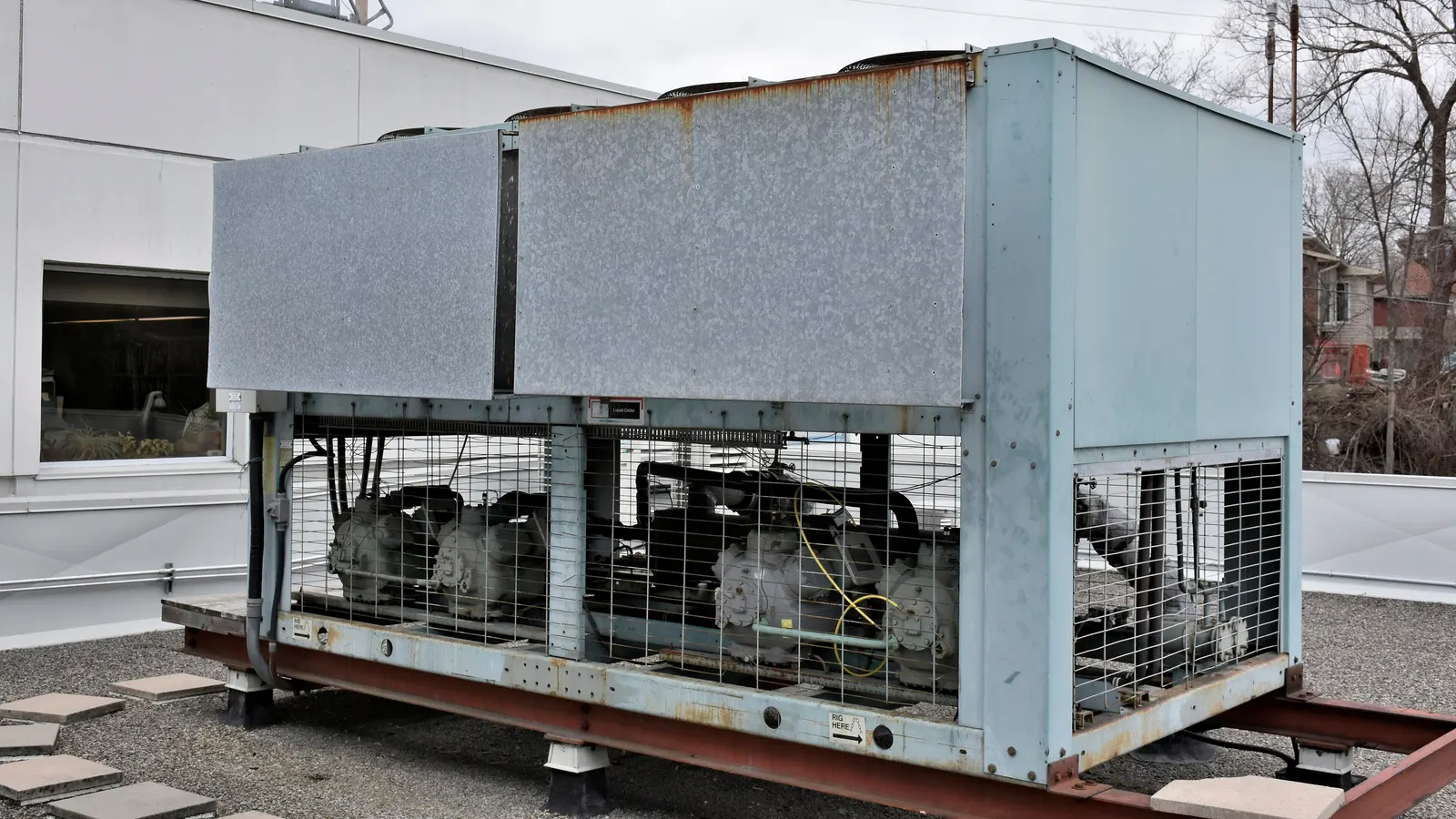
Chills water; rejects heat to outdoor air through finned condenser coils and fans
Mid-size commercial buildings, hospitals, schools, sites without cooling tower water
Efficiency falls as outdoor temperature rises; needs roof or yard space with free airflow
Water-cooled chiller
Chills water; rejects heat to condenser water cooled by cooling towers
Large central plants, towers, malls, district cooling plants
Make-up water, water treatment, tower maintenance and a plant room
District cooling
Chilled water bought from a utility network through an energy transfer station
Buildings inside a district cooling concession area
Connection and consumption tariffs; no own chiller plant to control
VRF or VRV
One outdoor unit circulates refrigerant to many indoor units with individual control
Offices, villas, retail, hotels with zoned loads
Refrigerant pipe lengths and charge in occupied spaces
Packaged and rooftop units
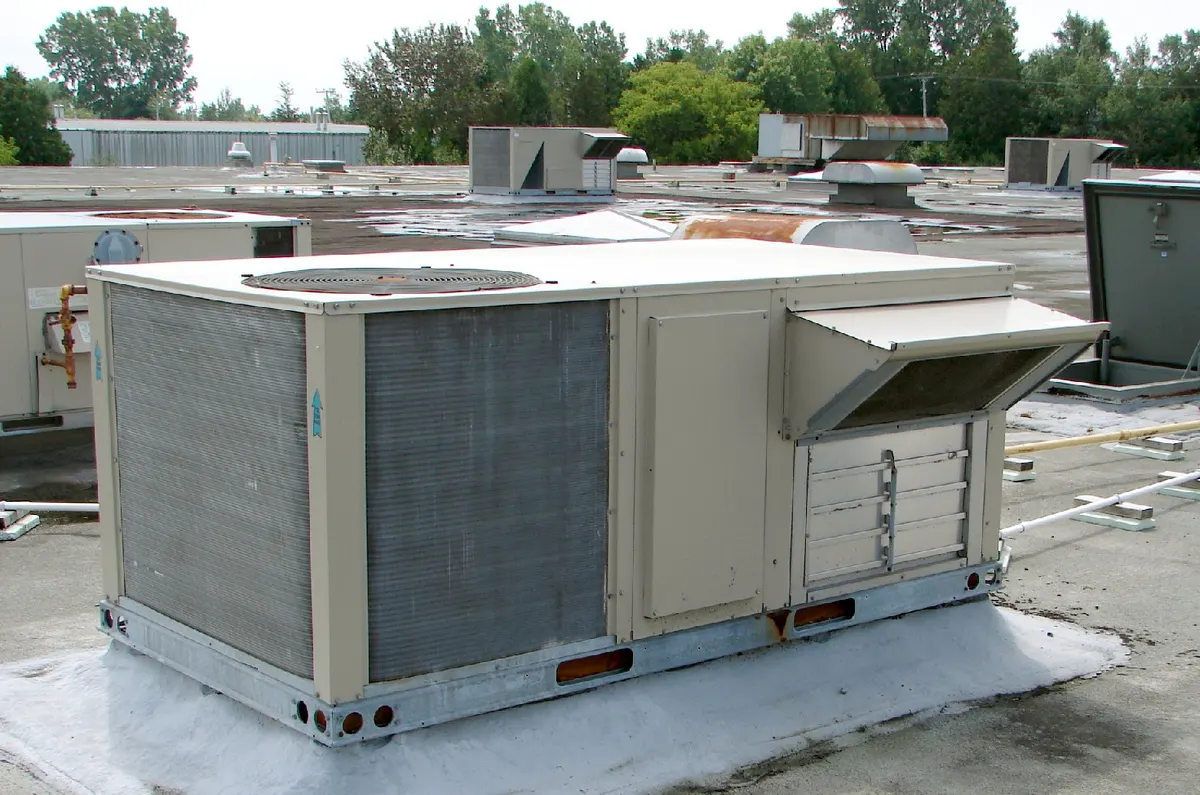
All refrigeration components in one cabinet, ducted to the space
Roof loading and duct runs; performance at peak ambient
Ducted split and split units
Indoor fan coil or ducted unit connected to an outdoor condensing unit
Villas, small offices, individual rooms
Many small units to maintain; each model needs its own efficiency certificate
Air-cooled vs water-cooled chillers
An air-cooled chiller is a single packaged unit: no cooling tower, no condenser water pumps and no tower water treatment. That simplicity is why it dominates mid-size projects. A water-cooled chiller rejects heat to water that is usually cooled by evaporation in a tower, so its condensing temperature is lower and it uses less power per ton of cooling. The Saudi minimum efficiency table in SASO 2874:2025 shows the gap clearly: air-cooled chillers must reach a rated EER of 9.7 Btu/W.h, while water-cooled positive displacement chillers start at 15.4 and water-cooled centrifugal chillers at 17.3 (more detail in the Saudi section below).
The trade is water and maintenance. A water-cooled plant needs cooling towers, condenser pumps, make-up water and a chemical treatment programme, and it pulls air handling units and fan coil units into a larger chilled water system that has to be balanced and controlled.
Scroll, screw, centrifugal and magnetic bearing compressors
Compressor type follows capacity. One manufacturer's range shows the usual pattern: SKM lists air-cooled scroll chillers from 8 to 279 TR, air-cooled screw chillers from about 78 to 519 TR depending on series, and water-cooled centrifugal chillers from 200 to 2,700 TR. Trane lists scroll chillers for small to medium applications, screw chillers for medium to large loads, and water-cooled centrifugal and helical rotary screw chillers from 200 to 6,000 tons.
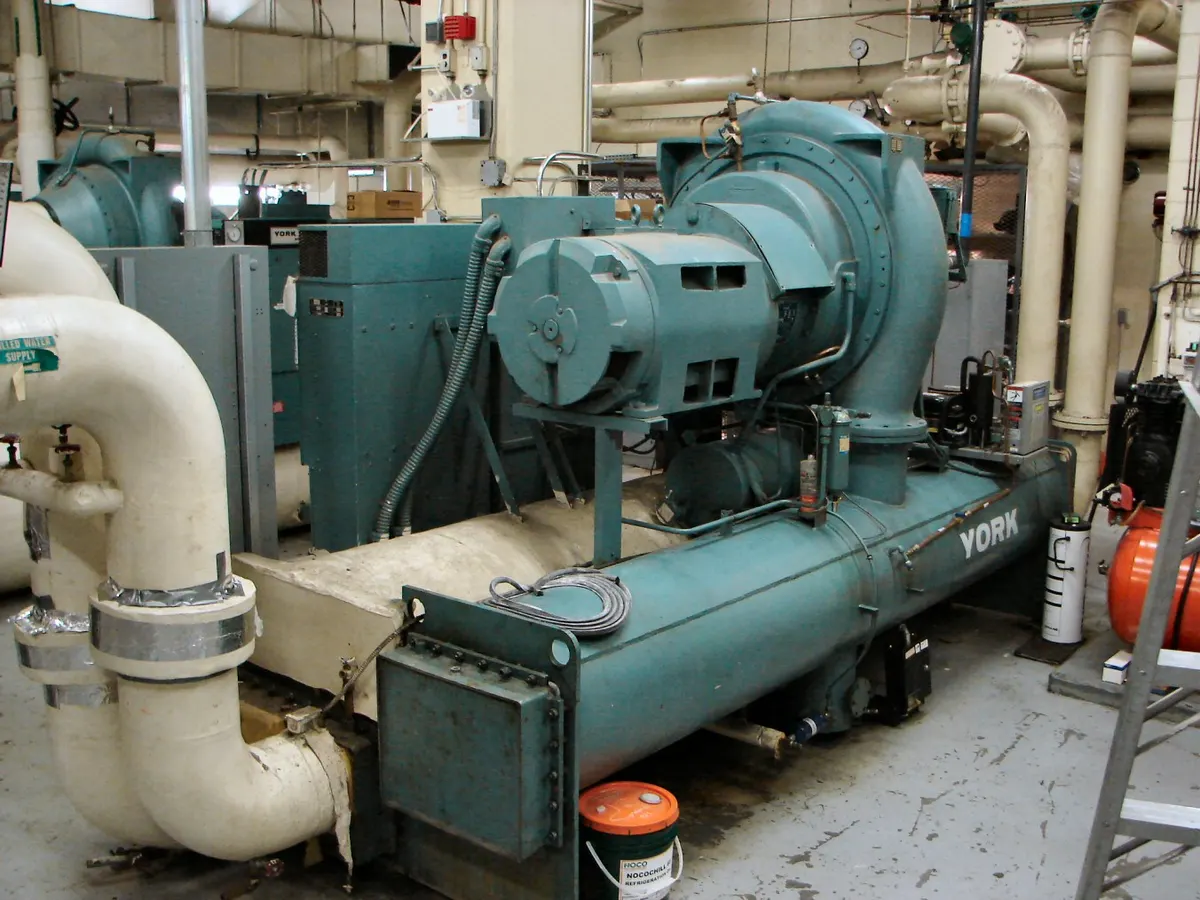
Magnetic bearing centrifugal chillers remove the oil system: Smardt states that "magnetic bearings eliminate the need for lubrication", and Johnson Controls lists the YORK YZ magnetic bearing centrifugal chiller from 150 to 2,020 tons. For large plants, ask bidders to compare part-load efficiency, because chillers in a multi-chiller plant spend most of their hours below full load.
Where a chilled water plant is not justified, direct expansion equipment cools the space with refrigerant directly. VRF and VRV systems connect many indoor units to one outdoor unit and suit buildings with many zones and varied occupancy. Rooftop packaged units suit large single-storey spaces. Ducted splits and wall splits serve villas and small offices. In Saudi Arabia, VRF systems above 65,000 Btu/h fall under SASO 2874:2025, while smaller window and split units fall under SASO 2663:2025, so the regulatory route depends on the size of each unit.
In many Dubai developments the building owner does not buy chillers at all but connects to a district cooling system. Emirates Central Cooling Systems Corporation (Empower), which the Dubai Media Office describes as the world's largest district cooling services provider, had 1.7 million refrigeration tons (RT) of connected capacity, 90 district cooling plants at the end of 2025, more than 430 km of pipeline and about 1,776 buildings served, according to a May 2026 release. If your plot sits in a concession area, the building's scope shrinks to the energy transfer station, the secondary chilled water system and the air side.
How to compare chiller efficiency: EER, COP, kW per ton, IPLV and SEER
Bidders quote efficiency in different units, so convert everything to one before you compare.
EER (energy efficiency ratio) is cooling output in Btu/h divided by power input in watts, at one rated condition. SASO tables use it in Btu/W.h.
COP is the same ratio with both sides in watts. Divide EER by 3.412 to get COP.
kW per ton is power input per refrigeration ton (12,000 Btu/h). It equals 12 divided by EER, so lower is better.
IPLV (integrated part load value, AHRI) and IEER weight efficiency at part-load points; SEER and SEERon are the seasonal equivalents used in ISO and EN methods.
As a worked example, the Saudi minimum for air-cooled chillers (EER 9.7) is about 1.24 kW per ton, or a COP of about 2.84. The minimum for the largest water-cooled centrifugal class (EER 20.5) is about 0.59 kW per ton, or a COP of about 6.0. SKM, for comparison, publishes COP ratings of 6.9 and 6.4 at AHRI conditions for two of its centrifugal models. Always ask which standard and which conditions a figure was rated at, because a full-load figure at mild conditions will flatter a unit that has to run at 46°C.
What the Gulf climate changes
Rate at T3, not just T1
Standard air conditioner ratings use two climate conditions. In Saudi Arabia's SASO 2663:2018 the T1 condition is 35°C outdoor dry bulb, while T3 is 46°C outdoor dry bulb (29°C indoor), and the standard set separate minimum EER values for each. The UAE's UAE.S 5010-1:2014 label was likewise tested at the T3 condition of 46°C outdoor, per ISO 5151. Both of those editions have since been replaced, but the point stands: ask for capacity and power input at T3 or at your design ambient, not only at T1.
Check the maximum operating ambient
Peak summer ambient at a condenser on a hot roof can exceed the weather-station design figure. Check the maximum outdoor operating temperature in the submittal, not the brochure headline. SKM, for example, lists 52°C as the maximum operating ambient for most of its air-cooled screw series and 55°C for its APCN-S series. Ask bidders for the same figure, and for the capacity derate at your design temperature.
Dust, salt and water
Sand and dust load condenser coils and cut heat rejection, so specify coil protection, access for cleaning and a maintenance interval. Coastal sites need corrosion protection on coils and casings. For water-cooled plants, account for make-up water supply and treatment from the start, since the cooling towers will consume water every hour they run.
Refrigerants: R-410A, R-32, R-454B and the Kigali phase-down
Under the Kigali Amendment to the Montreal Protocol, Saudi Arabia and the UAE are in the group of Article 5 parties (with Bahrain, India, Iran, Iraq, Kuwait, Oman, Pakistan and Qatar) that has a 2028 freeze date for HFC consumption. The schedule that applies to this group steps down to 90% of baseline from 2032, 80% from 2037, 70% from 2042 and 15% from 2047. The same decision allows parties with high ambient temperatures, including Saudi Arabia and the UAE, to apply for an exemption for multi-split, ducted split and ducted packaged air conditioners, with an initial duration of four years.
In practice, manufacturers are already moving to lower global warming potential (GWP) refrigerants:
R-32: Daikin gives its GWP as 675 against 2,090 for R-410A (IPCC Fourth Assessment Report values), classes it A2L (lower flammability) and says it can reduce the charge by 30% compared with R-410A.
Chillers: Trane lists R-1233zd, R-1234ze, R-514A, R-515B, R-513A and R-454B as low-GWP options for its chillers. Johnson Controls lists R-1234ze and R-515B for the YORK YK-HT. Many units in the market still use R-134a (for example SKM's screw and centrifugal chillers) or R-410A (SKM's scroll chillers).
A2L refrigerants change installation requirements such as charge limits and ventilation of plant rooms, so ask the supplier which safety standard the equipment is designed to and confirm it with your consultant and the local civil defence authority.
UAE energy efficiency rules for air conditioners
Cabinet Resolution No. 157 of 2025, on the technical regulations for energy consumption efficiency requirements for low and large capacity air conditioners, was issued on 4 November 2025, published in Official Gazette No. 811 on 14 November 2025 and entered into force on 15 November 2025. It makes the technical regulations listed in its schedule mandatory across the UAE, repeals Cabinet Resolution No. 3 of 2020 on electricity sector standards, and gives the concerned authorities existing at entry into force 365 days from entry into force to regularise their status, which runs to mid-November 2026. The schedule lists UAE.S 5010-1:2025 (energy efficiency label, low capacity household air conditioners) and UAE.S 5010-5:2025 (large capacity air conditioners).
The scheme is run by the Ministry of Industry and Advanced Technology (MoIAT). Products receive a rating on a five-star scale, with five stars the most efficient, and labels carry individual RFID serial numbers. Compliance is shown through an ECAS certificate of conformity, which is mandatory, or the voluntary Emirates Quality Mark (EQM); TÜV Rheinland, one of the bodies appointed to issue them, gives ECAS certificates one year of validity and EQM certificates three. Our guide to ECAS and EQM product conformity in the UAE explains the certification route. For each model on a UAE project, ask the supplier for the current certificate under the 2025 standard, the star rating and the label, and confirm with the certificate body whether the model falls inside the scope of the regulation.
Saudi energy efficiency rules: SASO 2663 and SASO 2874
Saudi Arabia splits air conditioners at 65,000 Btu/h (about 19 kW).
SASO 2663:2025 for window and split units
SASO 2663:2025 covers low capacity air conditioners up to 65,000 Btu/h and supersedes SASO 2663:2021 and its 2023 amendment. According to SASO's own presentation of the standard, it updates the minimum EER requirements and introduces minimum requirements for the seasonal energy efficiency ratio (SEER) for the first time.
SASO 2874:2025 for chillers, VRF and large units
SASO 2874:2025 supersedes SASO 2874:2016. Its scope covers electrically operated air conditioners and heat pumps, condensing units, chillers, absorption chillers, VRF air conditioners and computer room units above the SASO 2663 range. It excludes, among others, process cooling chillers, portable units, desert coolers, explosion-proof units and swimming pool units. Alongside updated full-load EER minimums, it introduces part-load metrics: SEER (ISO methods), SEERon (EN methods), and IEER and IPLV (AHRI methods). For chillers the rating options are AHRI 550/590 or EN 14511 and EN 14825.
The kW per ton column is our conversion (12 divided by EER). Absorption chillers have their own minimums: 2.0 for single effect and 3.4 for double effect units. VRF multi-split systems have separate tables depending on whether they are rated under AHRI 1230 or ISO 15042.
Certification and the enforcement timeline
To obtain a SASO energy efficiency certificate for a large air conditioner, the applicant submits through SASO's single sign-on portal a test report from a SASO-accepted laboratory (valid three years from issue), declarations of conformity from both manufacturer and importer, nameplate marking, an instruction sheet and the technical file. Certificates are issued with one to five years' validity. Where a unit is too large for any accepted laboratory, SASO accepts a simulation report backed by a test report on a similar reference model. Products then move through SABER for the shipment certificate; our guide to SASO and SABER certificates covers that step.
SASO's enforcement plan for the updated large AC standard sets these dates: the updated certification system launched on 7 June 2026; issuing of energy efficiency and SABER certificates against the previous version stopped on 31 August 2026; certificates issued under the previous version are cancelled on 29 November 2026; and enforcement at local manufacturers and customs starts on 1 December 2026. SASO states that products already in the Saudi market remain valid under the licences and certificates previously issued. For any chiller, VRF or packaged unit arriving after 1 December 2026, require a SASO 2874:2025 certificate in the bid, and confirm the SASO 2663:2025 timetable for small units on SASO's portal.
Chiller and air conditioning brands in the UAE and Saudi Arabia
These manufacturers appear regularly in Gulf HVAC specifications. They are listed by what their own sites say they make, not ranked; your consultant's approved vendor list has the final say.
Carrier
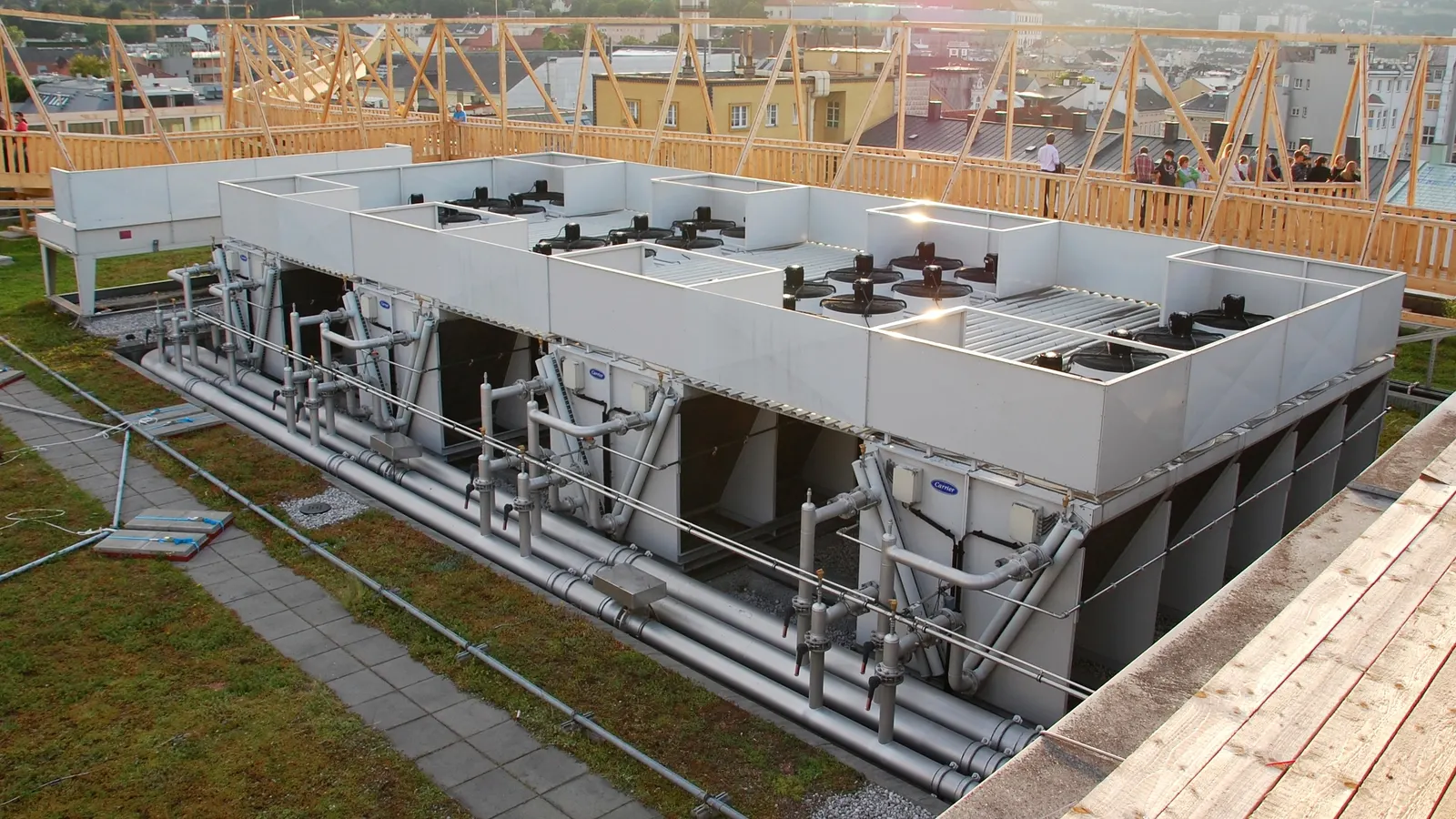
Carrier lists the AquaEdge 19MV water-cooled centrifugal chiller with magnetic bearing technology, the AquaForce 30XF air-cooled screw chiller, AquaForce 23XQ/XW chillers and heat pumps and the AquaSnap 30RQM modular heat pump, all on low-GWP refrigerants. It suits buyers who want air-cooled screw and water-cooled centrifugal plant from one maker.
Trane
Trane offers air-cooled chillers and heat pumps, scroll and screw chillers, water-cooled centrifugal and helical rotary screw chillers from 200 to 6,000 tons, data centre chillers and modular units, with a published list of low-GWP refrigerant options.
YORK (Johnson Controls)
YORK is a Johnson Controls brand. Its water-cooled range includes the YK centrifugal (250 to 3,000 tons), the YZ magnetic bearing centrifugal (150 to 2,020 tons) and the YD dual centrifugal (1,500 to 6,000 tons), the last aimed at very large plants such as district cooling. Johnson Controls also lists air-cooled and absorption chillers.
Daikin
Daikin, founded in 1924 in Japan, lists air-cooled and water-cooled chillers alongside its VRV systems. Its Middle East and Africa portal serves the UAE, Saudi Arabia and the other GCC states, which makes it a common name on both chiller and VRF schedules.
LG
LG lists centrifugal, oil-free centrifugal (R-1233zd), water-cooled and air-cooled screw, air-cooled scroll and absorption chillers (direct fired, hot water and steam), plus VRF, packaged and split systems for commercial buildings.
Zamil Air Conditioners
Zamil Air Conditioners operates four factories in Dammam, two in the First Industrial City and two in the Second. Its range runs from window and split units through central systems, chillers and air handling units, with a stated annual capacity of more than 1.1 million units. Its consumer brands include Classic and Cooline. It suits Saudi buyers who want locally made equipment across unitary and central cooling.
SKM Air Conditioning
SKM began producing air conditioning equipment in Sharjah's industrial area in 1974, now operates from Industrial Area 13 in Sharjah, and has a second factory in the Second Industrial City in Dammam. Its range covers air-cooled scroll and screw chillers, water-cooled screw and centrifugal chillers, AHUs, FCUs, packaged and condensing units, VRF and computer room units, and it lists SASO and ESMA EQM among its certifications.
Petra Engineering Industries
Petra was founded in 1987 in Jordan, with its main factory at Al Muwaqqar. It makes chillers, air handling units, fan coil units, packaged and split units and data centre cooling equipment.
Dunham-Bush
Dunham-Bush was founded in the USA in 1894. It lists water-cooled and air-cooled chillers, heat pumps, light commercial and airside products, and runs a MENA regional site with project references in Saudi Arabia.
Climaveneta and Mitsubishi Electric
Climaveneta is one of the applied HVAC brands of Mitsubishi Electric Hydronics & IT Cooling Systems, alongside Mitsubishi Electric and RC. The company designs and produces applied air conditioning and refrigeration equipment, including chillers and heat pumps.
Smardt
Smardt, with its first listed office in Dorval, Quebec, specialises in oil-free magnetic bearing centrifugal chillers: air-cooled AD/AE series from 30 to 520 tons, and water-cooled Ultra (300 to 3,600 tons) and Core (45 to 1,600 tons) series. It suits buyers prioritising part-load efficiency and low maintenance.
Chiller and AC buying checklist (RFQ)
Cooling load, diversity and number of units (for example N+1 chillers), with the design ambient temperature for the site.
System type (air-cooled, water-cooled, VRF, packaged) and compressor type, with any approved vendor list.
Capacity and power input at your design ambient and at T3 conditions, plus the maximum operating ambient.
Full-load EER or COP and part-load IPLV, IEER or SEER, stating the rating standard (AHRI 550/590, EN 14511 and 14825, ISO 5151, ISO 15042).
Chilled water and condenser water temperatures, flow rates and fouling factors.
Refrigerant type, charge, GWP and the safety standard the unit is designed to.
For the UAE: ECAS or EQM certificate and energy label under UAE.S 5010-1:2025 or 5010-5:2025 where in scope.
For Saudi Arabia: SASO 2874:2025 or SASO 2663:2025 energy efficiency certificate, SABER registration and the testing laboratory.
Coil protection for dust and coastal sites, sound data, and footprint and weight for roof or plant room.
Controls and interface to the HVAC and district cooling scope or building management system (BACnet or Modbus), factory testing, warranty, spares and local service.
If you want suppliers to quote against this list, post your cooling requirement on ListGCC and chiller and HVAC suppliers in the UAE and Saudi Arabia can respond directly.
Each of these guides takes one question from this page further.
Split, Ducted and Package AC Units: Choosing for Gulf Buildings: Wall split, ducted split, package or window unit: how they differ, what Saudi and UAE efficiency rules require of each, how they cope at 46°C, and which suits villas, offices and warehouses.
Air-Cooled vs Water-Cooled Chillers in the UAE and Saudi Arabia: Air cooled or water cooled chiller for a Gulf project: whole-plant efficiency, the limits of IPLV, cooling tower water and treatment, high ambient ratings, footprint, noise and maintenance compared.
HVAC Maintenance for Gulf Buildings: Schedules, Contracts and KPIs: A practical HVAC maintenance scope for Gulf buildings: PPM frequencies for chillers, towers and AHUs, filters and coils in dusty conditions, duct cleaning, Dubai Legionella limits, contract KPIs and BMS.
Frequently asked questions
Is an air-cooled or water-cooled chiller better in the UAE?
Neither is better in every case. Water-cooled chillers use far less power per ton: in Saudi Arabia's SASO 2874:2025, the minimum EER for air-cooled chillers is 9.7 Btu/W.h, against 15.4 to 20.5 for water-cooled units. But a water-cooled plant needs cooling towers, make-up water, treatment and a plant room. Air-cooled chillers suit mid-size buildings without tower water; large central plants usually justify water cooling.
What efficiency rules apply to air conditioners in the UAE?
Cabinet Resolution No. 157 of 2025, in force since 15 November 2025, makes the UAE.S 5010-1:2025 and UAE.S 5010-5:2025 energy efficiency label regulations mandatory for low and large capacity air conditioners. Products need an ECAS certificate of conformity (or the voluntary EQM) from MoIAT's scheme and a star-rated energy label. Concerned authorities existing at entry into force had 365 days to regularise their status.
What is SASO 2874 and when is it enforced?
SASO 2874:2025 is Saudi Arabia's performance standard for large capacity air conditioners above 65,000 Btu/h, including chillers, absorption chillers, VRF systems and condensing units. It sets minimum EER values and adds part-load metrics (IPLV, IEER, SEER). SASO's plan cancels certificates under the 2016 version on 29 November 2026 and enforces the new version at local manufacturers and customs from 1 December 2026.
What does T3 mean on an air conditioner?
T3 is the hot-climate rating condition: 46°C outdoor dry bulb with 29°C indoor dry bulb, compared with 35°C outdoor for the standard T1 condition. Saudi and UAE efficiency standards have used T3 testing because Gulf summers regularly reach these temperatures. A unit's capacity and efficiency are lower at T3 than at T1, so compare bids at T3 or at your site design temperature.
How do I convert EER to kW per ton?
Divide 12 by the EER in Btu/W.h. An EER of 9.7 equals about 1.24 kW per ton, and an EER of 20.5 equals about 0.59 kW per ton. To convert EER to COP, divide by 3.412. Make sure both figures are quoted at the same rating conditions and standard before comparing them, and compare part-load values (IPLV or SEER) as well as full load.
Which refrigerant should a new chiller or AC use?
Lower-GWP refrigerants are replacing R-410A and R-134a as the Kigali phase-down approaches; Saudi Arabia and the UAE have a 2028 HFC freeze date. R-32 (GWP 675 per Daikin, versus 2,090 for R-410A) is common in split units, while chiller makers offer options such as R-1234ze, R-1233zd, R-513A, R-515B and R-454B. Many of these are A2L, so check installation and plant room safety requirements.
How VRF and chilled water systems differ, where VRF runs out of capacity, refrigerant safety in small rooms, part-load and high ambient ratings, district cooling as a third option, and an RFQ checklist.
Where LV ends and MV begins, how GIS and AIS differ in size, cost and maintenance, what SF6 rules mean for Gulf buyers, how ring main units work and how to read an MV datasheet.
Wall split, ducted split, package or window unit: how they differ, what Saudi and UAE efficiency rules require of each, how they cope at 46°C, and which suits villas, offices and warehouses.