Air-Cooled vs Water-Cooled Chillers in the UAE and Saudi Arabia
Air cooled or water cooled chiller for a Gulf project: whole-plant efficiency, the limits of IPLV, cooling tower water and treatment, high ambient ratings, footprint, noise and maintenance compared.
An air cooled chiller rejects heat through finned coils and fans to outdoor air; a water cooled chiller rejects it to condenser water cooled by evaporation in a cooling tower. Water cooling uses far less power per ton but consumes make-up water and needs towers, treatment and a plant room. Mid-size buildings usually go air cooled; large central plants usually go water cooled. Compare chiller suppliers in the UAE on whole-plant figures, not chiller nameplates.
This guide is for MEP consultants, contractors, plant engineers and facility managers choosing between the two chiller types for projects in the UAE and Saudi Arabia, including teams sourcing from chiller suppliers in Saudi Arabia. The basics of system types, compressor technologies, the SASO minimum efficiency table and the brand overview are in our guide to chillers and air conditioning in the UAE and Saudi Arabia. Here we go deeper on the air cooled versus water cooled decision: real plant efficiency, part-load ratings, water use, footprint, heat and maintenance.
How each type rejects heat
Every vapour compression chiller has the same four basic components: evaporator, compressor, condenser and expansion valve. The US Department of Energy's O&M Best Practices Guide describes the cycle: refrigerant evaporates in the evaporator, absorbing heat from the chilled water; the compressor raises its pressure and temperature; it condenses in the condenser, giving up heat; and the expansion device drops the pressure again. The only difference between the two types is what the condenser gives its heat to.
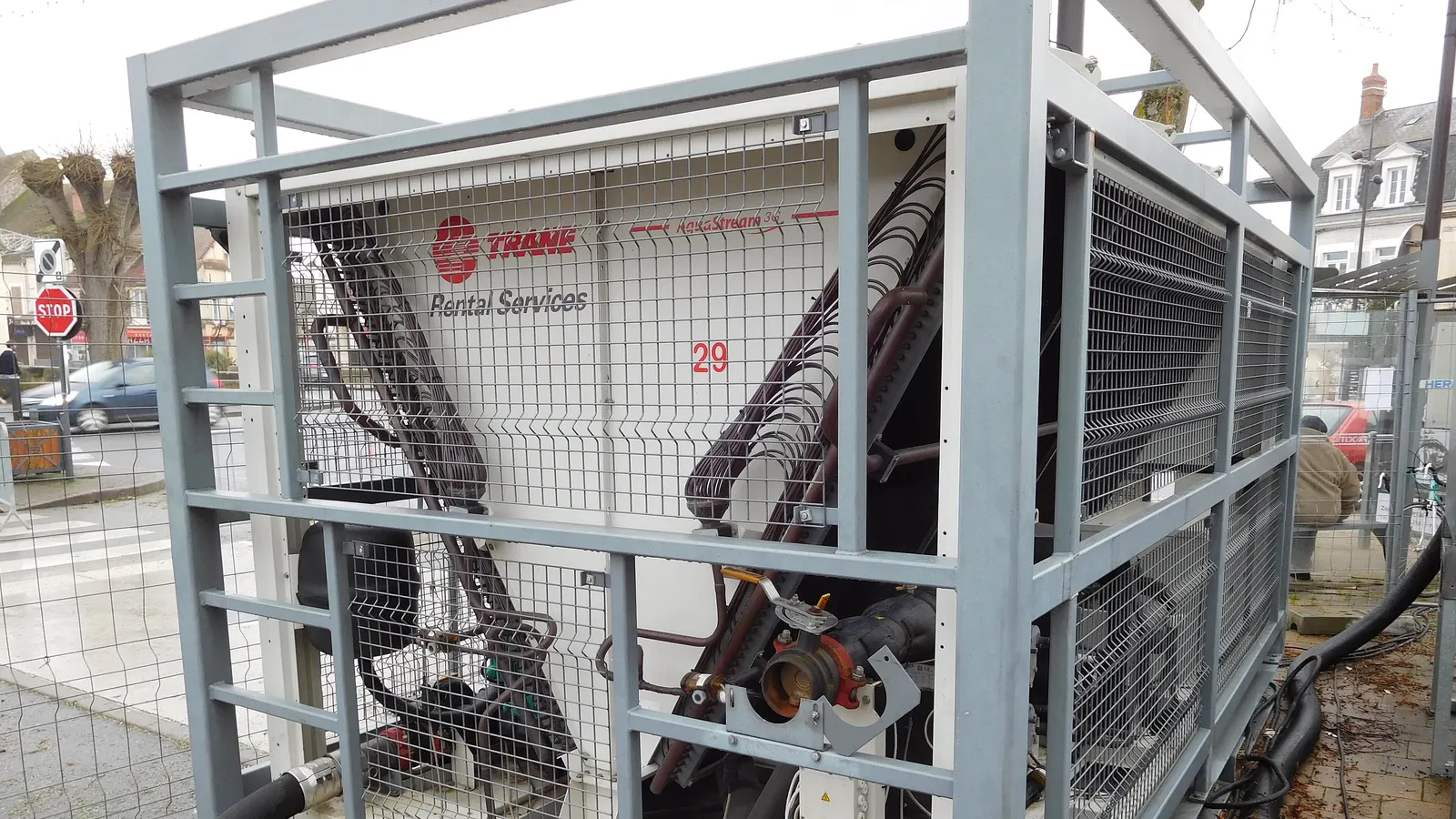
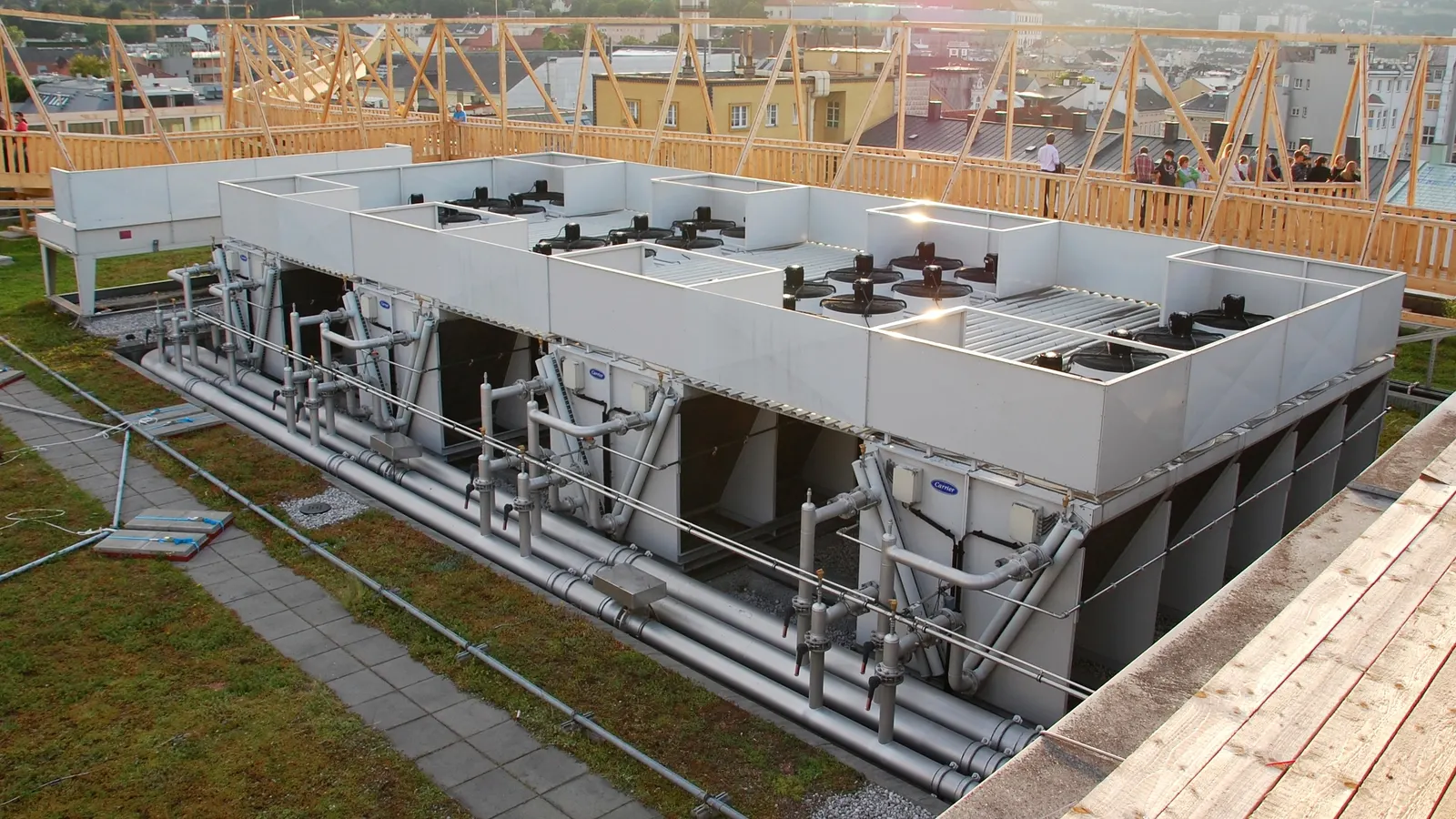
Air cooled: the condenser is a finned coil with fans, part of the chiller itself. The chiller sits outdoors on a roof or yard.
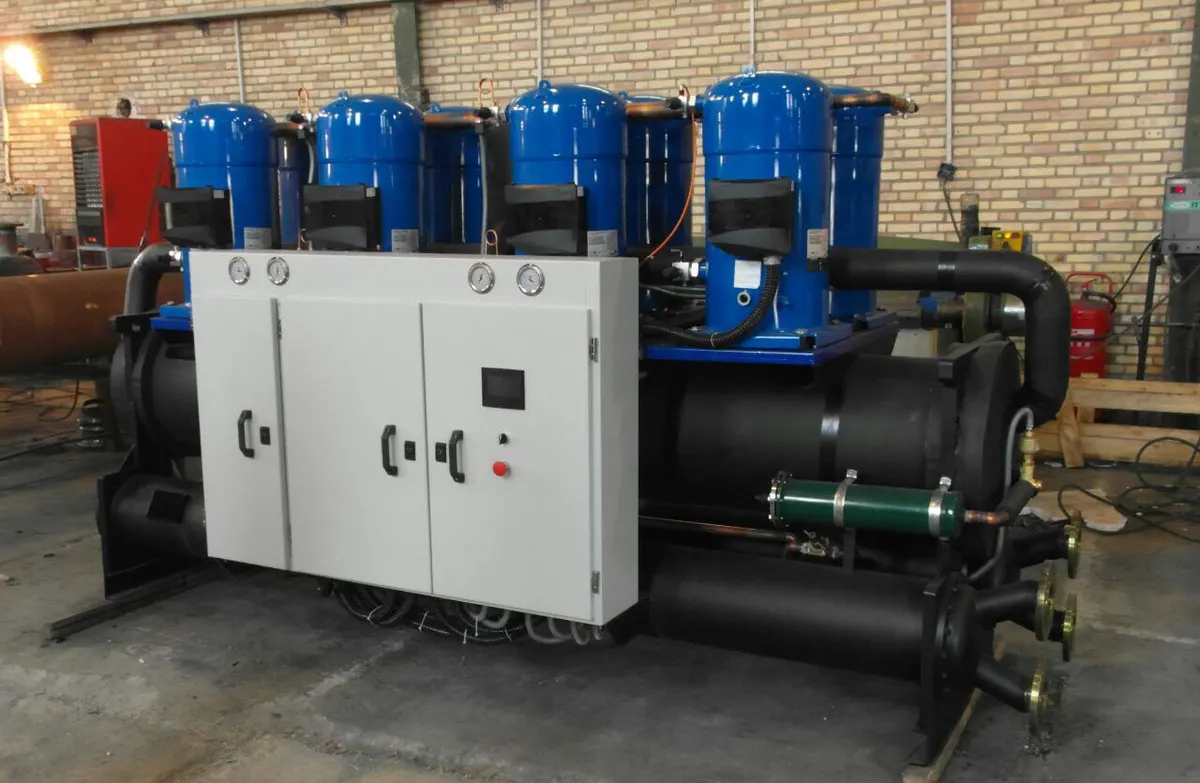
Water cooled: the condenser is a shell-and-tube heat exchanger. Condenser water carries the heat to cooling towers, which reject it mostly by evaporation. The chiller sits indoors in a plant room.
Efficiency in practice: chiller versus whole plant
The chiller nameplate tells only part of the story. A water cooled plant also runs condenser water pumps and tower fans; an air cooled plant runs condenser fans that are part of the chiller rating. Compare kW per ton at the plant level.
A 2020 Consulting-Specifying Engineer comparison of 200-ton plants by Mark Stehney put average plant efficiency at roughly 1.5 kW/ton for an air cooled plant against approximately 0.85 kW/ton for a water cooled plant, while the code-required chiller efficiencies it quoted were 1.18 kW/ton and 0.54 kW/ton. The gap between chiller and plant figures is the pumps, fans and operating conditions. The same article noted that air cooled chillers are typically limited to a maximum size of about 500 tons, so larger loads need several units.
The Saudi minimums in SASO 2874:2025 show the same direction at chiller level: air cooled chillers must reach a rated EER of 9.7 Btu/W.h, while water cooled chillers start at 15.4 and rise with size. The full table is in the main guide.
What IPLV measures and what it misses
Chillers spend most hours below full load, so bids quote a part-load figure, usually IPLV (integrated part load value) under AHRI 550/590. As set out in a December 2009 ASHRAE Journal article by Trane's W. Ryan Geister and Mike Thompson, the AHRI formula weights efficiency at four points: 1% at 100% load, 42% at 75% load, 45% at 50% load and 12% at 25% load, with entering condenser water falling from 85°F at full load to 65°F at the lowest loads for water cooled chillers.
The authors quote AHRI 550/590 itself: the equation "was derived to provide a representation of the average part-load efficiency for a single chiller only." The article cites estimates that more than 90% of central water cooled plants have more than one chiller, and argues that IPLV therefore does not represent how a plant actually operates. Two practical rules follow:
Use IPLV to compare how similar chillers unload, not to predict annual energy or savings.
For large plants, ask bidders for performance at your own load profile and condenser conditions (a non-standard part load value, NPLV, or an hour-by-hour plant model), using Gulf design temperatures rather than the AHRI defaults.
SASO 2874:2025 now requires a part-load rating for chillers as well: IPLV when rated under AHRI 550/590, or SEERon when rated under EN 14511 and EN 14825.
Water: the price of water cooling
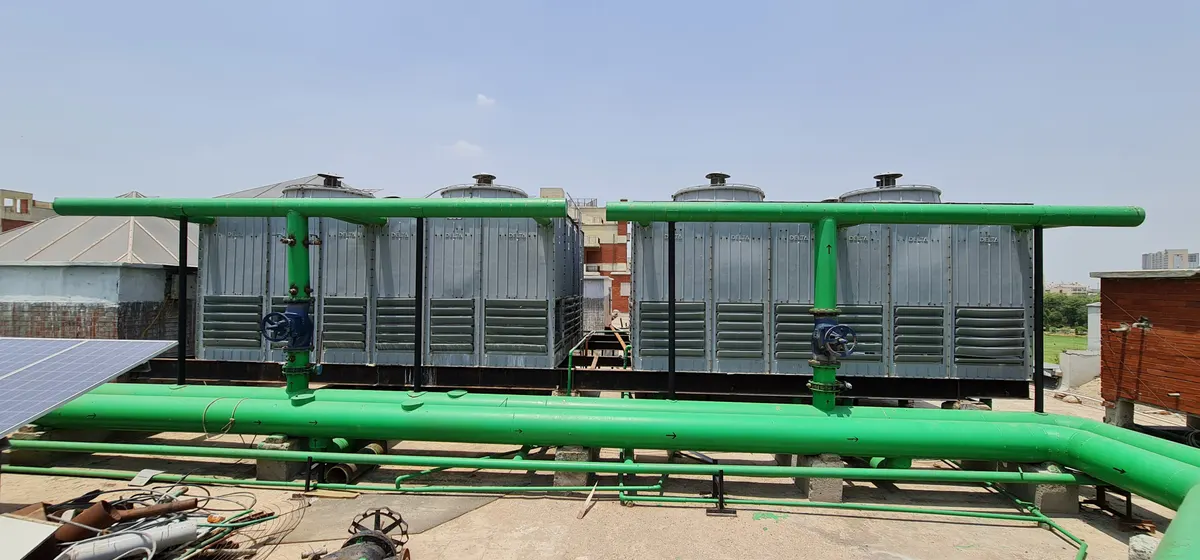
A cooling tower rejects heat by evaporating part of the water flowing through it. The US Federal Energy Management Program (FEMP) gives the water balance as: make-up = evaporation + blowdown + drift. Evaporation is the useful part; blowdown is water deliberately drained to stop dissolved solids building up; drift is droplets carried out with the air, controlled with baffles and drift eliminators.
Cycles of concentration
The number of times water is concentrated before it is blown down (cycles of concentration) decides how much water is wasted. FEMP notes that many systems run at two to four cycles while six or more may be possible, and gives an example: increasing cycles from three to six cuts make-up water by 20% and blowdown by 50%. How high you can go depends on make-up water quality and the treatment programme. FEMP recommends conductivity controllers to automate blowdown and flow meters on make-up and blowdown lines.
Water source and rules in the Gulf
In Dubai, Executive Council Resolution No. 27 of 2008 required district cooling companies to stop using desalinated water in central cooling and use treated seawater, greywater or sewage water instead. That resolution targets district cooling operators; for a building-owned tower, confirm the permitted make-up source with the local utility and municipality at design stage. FEMP also lists high-quality treated wastewater, recycled water and air handler condensate as alternative make-up sources.
Water cooled plants also carry a health obligation. Dubai Municipality's Technical Guidelines for Legionella Control in Water Systems (version 6, August 2025) require automatic biocide dosing on cooling water systems, drift eliminators, cleaning and disinfection at least every six months, and regular testing. Our HVAC maintenance guide for Gulf buildings covers that regime in detail. An air cooled chiller avoids all of it.
Plant space: an air cooled chiller sits outside, so inside the building only pumps, the expansion tank and air separator need space, as the Consulting-Specifying Engineer article notes. A water cooled plant needs an indoor plant room for chillers and condenser pumps plus roof or yard space for towers.
Roof loading and airflow: air cooled chillers need free airflow around their coils, so they need clearance from walls and from each other to avoid recirculating hot discharge air. Check structural capacity for both chillers and towers.
Noise: the same article gives typical exterior levels of 90 to 100 dB for an air cooled chiller, which has compressors and fans outdoors, against 80 to 90 dB for a cooling tower, which has only fans. It notes that a 10 dB increase is equivalent to double the noise. Residential neighbours and hotel rooms near the roof may decide the matter.
High ambient performance
An air cooled chiller condenses against dry-bulb air temperature, so its capacity and efficiency fall as the afternoon gets hotter, exactly when the load peaks. Makers serving the Gulf rate units for this. Daikin's EWAD-M air cooled screw chiller for the Middle East is rated at 275 to 1,927 kW at Middle East conditions (46°C ambient, 12.2/6.7°C evaporator water), with operation up to 55°C ambient. Carrier's AquaForce 30XV air cooled screw chiller, launched in the UAE in 2017, was stated to run from minus 29°C to 55°C ambient, with capacities from 140 to 500 tons.
A cooling tower cools water by evaporation, so its performance follows the wet-bulb temperature rather than the dry bulb. On humid coastal sites, design the towers for the site's summer wet-bulb condition, and check that the chiller selection matches the condenser water temperature the towers can actually deliver.
Maintenance compared
FEMP's chiller checklist applies to both types: daily checks of operation and setpoints, weekly assessment of evaporator and condenser fouling, weekly water quality tests and leak testing, and annual checks of oil, electrical connections and refrigerant level. The differences are in the condenser.
Task
Air cooled
Water cooled
Condenser cleaning
Wash finned coils; dust and sand load them quickly in the Gulf
Clean condenser tubes at least annually during shutdown; eddy current test tube walls as required (FEMP)
Cooling tower
None
Daily visual checks, weekly water testing and blowdown adjustment, monthly checks of drift eliminators and fill, annual cleaning (FEMP checklist)
Water treatment
Chilled water loop only
Chilled water loop plus condenser water treatment programme and biocide dosing
Health compliance
Not applicable to the condenser
Legionella risk assessment, sampling and disinfection under local rules
Skills
Chiller technician
Chiller technician, tower maintenance and a water treatment specialist
Which should you choose?
Choose air cooled when
Choose water cooled when
Total load fits a few units of up to about 500 tons each
The plant is large, or several large chillers are needed
There is roof or yard space with free airflow, but no plant room
A plant room is available and towers can be placed where drift and noise are acceptable
Make-up water is scarce, expensive or not permitted
A reliable, permitted make-up source (including treated effluent) exists
The owner has no water treatment or tower maintenance capability
There is a professional operator and a water treatment contract
Lower first cost and simpler operation matter most
Lifetime energy cost dominates the decision
If the plot is in a district cooling area, compare both against buying chilled water from the network.
Chiller makers with Gulf-rated air cooled ranges
Most major manufacturers make both types; the main guide lists their ranges. Two examples with published high ambient air cooled models:
Daikin
Daikin lists the EWAD-M air cooled screw chiller as optimised for Middle East climate conditions, with Daikin single screw compressors, 275 to 1,927 kW at 46°C ambient, operation up to 55°C, and compliance with Dubai Electricity and Water Authority (DEWA) and Kuwait Ministry of Electricity and Water requirements.
Carrier
Carrier launched the AquaForce 30XV air cooled screw chiller for UAE customers in 2017, with capacities from 140 to 500 tons, an operating range up to 55°C ambient and air-cooled IP55 variable frequency drives. Carrier also makes water cooled centrifugal chillers, listed in the main guide.
UAE and Saudi rules
UAE
Large capacity air conditioners, including chillers according to TÜV Rheinland's summary of the draft regulation, fall under UAE.S 5010-5:2025, mandatory under Cabinet Resolution No. 157 of 2025. Ask for the certificate for each chiller model, and confirm scope with the certification body.
Saudi Arabia
Air cooled and water cooled chillers fall under SASO 2874:2025, with ratings under AHRI 550/590 or EN 14511 and EN 14825. SASO's enforcement at local manufacturers and customs begins on 1 December 2026. Where a chiller is too large for any SASO-accepted laboratory, SASO accepts a simulation report backed by a test on a similar reference model.
RFQ checklist: air cooled or water cooled chiller
Design load, number of chillers and redundancy, with the load profile through the year.
Design dry bulb (air cooled) or wet bulb (cooling tower) temperature for the site.
Capacity and power input at design conditions, and the maximum operating ambient for air cooled units.
Full-load EER or kW/ton and IPLV or SEERon, with the rating standard; for large plants, NPLV or an hourly plant energy model.
For water cooled: tower selection, condenser water temperatures, make-up water source and estimated consumption at the planned cycles of concentration.
Water treatment and Legionella control scope, with biocide dosing and drift eliminators.
Sound power data and acoustic treatment for roof equipment.
Footprint, weights, service clearances and coil protection for dust and salt.
Certificates: UAE.S 5010-5:2025 in the UAE, SASO 2874:2025 in Saudi Arabia.
Maintenance contract scope covering chillers, towers and water treatment.
To price both options against your load, post your chiller requirement and suppliers in the UAE and Saudi Arabia can respond.
What is the main difference between air cooled and water cooled chillers?
The condenser. An air cooled chiller rejects heat to outdoor air through finned coils and fans and sits outside. A water cooled chiller rejects heat to condenser water that is cooled in a cooling tower, and sits in a plant room. Water cooling gives lower power per ton but adds towers, pumps, make-up water, water treatment and Legionella control.
How much more efficient is a water cooled chiller?
At chiller level, Saudi minimums show the gap: a rated EER of 9.7 for air cooled chillers against 15.4 to 20.5 for water cooled ones under SASO 2874:2025. At plant level, one published comparison of 200-ton plants gave about 1.5 kW/ton for air cooled and 0.85 kW/ton for water cooled, once pumps and tower fans are counted. Your own load profile and climate decide the real difference.
How much water does a cooling tower use?
Make-up water equals evaporation plus blowdown plus drift. Evaporation depends on the heat rejected; blowdown depends on the cycles of concentration the water treatment allows. FEMP notes many towers run at two to four cycles and that raising cycles from three to six cuts make-up water by 20%. Ask the tower and treatment suppliers for an estimate at your load and water quality.
What is IPLV on a chiller?
IPLV, the integrated part load value defined in AHRI 550/590, is a single-number weighted average of efficiency at 100%, 75%, 50% and 25% load, weighted 1%, 42%, 45% and 12%. AHRI states it represents the part-load efficiency of a single chiller only, so it is useful for comparing chillers but not for predicting the energy use of a multi-chiller plant.
Do air cooled chillers work at 50°C?
Units built for the Gulf do, with reduced capacity. Daikin lists its EWAD-M for operation up to 55°C ambient, and Carrier stated the same upper limit for its AquaForce 30XV. Always check the capacity the unit delivers at your design ambient, not only its maximum operating temperature, and leave enough clearance to stop hot discharge air recirculating into the coils.
Can a cooling tower use treated sewage effluent?
It can, with suitable treatment, and Dubai requires district cooling companies to use non-desalinated sources such as treated sewage water, greywater or treated seawater under Executive Council Resolution No. 27 of 2008. FEMP also lists treated wastewater as an alternative make-up source. Water quality affects the treatment programme and achievable cycles, so involve a water treatment specialist and confirm what the local authority permits.
How VRF and chilled water systems differ, where VRF runs out of capacity, refrigerant safety in small rooms, part-load and high ambient ratings, district cooling as a third option, and an RFQ checklist.
Where LV ends and MV begins, how GIS and AIS differ in size, cost and maintenance, what SF6 rules mean for Gulf buyers, how ring main units work and how to read an MV datasheet.
Wall split, ducted split, package or window unit: how they differ, what Saudi and UAE efficiency rules require of each, how they cope at 46°C, and which suits villas, offices and warehouses.