Solar Panels in Gulf Heat and Dust: Temperature Losses, Soiling and Cleaning
Why solar panels in the UAE and Saudi Arabia produce less than their rating in summer and after dust storms, how to compare modules on heat, and how to plan cleaning and warranties.
Gulf heat and dust both cut solar output. Module power is rated at a 25 °C cell temperature and falls by the datasheet's temperature coefficient, for example 0.29% per °C for one current TOPCon module, for every degree hotter. Dust blocks light: the IEA PVPS estimates soiling cost at least 3 to 4% of global PV output in 2018. Compare solar panels and modules on both.
This spoke is for owners, facility managers and O&M contractors in the UAE and Saudi Arabia who want to know how much summer heat and dust storms cost in output, how to compare modules on heat, how to plan cleaning, and what the 25 and 30-year warranties really cover. For module types, rules and brands, see our main guide to solar panels in the UAE and Saudi Arabia. ListGCC did not test any product; figures come from manufacturers' datasheets, the IEA PVPS soiling report and the authorities' guidance. In Saudi Arabia, see solar panel suppliers in Saudi Arabia.
How heat reduces solar output
A module's rated power is measured at standard test conditions: 1,000 W per square metre of irradiance and a cell temperature of 25 °C, as SEC's guidelines define them. On a Gulf roof the cells are far hotter than that for most of the year. The Global Solar Atlas puts the long-term average air temperature at about 28 °C in Dubai, Abu Dhabi and Jeddah and about 26 °C in Riyadh and Dammam, and cells run well above air temperature in sunshine.
How much above? The standard reference is the nominal operating cell temperature (NOCT), the temperature cells reach at 800 W per square metre, 20 °C air, 1 m/s wind and an open back. PVEducation reports typical modules at a NOCT of about 48 °C, the best at 33 °C and the worst at 58 °C, and notes that modules run hotter in still air and cooler in wind.
Power falls with every degree. The temperature coefficient of Pmax on the datasheet tells you by how much:
Source
Temperature coefficient of power
Loss at a cell temperature of 65 °C (40 °C above rating)
The 65 °C cell temperature is an illustration, not a measurement; your designer's yield model should use local weather data. The point is the spread: on the same roof, a lower coefficient keeps several percent more output on every hot afternoon. The Global Solar Atlas's modelled outputs already include temperature losses, which is one reason the modelled 4.9 kWh per kWp per day in Dubai sits well below the 6.4 peak sun hours on the panel.
Mounting that keeps cells cooler
NOCT is measured with the back of the module open to the air. Mounting that blocks airflow behind the module removes that cooling, so a frame that leaves a clear gap under tilted modules helps on a flat Gulf roof. Ask your designer what cell temperature the yield model assumes for the chosen mounting, and see solar mounting systems for frames.
How dust reduces solar output
The IEA PVPS Task 13 report, Soiling Losses: Impact on the Performance of Photovoltaic Power Plants (T13-21:2022), calls soiling the single most influential factor on PV yield after irradiance, and says arid regions may be affected to a significant extent. Its findings that matter in the Gulf:
The losses are large and growing. Soiling cost at least 3 to 4% of global annual PV production in 2018, expected to reach 4 to 5% by 2023, as more PV goes into sunny, dusty regions.
Fine dust sticks. Silt-size particles of 2 to 63 µm are the main contributors in arid and semi-arid climates, as analyses in the Atacama Desert and Qatar show, and particles smaller than 10 µm are rarely removed by wind.
Dew makes it worse. Dew formation often increases deposition when high ambient humidity combines with night-time cooling of the module glass, a pattern familiar on the Gulf coast.
Soiling hardens. Cementation, capillary ageing and caking make deposits more severe and harder to remove the longer they stay.
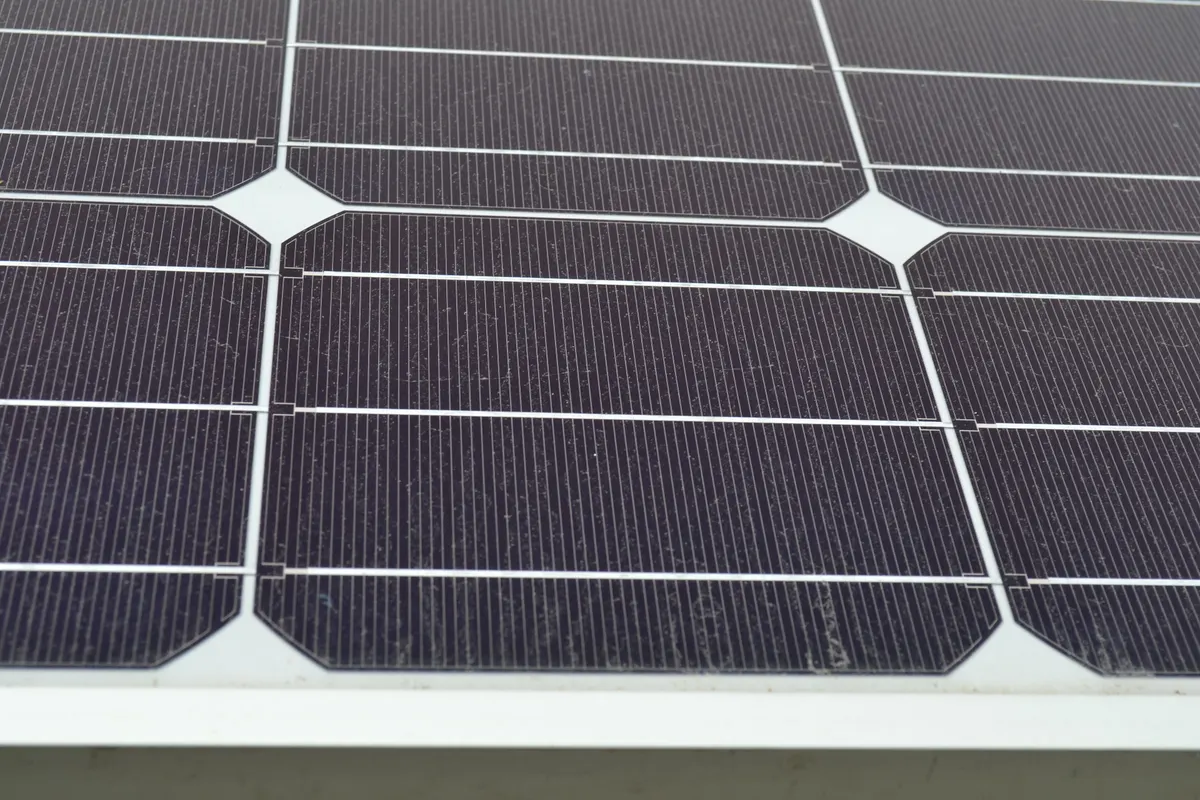
It is uneven. Dirt accumulates in the lower parts of modules, and uneven soiling can be underestimated by simple current-based sensors.
Efficient modules lose more. Under identical soiling, more efficient modules suffer larger energy losses.
DEWA's guidance for Dubai is direct: keep panels clean and avoid deposits of dirt and dust, because they noticeably reduce efficiency, and clean frequently because the region is prone to dust storms.
The IEA PVPS report sorts mitigation into preventive and corrective measures. Neither the report's summary nor the authorities publish a single right cleaning interval for the Gulf; it depends on the site, which is why the report recommends "best time to clean" models and monitoring.
Method
Type
Notes for Gulf rooftops
Site planning and layout
Preventive
Distance from dust sources, tilt and access routes decided at design stage
Anti-soiling coatings
Preventive
An investment that the IEA report lists as raising capital cost; ask for field evidence and its effect on the module warranty
Wet or dry brushing by hand
Corrective
Common on rooftops; needs safe access, the right water and the manufacturer's approved method
Cleaning robots
Corrective
The IEA report notes both the investment and the robots' own maintenance cost; more common on large arrays
Electrodynamic cleaning
Corrective
Listed by the IEA report among cleaning technologies
For scheduling, the IEA report points to IEC 61724-1 (Photovoltaic system performance, Part 1: Monitoring), which recommends when and where to measure soiling on site. On commercial systems, a soiling sensor or a clean reference module tied into energy monitoring lets you clean when the lost output costs more than a cleaning visit, instead of on a fixed calendar.
Who may clean, and how
In Dubai, this is not a DIY job. DEWA says all electrical installation, operation and maintenance should be done only by qualified solar PV electricians enrolled with DEWA, and that under no circumstances should the owner interact with the system's components, because PV arrays create a hazardous electrical condition when exposed to light. Maintenance is the customer's responsibility through a signed O&M contract with an enrolled company. In Saudi Arabia, SEC asks for an operation and maintenance manual covering shutdown and isolation, PPE, spare parts, preventive maintenance and warranty documentation, and for a maintenance programme for systems above 100 kW.
When you agree a cleaning scope, ask for the method (brush type, water or dry), the water quality and source, the safety arrangements for roof work, and written confirmation that the method follows the module manufacturer's instructions, so the warranty is not put at risk.
DEWA's minimum eligibility criteria for modules already include IEC 61215, IEC 61730 and IEC 61701 (salt mist). It requires IEC 62716 (ammonia) only for installations in special environments, and says it may later ask for IEC 60068-2-68, the sand and dust test. Certificates must come from ILAC-accredited laboratories working to ISO/IEC 17025.
Manufacturers list these on their datasheets. JinkoSolar's Tiger Neo 72HL4, for example, lists IEC 61215:2021, IEC 61730:2023, IEC 61701, IEC 62716, IEC 60068 and IEC 62804 (potential-induced degradation), an operating temperature range of -40 °C to +70 °C and a front-side static test load of 5,400 Pa. For coastal sites in Dubai, Abu Dhabi, Jeddah or Dammam, ask for the salt mist severity the module was tested to; for farms, ask for IEC 62716.
Degradation and what the 25 and 30-year warranties mean
All modules lose output slowly with age, separate from heat and dust losses that clean-up or cooler weather reverse. The power warranty is the manufacturer's promise on that slow loss.
JinkoSolar Tiger Neo 72HL4: no more than 1% degradation in the first year, 0.40% a year after that, 87.4% of rated power at year 30, under a 30-year linear power warranty; the product warranty is 12 years, and the datasheet also lists an anti-PID guarantee.
DEWA's description of a typical guarantee: 90% of rated output after 10 years and 80% after 25 years, with most panels lasting up to 25 years and some longer.
Two practical points. First, the product warranty (defects) is usually much shorter than the power warranty, so read both. Second, a power warranty claim needs evidence: keep commissioning test reports, monitoring data and cleaning records, because a dirty module that underperforms is not a warranty failure. After 25 or 30 years the modules keep producing at reduced output, and the decision becomes whether replacement pays.
Inverters in the heat
The inverter is the other component that heat punishes. DEWA asks for inverters to be installed in an airy, accessible place protected from direct sun and water, and SEC asks for the inverter's maximum temperature and how dust is kept out of the installation room. Huawei rates its SUN2000-MAP0 residential inverters from -25 °C to +60 °C with natural convection cooling and IP66, while Fronius uses active cooling on its GEN24 Plus and Verto Plus, also IP66. Our spoke on on-grid, off-grid and hybrid inverters covers derating and placement; compare solar inverters by their temperature ratings.
O&M checklist for a Gulf rooftop
Cleaning method, frequency and trigger (fixed schedule or monitored soiling), water source and quality.
Safe roof access and the contractor's work-at-height arrangements.
Monitoring with alerts for underperformance, and monthly yield reports against the design estimate.
Inverter inspection, including fans or heat sinks and dust ingress.
Annual electrical checks of connections, isolators and protection settings.
Records kept for warranty claims: commissioning reports, monitoring data and cleaning logs.
The contractor's DEWA enrolment or SEC approval, where the authority requires it.
Yes, but they produce less than their rating. Power is rated at a 25 °C cell temperature and falls by the temperature coefficient for each degree above it: -0.29% per °C on one current TOPCon datasheet, and about -0.4% to -0.5% per °C for silicon cells in general, according to PVEducation. Modules with a lower coefficient and mounting that lets air flow behind them lose less.
How much does dust reduce solar panel output?
It depends on the site and how long since the last cleaning. The IEA PVPS estimates soiling cost at least 3 to 4% of global annual PV output in 2018, rising to an expected 4 to 5% by 2023, and says arid regions may be affected significantly. Fine particles under 10 µm are rarely removed by wind, and dew can make deposits stick harder.
How often should solar panels be cleaned in the UAE?
No authority sets a fixed interval. DEWA advises cleaning frequently because Dubai is prone to dust storms, and the IEA PVPS recommends deciding with "best time to clean" models and soiling monitoring under IEC 61724-1. On larger systems, monitor output against a clean reference and clean when the lost energy is worth more than the visit.
Can I clean my own solar panels in Dubai?
DEWA says no. Its guidance is that all installation, operation and maintenance should be done by qualified solar PV electricians enrolled with DEWA, and that owners should not interact with system components under any circumstances, because arrays are electrically live in daylight. Every Shams Dubai customer must have a signed O&M contract with an enrolled company.
What happens to solar panels after 25 years?
They keep working at reduced output. DEWA describes a typical guarantee of 80% of rated output after 25 years, and some current power warranties run to 30 years, such as JinkoSolar's Tiger Neo at 87.4% in year 30. Once the warranty ends, owners decide whether the lower output still justifies keeping the modules or whether replacement pays.
What test standards matter for desert and coastal sites?
DEWA requires IEC 61701 salt mist testing for all modules, IEC 62716 ammonia testing for special environments such as farms, and may ask for IEC 60068-2-68 sand and dust testing. Certificates must come from ILAC-accredited labs. Check the module datasheet lists these, and ask for the certificate for the exact model offered.
A step-by-step method to size rooftop solar in the UAE and Saudi Arabia from your bills, with modelled yields for five cities, roof area per kWp, DEWA and SEC caps and air conditioning examples.
A buyer guide to rooftop solar in the UAE and Saudi Arabia: yields by city, module types, DEWA, Abu Dhabi and SEC connection rules, dated cost figures, brands, warranties and an RFQ list.
What a rooftop solar quote in the UAE or Saudi Arabia is made of: modules, inverter, structure, approvals and O&M, the only dated public price figures, and how DEWA and SEC tariffs set payback.