Solar Panels in the UAE and Saudi Arabia: Costs, Rules, Sizing and Brands
A buyer guide to rooftop solar in the UAE and Saudi Arabia: yields by city, module types, DEWA, Abu Dhabi and SEC connection rules, dated cost figures, brands, warranties and an RFQ list.
Rooftop solar in the UAE and Saudi Arabia means a grid-connected PV system that cuts daytime electricity bills: in Dubai through DEWA's Shams Dubai net metering, in Abu Dhabi through the Department of Energy's self-supply policy, and in Saudi Arabia through SEC net billing for systems of 1 kW to 2 MW. A well-sited array yields roughly 1,780 to 1,850 kWh per kWp a year. Start by comparing solar panels and modules on one specification.
This guide is for villa and building owners, facility managers, MEP contractors and procurement teams who need to decide what to buy, how big to go, which authority approves it and what to put in an RFQ. It covers how PV behaves in Gulf heat and dust, module types, sizing, the connection rules in Dubai, Abu Dhabi and Saudi Arabia, cost drivers, brands, warranties and a buyer checklist. For Saudi projects you can also browse solar panel suppliers in Saudi Arabia. ListGCC did not test any product: specifications below come from manufacturers' datasheets and from the authorities' own pages.
How rooftop solar works in the Gulf
A grid-connected system has four parts that matter to a buyer: the PV modules, the inverter that turns their DC output into AC, the interface protection that disconnects the plant when the grid has a fault, and the meters. DEWA describes exactly this set-up: power is used on site first and the surplus is exported to its network, and two meters are usually fitted, a generation check meter and a bi-directional meter for import and export. SEC's connection guidelines show the same configuration for Saudi Arabia.
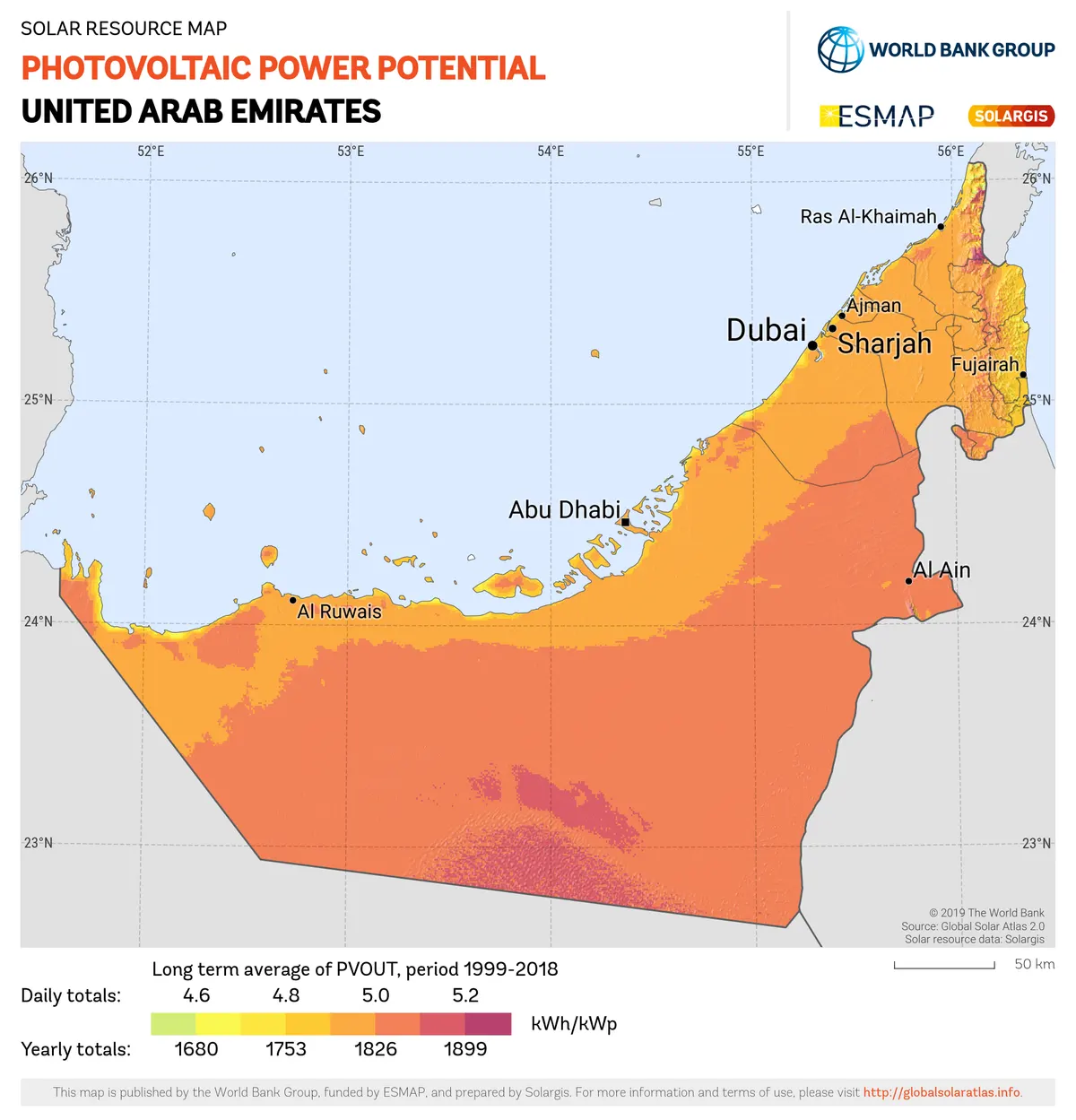
The resource is excellent everywhere in the region, and the differences between cities are small. The World Bank's Global Solar Atlas models these long-term values for a standard fixed crystalline silicon system:
City
Modelled PV output (kWh per kWp per year)
Average per day (kWh per kWp)
Optimum fixed tilt
Average air temperature
Dubai
1,790
4.9
26°
28.1 °C
Abu Dhabi
1,806
4.9
25°
28.1 °C
Riyadh
1,853
5.1
26°
26.2 °C
Jeddah
1,836
5.0
22°
28.2 °C
Dammam
1,780
4.9
27°
26.4 °C
DEWA gives a matching rule of thumb for Dubai: face fixed panels south at about 24 degrees, which allows an annual irradiation of about 2,100 kWh per square metre. Two things then pull real output below the brochure figure: heat and dust.
Heat. Module power is rated at a cell temperature of 25 °C, and power falls as cells get hotter. JinkoSolar's Tiger Neo datasheet gives a temperature coefficient of -0.29% per °C for its TOPCon module, and the company quotes -0.35% per °C for p-type modules. On a summer roof the cells run far above 25 °C, so the coefficient is worth comparing between bids.
Dust. The IEA PVPS soiling report calls soiling the single most influential factor on yield after irradiance, and DEWA advises frequent cleaning because Dubai is prone to dust storms.
Module types: PERC, TOPCon, heterojunction and bifacial
Almost every rooftop quote in the Gulf will be for monocrystalline silicon modules. Fraunhofer ISE's Photovoltaics Report (updated July 2026) says silicon wafer technology was about 98% of production in 2025, that 86% of wafers were n-type, and that n-type TOPCon has become dominant, with TOPCon and heterojunction replacing p-type PERC. Average commercial module efficiency was 22.7% in late 2024, with the best datasheet value at 24.8%.
Type
What it is
What it means for a Gulf buyer
Mono PERC (p-type)
The previous mainstream cell design
Being replaced by n-type cells; JinkoSolar quotes a weaker temperature coefficient for p-type (-0.35% per °C) than for its TOPCon (-0.29% per °C)
TOPCon (n-type)
Tunnel oxide passivated contact cells, now the dominant technology
The default in most current quotes; check the datasheet's temperature coefficient and degradation figures
Heterojunction (HJT, n-type)
A second n-type design replacing PERC
Compare on the same datasheet figures as TOPCon, not on the label
Bifacial
Modules that convert light reaching both front and back
SEC notes the extra yield depends on tilt, height, row spacing and ground reflectivity, so gains on a low flat roof are smaller than on a raised canopy
Thin film (CdTe, CIGS)
A thin semiconductor layer deposited on glass
SEC says efficiency is normally lower than crystalline silicon, except CdTe, which is similar
Module size has grown with wafer size: Fraunhofer reports power ratings of up to 750 W per module. Bigger modules mean fewer pieces to fix, but they are heavier and longer, so check them against the mounting system and roof access before you choose.
Certificates that decide grid eligibility
In Dubai, a module or inverter must be on DEWA's List of Eligible Equipment, or proven compliant, before the system can connect. DEWA's minimum criteria for modules are IEC 61215 (design qualification), IEC 61730 (safety) and IEC 61701 (salt mist), with IEC 62716 (ammonia) required only for special environments and IEC 60068-2-68 (sand and dust) something DEWA may ask for later. Certificates must come from ILAC-accredited laboratories working to ISO/IEC 17025. Inverters need IEC 62109-1/2 or UL 1741, harmonics and EMC tests from the IEC 61000 series, compliance with DEWA's own DRRG Standards (Version 3.0, December 2023) and harmonic spectrum data. DEWA notes that its old PDF list is obsolete and that equipment must be registered on its online portal.
In Saudi Arabia, SEC's guidelines refer installers to the Saudi Building Code (SBC 401, Chapter 712) and to applicable SASO or international standards, and the design file must include each module's temperature coefficients, NOCT and certifications. In Abu Dhabi, the Quality and Conformity Council launched a conformity assessment scheme for small-scale PV products and installations in 2017, alongside the emirate's energy netting regulation.
How big a system do you need?
Size from your consumption, then check it against your roof and the utility's limit.
Add up 12 months of kWh from your bills.
Divide by the specific yield for your city from the table above. A Dubai villa using 48,000 kWh a year would need about 48,000 ÷ 1,790 = 26.8 kWp to match its annual use on paper.
Check roof area. One 72-cell module on JinkoSolar's datasheet measures 2,278 by 1,134 mm (about 2.6 square metres) for 580 to 605 W, which is roughly 4.3 square metres of module per kWp before row spacing, walkways and setbacks.
Check the cap. DEWA limits capacity to a share of the premises' total connected load and may set a lower threshold for grid reasons. In Saudi Arabia, SEC checks the system against 15% of the rating of the transformer that feeds you and against an aggregate limit of 3% of the previous year's peak load.
Air conditioning dominates Gulf bills, so the sizing spoke includes a worked example for a 1.5 ton split unit on a 5 kW system. See how to size a solar system in kW.
Shams Dubai, under Executive Council Resolution No. 46 of 2014
Small-scale PV energy netting regulation (2017); Solar Energy Self-Supply Policy (2026)
Small-Scale Solar PV Systems Regulations ERD-TA-012 (V02/19), applied through SEC's connection guidelines
Who applies
A DEWA-enrolled solar PV consultant or contractor, as the customer's agent
2017 regulation: approval by the Regulation and Supervision Bureau; DoE says the 2026 phase streamlines installation and grid connection procedures
An SEC-approved consultant or contractor selected on SEC's portal
Surplus energy
Credited in kWh against future bills; indefinite rollover; no cash payment
2017 regulation: credited against future consumption, no monetary compensation
Net billing: surplus is valued financially and deducted from the next bill
Size limit
Share of total connected load (DEWA Connection Conditions, section 2.2)
Up to 5 MW on the LV network (2017 regulation, as reported)
1 kW to 2 MW; 15% of feeding transformer; technical assessment above 50 kW
Other approvals
Building permit from Dubai Municipality, Trakhees or the relevant authority
Municipal permits before connection
Saudi Building Code SBC 401 Chapter 712; SEC design approval and inspection
Outside Dubai and Abu Dhabi, ask the local utility for its current rooftop procedure before you order equipment. Abu Dhabi's 2026 policy announcement did not publish export terms, so confirm the current metering and settlement rules with your distribution company and the DoE before you size for export.
What drives the cost of a solar system
There is no fixed price, and DEWA itself says there is no single or simple answer. The only dated figures from an authority are DEWA's own: in Q2 2021 it put typical costs at AED 4,500 to 5,000 per kWp for small villa systems and AED 3,500 to 4,000 per kWp or below for larger ones, plus a one-off connection fee of AED 1,500 per generator, with operating costs of roughly 5% of the initial investment. Module prices have moved since: Fraunhofer ISE reports a global average selling price of about US$0.10 per Wp in 2025, and says China's removal of its 9% export VAT refund in April 2026, together with material and shipping costs, is pushing module and installation prices up. Treat any figure as a snapshot and get current quotes.
The cost drivers, roughly in order of weight:
System size: larger systems spread fixed costs (design, approvals, connection, mobilisation) over more kWp.
Modules and inverter: brand, technology and whether the exact models are already on DEWA's list or carry the certificates SEC asks for.
Mounting: a ballasted frame on a flat roof, a penetrating structure or a raised carport canopy cost very different amounts; see solar mounting systems.
Approvals and testing: DEWA requires a plant performance test above 100 kW and may charge for dedicated grid equipment above 400 kW.
Batteries, if you want backup or night-time use.
Operation and maintenance: DEWA requires a signed O&M contract with an enrolled company, and cleaning frequency drives that cost.
Payback depends on the tariff you offset. DEWA's residential and commercial slabs run from 23 fils per kWh (0 to 2,000 kWh a month) to 38 fils above 6,000 kWh, plus a fuel surcharge (6 fils per kWh for November 2026) and 5% VAT, and DEWA deducts solar exports before applying the slabs, so savings come off your most expensive units first. In Saudi Arabia, the residential tariff is 18 halalas per kWh up to 6,000 kWh a month and 30 halalas above. The cost spoke, solar panel prices in the UAE and Saudi Arabia, sets out the payback arithmetic.
Inverters and batteries
Most grid-connected rooftops use a string inverter; hybrid inverters add a battery port and backup, and off-grid systems need batteries sized for the night. DEWA says inverters typically exceed 95% efficiency with a 10-year warranty and should be installed in an airy, accessible place protected from direct sun and water. Compare solar inverters and battery energy storage systems, and read the inverter spoke, on-grid, off-grid and hybrid inverters compared.
Solar brands Gulf buyers will see in quotes
The list below describes what each manufacturer says it makes. It is not a ranking, and ListGCC did not test any of these products. For modules, the brand matters less than whether the specific model is on DEWA's list or carries the certificates SEC asks for.
Huawei's FusionSolar range covers SUN2000 inverters for homes and businesses, LUNA2000 battery storage and module-level controllers. Its residential SUN2000-5K to 12K-MAP0 inverters list a maximum efficiency of 98.4% to 98.6%, natural convection cooling, IP66 and an operating range of -25 °C to +60 °C. The LUNA2000-S1 battery uses LFP cells in packs that combine from 5 to 21 kWh. Huawei runs regional FusionSolar sites for both the UAE and Saudi Arabia. It suits buyers who want inverter, battery and monitoring from one maker.
Fronius International, based in Wels, Austria, runs a solar energy business alongside its welding division. Its current inverters include the GEN24 Plus hybrid (Primo GEN24 single-phase from 3 to 6 kW; Symo GEN24 three-phase up to 12 kW), with backup when combined with its Reserva LFP battery, and the Verto Plus hybrid in classes from 15 to 33.3 kW for small businesses and large homes. Both are rated IP66 and use active cooling.
LONGi
LONGi Green Energy Technology was founded in 2000 and says it continues to focus on monocrystalline technology across wafers, cells, modules and building-integrated PV. It runs a UAE regional website, and LONGi Green Energy Technology appears among the PV module manufacturers on DEWA's eligible equipment list.
JinkoSolar
JinkoSolar's Tiger Neo modules use n-type TOPCon cells. The company says it has more than ten manufacturing bases, one of them in the Middle East. Jinko Solar Co., Ltd. is on DEWA's eligible module list.
Trina Solar
Trina Solar was founded in 1997 and has its global headquarters in Changzhou, China, and a regional headquarters in Dubai. It makes Vertex N modules, TrinaTracker trackers and Elementa storage systems, and Trina Solar Co., Ltd. is on DEWA's eligible module list.
Sungrow
Sungrow lists PV inverters, energy storage systems, EV chargers and floating PV systems among its products. As with any inverter, ask for proof that the exact model is on DEWA's list or meets SEC's technical standards.
Warranties, degradation and what happens after 25 years
Read two warranties on every module datasheet. The product warranty covers defects; the power warranty guarantees a minimum output over time. JinkoSolar's Tiger Neo 72HL4 datasheet gives a 12-year product warranty and a 30-year linear power warranty, with no more than 1% degradation in the first year, 0.40% a year after that and 87.4% of rated power at year 30. DEWA describes a typical guarantee as 90% after 10 years and 80% after 25 years, and says most panels have a life of up to 25 years, sometimes longer.
After 25 years a panel does not switch off: it keeps producing at a lower output, and the question becomes whether replacing it pays. Fraunhofer ISE notes that PV modules can be recycled to recover valuable materials. Inverters wear out sooner: DEWA cites a typical 10-year warranty, so budget for one replacement over the life of the array.
Gulf conditions that change the specification
Salt. Coastal sites in Dubai, Abu Dhabi, Jeddah and Dammam justify IEC 61701 salt mist certification, which DEWA already requires.
Sand and dust. Ask for IEC 60068-2-68 test evidence and for the manufacturer's cleaning instructions, since cleaning frequency drives O&M cost.
Ammonia. Farms and some industrial sites are the "special environments" where DEWA requires IEC 62716.
Inverter location. Keep inverters out of direct sun and in a ventilated space. SEC's design checklist asks how dust is kept out of the inverter room.
RFQ checklist for a rooftop solar system
Site and utility: emirate or Saudi region, utility and account number, and 12 months of bills.
Target: kWp, or the share of annual consumption to offset, and whether backup or night-time battery use is needed.
Roof data: area, structure type, roof drawings, shading, parapet height and access for cleaning.
Modules: technology, wattage, temperature coefficient of Pmax, degradation, product and power warranty years, and IEC 61215, 61730, 61701 (plus 62716 and 60068-2-68 where relevant) certificates from accredited labs.
Inverter: type, model, efficiency, operating temperature range and derating, IP rating, grid compliance certificates, and evidence the model is on DEWA's list or meets SEC's technical standards.
Mounting: material, finish, wind design basis and roof fixing method.
Yield estimate: annual kWh with stated assumptions for temperature, soiling and inverter losses.
Approvals: who prepares and submits the utility application, building permit and inspection documents, and the contractor's DEWA enrolment or SEC approval.
O&M: cleaning frequency, water source, monitoring, response times and contract term.
How much does a solar panel system cost in the UAE?
There is no fixed price. DEWA's own dated guidance, from Q2 2021, put small villa systems at AED 4,500 to 5,000 per kWp and larger systems at AED 3,500 to 4,000 per kWp or less, plus a one-off DEWA connection fee of AED 1,500. Module prices have changed since then, and Fraunhofer ISE reports that export policy changes in China pushed prices up in 2026. Get itemised current quotes and compare them per kWp.
Does the UAE use solar panels on homes?
Yes. Dubai has connected rooftop systems to the DEWA grid under Shams Dubai since Executive Council Resolution No. 46 of 2014, and in March 2026 Abu Dhabi's Department of Energy extended its Solar Energy Self-Supply Policy to villas and residential buildings, with or without battery storage. Homes elsewhere in the UAE should check with their own utility.
Can I sell solar electricity back to DEWA?
Not for cash. Under Shams Dubai, surplus electricity exported to the grid is credited and used to offset future consumption, and the resolution states that the producer is not paid for the excess. Credits roll over indefinitely, but they cannot be transferred to a new owner or tenant if you sell or rent the property.
Is rooftop solar allowed in Saudi Arabia?
Yes. Small-scale systems from 1 kW to 2 MW can connect to SEC's low and medium voltage network under the regulator's Small-Scale Solar PV Systems Regulations. You choose an SEC-approved consultant or contractor, who applies through SEC's portal. Surplus energy is valued under net billing and deducted from the next bill. Residential consumers get connection priority.
Which is better for the Gulf, TOPCon or PERC?
Fraunhofer ISE reports that n-type TOPCon has become the dominant technology and is replacing p-type PERC. For hot roofs, the figure to compare is the temperature coefficient of power: JinkoSolar, for example, quotes -0.29% per °C for its TOPCon module and -0.35% per °C for p-type. Compare datasheets for the exact models offered rather than relying on the technology name.
What happens to solar panels after 25 years?
They keep working at reduced output. DEWA describes a typical guarantee of 80% of rated power after 25 years, and some current datasheets go further, such as JinkoSolar's 30-year linear power warranty to 87.4%. After that, owners decide whether replacement pays. Fraunhofer ISE notes that modules can be recycled to recover valuable materials.
Do solar panels work in dust storms and summer heat?
Yes, but output drops. Hot cells produce less power than at their 25 °C rating, by the datasheet's temperature coefficient for each degree, and dust on the glass blocks light. The IEA PVPS estimates soiling cost at least 3 to 4% of global PV output in 2018. Plan cleaning into the O&M contract, as DEWA advises frequent cleaning in Dubai.
A step-by-step method to size rooftop solar in the UAE and Saudi Arabia from your bills, with modelled yields for five cities, roof area per kWp, DEWA and SEC caps and air conditioning examples.
Why solar panels in the UAE and Saudi Arabia produce less than their rating in summer and after dust storms, how to compare modules on heat, and how to plan cleaning and warranties.
What a rooftop solar quote in the UAE or Saudi Arabia is made of: modules, inverter, structure, approvals and O&M, the only dated public price figures, and how DEWA and SEC tariffs set payback.