How to Size a Solar System in kW for a Villa, Office or Factory
A step-by-step method to size rooftop solar in the UAE and Saudi Arabia from your bills, with modelled yields for five cities, roof area per kWp, DEWA and SEC caps and air conditioning examples.
To size a solar system in kW, divide the electricity you want to offset each year (in kWh, from 12 months of bills) by what one kWp produces where you are: about 1,790 kWh a year in Dubai and 1,853 kWh in Riyadh on World Bank Global Solar Atlas data. Then check roof area and the utility's cap. That number is the DC rating to ask suppliers of solar panels and modules to quote.
This spoke is for villa owners, office facility managers and factory engineers in the UAE and Saudi Arabia who want a defensible system size before they ask for quotes. It sets out the method step by step, with worked examples and the air conditioning question most Gulf buyers ask. For module types, rules and brands, see our main guide to solar panels in the UAE and Saudi Arabia. ListGCC did not test any equipment; yields are modelled values from the Global Solar Atlas and product figures come from manufacturers. Saudi buyers can compare solar panel suppliers in Saudi Arabia.
Step 1: get your load from the bills
Collect 12 consecutive monthly bills and note the kWh, not the amount paid. Gulf consumption swings with cooling demand, so a single summer or winter bill will mislead you. Note also when you use the power: offices and factories use most of it in daylight, when solar produces, while villas run cooling into the night.
Annual total: the sum of 12 months is the ceiling for a system designed to offset everything.
Daytime share: if you have interval data from a smart meter, estimate the share used between roughly 8 am and 5 pm. In Saudi Arabia, where surplus is valued under net billing, this share matters more for sizing.
Tariff band: in Dubai, solar exports are deducted before DEWA's slabs are applied, so solar first removes your most expensive units. The cost spoke shows how that sets payback.
Step 2: find the yield per kWp for your city
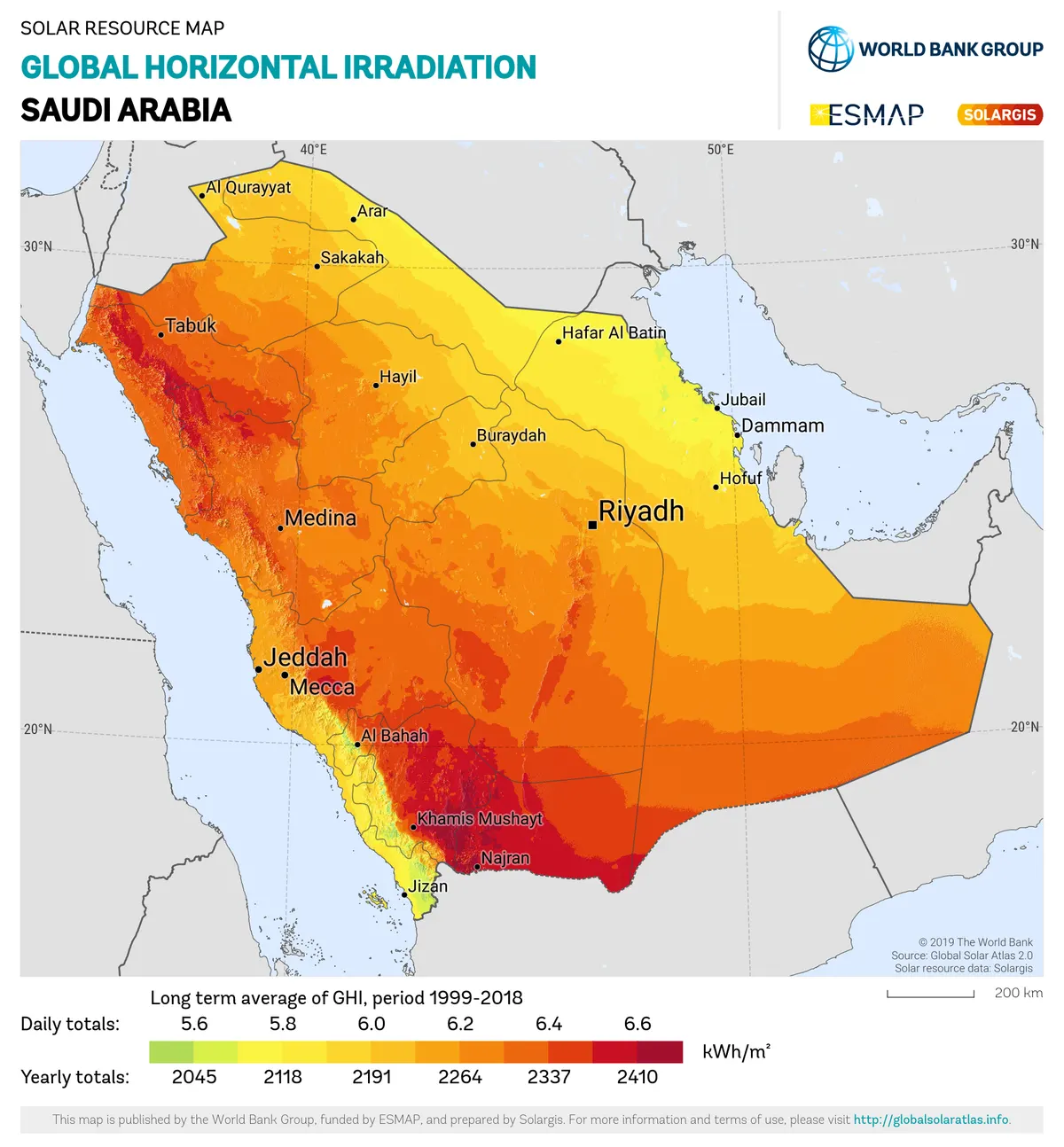
The Global Solar Atlas publishes long-term modelled values for any location. Two figures matter. Irradiation on a panel at the best fixed tilt, divided by 365, gives "peak sun hours", the number of hours a day at the standard 1,000 W per square metre test irradiance. Modelled PV output is what a standard fixed crystalline silicon system actually delivers after the losses the Atlas models, including temperature.
City
Irradiation at optimum tilt (kWh/m² per year)
Peak sun hours per day
Modelled PV output (kWh per kWp per year)
Output per kWp per day
Optimum tilt
Dubai
2,338
6.4
1,790
4.9
26°
Abu Dhabi
2,347
6.4
1,806
4.9
25°
Riyadh
2,416
6.6
1,853
5.1
26°
Jeddah
2,370
6.5
1,836
5.0
22°
Dammam
2,299
6.3
1,780
4.9
27°
Use the PV output column for sizing, not peak sun hours. The gap between them (roughly 6.4 against 4.9 in Dubai) is the effect of heat, inverter and other losses, and it is why a sizing based on peak sun hours alone oversells a system. DEWA's guidance agrees on orientation: in the UAE, fixed panels should face south at about 24 degrees.
Divide the kWh you want to offset by the yield. The answer is the DC module capacity in kWp.
Dubai. Under Shams Dubai, surplus is credited in kWh and an indefinite rollover applies, so you can size towards your annual consumption, subject to DEWA's cap. Oversizing beyond your own use earns nothing: the producer is not paid for excess electricity, and credits cannot be transferred to a new owner or tenant.
Abu Dhabi. The DoE's 2026 self-supply policy is framed around meeting "a significant share" of daytime consumption, with optional battery storage. Confirm current settlement rules for exports with your distribution company and the DoE before you size above daytime use.
Saudi Arabia. Under SEC net billing, surplus energy is given a financial value and deducted from the next bill. Ask how exported energy is valued before you size well above your daytime consumption.
Step 4: check the roof area
Module area sets the floor for roof space. JinkoSolar's Tiger Neo 72HL4 module, for example, measures 2,278 by 1,134 mm, about 2.6 square metres, for 580 to 605 W. That is roughly 4.3 square metres of module per kWp. Tilted rows need gaps so one row does not shade the next, and you need walkways for cleaning and setbacks from roof edges and plant, so the usable roof must be a good deal larger than the module area. DEWA also notes that shading causes a significant drop in performance and can damage modules.
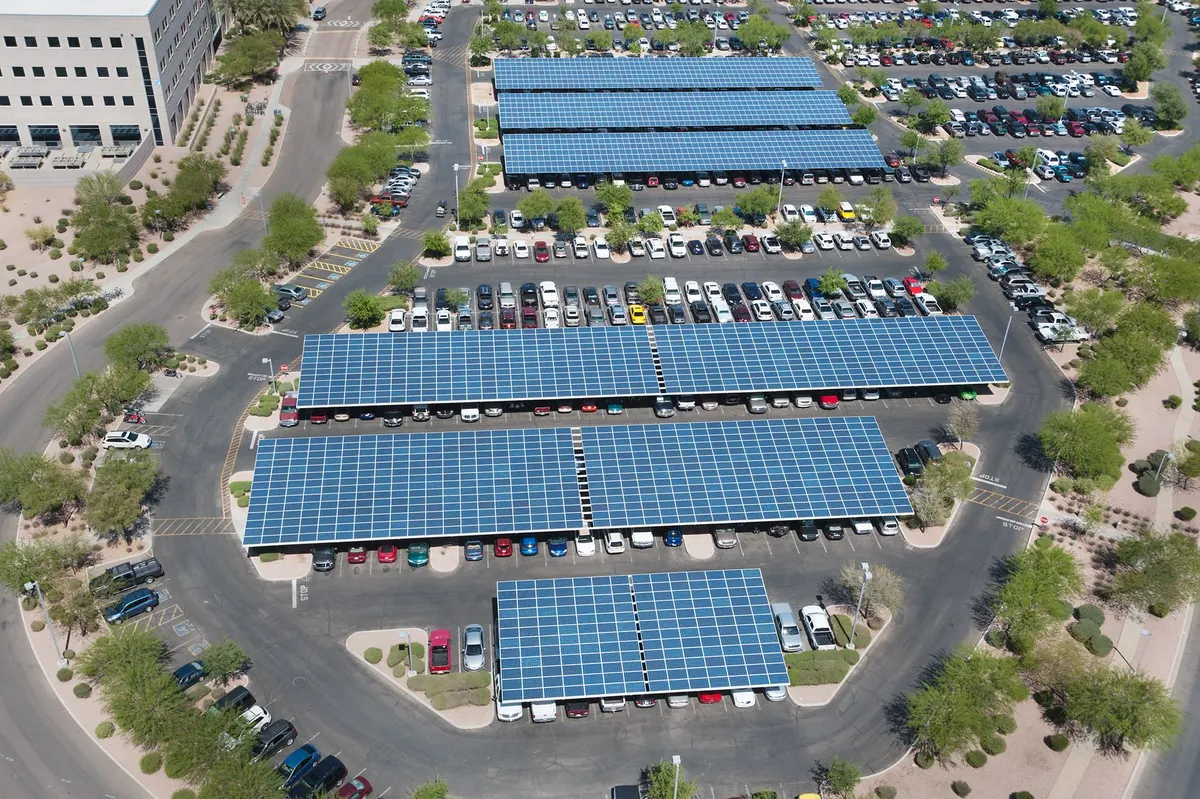
Within Shams Dubai, ground-mounted panels are not envisaged, so a Dubai system must fit on the building or on structures such as car park canopies. Ask your designer for a layout drawing, not just a kWp figure, and see solar mounting systems for frames and canopies.
Dubai. Capacity cannot exceed the applicable share of the premises' total connected load set in section 2.2 of DEWA's Connection Conditions, and DEWA may impose a lower threshold for grid reasons. Above 100 kW you need a plant performance test before connection, and above 400 kW DEWA may need dedicated grid equipment.
Saudi Arabia. Small-scale systems run from 1 kW to 2 MW. SEC checks the PV capacity against 15% of the rated capacity of the transformer feeding the consumer and against an aggregate limit of 3% of the previous year's peak load, and asks for a technical assessment of network hosting capacity above 50 kW. Design documents are lighter for systems up to 11 kW than above it.
Ask your contractor to request the transformer data early: in Saudi Arabia the consultant or contractor asks SEC through its portal for the transformer capacity and the remaining capacity available for solar before submitting the application.
Worked examples
These use round, illustrative consumption figures. Replace them with your own bills.
Site
Annual use
Yield used
Size to offset 100%
Module area (at 4.3 m² per kWp)
Check
Villa, Dubai
48,000 kWh
1,790
26.8 kWp
About 115 m²
DEWA share of connected load
Office, Riyadh
120,000 kWh
1,853
64.8 kWp
About 280 m²
SEC technical assessment (above 50 kW)
Factory, Dammam
1,000,000 kWh
1,780
562 kWp
About 2,420 m²
15% of transformer rating: a 2,000 kVA transformer would limit PV to about 300 kW
The factory row shows why the transformer check comes first: the cap, not the bill, often sets the size of a large Saudi system.
Can a 5 kW solar system run a 1.5 ton air conditioner?
In daylight on a grid-connected system, usually yes on average; at night or off-grid, only with batteries. The arithmetic:
The AC's demand. A refrigeration ton is 12,000 Btu/h, so 1.5 tons is 18,000 Btu/h of cooling. SASO 2663:2025 sets a minimum rated EER of 11.80 Btu/W·h at the T1 condition (35 °C outdoors) for split units, so a compliant 18,000 Btu/h split draws at most about 18,000 ÷ 11.80 = 1.5 kW at T1. At the hotter T3 condition (46 °C) the minimum EER is lower (8.50 for non-ducted splits), so power per unit of cooling rises. Read the actual power input from the nameplate or energy label.
The array's supply. A 5 kWp array produces about 5 × 4.9 = 24.5 kWh a day on average in Dubai. At midday in summer it delivers less than 5 kW because hot cells lose power, but well above 1.5 kW.
The balance. Ten daylight hours of cooling at about 1.5 kW is about 15 kWh, within the array's average daily output. On a grid-tied system the grid covers clouds, dust, start-up surges and the evening.
Off-grid or in backup mode, the inverter must also handle the compressor's starting current. Inverter datasheets state their overload capacity: Huawei lists 150% overload for 5 minutes and 200% for 10 seconds on its SUN2000-MAP0 residential inverters, and Fronius says its Verto Plus, with a battery connected, can briefly deliver up to 50 kVA of AC peak power for loads with high starting currents. For AC efficiency labels, see our guide to AC energy efficiency labels in the UAE and Saudi Arabia.
Matching the inverter to the array
The kWp figure is DC module capacity; the inverter has its own AC rating. Huawei's SUN2000-MAP0 range runs from 5 to 12 kW with two MPP trackers, and Fronius's Primo GEN24 covers 3 to 6 kW single-phase, with Symo GEN24 three-phase models up to 12 kW. Ask the designer to state the DC-to-AC ratio and the clipping loss it causes, to use a separate MPP tracker for each roof face or orientation, and to confirm the inverter model is on DEWA's eligible list or meets SEC's technical standards. Compare solar inverters once the array size is fixed.
Sizing checklist before you ask for quotes
12 months of kWh from bills, with any interval data from the smart meter.
Target share of annual or daytime use to offset.
Roof drawings with dimensions, obstructions, parapets and shading sources.
Utility account details and, in Saudi Arabia, a request for transformer capacity data.
Any backup requirement (which loads, for how long), which decides whether you need a hybrid inverter and batteries.
How much electricity does a 5 kW solar system produce in the UAE?
About 8,950 kWh a year in Dubai, or roughly 24.5 kWh a day on average, using the World Bank Global Solar Atlas modelled output of 1,790 kWh per kWp. Abu Dhabi is slightly higher at 1,806 kWh per kWp. Summer days produce more energy in total, but hot cells deliver less power per hour of sun, and dust reduces output until panels are cleaned.
How many kW of solar does a villa need?
Divide your annual consumption by your city's yield. A Dubai villa using 48,000 kWh a year needs about 26.8 kWp to offset all of it on paper, which takes roughly 115 square metres of module area before row spacing. Most villas are limited by roof space or by DEWA's cap on capacity relative to connected load, so many offset part of their use.
How many panels make a 5 kW system?
Divide 5,000 W by the module rating. With modules of 580 to 605 W, such as JinkoSolar's Tiger Neo 72HL4, that is 9 modules for a little over 5 kWp. With smaller 400 to 450 W modules, it is 12 or 13. The exact count also depends on how the inverter's MPP trackers and voltage limits allow the strings to be arranged.
Is there a maximum size for a rooftop system in Dubai?
Yes. DEWA limits installed capacity to the applicable share of the premises' total connected load under section 2.2 of its Shams Dubai Connection Conditions, and it may set a lower threshold if grid integration requires it. Systems above 100 kW also need a plant performance test, and above 400 kW DEWA may require dedicated grid equipment.
What is the size limit for small-scale solar in Saudi Arabia?
Systems from 1 kW to 2 MW qualify. SEC also checks each application against 15% of the rated capacity of the transformer that feeds the consumer and against an aggregate limit of 3% of the previous year's peak load, and systems above 50 kW need a technical assessment of the network's hosting capacity. Residential consumers get priority.
Should I size solar using peak sun hours?
Use modelled PV output instead. Peak sun hours describe the sunlight reaching a tilted panel (about 6.4 hours a day in Dubai), but real systems lose output to heat, inverter conversion and other factors. The Global Solar Atlas's modelled output for Dubai is about 4.9 kWh per kWp per day, and sizing on that figure avoids overselling the system.
A buyer guide to rooftop solar in the UAE and Saudi Arabia: yields by city, module types, DEWA, Abu Dhabi and SEC connection rules, dated cost figures, brands, warranties and an RFQ list.
Why solar panels in the UAE and Saudi Arabia produce less than their rating in summer and after dust storms, how to compare modules on heat, and how to plan cleaning and warranties.
What a rooftop solar quote in the UAE or Saudi Arabia is made of: modules, inverter, structure, approvals and O&M, the only dated public price figures, and how DEWA and SEC tariffs set payback.