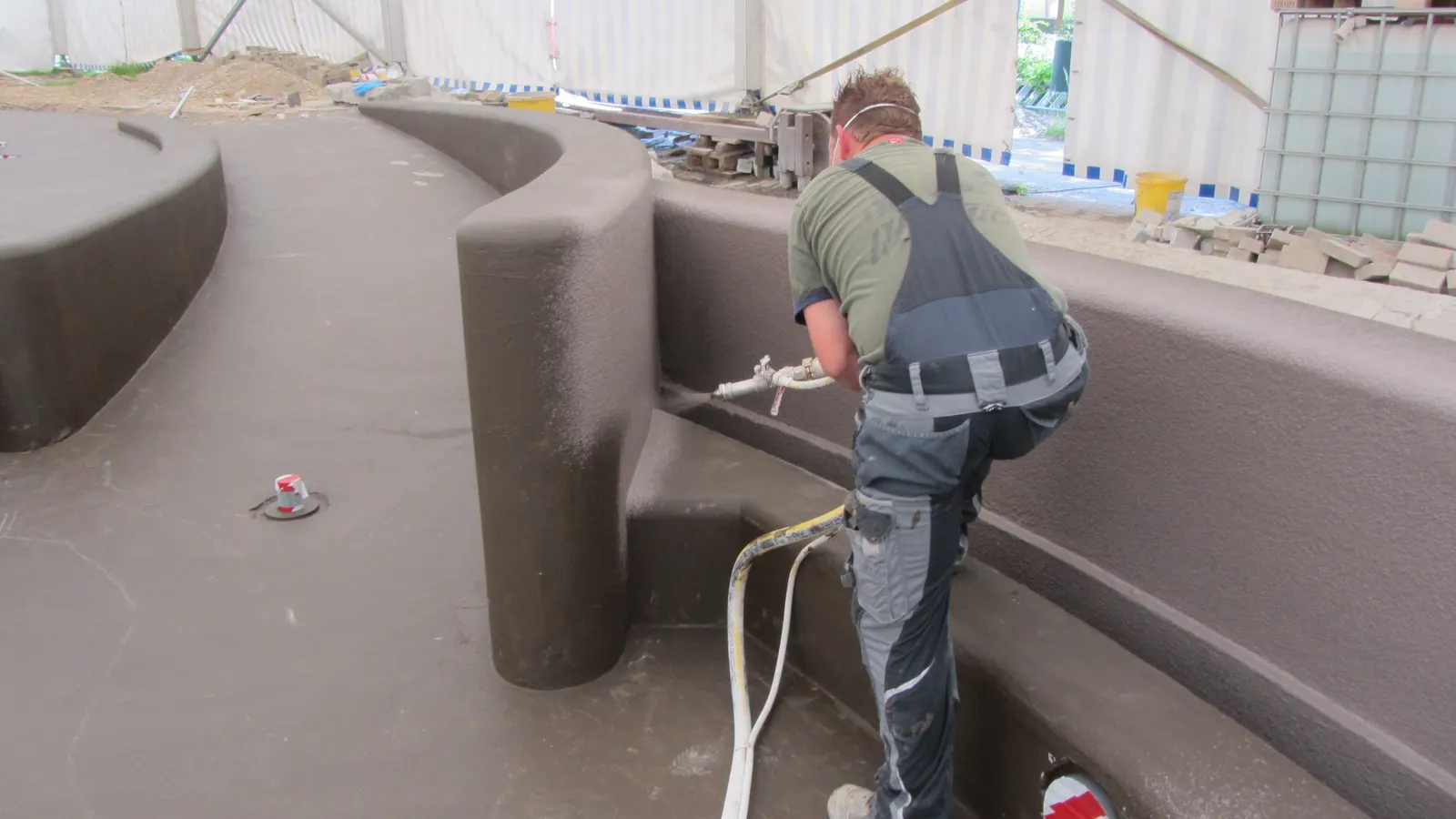
Basement and Water Tank Waterproofing for Gulf Projects
How to waterproof basements under high water tables and concrete water tanks: positive vs negative side, pre-applied bonded sheets, crystalline and bentonite, joints and service entries, potable linings and dewatering.
Basement and water tank waterproofing on Gulf projects starts from the water side. For basements under a high water table, that means a membrane on the outside (positive side), usually a fully bonded sheet laid before the concrete, backed by watertight concrete and sealed joints. For tanks, the water is inside, so the lining goes on the inner face and must be approved for drinking water if it touches it. Compare suppliers on the waterproof membranes suppliers page for the UAE.
This guide is for structural and MEP consultants, main contractors and developers planning below-ground structures and concrete tanks in the UAE and Saudi Arabia. Our waterproofing membranes guide for the UAE and Saudi Arabia explains the BS 8102 grades of protection and the main membrane families; this page goes into the decisions specific to basements and tanks: which side to waterproof, which below-ground system, how to handle joints and service entries, and what a tank lining needs. Saudi buyers will find the same supplier list on waterproof membrane suppliers in Saudi Arabia.
Start with the water: groundwater, grade and side
Three questions fix the system before any product is named:
Where is the water, and what is in it? The site investigation should give the design groundwater level and its chemistry. Saline or sulphate-bearing groundwater affects the concrete mix and can affect some waterproofing materials, so send the groundwater results to the membrane supplier and ask for written confirmation of compatibility.
How dry must the space be? Agree the BS 8102 grade with the client first (the main guide sets out Grades 1a to 3). The Concrete Centre notes that for Grades 2 and 3 additional measures, "such as a combined protection, water resisting admixture, pre- or post-tensioning", should be used.
Which side can you reach? On new work you control the outside face. On existing structures, or where the basement is built hard against a secant pile wall, you may only reach the inside.
Positive side or negative side?
Positive-side waterproofing sits on the face the water comes from: the outside of a basement, the inside of a tank. Water pressure pushes the membrane onto the structure, and the concrete stays dry. Negative-side waterproofing sits on the opposite face, so the water reaches the concrete and pushes the coating away from it.
Question
Positive side
Negative side
Basement
Membrane on the outside face or under the raft
Coating on the inside face
Tank
Lining on the inside face, in contact with stored water
Coating on the outside face (rare; usually a damp-proofing role)
Concrete
Kept dry and protected from aggressive groundwater
Saturated; reinforcement exposed to groundwater chemistry
Typical systems
Pre-applied and post-applied bonded sheets, bitumen sheets, liquid membranes, tank linings
Cementitious and crystalline slurries, injection
Best use
New construction
Remedial work, lift pits, inaccessible outer faces, a second line of defence
Some products work on both sides. Sika's SikaSeal-250 Migrating, a crystalline slurry, is listed "for positive and negative waterproofing" of basements, retaining walls and lift pits. Our cementitious waterproofing guide covers negative-side coatings in detail.
Below-ground systems compared
Pre-applied fully bonded sheets
Pre-applied membranes are laid on the blinding and against the shoring before the reinforcement and concrete go in, and bond to the concrete as it cures. That is the only way to put a positive-side membrane under a raft or against a pile wall where no working space is left outside. Sika's GCC range includes two types:
HDPE: SikaProof-730 PA is a 1.2 mm pre-applied HDPE sheet with a pressure-sensitive adhesive and top film that bond to concrete, for basements with a high water table and cut-and-cover tunnels. Sika states it prevents lateral water migration and gives 71 m resistance to water penetration and lateral migration under a modified ASTM D5385 test. Laps are self-adhered with tapes, with no welding. Sika recommends pouring concrete within 60 days of laying, warns that the vibrator needle must not touch the membrane, and says rolls must be stored between +5 °C and +30 °C out of direct sun.
FPO: the SikaProof A+ range (A+ 08, 12 and 20) is described as FPO sheet for "pre and post-applied fully bonded below ground waterproofing", with post-applied SikaProof P versions for walls cast first.
The value of full bond is that a puncture stays a local leak. Sika's main below-ground system description, quoted in the main guide, makes the same point about stopping water travelling along the interface. Ask any bidder for the lateral migration test result and method.
Loose-laid sheets with compartments
Sika's Sikaplan WP sheets are PVC membranes for basements and tunnels, described as loose laid. Because water can travel under a loose sheet, these systems divide the structure into compartments with waterbars. Sika's control and injection system adds sockets and hoses, installed before concreting, that let the contractor check each compartment after construction and inject a sealing material into the compartment if a leak appears. If you buy a loose-laid system, buy the compartment and injection design with it.
Watertight concrete with crystalline or admixture systems
Here the concrete itself is the barrier (BS 8102 Type B), sometimes with a crystalline concrete admixture or a crystalline slurry on the surface. The Concrete Centre's summary of BS 8102:2022 says the revision expanded the factors for watertight concrete to include pour sizes, aspect ratios, site logistics and on-site quality assurance; that for Grade 1b, cracks expected to pass through the full section should be limited to the wk1 class in Eurocode 2; and that many cracks come from early-age thermal effects, for which it points to CIRIA C766. It also says water resisting admixtures should be "assessed and certified" and the casting "adequately supervised". In practice that makes Type B as much a construction-quality system as a product: the pour plan, curing and joint details carry as much weight as the admixture. See crystalline waterproofing suppliers for products.
Bentonite
Sodium bentonite clay swells when wetted, which makes it a self-sealing, low-permeability barrier; Wikipedia's bentonite article lists waterproofing of below-grade walls among its sealant uses. That article does not cover performance in saline groundwater, so for Gulf sites ask the supplier for compatibility testing against the site's actual groundwater, and for the confinement and installation conditions the system needs, before accepting a bentonite system.
Choosing between them
System
Strong points
Watch-outs
Pre-applied bonded sheet (HDPE or FPO)
Positive side under rafts and against piles; bond limits lateral water travel
Protect from damage and sun before pouring; detailing at pile heads and joints
Post-applied bonded or bitumen sheet
Visible, inspectable before backfill
Needs working space outside the wall; protection board before backfill
Loose-laid PVC with compartments
Leaks can be located and injected by compartment
Only as good as the compartment and waterbar design
Watertight concrete with crystalline or admixture
No separate membrane to damage
Depends on crack control, pour planning, supervision and joint details
Bentonite
Self-sealing when hydrated
Check against site groundwater chemistry and the maker's installation conditions
For drier grades, combine them: for example a bonded membrane outside watertight concrete. The main guide lists combined protection among the additional measures for Grades 2 and 3.
Joints, pile heads and service entries
Below ground, joints and penetrations are where the membrane and the concrete are interrupted. The Concrete Centre's BS 8102 summary is direct about one of them: "Service entries are particularly vulnerable to water penetration", so their location and spacing should be considered, and services design should be coordinated early so locations are agreed before casting.
Construction and movement joints: specify waterbars or waterstops, injection hoses or swelling strips, and lap the membrane's own joint detail across them.
Pile heads: the membrane has to be sealed around each pile and its starter bars; ask for the manufacturer's pile-head detail and the sealant or crystalline treatment it calls for.
Service entries: use puddle flanges or purpose-made sleeves with a membrane collar; group entries and keep them away from joints and corners.
Tie holes and shoring anchors: plan how they are sealed before the formwork goes up.
On a high water table, waterproofing and dewatering are one programme, not two packages. Agree these points between the geotechnical, structural and waterproofing teams before the excavation starts:
Keep the excavation dry until the structure can resist uplift. The dewatering plan should state when pumps may be switched off, based on the structure's weight and the design water level, not on the waterproofing being finished.
Give the membrane a dry, stable base. Pre-applied sheets need firm blinding free of loose aggregate and sharp protrusions, and vertical surfaces need support such as concrete, plywood or sheet piling, as Sika's SikaProof-730 PA data states.
Plan the dewatering wells and pipes through the slab. Each one becomes a penetration that must be sealed when pumping stops; design the detail in advance.
Hold a pre-pour inspection. Membrane, laps, pile heads and joints checked and signed off before concrete covers them.
Water tanks: linings and approvals
For concrete water tanks, the lining is on the water side, and if the water is for drinking the lining must have an approval that covers drinking water contact. Three lining types are common:
Lining type
Example from a maker's page
Approval evidence listed
Notes
Polyolefin sheet lining
Sikaplan WT 4220-18 H, 1.8 mm FPO-PP sheet, heat welded, for enclosed potable water tanks
"Approved for contact with potable (drinking) water"; CE to EN 13361
Water temperature up to +40 °C; substrate disinfected; geotextile of at least 300 g/m² beneath if no cushion layer
Hot-spray pure polyurea
Sikalastic-836 DW, for drinking water tanks, filtration tanks and desalination plants
Hygiene test certificate No. K-260202-15-K from a German hygiene institute
Minimum 2 mm; full cure 24 h at +20 °C; trained spray crew
Cementitious coating
Fosroc Brushbond UltraFlex, for water-retaining structures including water tanks
Fosroc cites testing to USFDA CFR 175.300; Brushbond FLXIII listed by NBS as WRAS approved
The approval names the exact product and covers the water temperature and use on your project. Confirm with the consultant or water authority which approvals they accept.
Cure and flushing before filling. Ask for the full cure time and the cleaning and disinfection procedure.
Joints and penetrations inside the tank: inlet, outlet, overflow, drain and ladder fixings each need a detail compatible with the lining.
The tank structure itself. A lining is not a substitute for crack control in the concrete; Sika's polyurea data asks for concrete of at least 25 N/mm² compressive and 1.5 N/mm² tensile strength.
Buried tanks need waterproofing on both faces: a positive-side lining inside against stored water, and protection outside against groundwater, treated like a basement wall. For liquid lining chemistry, see our guide to polyurethane and polyurea waterproofing, and for tank suppliers, water tanks and reservoirs in the UAE.
UAE and Saudi points
UAE
The authority having jurisdiction and the consultant's specification set the approval route for below-ground systems and potable linings; the main guide covers Dubai Municipality and the rest of the UAE. Ask early which drinking water approvals the authority accepts for tank linings, because changing the lining late usually means a new submittal.
Saudi Arabia
Owner specifications on Saudi projects often add their own below-ground and tank requirements on top of the Saudi Building Code, and imported membranes go through SABER. Confirm both before you compare prices.
Brands to compare
Sika
Sika's GCC range covers pre-applied HDPE and FPO bonded sheets, loose-laid PVC with control and injection systems, crystalline slurries, a potable-approved FPO tank lining and drinking-water polyurea. It suits projects that want the basement and tank systems from one maker.
Fosroc
Fosroc describes "a full range of world-class waterproofing systems from basement to roof", and its Brushbond cementitious coatings include grades for water-retaining structures and tanks. Ask its UAE or Saudi office for the country data sheets and approvals.
Other brands with below-ground and crystalline ranges are covered in the main guide; Xypex is a crystalline brand described there.
RFQ checklist for basements and tanks
Groundwater: design level, chemistry from the site investigation, and the dewatering plan with switch-off criteria.
Performance: BS 8102 grade (or project equivalent) for each basement area; potable or non-potable for each tank.
System: positive or negative side; pre-applied, post-applied, loose-laid with compartments, watertight concrete with crystalline or admixture, or combined.
Evidence: lateral migration and hydrostatic test results with methods; groundwater compatibility confirmation; drinking water approval naming the product.
Details: pile heads, construction and movement joints, service entries, tie holes, dewatering penetrations, tank inlets and outlets.
Protection and inspection: protection boards before backfill, pre-pour inspection, test plan and hold points.
Applicator approval, warranty scope and the remedial route (injection) if a leak appears.
What is the best waterproofing for a basement with a high water table?
Usually a positive-side system that the water presses onto the structure, such as a fully bonded pre-applied sheet under the raft and against the shoring, combined with watertight concrete and sealed joints. Bonded sheets like Sika's SikaProof-730 PA are designed to stop water travelling along the interface if punctured. The required BS 8102 grade decides whether a single or combined system is needed.
What is the difference between positive and negative side waterproofing?
Positive-side waterproofing is on the face the water comes from, so water pressure holds it against the structure and the concrete stays dry. Negative-side waterproofing is on the opposite face; water reaches the concrete and pushes against the coating. Positive side is preferred for new basements; negative side suits remedial work and inaccessible walls.
What is a pre-applied waterproofing membrane?
It is a sheet laid on the blinding and against shoring before the concrete is poured, which bonds to the concrete as it cures. Sika's SikaProof-730 PA, for example, is a 1.2 mm HDPE sheet with a pressure-sensitive adhesive and top film, with self-adhered laps. Sika recommends pouring within 60 days and keeping vibrators off the membrane.
Does crystalline waterproofing work on its own for basements?
It can form part of a watertight concrete (Type B) design, but it depends on the concrete, crack control, pour planning and joint details. The Concrete Centre notes BS 8102:2022 expanded the factors for watertight concrete and lists water resisting admixtures among the additional measures for the drier Grades 2 and 3, alongside combined protection.
What lining is used for drinking water tanks?
Linings with a drinking water approval: for example a heat-welded polyolefin sheet such as Sika's Sikaplan WT 4220-18 H, a hot-spray polyurea such as Sikalastic-836 DW, or an approved cementitious coating. Ask for the certificate naming the product, check that it covers your water temperature and use, and follow the cure and disinfection steps before filling.
Why do basements leak at service entries?
Every pipe or duct through the wall interrupts the membrane and the concrete. The Concrete Centre's summary of BS 8102:2022 says service entries are particularly vulnerable to water penetration and that services should be coordinated early so locations are agreed before casting. Use purpose-made sleeves or puddle flanges with a membrane collar.
How one-component and two-component polyurethane, PU/polyurea hybrids and hot-spray pure polyurea differ, where each suits Gulf roofs, decks, wet areas and tanks, and what the data sheets and approvals should show.
How to choose a roof waterproofing build-up for Gulf heat, why roofs leak at falls, outlets, upstands and plant bases, how to test a finished roof, and what to put in the warranty and maintenance plan.
Rigid or flexible cementitious waterproofing, where each works (wet areas, tanks, pools, basements from the inside), how thick to apply it, how to cure it in Gulf heat and what to ask suppliers for.