Polyurethane and Polyurea Liquid Waterproofing Explained
How one-component and two-component polyurethane, PU/polyurea hybrids and hot-spray pure polyurea differ, where each suits Gulf roofs, decks, wet areas and tanks, and what the data sheets and approvals should show.
Polyurethane (PU) and polyurea are liquid-applied membranes that cure into a seamless, elastic waterproof layer. Polyurethane is usually rolled, troweled or brushed and cures over hours; pure polyurea is hot-sprayed with plural-component equipment and cures in seconds. Hybrids sit between them. Neither is automatically UV stable, so check the data sheet. Find suppliers on the waterproof membranes suppliers page for the UAE.
This guide is for specifiers, contractors and asset owners deciding between liquid systems for roofs, podiums, balconies, wet areas, car park decks and tanks. Our guide to waterproofing membranes in the UAE and Saudi Arabia explains where liquid membranes fit against sheets and cement systems, and the Dubai and Saudi rules. Here we go inside the liquid category: the chemistries, what their data sheets actually say, and how to buy them. Saudi buyers can shortlist on waterproof membrane suppliers in Saudi Arabia.
The four liquid families in one table
Sika's GCC range is a useful map because it contains every family. The figures below are from Sika's GCC product pages; other makers' products will differ, so use the table to know which questions to ask.
Family (Sika GCC example)
How it is applied
Cure
Elongation / strength
Exposure
Typical uses listed
One-component PU (Sikalastic M 262)
Brush, roller or trowel; no mixing
Moisture curing: "cures with the humidity in the atmosphere"
About 700% elongation (ASTM D412)
For applications not exposed to UV
Wet rooms, foundations, flat roofs under tile or screed, balconies under protection
Two-component PU (Sikalastic M 266)
Mixed, poured and spread with squeegee or notched trowel; brush or roller on verticals; at least two coats
Pot life about 50 min, tack-free about 8 h, dry about 24 h at +25 °C
About 700% elongation, about 3 N/mm² tensile (ASTM D412)
Not stated on the page
Foundations, bathrooms, kitchens, balconies
PU/polyurea hybrid (Sikalastic-851)
Plural-component heated spray
Gel time about 11 s; overcoat after 1 to 2 min at +20 °C
About 11 N/mm² tensile (DIN 53504)
"Not UV resistant"
Bridge and car park decks, balconies, submerged and cut-and-cover structures, tank linings
Pure polyurea (Sikalastic M 689 AE)
Hot spray, components preheated to 70 to 80 °C, high-pressure proportioning unit
Tack-free about 30 s, in use after about 12 h at 25 °C
About 340% elongation, about 16 N/mm² tensile (ISO 527-1)
Two patterns are worth noting. Polyurethanes stretch further; the polyureas listed here are much stronger. And speed is the polyurea trade-off: a membrane that cures in seconds lets a deck return to service the same day, but only a trained crew with the right rig can apply it.
One-component or two-component polyurethane?
One-component (1K) PU is the simplest to use: open the pail and apply. Sika describes M 262 as moisture curing: it cures with the humidity in the atmosphere. Sika's M 262 needs a minimum of 1.5 kg/m² for a 1.0 mm dry film, applied in one or two coats.
Two-component (2K) PU starts curing once the two parts are mixed, and the mixed material has a pot life (about 50 minutes for M 266 at +25 °C). Sika recommends 1.2 mm dry film for below-ground and wet areas with M 266 and allows fabric reinforcement in the first coat for higher performance.
In practice:
Use 1K PU for small areas, wet rooms and protected roofs where the crew needs simplicity and the product will be covered.
Use 2K PU where the system you are buying is offered as 2K, or where you want reinforcement fabric bedded in the first coat, as Sika allows with M 266.
Either way, specify the minimum dry film thickness, not the number of coats or the litres per pail.
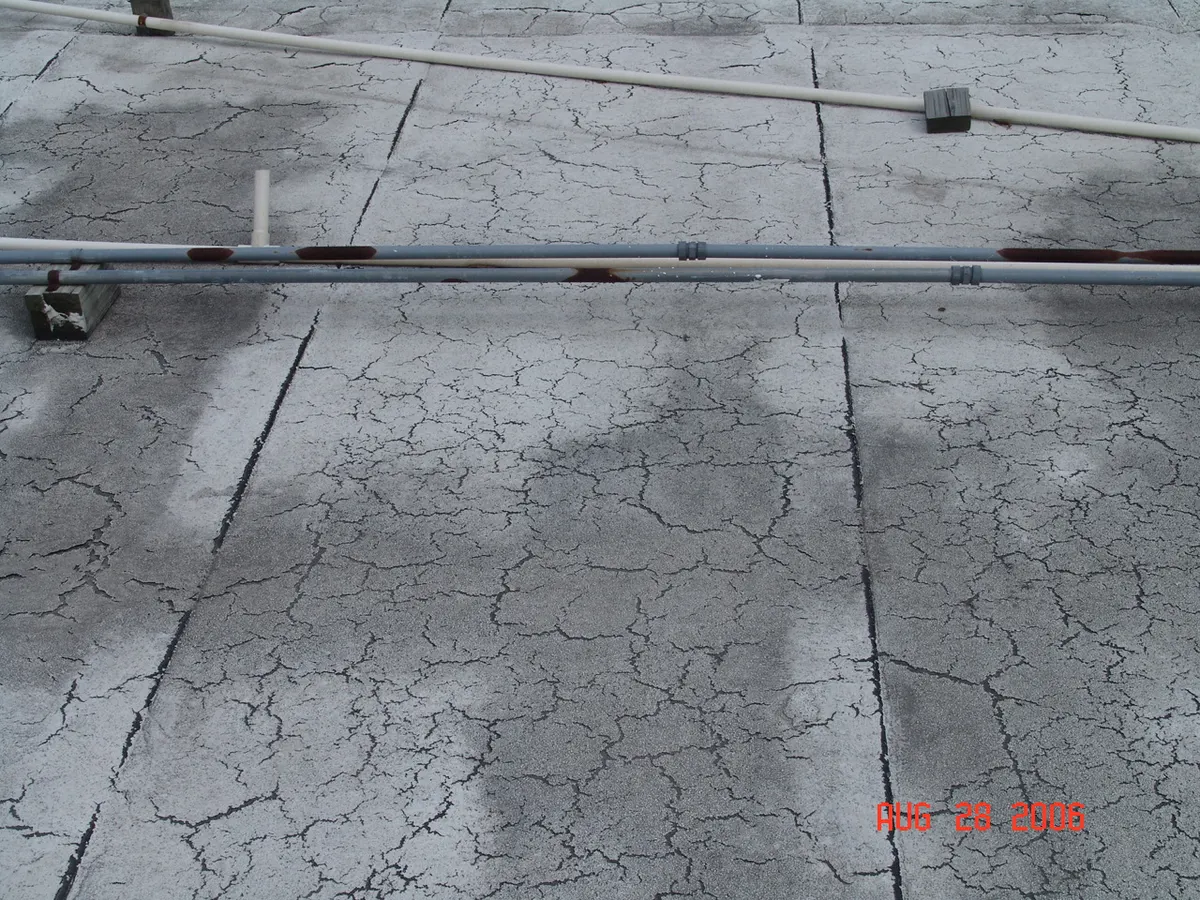
A one-component polyurethane roof refurbishment that, according to its Commons description, was applied too thinly to save cost and failed quickly, cracking across the whole surface. Photo: GRALISTAIR, CC BY-SA 4.0, via Wikimedia Commons
Polyurea and hybrids: fast, strong and equipment-dependent
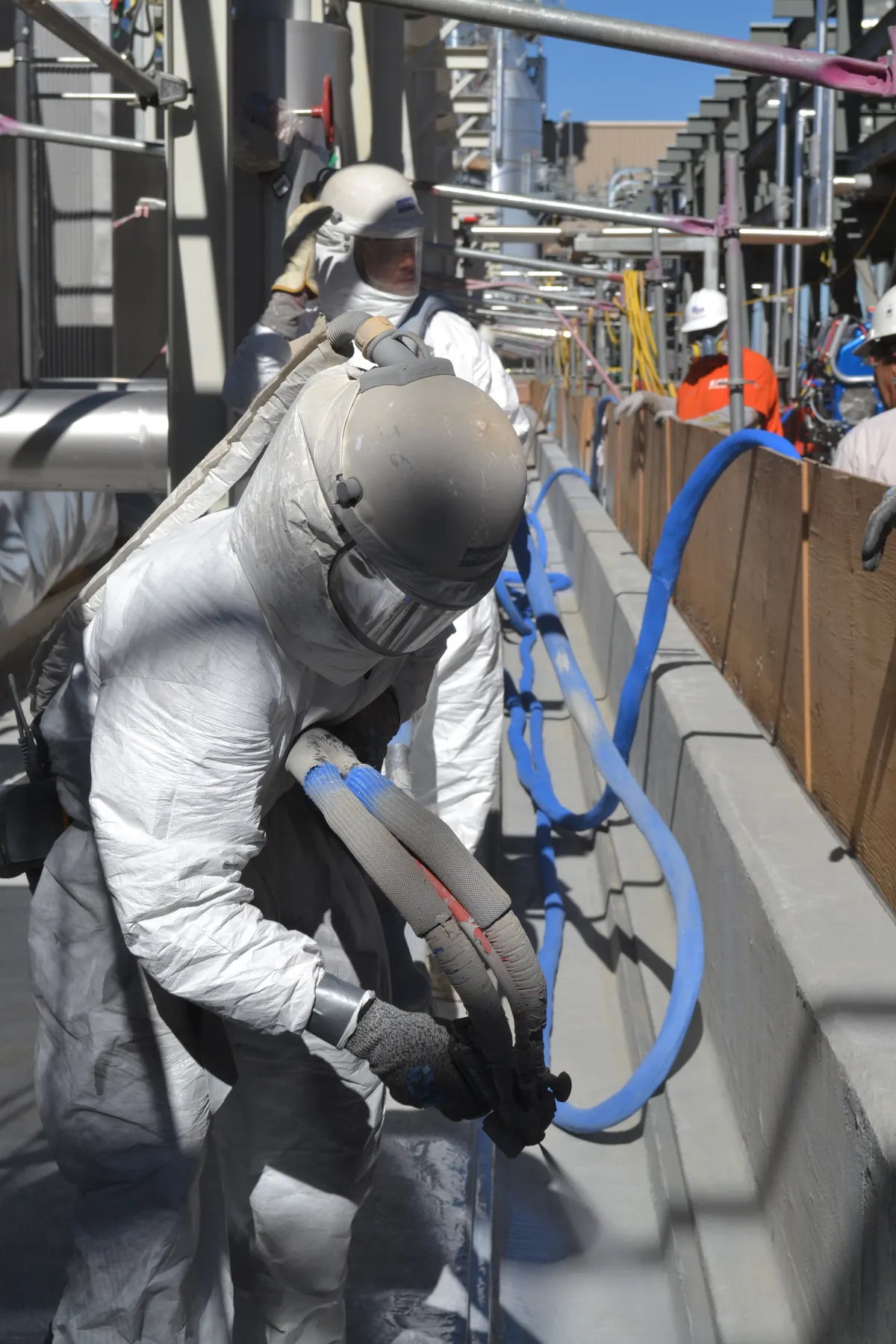
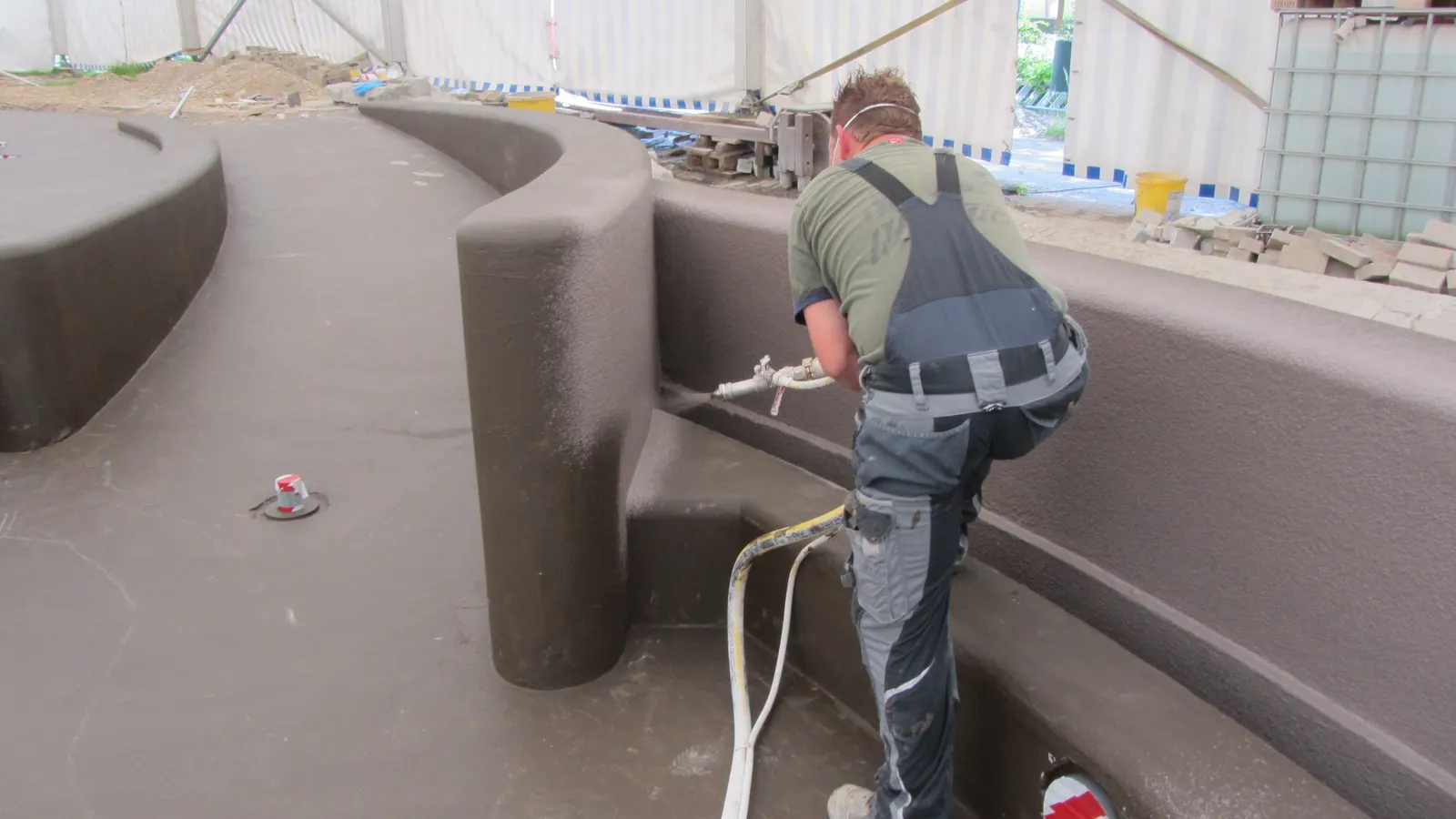
Polyurea forms from the reaction of an isocyanate with an amine component, and the reaction is very fast. Sika's data sheets show what that means on site: Sikalastic M 689 AE has an open time of 5 to 7 seconds and is tack-free in about 30 seconds at 25 °C. Both pure polyurea and the PU/polyurea hybrid in Sika's range are applied with heated plural-component spray equipment that meters, heats and mixes the two parts at the gun.
That makes polyurea the choice when time is the constraint: car park decks that must reopen quickly, tank linings with a short shutdown, and industrial containment where chemical resistance matters. Sika lists its pure polyureas for wastewater plants, sewage pipelines and secondary containment bunds, and describes M 689 AE as a membrane restricted to experienced professionals.
What to check before choosing polyurea:
The applicator's rig and record. Ask for the proportioner model, hose heating, and recent references with the same product.
Substrate strength. Sika asks for concrete pull-off strength of at least 1.5 N/mm² for M 689 AE and the hybrid, and compressive strength of at least 25 N/mm² for the hybrid.
Primer. The membrane bonds through the primer; Sika names specific primers for concrete and metal on the hybrid's page and calls substrate preparation and primer choice critical for M 689 AE.
Thickness. Sika gives about 2.2 kg/m² for about 2.0 mm dry film with M 689 AE, and a 2 mm minimum for its drinking-water polyurea. Spray work makes thickness easy to vary, so agree how it will be measured.
Workers in powered air-purifying respirators and protective suits spray a polyurea coating on a concrete floor, fed by heated hoses from a plural-component unit. Photo: PEO ACWA, CC BY 2.0, via Wikimedia Commons
UV stability and topcoats
A liquid membrane that will see the sun needs either a UV-stable formulation or a topcoat. The isocyanate in polyurea and polyurethane can be aromatic or aliphatic, and data sheets often skip that word and simply state the result. Read what the sheet says about exposure:
Sika's 1K PU M 262 is for "any application not exposed to UV".
Sika's hybrid Sikalastic-851 is "not UV resistant".
Sika's pure polyurea M 689 AE can be overcoated with a UV-protective topcoat "where color stability is required", and passed artificial weathering under EN 1062.
Fosroc's Nitoproof UVR Topcoat is a two-component, high-solids, colour-stable polyurethane topcoat for its Nitoproof 800 roof and balcony system and its polyurea WPE system.
For an exposed Gulf roof, treat the membrane and topcoat as one system with one warranty. Ask how often the topcoat must be renewed and include it in the maintenance plan. In Dubai, the finished colour also has to meet the Al Sa'fat roof reflectance rule; Sika says its white liquid-applied roof membranes have a high solar reflectance index. Our guide to roof waterproofing in the Gulf covers the rest of the roof build-up.
Substrate moisture, humidity and heat
Liquid membranes bond only to dry, sound substrates, and isocyanate chemistry reacts with water. Gulf sites add heat and, on the coast, humidity and dew. The data sheets set hard limits:
Sika GCC product
Substrate moisture
Air humidity and dew point
Temperature limits for application
Sikalastic M 262 (1K PU)
4% by weight or less
Not stated
+5 °C to +35 °C air and substrate
Sikalastic M 266 (2K PU)
No standing water; no limit stated
Not stated
+5 °C to +40 °C
Sikalastic-851 (hybrid)
Clean and dry
RH 80% max; substrate 3 °C above dew point
+8 °C to +45 °C air, +8 °C to +50 °C substrate
Sikalastic M 689 AE (polyurea)
4% by weight or less; no rising moisture (polyethylene sheet test)
RH 85% max; substrate 3 °C above dew point
Substrate +5 °C to +50 °C, best +5 °C to +40 °C
What this means on a Gulf site:
Measure, do not guess. Record substrate moisture, air temperature, humidity and dew point at the start of each shift. On coastal sites, early-morning dew can put a cool slab below the dew point margin.
Watch the upper limit. A roof slab in direct summer sun can exceed the substrate maximum; schedule work early or late and measure the surface.
Allow new screeds to dry to the moisture limit before coating, and use the polyethylene sheet test or a meter as the data sheet specifies.
Store pails in the shade. Hot material shortens pot life on 2K products.
Approvals and test standards
European Technical Assessments for roofs and wet rooms
In Europe, liquid roof waterproofing kits were assessed under ETAG 005, Liquid Applied Roof Waterproofing Kits, which ran to eight parts. EOTA lists ETAG 005 as superseded by EAD 030350-00-0402, Liquid applied roof waterproofing kits. Wet-room products have their own document, EAD 030352-00-0503, Liquid applied watertight covering kits for wet room floors and/or walls. If a Gulf specification asks for ETAG 005 evidence, a European Technical Assessment against the EAD is the current equivalent; ask the supplier for the ETA document and check that it covers the kit (primer, membrane, reinforcement, topcoat) you are buying.
Other evidence on data sheets
Sika's hybrid Sikalastic-851, for example, lists CE marking to EN 1504-2 as a concrete protection coating, DIN 4062 root resistance, fire classification to DIN EN 13501-1, and bridge deck certification and testing (BBA/HAPAS, ETAG 033). Not every certificate matters for every job: root resistance matters under planters, EN 1504-2 where the coating also protects exposed concrete, and fire classification on roofs where the authority asks for it.
Drinking water
For potable tanks, ask for a named approval. Sika lists a WRAS drinking water approval (No. 240455060, April 2024, for hot water up to 70 °C) for Sikalastic M 689 AE, and a hygiene test certificate from a German hygiene institute (No. K-260202-15-K) for Sikalastic-836 DW, a hot-spray pure polyurea for concrete drinking water tanks, desalination plants and filtration tanks with a 2 mm minimum thickness and full cure in 24 hours at +20 °C. Confirm with the consultant or water authority which approvals they accept, and follow the cure time before filling. For cement-based tank coatings, see our cementitious waterproofing guide.
Where PU and polyurea fit, and where they do not
Good fit: roofs with many penetrations and plant bases; refurbishment over existing roofs; balconies and podiums under tiles or screed; car park and bridge decks (hybrids and polyurea); tank and containment linings (polyurea, with the right approvals).
Use with care: exposed roofs without a UV-stable system or topcoat; damp or weak substrates; sites where the applicator cannot control conditions.
Not on their own: movement joints, which need a joint system. Use compatible sealants and adhesives named by the membrane maker at joints and terminations.
Brands to compare
Listed by what their own pages show, not ranked.
Sika
Sika's GCC liquid-applied range includes one- and two-component polyurethanes, a pitch-modified PU, a PU/polyurea hybrid, several pure polyureas (including chemical-resistant and drinking-water grades), primers and bitumen emulsions. It suits projects that want one supplier across roofs, wet areas, decks and tanks.
Fosroc
Fosroc lists Nitoproof 600PF as a continuous, seamless membrane for concrete, for roofs, podiums, balconies, planters, bathrooms, pools, bridge decks, basements and tunnels, and the Nitoproof UVR Topcoat for its Nitoproof 800 and polyurea WPE systems. Ask the UAE or Saudi office for the current country data sheets.
RFQ checklist for liquid membranes
Location and exposure: exposed roof, protected roof, deck with traffic, wet area, tank (potable or not), containment.
Chemistry and system: 1K PU, 2K PU, hybrid or pure polyurea; primer, reinforcement and topcoat named as one kit.
Minimum dry film thickness, how it will be measured, and consumption per square metre.
UV: is the membrane UV-stable, or which topcoat is required and how often renewed; reflectance evidence for Dubai roofs.
Limits: substrate moisture and test method, humidity, dew point margin, temperature range; how they will be recorded each shift.
Evidence: ETA to EAD 030350-00-0402 or 030352-00-0503 where specified, EN 1504-2, root resistance, fire class, drinking water approval naming the product.
Applicator: training record on the product, spray equipment for polyurea, references, warranty scope.
What is the difference between polyurethane and polyurea waterproofing?
Both are liquid membranes that cure to a seamless elastic layer. Polyurethane is usually hand-applied and cures over hours; Sika's two-component PU is tack-free in about 8 hours. Pure polyurea is hot-sprayed with plural-component equipment and cures in seconds, giving fast return to service and high strength, but it needs a trained crew and a dry, strong substrate.
Is polyurethane waterproofing UV resistant?
Not always. Some products are made for exposure, others are not: Sika's one-component M 262 is for applications not exposed to UV. For exposed roofs, buy a system the maker states is UV-stable or one with a specified topcoat, and include topcoat renewal in the maintenance plan.
What does a polyurea hybrid mean?
A hybrid combines polyurethane and polyurea chemistry. Sika describes Sikalastic-851 as a two-part polyurethane/polyurea hybrid, 100% solids and very fast curing, sprayed with heated plural-component equipment, with a gel time of about 11 seconds. Hybrids are used on decks, balconies and tank linings, and the one cited here is not UV resistant.
How thick should a PU waterproofing membrane be?
Follow the system data sheet. Sika gives 1.0 mm dry film for its one-component M 262 at a minimum 1.5 kg/m², and recommends 1.2 mm dry film for its two-component M 266 below ground and in wet areas. Sika's polyurea examples are specified at about 2 mm, with a 2 mm minimum for its drinking-water grade.
Can polyurea be used in drinking water tanks?
Yes, if the product has a drinking-water approval accepted on your project. Sika lists a WRAS approval for Sikalastic M 689 AE and a German hygiene test certificate for Sikalastic-836 DW, which it describes for concrete drinking water tanks and desalination plants. Ask for the certificate and observe the cure time before filling.
What replaced ETAG 005 for liquid roof waterproofing?
EOTA lists ETAG 005, Liquid Applied Roof Waterproofing Kits, as superseded by EAD 030350-00-0402, Liquid applied roof waterproofing kits. Products assessed under it receive a European Technical Assessment. For wet rooms, the relevant document is EAD 030352-00-0503.
How to choose a roof waterproofing build-up for Gulf heat, why roofs leak at falls, outlets, upstands and plant bases, how to test a finished roof, and what to put in the warranty and maintenance plan.
Rigid or flexible cementitious waterproofing, where each works (wet areas, tanks, pools, basements from the inside), how thick to apply it, how to cure it in Gulf heat and what to ask suppliers for.
How to waterproof basements under high water tables and concrete water tanks: positive vs negative side, pre-applied bonded sheets, crystalline and bentonite, joints and service entries, potable linings and dewatering.