Cementitious Waterproofing: Where It Works and How to Specify It
Rigid or flexible cementitious waterproofing, where each works (wet areas, tanks, pools, basements from the inside), how thick to apply it, how to cure it in Gulf heat and what to ask suppliers for.
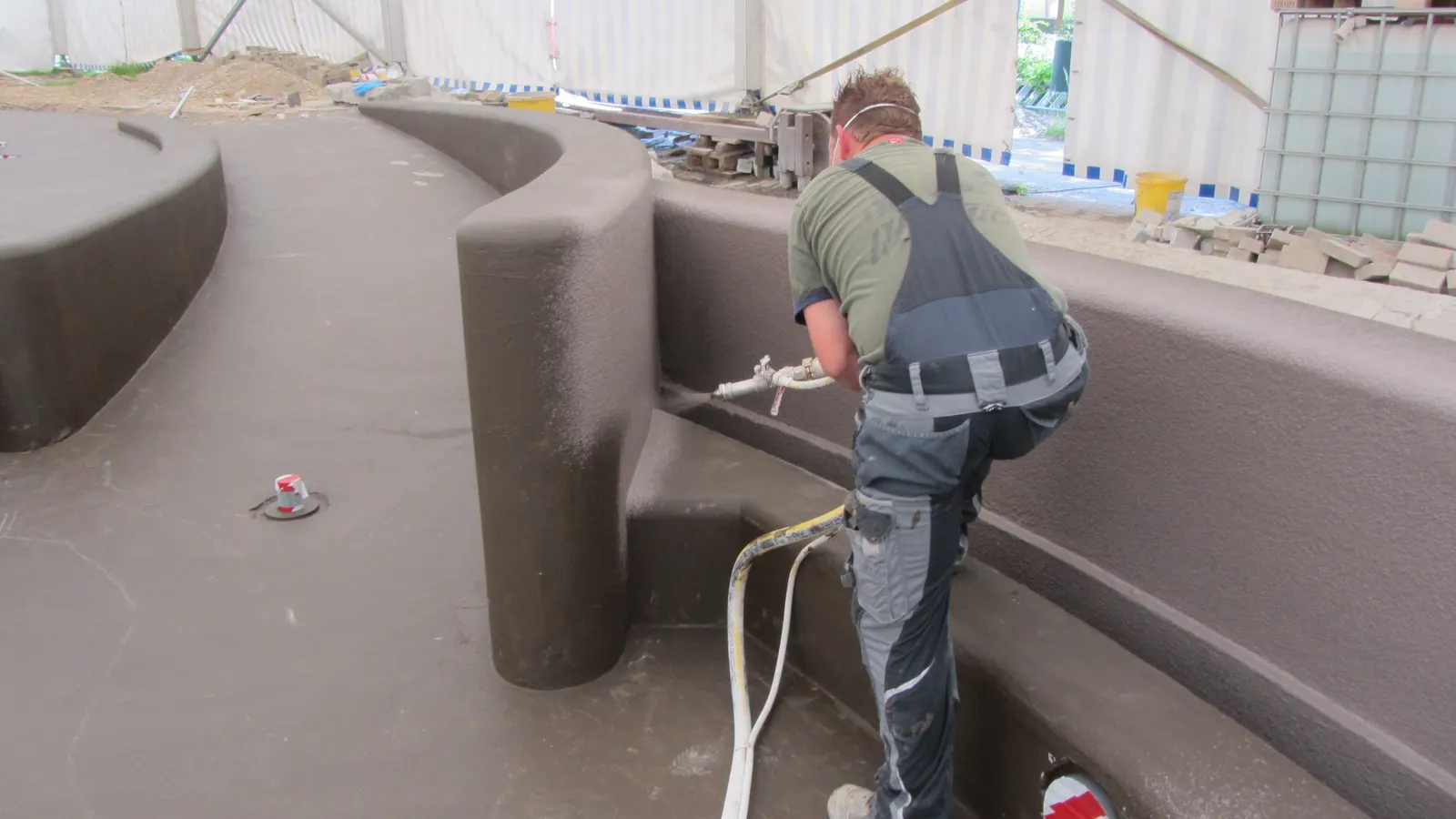
Cementitious waterproofing is a polymer-modified cement slurry or mortar brushed, troweled or sprayed onto concrete and masonry in two or more thin coats. Rigid grades suit stable substrates such as tank walls and basement walls treated from the inside; flexible, crack-bridging grades suit wet areas under tiles, balconies, pools and anything that moves. Compare products and suppliers on the cementitious waterproofing suppliers page for the UAE.
This guide is for site engineers, MEP and fit-out contractors and procurement teams who have already decided that a cement-based coating is on the table and now need to specify it properly. It goes deeper than our waterproofing membranes guide for the UAE and Saudi Arabia, which compares every membrane family and covers Dubai and Saudi approval routes. Here the focus is one product family: rigid versus flexible grades, where each works, the standards that describe them, application thickness, curing in Gulf heat and what to put in a request for quotation. Saudi buyers will find the same supplier list on cementitious waterproofing suppliers in Saudi Arabia.
Rigid or flexible: the first decision
If the substrate will not crack or move after coating, a rigid slurry is enough. If it will, or you do not know, buy a flexible grade with a declared crack-bridging value.
Sika's GCC range shows the split clearly. Its waterproofing mortar page says "crack-bridging or rigid products available", and the products line up on either side:
Rigid slurry. SikaTop-107 Seal WR is described as a two-part, polymer-modified cementitious waterproofing and damp-proofing slurry. Its listed uses include rigid waterproofing of wet areas and basement walls, hydraulic structures such as basins, tanks, pipes and canals, and sealing fine hairline cracks "not subject to movement". The data sheet gives a compressive strength of about 28 N/mm² at 28 days, which tells you it behaves like a mortar, not a membrane.
Flexible coating. Sikalastic-152 AE is a two-component, fibre-reinforced cementitious coating "for flexible waterproofing and concrete protection" of concrete subject to flexural strain. Sika states crack bridging of Class A4 (more than 1.25 mm) under EN 1062-7 Method A.
Crystalline slurry. SikaSeal-250 Migrating is a one-part cementitious slurry whose active chemicals migrate into the concrete and form a non-soluble crystalline structure in the pores. It sits between this guide and crystalline waterproofing, and is covered under basements below.
Fosroc's Brushbond family follows the same logic. Brushbond R is described as a two-component acrylic polymer-modified cementitious coating whose thermal expansion is similar to concrete, while Brushbond UltraFlex and Brushbond FLXIII cure to an elastomeric coating that can bridge cracks.
Question
Rigid slurry
Flexible (elastomeric) coating
Typical make-up
Cement, graded fillers and a polymer; often two-part
Cement plus a high proportion of polymer, often fibre-reinforced; two-part or one-part
Movement capacity
Seals static hairline cracks only
Bridges cracks; check the declared value (EN 14891 or EN 1062-7)
Good fit
Tank and reservoir walls, lift pits, basement walls from the inside, damp-proofing masonry
Bathrooms and kitchens under tiles, balconies, terraces under screed, pools, slabs that deflect
Poor fit
Suspended slabs, timber or board substrates, joints
Permanent UV exposure without a topcoat (check the data sheet)
What to ask for
Water-tightness test result and test pressure, adhesion
Crack-bridging class, EN 14891 class if tiled, adhesion after water contact
Where cementitious waterproofing works
Wet areas under tiles
Bathrooms, kitchens, laundry rooms and balconies are the core market. The coating goes on the screed or slab and the tiles are bonded straight onto it. Sika lists bathrooms, showers, terraces, balconies and swimming pools "before ceramic tiling bonded with adhesive" among the uses for Sikalastic-152 AE. Choose a flexible grade here. Match the coating to the ceramic and porcelain tiles and the adhesive the tiler will use, and ask the supplier to confirm they are compatible.
Swimming pools and water features
Pools combine constant immersion, chlorinated water and tiles. Sika declares its Sikalastic-1K HP for "all external installations and swimming pools beneath ceramic tiling" under EN 14891:2017, Class CM O1P. The P in the class matters for pools: it marks a product tested for tensile adhesion after contact with chlorinated water.
Water tanks and reservoirs
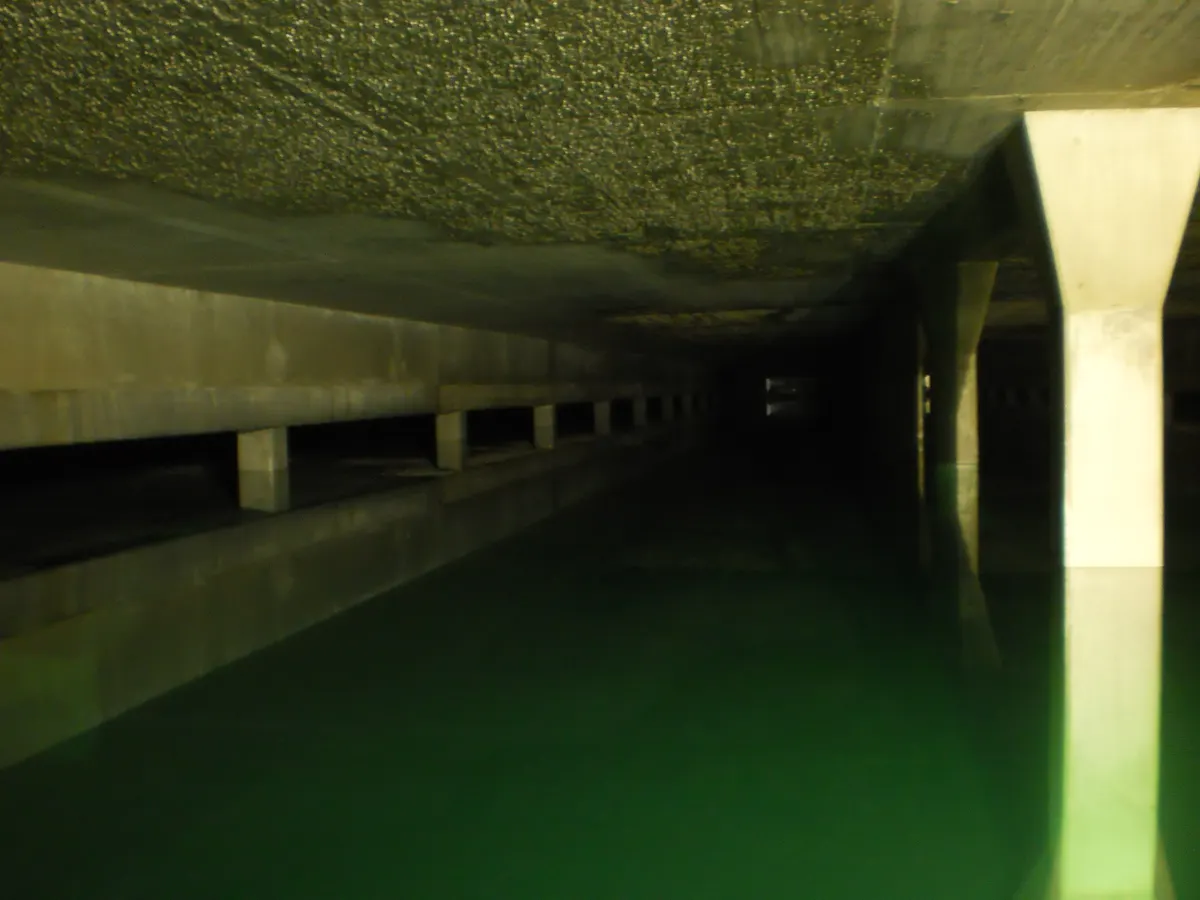
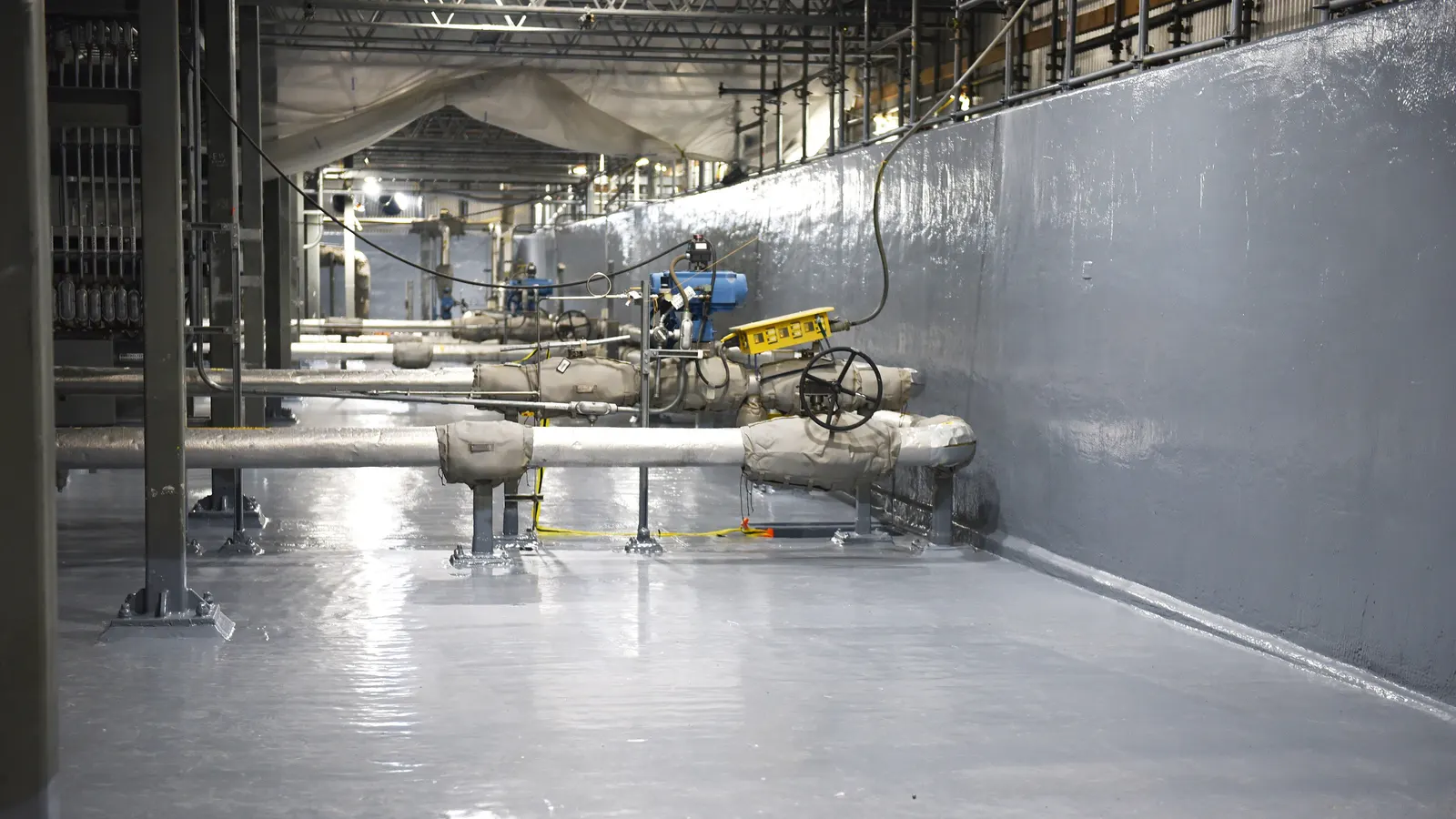
Concrete tanks are a natural fit because the coating can go on the inside face, where the water is, without excavating. Sika lists basins, tanks and concrete piping as uses for both its rigid and flexible grades, and Fosroc describes Brushbond UltraFlex as a coating for water-retaining structures including water tanks and swimming pools. Drinking water is a separate question, covered below.
When a basement already leaks and the outside face cannot be reached, a cementitious coating on the inside face is often the only practical option. That is negative-side waterproofing: the water pushes the coating away from the wall rather than into it, so bond strength and the condition of the concrete behind it decide whether it holds. Sika lists SikaSeal-250 Migrating "for positive and negative waterproofing" of basements, retaining walls and lift pits, and reports nil water penetration at 5 bar positive water pressure under DIN 1048. Notice that the test pressure quoted is positive; if you are buying for the negative side, ask the supplier for a negative-pressure result and the test method behind it. For a new basement under a high water table, design the full system first; our waterproofing membranes guide explains the BS 8102 grades that drive that decision.
Where it does not belong
Movement joints. No cement coating, flexible or not, is designed to span an expansion joint. Joints need a joint band or sealant system, detailed separately.
Exposed roofs without protection. Most flexible cementitious coatings expect a covering. NBS lists roof deck use of Fosroc's Brushbond FLXIII only "in conjunction with protective finishes". Sika says Sikalastic-152 AE should be protected with screed or tiles under pedestrian traffic.
What EN 14891 and EN 1504-2 tell you
EN 14891 covers liquid-applied water-impermeable products used beneath ceramic tiling bonded with adhesives, and the current BSI listing is titled "Essential characteristics and AVCP". A cementitious product carries the code CM, followed by optional letters for improved performance. Sika's declarations of performance spell them out:
CM O1P (Sikalastic-1K HP): improved crack bridging at low temperature (minus 5 °C) and resistance to chlorinated water.
CM O2P (Sikalastic-152): improved crack bridging at very low temperature (minus 20 °C) and resistance to contact with chlorinated water, for use under tiles bonded with C2 adhesives to EN 12004.
Both declarations list the same base requirements: initial tensile adhesion of at least 0.5 N/mm², no water penetration, crack bridging of at least 0.75 mm under standard conditions, and adhesion of at least 0.5 N/mm² after heat ageing, water contact, lime water and chlorinated water. The low-temperature tests matter little in the Gulf; the chlorinated-water rating (P) matters for pools.
EN 1504-2 is the concrete protection standard. Sika cites it for the adhesion of Sikalastic-152 AE (about 0.9 N/mm² against a requirement of at least 0.8 N/mm²). If the coating's job is to protect exposed concrete against carbonation and chlorides as well as water, ask for the EN 1504-2 declaration.
Thickness, coats and coverage
Too thin is the usual failure. Specify a minimum total dry thickness and number of coats.
Product (Sika GCC data)
Thickness per coat
Coats
Theoretical consumption
Application temperature
SikaTop-107 Seal WR (rigid)
0.75 to 1.5 mm
Minimum 2; 3 for severe water ingress
About 2.0 kg/m² per mm
+5 °C to +40 °C (air and substrate)
Sikalastic-152 AE (flexible)
About 1 mm
Minimum 2
About 1.7 kg/m² per mm
+5 °C to +40 °C
SikaSeal-250 Migrating (crystalline)
At least 1.0 mm total
2, wet on wet
About 2 kg/m² per mm
+10 °C to +35 °C
The consumption figures are theoretical and exclude porosity, surface profile and waste, so allow for those when you check a supplier's quantity. On site, compare material issued with area coated: half the theoretical quantity means half the thickness.
Detailing is where wet areas leak. Sika's application notes for Sikalastic-152 AE call for pre-sealing joints and penetrations, coved details at floor-to-wall junctions, and alkali-resistant glass fibre mesh embedded in the first coat in highly stressed areas.
Surface preparation
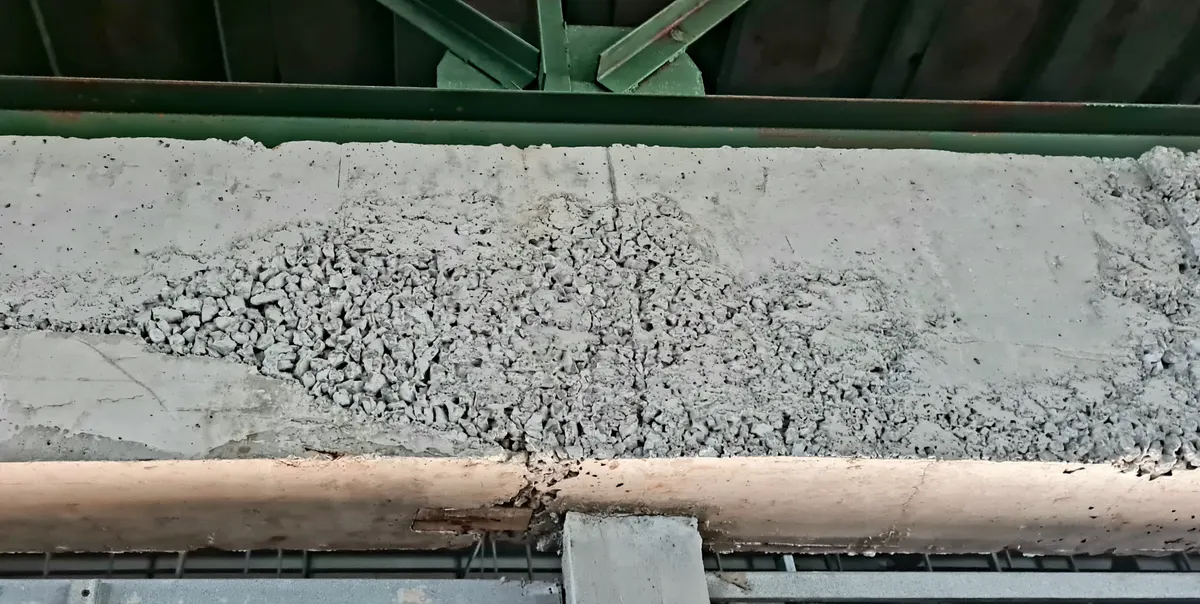
A cement coating bonds to sound, clean, open-textured concrete. Sika's data sheets call for removal of laitance and contamination by methods such as water-jetting or blast cleaning, and for cracks to be identified and sealed beforehand, for example with epoxy resin. Honeycombing and blowholes should be repaired first; SikaTop-107 Seal WR also lists pore and blowhole filling as a use, but a large void needs a repair mortar, not a thicker coat.
Pre-wetting is the other half of preparation. A dry, hot, absorbent substrate pulls water out of the slurry before the cement can hydrate. Sika's SikaTop-107 Seal WR data sheet says to dampen hot-climate or absorbent substrates before application without leaving standing water, and the SikaSeal-250 sheet calls for a saturated surface dry (SSD) condition.
Curing and application in Gulf heat
Heat shortens every time on the data sheet. Plan around the published limits.
Respect the upper temperature limit. Sika gives +40 °C as the maximum air and substrate temperature for SikaTop-107 Seal WR and Sikalastic-152 AE, and +35 °C for SikaSeal-250 Migrating. On an exposed slab in summer, the substrate can be hotter than the air, so measure it.
Expect shorter pot life. SikaTop-107 Seal WR has a pot life of about 30 minutes at +20 °C. Mix only what the crew can apply in that window, and never add water to a stiffening mix; Sika's pre-batched two-part products are designed to be used without added water.
Time the second coat. Sika gives about 6 hours at +20 °C and about 3 hours at +30 °C between coats of SikaTop-107 Seal WR, and about 6 to 12 hours at +30 °C for Sikalastic-152 AE.
Protect from fast drying. For SikaSeal-250, Sika calls for curing of at least 5 days and protection from premature drying with water spray, moist geotextile or polyethylene sheeting.
Wait before filling. For Sikalastic-152 AE, Sika gives about 48 hours at +30 °C before temporary immersion testing and about 7 days before permanent immersion.
Store packs between +5 °C and +35 °C out of direct sunlight, as Sika specifies for SikaTop-107 Seal WR.
Drinking water tanks: approvals, not adjectives
A data sheet that says "non-toxic" or "suitable for potable water" is a description, not an approval. Ask for the certificate and check what it covers.
WRAS approval in the UK shows that a non-metallic material has been tested for compliance with BS 6920, and the tests look at the material's effect on water quality only. NBS lists Fosroc's Brushbond FLXIII as WRAS approved.
Other test references. Fosroc's page for Brushbond UltraFlex describes it as suitable for potable water sources "as tested as per USFDA CFR 175-300". That is a different test basis from WRAS, so ask your consultant or water authority whether it is accepted on your project.
Same product, same country version. Sika's data sheets warn that declared data can vary by country. Make sure the approval certificate names the exact product and the version supplied to the UAE or Saudi Arabia.
Approvals that come up in the UAE and Saudi Arabia
UAE
Dubai consultants may ask for low-emitting evidence under Al Sa'fat, the Dubai green building system. Sika, for example, lists a Dubai Central Laboratory Low Emitting Materials certificate (No. CL17020432) for Sikalastic-152 AE; ask other suppliers for the equivalent.
Saudi Arabia
Imported coatings go through SASO's SABER platform; the main waterproofing guide explains how. Read the owner's specification for the accepted standards before comparing quotes.
Brands with cementitious waterproofing ranges
Listed by what they make, not ranked. Ask each for the data sheet of the country version supplied to your project.
Sika
Sika's GCC site lists flexible products (Sikalastic-1K, Sikalastic-152 AE and SA, SikaTop-578 Seal), elastomeric acrylic cementitious coatings (SikaTop-570 and 588 Seal), the rigid SikaTop-107 Seal WR and the crystalline SikaSeal-250 Migrating, with several described as suitable for hot and tropical climates. It suits buyers who want rigid, flexible and crystalline options from one supplier with GCC-specific data sheets.
Fosroc
Fosroc sells cementitious waterproofing under the Brushbond name, from Brushbond R (an acrylic polymer-modified coating) to the elastomeric Brushbond UltraFlex and FLXIII. It suits contractors already buying Fosroc admixtures, grouts and repair mortars. Check which Brushbond grades the UAE or Saudi office stocks, as Fosroc's product pages are country-specific.
Dr. Fixit
Dr. Fixit, Pidilite's waterproofing brand, sells bathroom and water tank waterproofing among its ranges. It suits small wet-area and tank jobs; confirm the Gulf distributor and the product's data sheet locally.
Buying checklist and RFQ
Location and exposure: wet area, balcony, pool, tank (potable or not), basement inside face; tiled, screeded or exposed.
Grade: rigid or flexible; the crack-bridging value and test method required.
Standards: EN 14891 class (CM, CM O1P, CM O2P) for tiled areas, EN 1504-2 where concrete protection is needed, and the water-tightness test and pressure (positive or negative side) for basements and tanks.
Approvals: drinking water approval certificate naming the exact product for potable tanks; Dubai Central Laboratory or other certificates your consultant requires.
System: primer if any, reinforcing mesh and corner bands, joint and penetration details, the compatible tile adhesive.
Thickness: minimum total dry thickness, number of coats, theoretical consumption per square metre per millimetre, and how thickness will be checked.
Site conditions: maximum application temperature, pre-wetting, recoat time, curing method and the wait before tiling, flood testing or filling.
Supply: pack size, shelf life, storage temperature on site and lead time.
It is a coating of cement, fine fillers and polymers, mixed on site and applied by brush, trowel or spray in two or more thin coats on concrete or masonry. Rigid grades seal static surfaces; flexible grades bridge small cracks. It is used mainly in wet areas under tiles, tanks, pools and on the inside face of basements.
Is cementitious waterproofing rigid or flexible?
Both exist. Rigid slurries, such as Sika's SikaTop-107 Seal WR, suit stable concrete and seal hairline cracks that are not moving. Flexible grades, such as Sikalastic-152 AE or Fosroc's Brushbond UltraFlex, cure to an elastomeric coating that bridges cracks. Use a flexible grade on slabs that deflect, under tiles and wherever cracking is likely, and check the declared crack-bridging value.
How thick should cementitious waterproofing be?
Follow the data sheet, but most products are applied in at least two coats of roughly 1 mm each. Sika gives 0.75 to 1.5 mm per coat for SikaTop-107 Seal WR and about 1 mm per coat for Sikalastic-152 AE, with a minimum of two coats. Specify a minimum total dry thickness and check consumption on site.
Can cementitious waterproofing be used on the negative side?
Some products are designed for it. Sika lists SikaSeal-250 Migrating for positive and negative waterproofing of basements, retaining walls and lift pits. Negative-side work depends on sound concrete and good bond, because water pressure pushes the coating off the wall. Ask the supplier for a negative-pressure test result, not only a positive one.
Is cementitious waterproofing safe for drinking water tanks?
Only if the exact product has a drinking water approval accepted on your project. Fosroc's Brushbond FLXIII is listed as WRAS approved, which means its material passed BS 6920 tests on water quality. Brushbond UltraFlex refers to testing under USFDA CFR 175.300. Ask for the certificate, check that it names the product supplied, and follow the cure time before filling.
How hot is too hot to apply cementitious waterproofing?
Each product has a limit on its data sheet. Sika gives a maximum of +40 °C air and substrate temperature for SikaTop-107 Seal WR and Sikalastic-152 AE, and +35 °C for SikaSeal-250 Migrating. In summer, measure the substrate temperature, pre-wet and protect fresh coats from fast drying.
How one-component and two-component polyurethane, PU/polyurea hybrids and hot-spray pure polyurea differ, where each suits Gulf roofs, decks, wet areas and tanks, and what the data sheets and approvals should show.
How to choose a roof waterproofing build-up for Gulf heat, why roofs leak at falls, outlets, upstands and plant bases, how to test a finished roof, and what to put in the warranty and maintenance plan.
How to waterproof basements under high water tables and concrete water tanks: positive vs negative side, pre-applied bonded sheets, crystalline and bentonite, joints and service entries, potable linings and dewatering.