Scaffolding in the UAE and Saudi Arabia: Systems, Safety Rules, Hire and Suppliers
Scaffold systems compared, the EN and GSO standards suppliers quote, the scaffolding codes in Abu Dhabi, Dubai, Sharjah and Saudi Arabia, inspection and tags, hire or buy, and an RFQ checklist.
Most scaffolding on UAE and Saudi sites is one of five types: tube and clamp, cuplock, ringlock, frame, or aluminium mobile towers. The rules depend on the emirate. Abu Dhabi, Dubai and Sharjah each publish their own scaffolding code, and in Saudi Arabia SASO publishes a scaffolding safety guide. Hiring makes sense for one-off jobs and buying makes sense for long, repeated use. You can compare suppliers of scaffolding systems in the UAE and scaffolding systems in Saudi Arabia on ListGCC.
This guide is for contractors, site managers, HSE officers and procurement teams who need to specify, hire or buy scaffolding in the Gulf. It explains the main systems and when each one fits, the standards suppliers refer to, the rules that apply in Abu Dhabi, Dubai, Sharjah and Saudi Arabia, how tagging and inspection work, and what to put in an RFQ. ListGCC did not test any scaffold system or brand. Everything below comes from the regulators' own codes, standards bodies and manufacturers' published information.
What scaffolding is, in the regulators' words
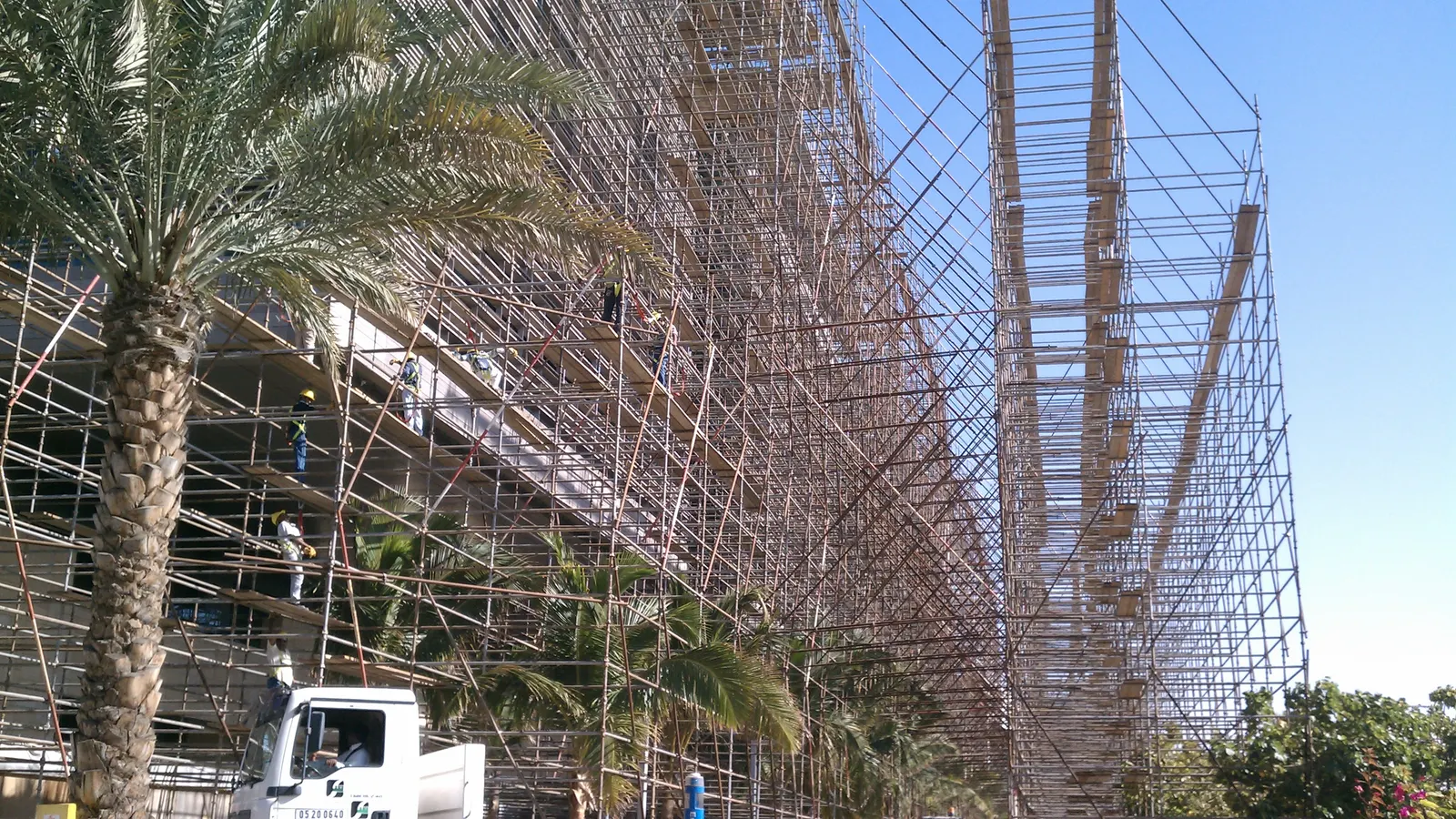
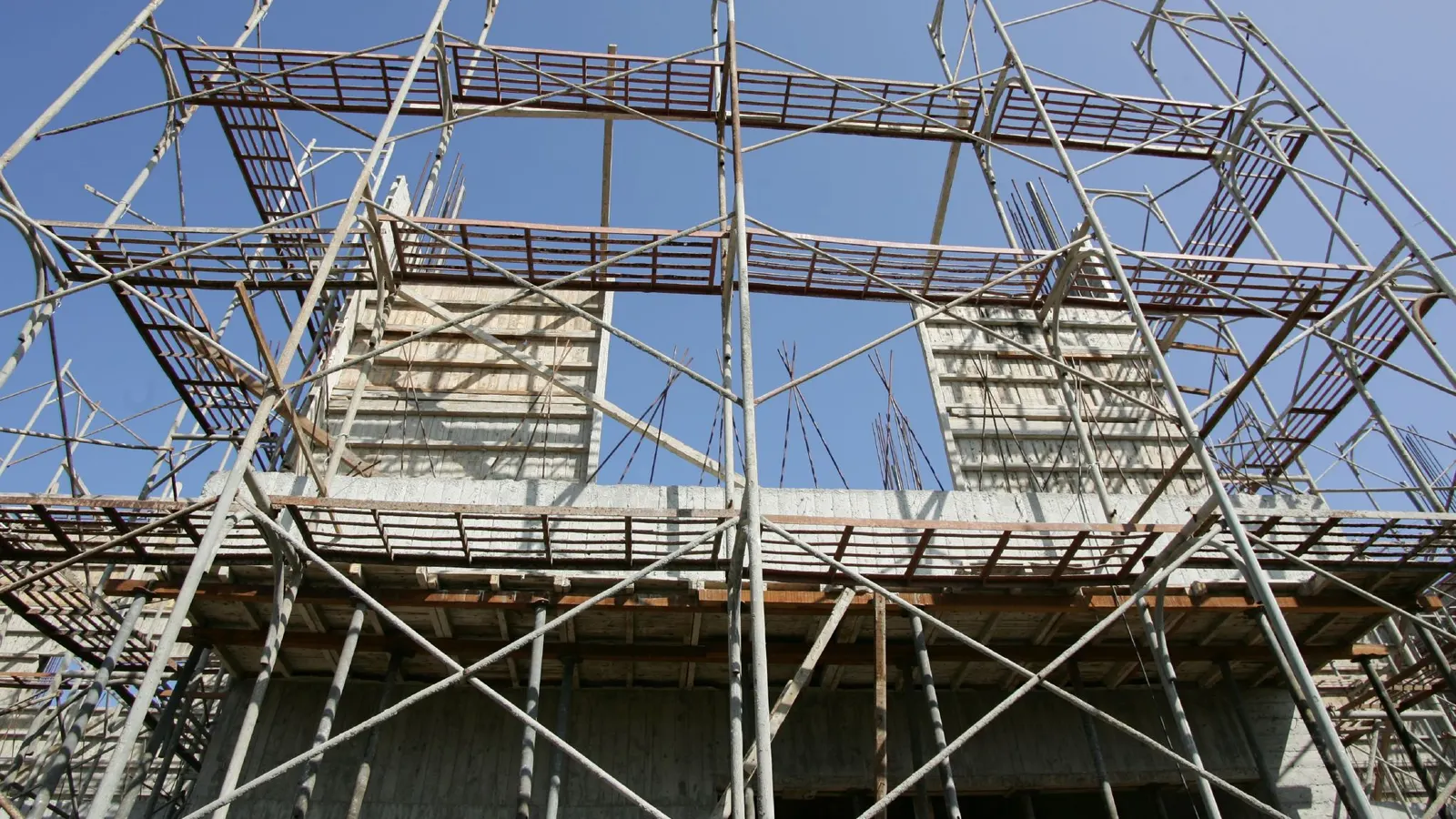
Abu Dhabi's code defines scaffolding as a temporary structure on the inside or outside of a building or structure, made of wooden or metal planks and metal poles, that employees use for building, repair or cleaning work. It applies to every platform assembled wholly or partly from scaffold components, whatever its height. That covers modular systems, tube and coupler scaffolds, suspended scaffolds, swinging stages, and planks laid across structures that were not engineered to take them.
Dubai Municipality's Code of Construction Safety Practice calls a scaffold an elevated temporary working platform for workers, materials and tools, to be used when the work cannot be done safely by other means. Its scaffolding chapter covers scaffolds higher than 2 m and names the common supported types: frame, tube and clamp, system, suspended and mobile tower scaffolds.
Scaffolding systems compared
Choose the system by job geometry, duty and how often it will be moved, not by habit. The table summarises what each type is and where it is usually the better fit.
System
How it connects
Strengths
Watch out for
Tube and clamp (tube and fitting)
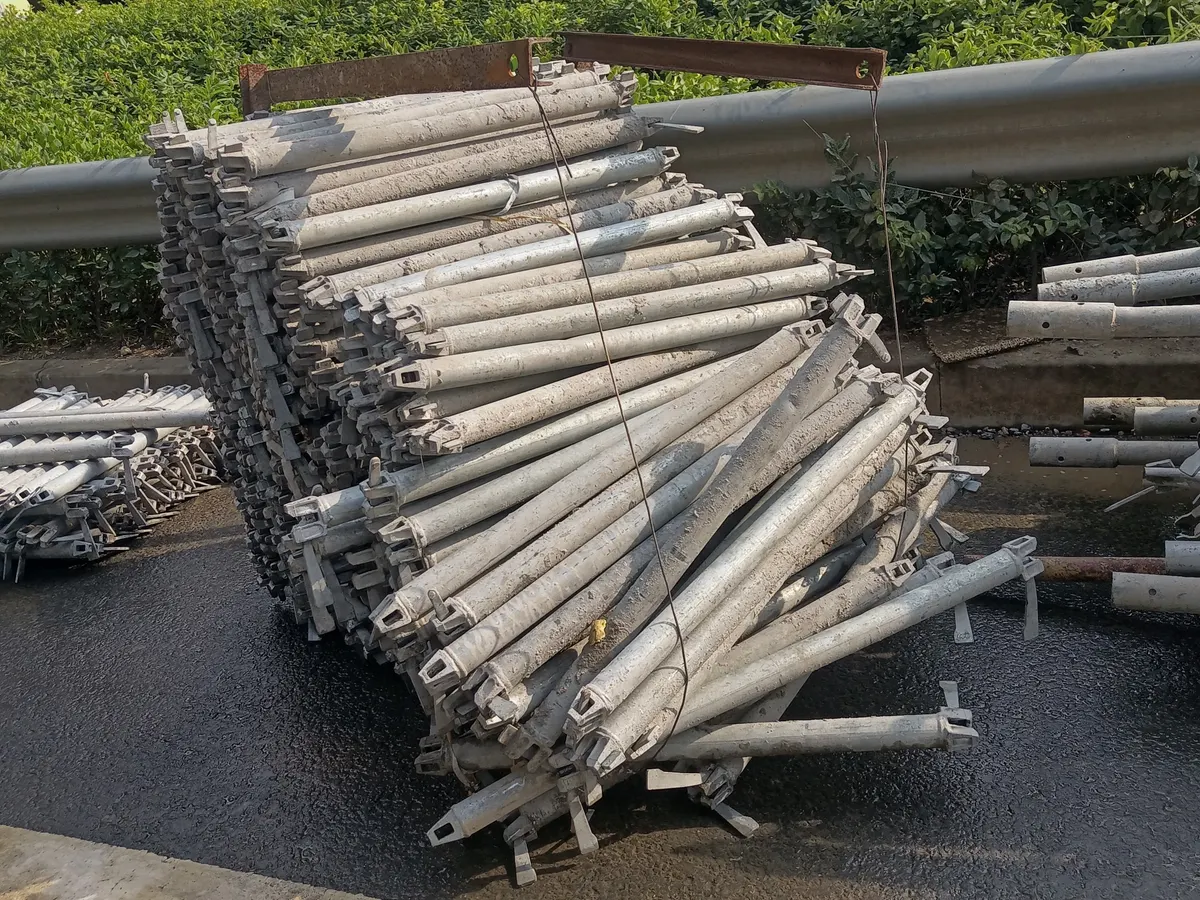
Loose steel tubes joined by right-angle, swivel, sleeve and parallel couplers
Fits any shape: plant rooms, pipe racks, irregular facades, birdcages
Slow to erect, and every joint depends on the scaffolder's skill and coupler torque
Cuplock (cup-type system)
Ledger blades lock into cups fixed to the upright at set intervals
Fast and repeatable on regular grids. Also used for shoring
Fixed node spacing. Components are not interchangeable between makers
Ringlock (rosette or "allround" type)
Wedge heads on ledgers and braces drop into a rosette on the upright
Several connections per node at different angles. Good for industrial and curved work
Rosette and wedge shapes vary between brands, so components cannot be mixed
Frame (H-frame or facade frame)
Prefabricated welded frames with cross bracing
Quick on flat, regular facades with level ground
Poor fit for irregular buildings. Needs good base levelling
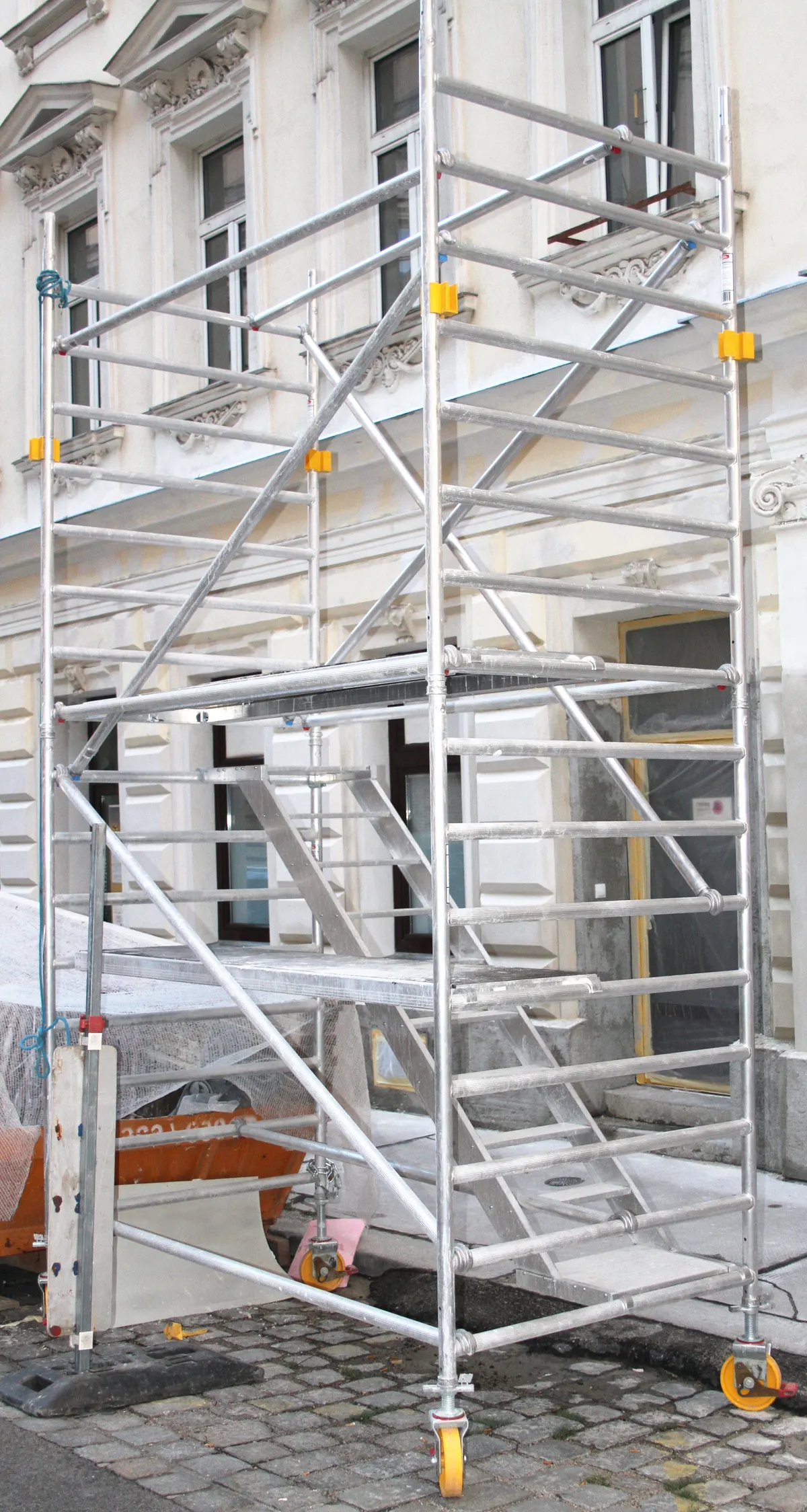
Mobile and aluminium towers
Prefabricated frames, braces and platforms on lockable castors
Short, low-level tasks indoors and outdoors. Light to move
Height to base limits, firm level ground, and no moving the tower with people on it
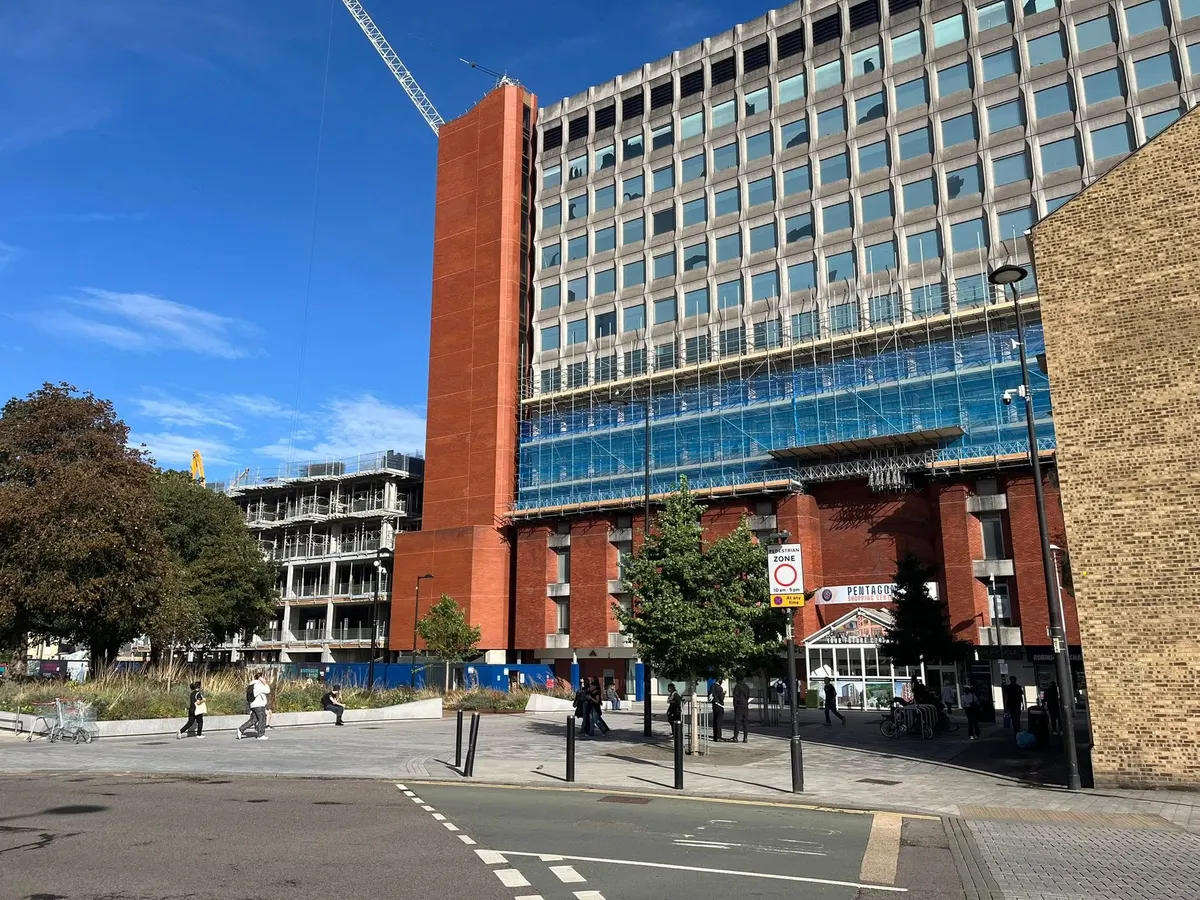
A facade scaffold with protective sheeting above a pedestrian area. Sheeting adds wind load, so both the Abu Dhabi and Sharjah codes call for design checks and extra ties. Photo: Robert Brisley, CC BY 4.0, via Wikimedia Commons
Steel or aluminium
Galvanised steel is still standard for facade, industrial and heavy-duty work. Aluminium is mainly used for mobile access towers and lightweight system scaffolds. Layher, for example, sells its Allround system in both steel and aluminium. Abu Dhabi's code says not to mix aluminium and steel components, because steel clamps can crush aluminium tube. It also says never to lift a lightweight aluminium tower with a crane. If your job needs both materials, keep them as separate structures.
Standards suppliers will quote
The European scaffold standards have been adopted in the Gulf as GSO standards. Ask suppliers which ones their equipment is designed and tested to.
EN 12811-1, Temporary works equipment, Part 1: Scaffolds, performance requirements and general design. GSO EN 12811-1:2012 is listed as the current edition, approved on 31 December 2012. It covers working scaffolds that rely on the adjacent structure for stability. It excludes rope-suspended platforms, mobile access towers and power-operated platforms.
EN 12810-1, Facade scaffolds made of prefabricated components, Part 1: Product specifications (GSO EN 12810-1:2012). It covers prefabricated facade systems tied to the facade, with steel or aluminium standards.
EN 39, Loose steel tubes for tube and coupler scaffolds (GSO EN 39:2012). It covers 48.3 mm outside diameter tube in 3.2 mm or 4.0 mm wall thickness.
EN 74-1, Couplers for tubes: right-angle, swivel, sleeve and parallel couplers that work by friction. BSI lists BS EN 74-1:2005 as withdrawn on 28 April 2022, so ask which edition a supplier's couplers were tested to.
EN 1004-1:2020, Mobile access and working towers made of prefabricated elements. According to PASMA it covers standard towers up to 12 m indoors and 8 m outdoors, and it replaces EN 1004:2004. Abu Dhabi's code requires prefabricated mobile towers to carry product conformity certification to BS EN 1004.
Two legacy references still appear in Gulf method statements. BS 5973:1993 was withdrawn. The UK's HSE said it would no longer recognise it from 1 January 2011, and BS EN 12811-1 replaced it. TG20 is the guidance from the UK's National Access and Scaffolding Confederation (NASC) for tube and fitting scaffolds. HSE describes TG20 configurations, and manufacturers' instructions for system scaffolds, as examples of "generally recognised standard configurations". A scaffold that falls outside those needs a bespoke design by a competent person.
UAE rules: which code applies where
Each emirate has its own scaffolding code. The emirate you are building in decides which one applies, along with any stricter client or free zone requirements.
Abu Dhabi: ADOSH-SF CoP 26.0 Scaffolding
The Abu Dhabi Public Health Centre publishes CoP 26.0, Scaffolding (version 4.1, 16 February 2026) under the Abu Dhabi Occupational Safety and Health System Framework. It applies to all employers in the emirate. The main requirements for buyers:
A competent engineer must prepare a design drawing for scaffolds over 10 m high, and for any scaffold that uses ladder beams, mesh or shade cloth, freestanding or suspended configurations, or non-standard ties or bracing.
People who erect, alter or dismantle scaffolds over 10 m, and all suspended scaffolds, need a Scaffolding Competency Certificate from an approved third-party training provider. Below 10 m the certificate can come from a registered trainer. Mobile tower erectors must be trained to PASMA or an equivalent standard.
Scaffolders must wear a harness at all times when working at height. They must clip on whenever they are outside an area protected by at least one guardrail at 950 mm.
Inspections: before first use, then at least every 7 days, after any alteration or repair, and after any event that could affect stability, such as strong winds. Each scaffold must be marked with the date erected, its use, its loading, the last inspection and who carried it out.
Components from different manufacturers must not be mixed unless a competent engineer confirms they are compatible.
Dubai: Code of Construction Safety Practice
Dubai Municipality's Code of Construction Safety Practice has a scaffolding chapter. Under Decree No. (19) of 2025 the code is binding, and it applies to all zones in the emirate, including Special Development Zones and free zones. The chapter requires the following:
Every scaffold must support its own weight and at least 4 times its maximum intended load. Duty classes are light (1.2 kN/m²), medium (2.4 kN/m²) and heavy (3.6 kN/m²).
The contractor prepares designs, drawings and design loads, and the engineering office approves them before erection. Tube and clamp scaffolds above 38 m need a design from a specialised third party.
A third-party inspection body approved by the competent authority must inspect supported and suspended scaffolds and issue a certificate. Inspection is repeated whenever the scaffold is moved.
The competent person must hold a scaffold competent person training certificate from a company approved by the competent authority. That person inspects scaffolds daily before each use, after bad weather or long periods out of use, and after any alteration.
An incomplete scaffold must carry a red scaffold tag and have its access blocked. The competent person signs and posts a green tag once the scaffold is complete and safe to use.
The contractor must be able to measure wind speed on site. The code recommends stopping work completely when wind reaches 38 km/h.
Sharjah: OSHJ-CoP-23 Scaffolding
Sharjah's Prevention and Safety Authority publishes OSHJ-CoP-23, Scaffolding (version 2, July 2024). Scaffolds above 10 m need an engineer's design. A scaffold may only be used if a competent person has inspected it within the previous seven days. Sites must use a tag system that shows whether a scaffold is in use. The code also places a duty on hire companies: suppliers that hire or lease system scaffold must supply the manufacturer's manual. Mobile access towers are covered by a separate Sharjah code, OSHJ-CoP-24.
Saudi rules
In Saudi Arabia, SASO (the Saudi Standards, Metrology and Quality Organization) publishes an occupational safety and health procedures guide for scaffolding activities and responsibilities. It sets out requirements for each type of scaffold used in construction and industry. Its main points:
Employers must provide fall protection for every worker on a scaffold above 1.80 m, depending on the scaffold type.
A scaffold must be tied to the building or another solid structure once its height exceeds four times its base dimension. Ties must be no more than 9 m apart horizontally and 7.9 m vertically.
Scaffolds must be inspected after erection and before first use, visually before every shift, after any break in work longer than 7 days, and after severe weather such as high winds.
Green, yellow and red tags are mandatory under the guide's annex. Each tag records the erection date, tag date, inspection date and the inspector's name or signature.
Check the contract's HSE specification for any client-specific scaffold rules, such as a required tag format or inspection interval, before you choose a system or tag supplier.
Inspection and tagging in practice
Every Gulf code requires a competent person to inspect the scaffold before it is used, and a visible status marker at the access point. They differ on how often to inspect. Dubai requires a check daily before each use. SASO requires a visual check before every shift. Abu Dhabi and Sharjah set a 7-day maximum interval, plus extra checks after events. On a project that crosses emirates, or uses a Saudi client's rules, follow the strictest interval. Our guide to scaffolding tags and inspection sets out the green, yellow and red tag meanings and a record template.
Gulf conditions that change the choice
Wind and sheeting. Shade cloth, debris netting and signs add wind load. Abu Dhabi requires design calculations for containment screens and extra ties for sheeted or netted scaffolds, and Dubai's 38 km/h stop recommendation applies to external scaffolds.
Corrosion. Abu Dhabi's code bans unprotected steel in particularly corrosive atmospheres. Dubai asks for coated tubes in high humidity. On coastal and marine sites, ask for galvanised components and inspect couplers for corrosion.
Heat. The UAE banned outdoor work in direct sunlight from 12:30 pm to 3:00 pm between 15 June and 15 September 2026. Saudi Arabia's Ministry of Human Resources and Social Development applied a noon to 3 pm ban over the same dates in 2025. Plan erection and dismantling crews around these hours. Our guide to PPE and heat stress for outdoor work covers worker protection.
Sand and soft ground. Abu Dhabi requires base plates on every standard and a sole board of at least 225 mm x 450 mm where the design calls for one. Dubai requires base plates even on concrete and mudsills at least 5 cm thick and 25 cm wide on soft soil.
A mobile scaffold tower on castors with an internal stair and diagonal braces. Abu Dhabi limits tower height to three times the minimum base dimension unless the manufacturer specifies otherwise. Photo: Leo Miregalitheo, CC BY-SA 4.0, via Wikimedia Commons
Hire or buy
Hiring usually wins for single projects, unusual configurations, and jobs where the supplier also erects, inspects and dismantles. Buying can pay off for contractors who keep a steady pipeline of similar work and can store, maintain and account for components. In practice the decision comes down to four cost drivers:
How long the scaffold stays up, and how often the same kit is reused.
Labour. Hire contracts often include erection, alteration, inspection and dismantling by certified scaffolders, which you would otherwise have to staff and certify yourself.
Losses and damage. Hire contracts charge for missing or damaged couplers, boards and fittings. An owned fleet needs yard storage, a defect quarantine area and a stock count.
Compliance overhead: design drawings, third-party inspection certificates in Dubai, and competency certificates in Abu Dhabi.
ListGCC does not publish rental rates because they vary by system, height, duration and scope. Get two or three itemised quotes through the scaffolding rental category. Our guide to scaffolding rental vs buying works through break-even logic and contract clauses.
For short tasks at height with good ground access, a mobile elevating work platform (MEWP) can replace a scaffold altogether. Examples are inspecting a canopy, fixing a sign, or a few hours of MEP work at ceiling level. Abu Dhabi's code lists selecting a less hazardous access system as the first control when hazards cannot be eliminated. Sharjah covers MEWPs in its own code, OSHJ-CoP-22. Compare machines in the aerial work platforms category.
Genie
Genie was founded in 1966 and has been part of Terex since 2002. Its range covers scissor lifts, articulating and telescopic booms, telehandlers and vertical mast lifts. It suits contractors and rental fleets that need low-level and mid-height access.
JLG
JLG has made mobile elevating work platforms and telehandlers since 1969. It is based in McConnellsburg, Pennsylvania, and has been owned by Oshkosh Corporation since 2006. It is a common choice for high-reach booms on industrial and infrastructure work.
Fall protection brands for scaffolders
Abu Dhabi requires a harness for scaffold erectors, and Dubai and SASO require fall protection where guardrails cannot be provided, so harnesses are part of every scaffold package. Petzl, the French work-at-height specialist, makes the NEWTON full-body fall-arrest harness to EN 361:2002. It recommends a detailed inspection by a competent person at least every 12 months. Honeywell's Miller harness manual requires the user to inspect before each use, plus an inspection by a competent person other than the user at least once a year. Compare suppliers in fall protection systems.
Scaffold system makers without a ListGCC page
Several system scaffold makers whose names appear in Gulf tenders do not yet have a ListGCC brand page. Layher, founded in 1945 in Güglingen-Eibensbach, Germany, introduced its Allround wedge-and-rosette system in 1974. PERI, of Weissenhorn, Germany, sells PERI UP, which combines frame and modular elements. Doka sells Ringlock modular scaffolding with a galvanised finish, and fully acquired the scaffolding maker AT-PAC at the start of 2023. Cuplok, the cup-type system, is now sold by BrandSafway as a fully galvanised, multipurpose steel system.
Scaffolding RFQ checklist
Site, emirate or Saudi region, and the code that applies (ADOSH-SF CoP 26.0, Dubai Code of Construction Safety Practice, OSHJ-CoP-23, or the SASO guide), plus any client HSE specification.
Task, working heights, number of working lifts, and duty or load class for each lift. Include loading bays and any sheeting, netting or signage.
Preferred system (tube and clamp, cuplock, ringlock, frame or mobile tower), or ask the supplier to propose one with reasons.
Standards the equipment complies with (EN 12811-1, EN 12810-1, EN 39, EN 74-1, EN 1004-1), with test certificates and the manufacturer's manual.
Design drawings and calculations where the code requires them (over 10 m in Abu Dhabi and Sharjah, contractor design approved by the engineering office in Dubai).
Scope: supply only, or supply with erection, alteration, inspection and dismantling. Ask for the scaffolders' competency certificates.
Inspection and tagging: who inspects, how often, the tag format, and how records are handed over. In Dubai, who provides the third-party inspection certificate.
Ground conditions, base plates, sole boards, tie method, and anchor testing.
Hire period, minimum hire, alteration charges, loss and damage terms, and insurance responsibilities.
Delivery, storage area, and collection, with times planned around the midday work ban.
The Abu Dhabi Public Health Centre's ADOSH-SF Code of Practice CoP 26.0, Scaffolding, applies to all employers in the emirate. Version 4.1 is dated 16 February 2026. It covers planning, design, erection, use, inspection and dismantling. Scaffolds over 10 m need an engineer's design drawing, and they must be inspected before first use and then at least every 7 days.
How often must scaffolding be inspected in Dubai?
Dubai Municipality's Code of Construction Safety Practice requires a competent person to inspect scaffolds daily before each use, after bad weather or long periods out of use, and after any alteration. A third-party inspection body approved by the competent authority must also inspect supported and suspended scaffolds and issue a certificate, and repeat this if the scaffold is moved.
What do green, yellow and red scaffold tags mean?
Under SASO's scaffolding guide, a green tag means the scaffold has been inspected and is safe to use. A yellow tag means it has been modified and needs special precautions, which the tag must list. A red tag means it is unsafe, for example because it is under erection, being dismantled or needs repair. Dubai's code also uses red for incomplete scaffolds and green for complete, inspected scaffolds.
Is BS 5973 still valid for scaffolding in the Gulf?
BS 5973:1993 was withdrawn, and the UK's HSE stopped recognising it from 1 January 2011. BS EN 12811-1 replaced it. The Gulf adopted EN 12811-1 as GSO EN 12811-1:2012. Specifications that still cite BS 5973 should be updated to EN 12811-1, with TG20 or the manufacturer's instructions for standard configurations.
Do I need a design drawing for my scaffold?
In Abu Dhabi and Sharjah, yes for any scaffold over 10 m high. You also need one for scaffolds with ladder beams, mesh or shade cloth, freestanding or suspended configurations, or non-standard ties or bracing. In Dubai the contractor prepares designs and design loads for all scaffolds and gets them approved by the engineering office before erection.
Can I mix scaffolding components from different manufacturers?
Not without engineering approval. Abu Dhabi's CoP 26.0 bans mixing components from different manufacturers unless a competent engineer confirms compatible size, strength, deflection and fixings. It also warns that the rosette and wedge shapes of different modular systems are often incompatible. Dubai bans mixing different metals in the same scaffold unless a competent person approves it.
Is it cheaper to rent or buy scaffolding?
It depends on how long the scaffold stays up, how often you reuse it, and who does the labour. Renting avoids storage, maintenance, certification and loss tracking, and often includes erection and inspection. Buying can pay off for contractors with steady, repeated work of similar shape. Compare itemised hire quotes against the full cost of owning before you decide.
Supported, frame, birdcage, suspended, cantilever and mobile tower scaffolds compared by job, with the Abu Dhabi, Dubai, Sharjah and SASO rules for each, aluminium towers and when to use a MEWP.
What green, yellow and red scaffold tags mean, what each must show, how often Abu Dhabi, Dubai, Sharjah and SASO require inspection, who the competent person is, and how to keep the register.
When to rent and when to buy scaffolding in the Gulf: the cost drivers, a break-even method with real quotes, hire clauses on minimum hire, alterations, loss, damage and insurance, and owner duties.