Scaffolding Rental vs Buying in the UAE and Saudi Arabia
When to rent and when to buy scaffolding in the Gulf: the cost drivers, a break-even method with real quotes, hire clauses on minimum hire, alterations, loss, damage and insurance, and owner duties.
Rent scaffolding when the job is one-off, short, or an unusual shape, or when you want the supplier to handle erection, inspection and dismantling by certified scaffolders. Buy when the same kind of scaffold will be in near-constant use across projects, and you can store, maintain, count and certify it yourself. The answer comes from your own utilisation and labour costs, not a rule of thumb. Compare hire firms in scaffolding systems and scaffolding rental in the UAE, or scaffolding rental in Saudi Arabia.
This guide is for contractors, facility managers and procurement teams weighing a hire quote against a purchase. It lists the cost drivers, gives a simple break-even method, and covers the hire contract clauses that cause disputes: minimum hire, alterations, loss and damage, and insurance. It also covers the compliance duties that come with owning scaffolding in each emirate and in Saudi Arabia. For systems and rules, see the main guide to scaffolding systems, safety rules and hire in the UAE and Saudi Arabia. ListGCC does not publish hire rates or purchase prices, because they depend on system, quantity, height, duration and scope. Use the method below with real quotes.
Rent or buy: the short answer
Situation
Usually better
Why
Single project, a few weeks to a few months
Rent
No capital tied up, and no storage or certification overhead
Complex or tall scaffold needing design
Rent with erection
The supplier brings the design engineer and certified scaffolders
Suspended scaffold or cradle
Rent with erection
Third-party certification in Dubai, a design drawing and certified erectors in Abu Dhabi
Steady pipeline of similar low-rise work
Buy
High reuse spreads the capital cost, and you control availability
Maintenance team needing towers year-round
Buy towers
Light kit, frequent use, simple to store. Erectors still need PASMA or equivalent training in Abu Dhabi
Short, single-point tasks at height
Rent a MEWP
It may replace the scaffold altogether
The cost drivers
Every hire or purchase quote is built from the same few drivers. Ask for quotes itemised along these lines so you can compare like with like.
Quantity and system. Tonnage or component count, and the system (tube and clamp, cuplock, ringlock, frame, tower). System components and tube and clamp are priced differently, and tube and clamp involves many more loose fittings.
Duration. Weeks on hire, including the minimum hire period and how part-weeks are charged.
Labour. Erection, alterations, dismantling and any standby scaffolders. On tall or complex scaffolds labour can be significant, so price it separately.
Design and certification. Engineer's drawings and calculations (required over 10 m in Abu Dhabi and Sharjah, and approved by the engineering office in Dubai), plus third-party inspection certificates in Dubai.
Inspection and tagging. Who inspects, how often, and whether that is included or charged per visit.
Transport. Delivery, return, and any crane or forklift time for loading.
Loss and damage. How missing and damaged items are counted and charged at off-hire.
Accessories. Sheeting, netting, fans, loading bays, stair towers and signage, which also add wind load and ties.
A simple break-even method
You can compare renting and owning without published prices. Gather two or three itemised hire quotes and one purchase quote for the same quantity and system, then work through these steps.
Hire cost per week = hire rate for the kit + any weekly inspection charge.
Owning cost per week = (purchase price minus expected resale value) divided by the weeks you expect to use the kit over its life. Add the weekly costs of storage yard space, maintenance and replacement of damaged items, insurance, and your own competent person and inspection time.
One-off costs both ways: transport, erection and dismantling labour, and design. These are often similar for hire and owned kit if you sub-contract the labour, so do not count them twice.
Utilisation: the key number is how many weeks a year the kit will really be on a job. Owned scaffolding that sits in a yard still costs money.
If the owning cost per week at your realistic utilisation is below the hire cost per week, buying is worth considering. If utilisation is uncertain, the comparison usually favours hire. Rerun it whenever your project pipeline changes.
Buying scaffolding also means taking on the duties that a hire company would otherwise carry.
Manuals and information. Sharjah's OSHJ-CoP-23 says manufacturers and suppliers must give purchasers information on how the scaffold was designed and tested and how to erect, use and dismantle it safely. Hire suppliers must provide the manufacturer's manual. When you own the kit, you keep the manuals and make them available on every site.
Maintenance and storage. Abu Dhabi's CoP 26.0 requires scaffolding materials to be stored properly when not in use. Protective coatings must be kept intact. Tube straightening may only be done by a competent person. Couplers must be checked and lubricated, and boards cleaned, stacked flat and inspected after each job. Sharjah requires a set-aside area with signs for damaged or defective materials.
No mixing. Abu Dhabi bans mixing components from different manufacturers without an engineer's confirmation. Buy enough of one system to cover your jobs, or keep systems strictly separate.
Competence. Your scaffolders need the certificates each emirate requires: a third-party certificate in Abu Dhabi for scaffolds over 10 m and for suspended scaffolds, PASMA or equivalent for towers, and a Dubai scaffold competent person certificate from an approved company.
Supply-only hire is cheaper on paper, but your own team then carries erection, inspection and compliance. Supply-and-erect contracts should say who designs, who inspects and tags, how often, and who holds the register. For Dubai projects they should also say who obtains the approved third-party inspection certificate.
Minimum hire and off-hire
Check the minimum hire period, how part-weeks are charged, and exactly when hire stops: on written off-hire notice, on collection, or some other point. It will not stop just because you stopped using the kit. Confirm collection lead times so you are not paying while waiting for a truck.
Alterations
Under the UAE codes, only competent scaffolders may alter a scaffold, and Abu Dhabi requires the designer to be consulted first. Ask how alterations are requested, priced (per visit, per hour or per item) and recorded, and how fast they are done.
Loss and damage
Most disputes happen at off-hire. Agree the counting method (joint count at delivery and return, photos, signed delivery notes), the replacement price list, what counts as fair wear and tear, and how damaged boards are treated. Keep components in a controlled area on site, and do not let other trades take boards or tubes for other uses. Abu Dhabi specifically forbids using scaffold boards for crawling boards, shuttering or propping door frames.
Insurance and liability
Ask who insures the equipment against theft and damage while on site, what third-party liability cover the supplier holds for its scaffolders, and what the contract says about responsibility if a scaffold is altered by someone else. Have your insurer review these clauses before you sign.
Weather and stoppages
Dubai recommends stopping work on external scaffolds at 38 km/h wind. The UAE banned outdoor work in direct sunlight from 12:30 pm to 3:00 pm between 15 June and 15 September 2026, and Saudi Arabia applied a noon to 3 pm ban over the same dates in 2025. Check whether hire charges continue during weather and midday stoppages, and plan erection crews around these hours.
When to rent a MEWP instead
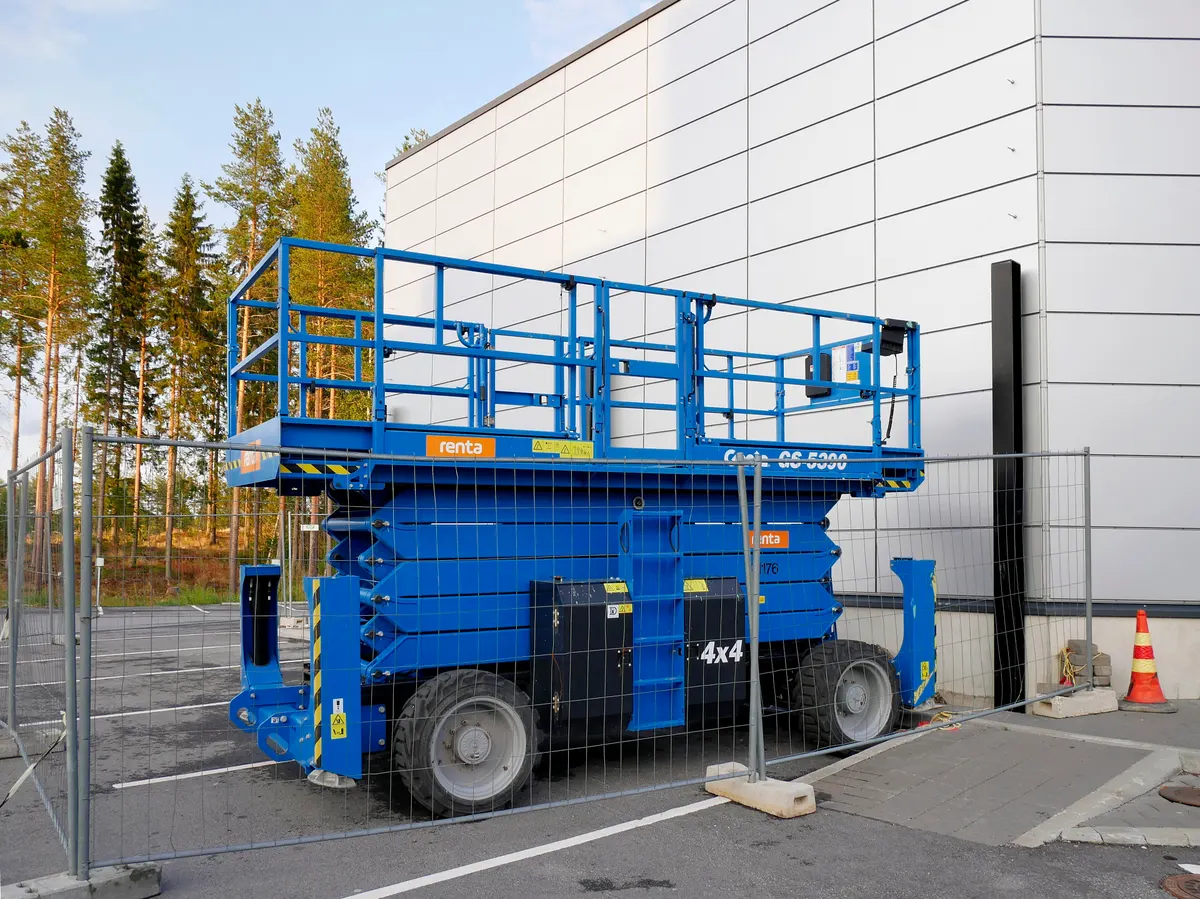
For short, single-location tasks with firm, level access, a MEWP can cost less than scaffold hire plus erection and dismantling. Abu Dhabi's code points to selecting a less hazardous access system as the first control where hazards cannot be eliminated.
Genie
Genie, part of Terex since 2002, makes scissor lifts, articulating and telescopic booms, telehandlers and vertical mast lifts. Its scissor lifts are suited to slab-level indoor work during fit-out.
Skyjack
Skyjack, a Linamar company, says it designs its machines for the rental industry, with easy-to-reach service points to cut downtime. Its range includes DC and rough-terrain scissor lifts, booms, vertical mast lifts and telehandlers.
JLG
JLG has made MEWPs and telehandlers since 1969 and has been part of Oshkosh Corporation since 2006. It is a common source of high-reach telescopic booms.
It depends on utilisation. Divide the purchase price minus resale value by the weeks you will really use the kit, then add weekly storage, maintenance, loss, insurance and inspection costs. Compare that with itemised weekly hire. Low or uncertain utilisation favours hire. Steady reuse of the same system can favour buying.
Does scaffolding rental include erection?
Not always. Some hire is supply only, and some includes erection, alterations, inspection and dismantling by the supplier's scaffolders. Ask for both options itemised. In Abu Dhabi, erectors of scaffolds over 10 m need a third-party Scaffolding Competency Certificate, so check the credentials of whoever erects.
Who is responsible for scaffold inspection on hired scaffolding?
The contract should say so. Abu Dhabi requires an employer using a scaffold erected by another employer to make sure it is inspected by a competent person and declared safe. Dubai requires a competent person to inspect daily before use, and an approved third party for supported and suspended scaffold certificates.
What happens if hired scaffolding components are lost?
Hire contracts normally charge missing or damaged items at a replacement price list after the off-hire count. Agree the count method, wear and tear, and prices before delivery. Keep components in a controlled area and stop other trades from taking boards or tubes for other uses.
Do I need the manufacturer's manual for hired scaffolding?
Yes. Sharjah's OSHJ-CoP-23 says suppliers that hire or lease system scaffold must supply the manufacturer's manual. Abu Dhabi requires manufacturer's instructions or drawings to be available on site for scaffolds below 10 m. Above 10 m, it requires the design drawing or manufacturer's instructions to be followed.
Supported, frame, birdcage, suspended, cantilever and mobile tower scaffolds compared by job, with the Abu Dhabi, Dubai, Sharjah and SASO rules for each, aluminium towers and when to use a MEWP.
Scaffold systems compared, the EN and GSO standards suppliers quote, the scaffolding codes in Abu Dhabi, Dubai, Sharjah and Saudi Arabia, inspection and tags, hire or buy, and an RFQ checklist.
What green, yellow and red scaffold tags mean, what each must show, how often Abu Dhabi, Dubai, Sharjah and SASO require inspection, who the competent person is, and how to keep the register.