Scaffolding Parts and Components: Names, Functions and Checks
Every scaffold part named and explained, with the dimensions Abu Dhabi, Dubai, Sharjah and SASO set for boards, guardrails, toe boards, base plates, sole boards and ties, plus a delivery checklist.
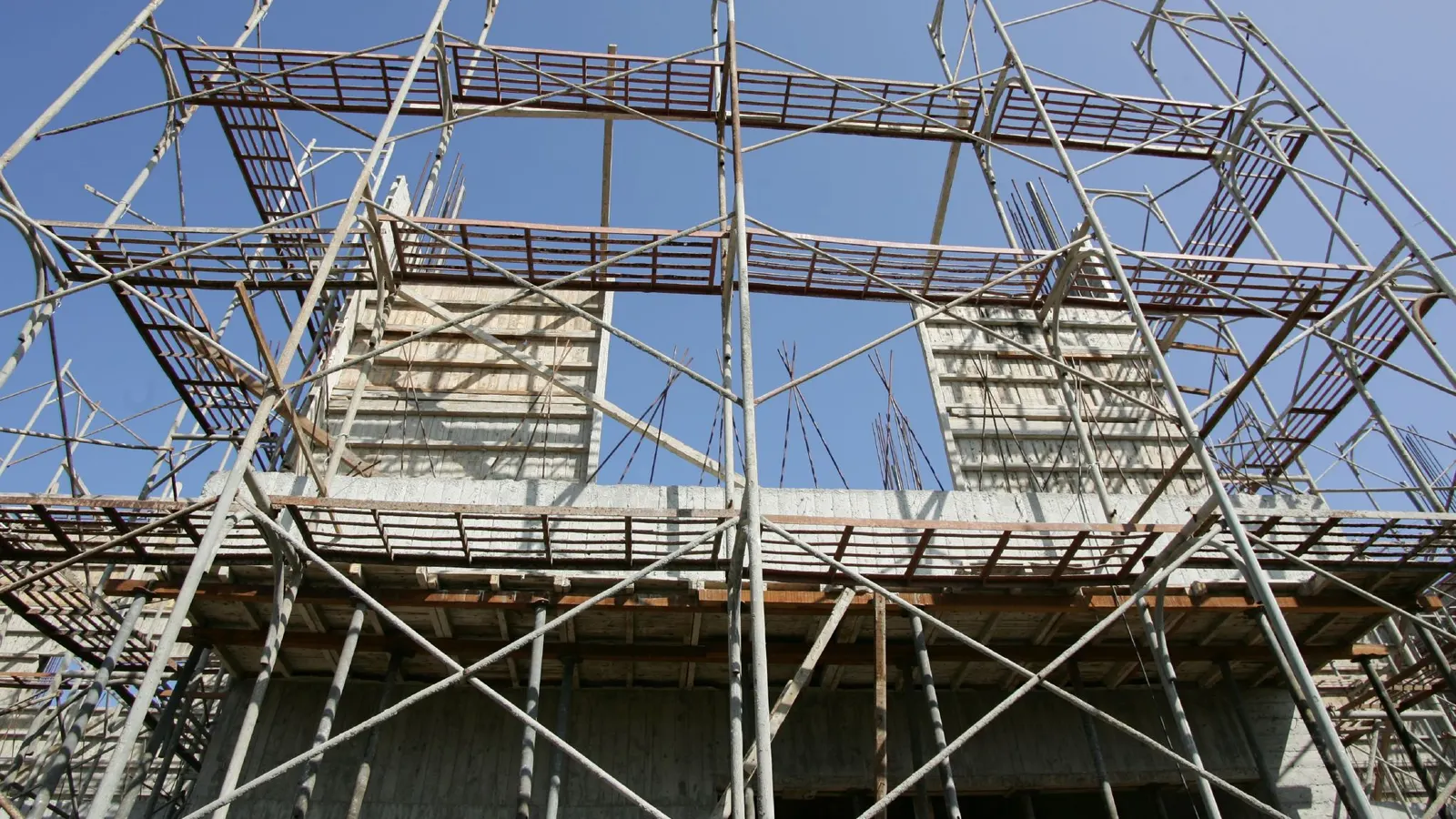
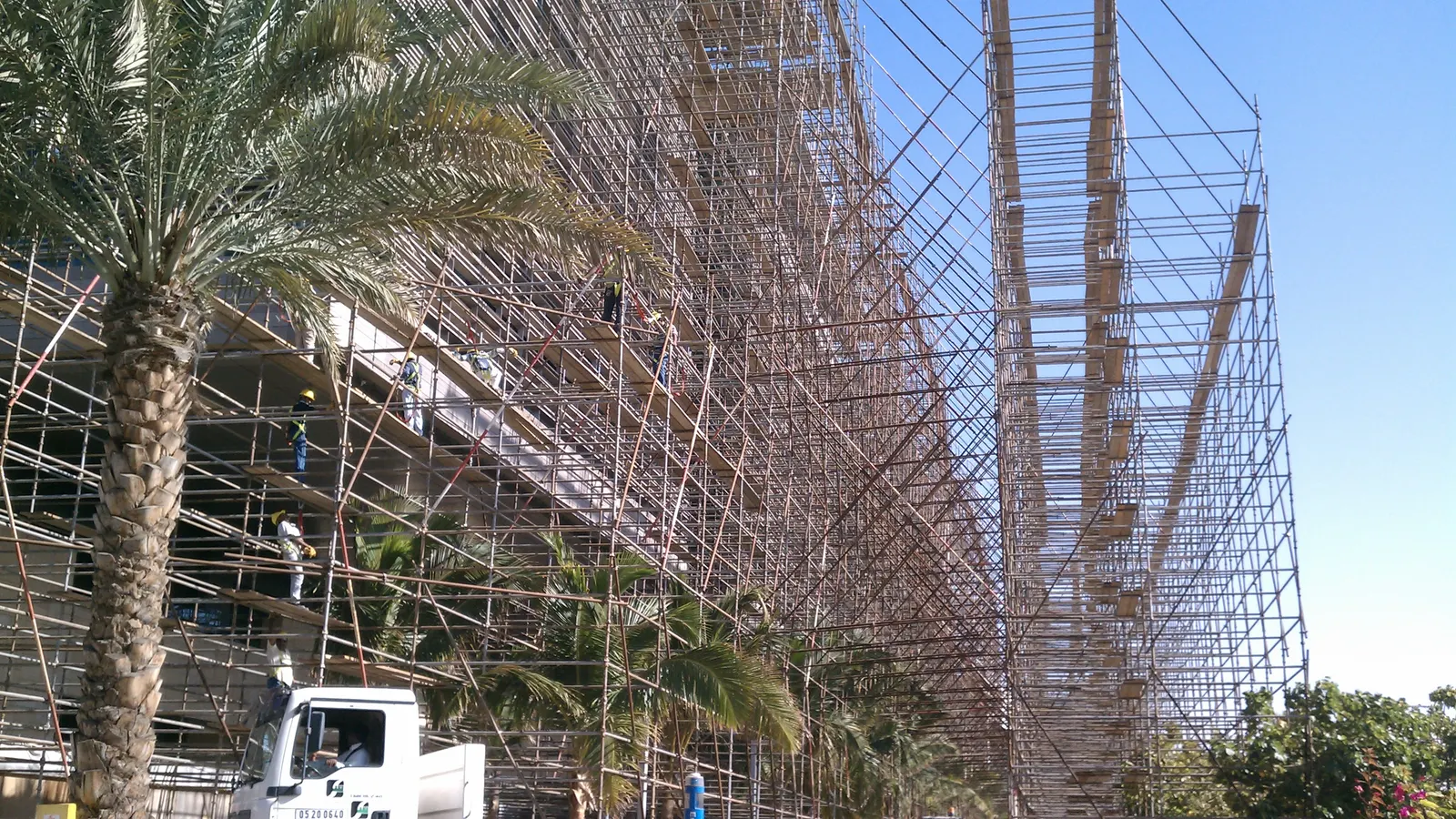
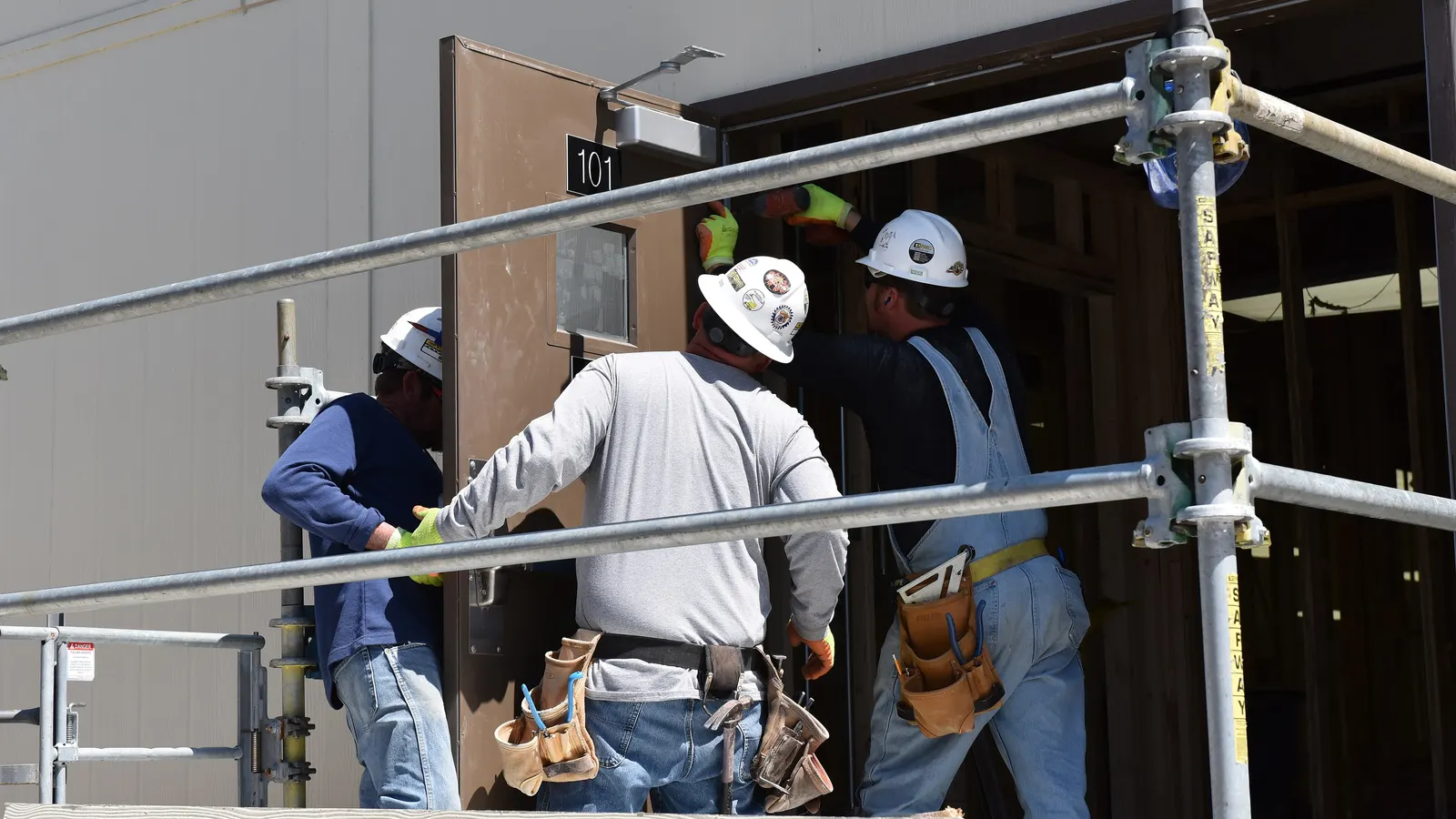
A scaffold is built from uprights called standards, horizontal ledgers and transoms, couplers or system nodes that join them, base plates and sole boards that spread the load, a boarded platform with guardrails and toe boards, and ties and bracing that keep it stable. Suppliers of scaffolding systems in the UAE and in Saudi Arabia use these names on delivery notes, load charts and inspection checklists.
This guide is for site engineers, storekeepers, HSE officers and buyers who need to check a delivery, read a method statement or brief an inspector. It names each part, explains what it does, and lists the dimensional checks that Gulf codes set for it. For the wider picture, including systems, emirate codes and hire or buy, see our main guide to scaffolding in the UAE and Saudi Arabia. ListGCC did not test any components. Figures come from the Abu Dhabi, Dubai and Sharjah codes, the SASO guide, and the GSO and EN standards cited below.
Scaffolding parts at a glance
Sharjah's OSHJ-CoP-23 gives short definitions of the core members, and the other codes use the same terms. The table pairs each part with its job and the check that matters.
Part
What it does
Key check
Standard (upright, post)
Vertical member that carries load to the ground
Straight, undamaged, plumb, on a base plate. Joints staggered
Ledger (runner)
Horizontal member along the long side of the scaffold
Fixed at every lift. Positions as per design
Transom (bearer)
Horizontal member across the short side, carrying the boards
Spaced to suit board length and thickness
Coupler (clamp, fitting)
Joins two tubes in tube and clamp scaffolds
Correct type, tightened, threads clean and greased
Base plate and base jack
Spreads standard load. A jack adjusts the level
Fitted on every standard, even on concrete
Sole board (mudsill)
Timber under base plates on soft or uneven ground
At least 225 mm x 450 mm in Abu Dhabi. At least 5 cm thick and 25 cm wide in Dubai
Boards and decks
Form the working platform
Width, gaps, overhang, no splits, not painted over
Guardrail and mid-rail
Edge protection at open sides
Top rail at least 950 mm. Gaps no more than 470 mm
Toe board
Stops tools, materials and feet going over the edge
At least 150 mm high (UAE codes)
Ties
Connect the scaffold to the building for stability
Type, spacing and anchor testing as per design
Bracing
Diagonal members that stop the scaffold racking
All faces braced. Never removed by other trades
Standards, ledgers and transoms
Sharjah's code defines a standard as an upright member. A ledger is a horizontal member normally running along the larger dimension of the scaffold, and a transom is a horizontal member normally in the direction of the smaller dimension. Dubai's code uses the alternative names posts, runners and bearers for the same parts of a tube and clamp scaffold.
In tube and clamp scaffolds these are all loose tubes. GSO EN 39:2012 covers non-alloy steel tubes for use with EN 74 couplers, and it notes that tubes of 48.3 mm outside diameter with 3.2 mm or 4.0 mm wall thickness can also be used with prefabricated scaffolds. In system scaffolds, the standards come with fixed connection points (cups or rosettes) and the ledgers and transoms have matching ends. The system's manual then sets the bay sizes and lift heights.
Abu Dhabi's code adds two points. Staggering the joints in standards helps control the risk of collapse under environmental loads. Tubes must only be straightened by a competent person, because bending and straightening can harden the steel and make it brittle. Split or damaged sections must be cut out square and discarded.
Couplers and fittings
BS EN 74-1 covers four friction couplers: right-angle couplers, swivel couplers, sleeve couplers and parallel couplers. BSI lists BS EN 74-1:2005 as withdrawn since 28 April 2022, so check which edition a supplier's couplers were tested to.
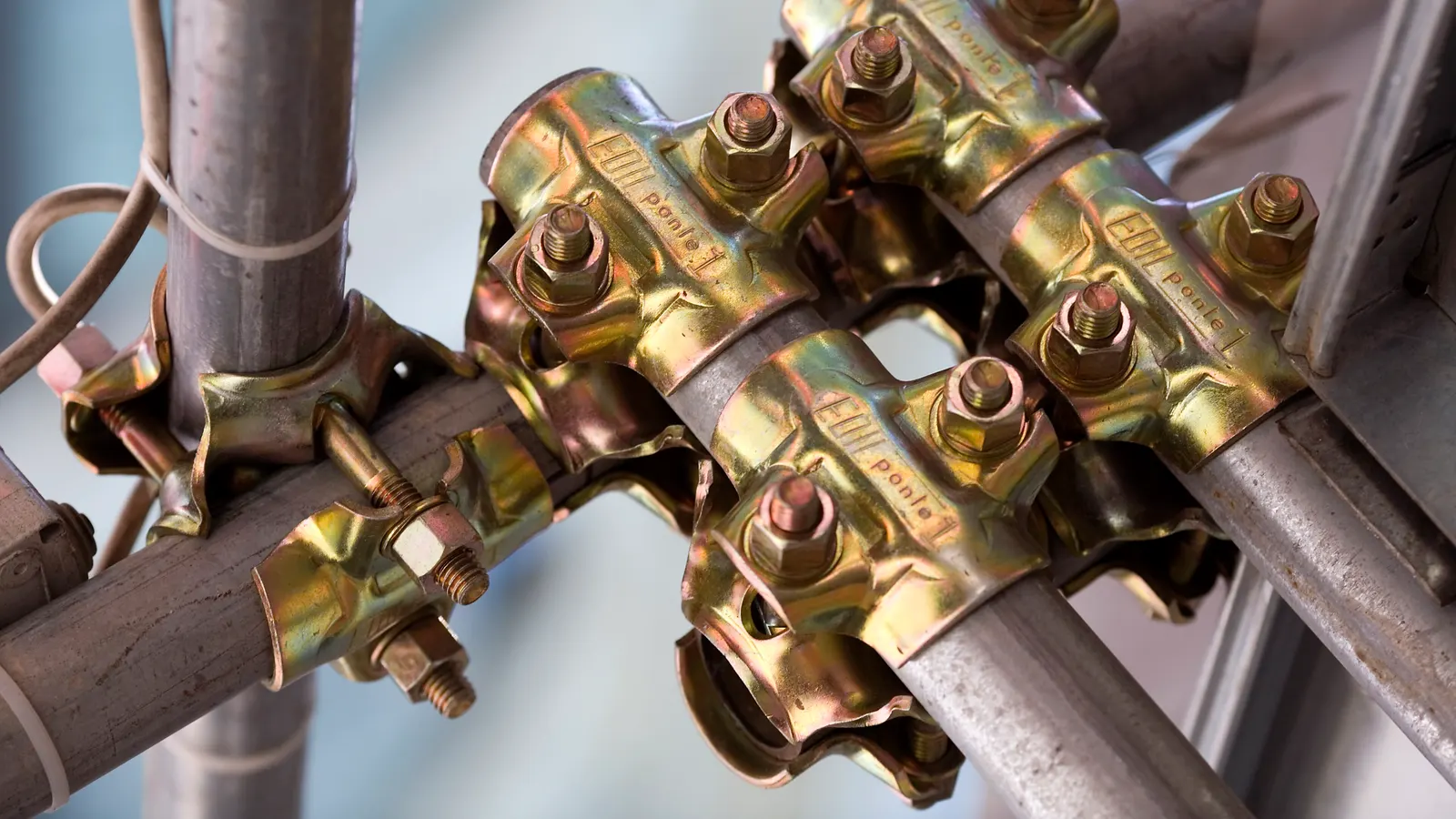
Right-angle (double) coupler: joins ledgers to standards and transoms to ledgers at 90 degrees. It carries most of the load in a tube and clamp scaffold.
Swivel coupler: joins tubes at any angle. It is mainly used for bracing.
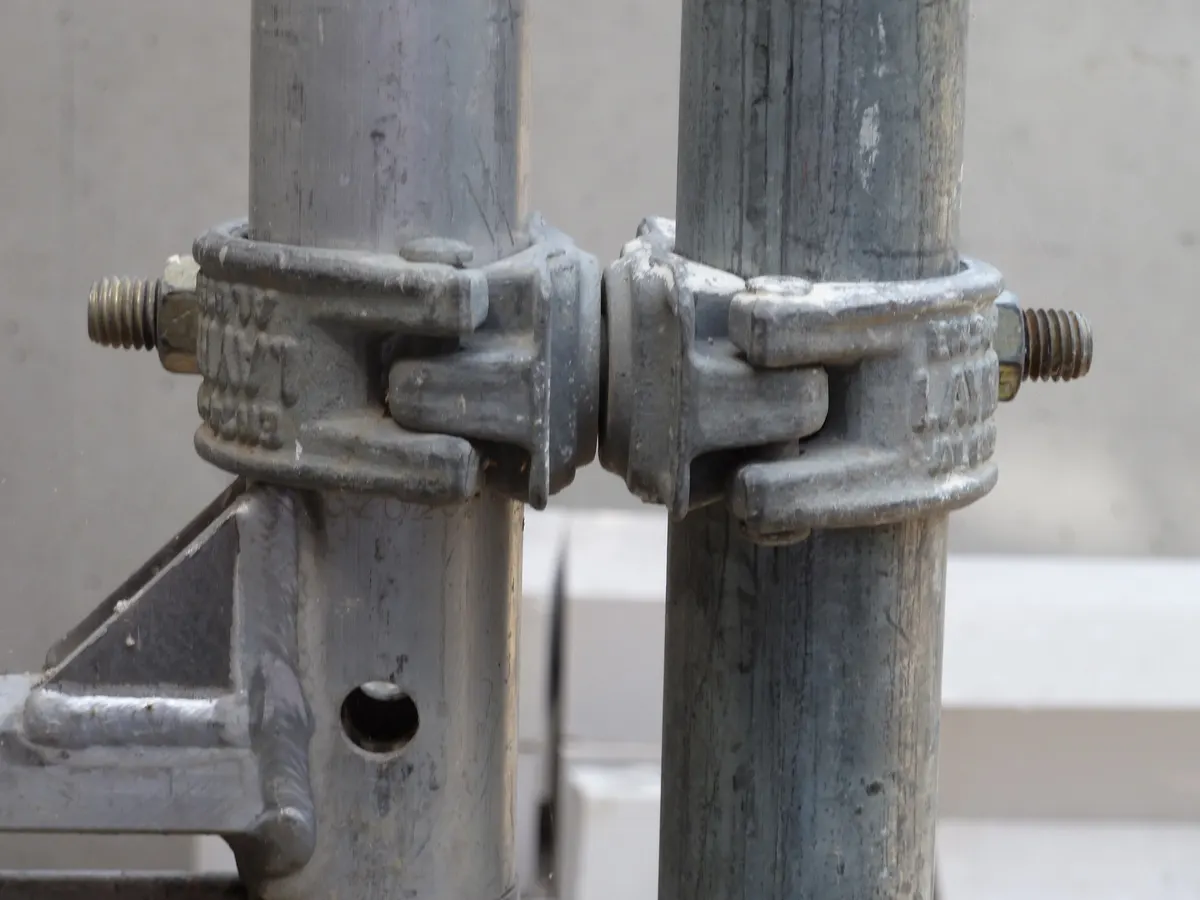
Sleeve coupler: joins two tubes end to end on the outside.
Parallel coupler: joins two parallel tubes, for example where tubes overlap.
Dubai's code describes tube and clamp scaffolds as joined by two clamp types, right-angle clamps and swivel joint clamps. It requires all clamps to be inspected and maintained regularly, checked before each use, and to have their moving parts greased so the threads keep working. Abu Dhabi requires couplers and fittings to be examined before use, with moving parts free from wear and well lubricated. Beam clamps and flange clamps must come with information on safe use, including the tightening torque.
Most scaffold collapses start at the base. SASO's guide says the strength of any scaffold depends on its base and attributes most collapses to weak bases. The rules on bases are clear:
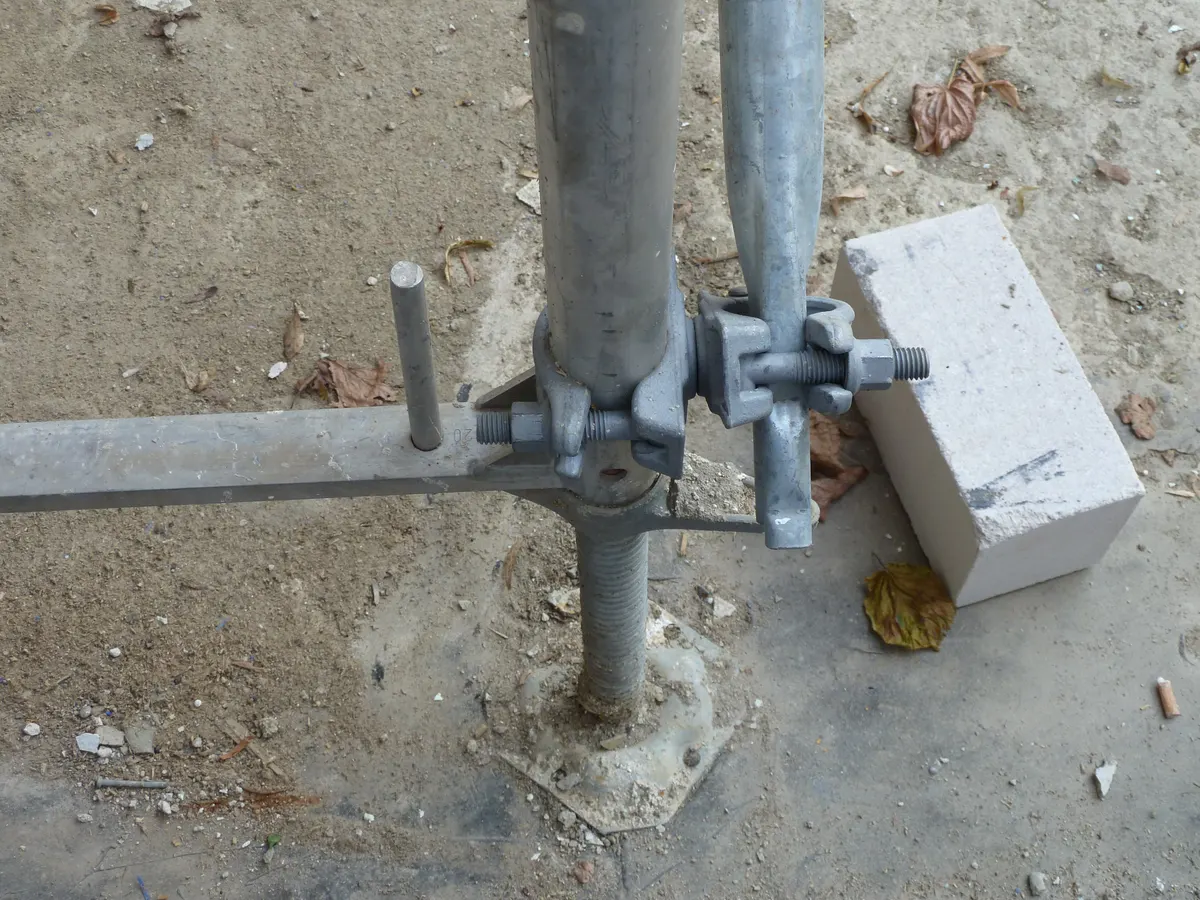
Abu Dhabi requires base plates on all uprights to spread the load evenly. Sole boards are required on less stable surfaces such as sand, soil, gravel and fill, as per the design, with a minimum size of 225 mm x 450 mm. Needles and spurs should be considered where ground is very unstable.
Dubai requires base plates even on a concrete floor. On soft soil the ground must be compacted, and legs must sit on base plates and mudsills at least 5 cm thick and 25 cm wide.
Sharjah says standards should not be placed over manhole lids or shallow drains that may not carry the load.
Base jacks (adjustable bases) level the scaffold on uneven ground. Dubai's code calls for frame scaffolds to sit on base plates with adjustable levelling screws on proper mudsills over well-compacted soil. Abu Dhabi warns that excavation, water and recently filled trenches near the base can wash out the ground, so keep services trenches away from scaffold bases.
The platform is where codes are most specific. These are the figures inspectors check:
Board size (Abu Dhabi and Sharjah): at least 200 mm wide if 50 mm thick or less, and at least 150 mm wide if thicker than 50 mm.
Gaps (Abu Dhabi): no single gap between boards over 25 mm and a total gap no more than 50 mm. Boards must be captive and fixed against uplift.
Overhang: no more than 150 mm or four times the board thickness, whichever is less, in Abu Dhabi. Sharjah sets at least 50 mm and no more than four times the thickness where transoms do not restrain the boards.
Platform width (Abu Dhabi): 800 mm (4 boards) for persons only and 1.0 m (5 boards) for persons and materials with a clear 430 mm passage, rising to 600 mm if barrows are used. Use 1.2 m (6 boards) for masons and 600 mm for light, short-duration work. During erection, a platform at least 450 mm wide must run along the full length.
Platform width (Dubai): at least 60 cm (3 boards) for persons only, 80 cm (4 boards) for persons and materials, and 150 cm (7 boards) to support a higher platform. Dubai specifies wood planks of nominal 5 cm x 25 cm with gaps no more than 2.5 cm, and plank ends in metal bands.
Gap to the building: 225 mm maximum in Sharjah, with internal guardrails if it must be wider. Abu Dhabi requires internal edge protection, extra boards or harnesses above 225 mm. Dubai allows a front edge no more than 35 cm from the work face unless guardrails or personal fall arrest are used.
Boards must not be painted or treated in a way that hides defects, under Abu Dhabi, Dubai and SASO rules. Abu Dhabi also says boards should be inspected after each job, cleaned, stacked flat on battens, and never dropped from height. Dropping can cause unseen damage.
Guardrails, mid-rails and toe boards
The UAE codes agree on the core dimensions. The top guardrail must be at least 950 mm above the platform (Dubai sets 95 to 115 cm). The gap between rails, and between the mid-rail and toe board, must not exceed 470 mm. Toe boards must be at least 150 mm high. Abu Dhabi requires mid-rails on all platforms over 2 m and requires guardrails and toe boards to be fitted inside the standards. SASO's guide gives a minimum toe board height of 0.1 m and says guardrails must withstand at least 45.5 kg at any point in any direction.
Where people work or pass below, Dubai requires a screen between the toe board and guardrail along the whole opening. Sharjah lists brick guards, sheeting and fans as falling-object controls, and warns that sheeting significantly increases wind load on the scaffold and its ties.
Ties and bracing
Ties stop the scaffold falling away from or into the building, and bracing stops it racking. Dubai's code is the most detailed:
Supported scaffolds taller than four times their minimum base width must be tied vertically and horizontally. The first tie can be no higher than four times the base width, with vertical ties at no more than 8 m and horizontal ties at each end and no more than 9 m apart.
At least 50 percent of ties must be positive ties that do not rely on friction. Dubai lists through ties, box ties and anchor bolt ties as positive and reveal ties as not positive.
All faces of the scaffold must be braced diagonally, internally and externally.
Abu Dhabi prefers cast-in anchors or through ties to drilled anchors. Where drilled expansion or chemical anchors are used, 10 percent of expansion anchors and all chemical anchors must be proof tested to 1.25 times the working load. Extra ties are required when the scaffold is sheeted, used as a loading platform, or carries hoists or rubbish chutes. A competent person must check regularly that finishing trades have not loosened or removed ties. SASO sets tie spacing at no more than 9 m horizontally and 7.9 m vertically.
Access: ladders, stairs and landings
Ladders must be set at 75 degrees (1 m out for every 4 m up) and secured at the top under the UAE codes. They must extend at least 1 m above the landing in Dubai and Sharjah, and 1.05 m (5 rungs) in Abu Dhabi. Landings are needed at least every 9 m of height. Dubai requires a cage or fall arrest device on vertical ladders over 6 m. SASO does not allow portable ladders as access where the platform is higher than 3.7 m, and prefers fixed ladders above that height. Sharjah gives priority to independent stair towers where use is heavy or materials are carried by hand.
Fall protection for scaffolders
Abu Dhabi requires every scaffold erector to be issued with a personal safety harness and to wear it at all times when working at height. They must clip on whenever they are outside an area protected by a 950 mm guardrail. Harnesses are part of the scaffold kit and need their own inspection. Petzl recommends a detailed inspection of its NEWTON fall-arrest harness by a competent person at least every 12 months, and a check of the webbing, buckles and fall-arrest indicators before each use. Honeywell's Miller manual requires a user check before each use and a competent person inspection at least annually. Find suppliers under safety harnesses and fall protection systems.
Delivery and pre-use checklist
Check the components against the system named in the design. Do not mix manufacturers without an engineer's confirmation (Abu Dhabi CoP 26.0).
Tubes must be straight, free of cracks, splits and heavy corrosion, and the right diameter and wall thickness.
Couplers must be the correct type, with clean, greased threads and no cracks or bent parts.
Boards must be the correct width and thickness, with no splits or decay and no paint hiding defects.
Base plates must be present for every standard, with sole boards sized for the ground.
Guardrails, mid-rails and toe boards must be enough for every open side and end.
Tie components and anchors must match the design, with anchor test results if anchors are drilled.
Defective items go to a marked quarantine area and are never built into the scaffold, as Sharjah's code requires.
Need a supplier to quote components or a full system? Post the list once with ListGCC's requirement form.
Frequently asked questions
What is the difference between a ledger and a transom?
Both are horizontal members. Under Sharjah's OSHJ-CoP-23, a ledger normally runs along the larger dimension of the scaffold, parallel to the building. A transom normally runs across the smaller dimension and supports the boards. Dubai's code calls the same members runners and bearers.
What size is a standard scaffold tube?
GSO EN 39:2012, the Gulf adoption of EN 39, covers non-alloy steel tubes for use with EN 74 couplers. Its note refers to tubes with a 48.3 mm outside diameter and 3.2 mm or 4.0 mm wall thickness. Always confirm the diameter and wall thickness for your design, because Abu Dhabi's code says tubes of different diameters and strengths must not be mixed.
How high must a scaffold toe board be?
In the UAE, at least 150 mm above the working platform under the Abu Dhabi, Dubai and Sharjah codes. SASO's guide in Saudi Arabia gives a minimum of 0.1 m. If materials are stacked on the platform, Abu Dhabi says higher toe boards or debris guards may be needed.
Is a base plate needed on concrete?
Yes. Dubai's Code of Construction Safety Practice requires base plates even when the scaffold stands on a concrete floor. Abu Dhabi requires base plates on all uprights or standards. Sole boards are added on less stable surfaces such as sand, soil, gravel or fill.
What is a positive scaffold tie?
A positive tie does not rely on friction for its strength. Dubai's code lists through ties, box ties and anchor bolt ties as positive and reveal ties as not positive. It requires at least 50 percent of all ties to be positive. Abu Dhabi prefers cast-in anchors or through ties to drilled anchors.
How many boards wide should a scaffold platform be?
In Abu Dhabi, platforms more than 2 m high need 800 mm (4 boards) for persons only and 1.0 m (5 boards) for persons and materials. Masons need 1.2 m (6 boards), and 600 mm (3 boards) is allowed for light, short work. Dubai sets 60 cm (3 boards) for persons only and 80 cm (4 boards) with materials.
Supported, frame, birdcage, suspended, cantilever and mobile tower scaffolds compared by job, with the Abu Dhabi, Dubai, Sharjah and SASO rules for each, aluminium towers and when to use a MEWP.
Scaffold systems compared, the EN and GSO standards suppliers quote, the scaffolding codes in Abu Dhabi, Dubai, Sharjah and Saudi Arabia, inspection and tags, hire or buy, and an RFQ checklist.
What green, yellow and red scaffold tags mean, what each must show, how often Abu Dhabi, Dubai, Sharjah and SASO require inspection, who the competent person is, and how to keep the register.