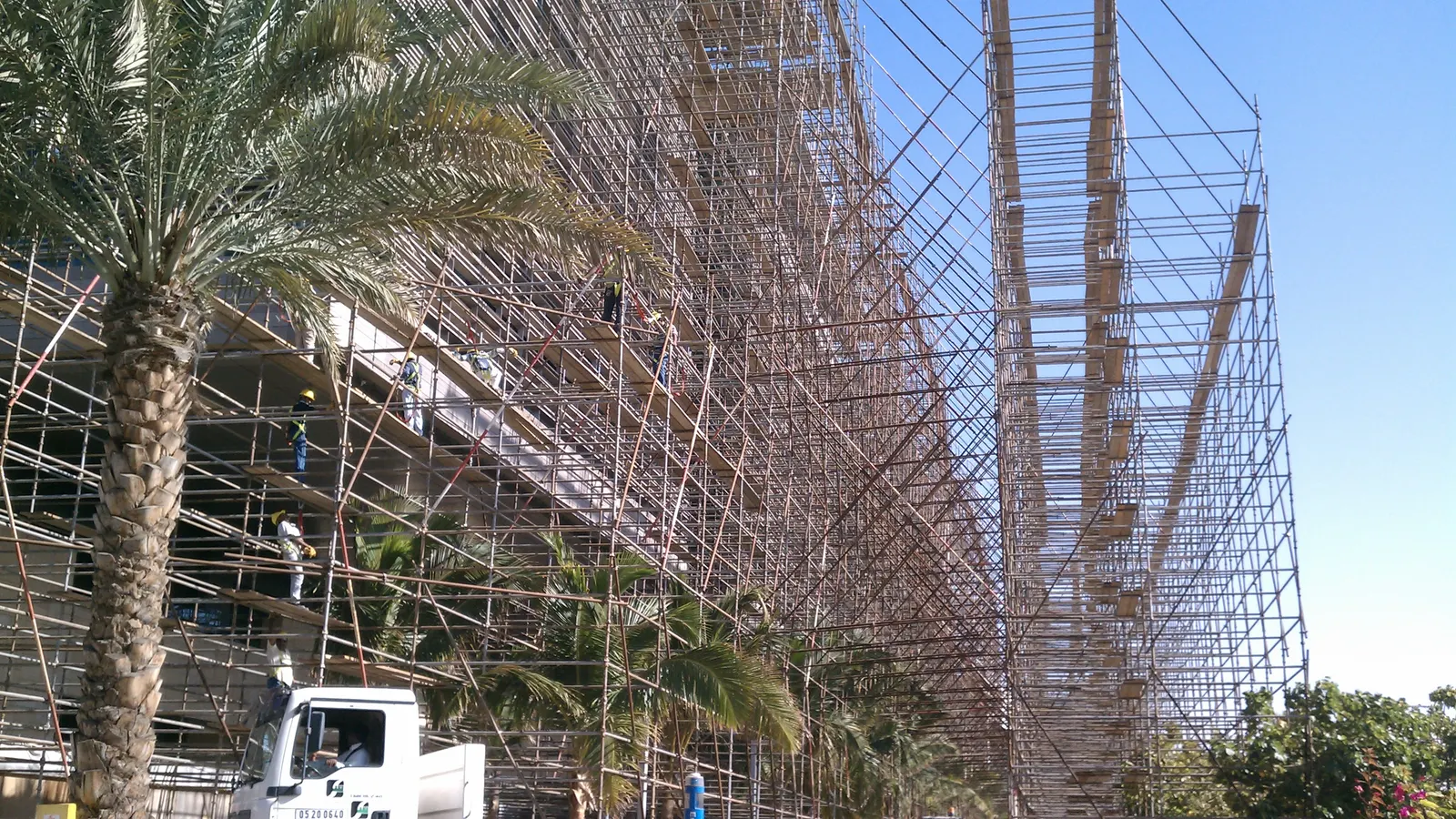
Cuplock, ringlock and tube and clamp compared on node design, flexibility, speed, compatibility and finish, with Abu Dhabi rules on mixing brands and a supplier question list.
Cuplock and ringlock are both modular system scaffolds. Cuplock locks up to four ledgers into a cup on the standard in one action. Ringlock uses wedge heads in a rosette and takes more connections at more angles. Tube and clamp uses loose tubes and couplers and fits any shape, but it is slower and depends more on the scaffolder's skill. You can compare suppliers of all three on ListGCC's scaffolding systems page for the UAE and for Saudi Arabia.
This comparison is for contractors and buyers choosing a system for a project or a fleet purchase. It sets the three side by side on connection, flexibility, speed, compatibility, finish and Gulf code requirements. For systems in general, standards and the rules in each emirate, see our main guide to scaffolding systems, rules and hire in the UAE and Saudi Arabia. ListGCC did not test any system. Product descriptions come from the manufacturers' own pages, and rules come from the regulators' codes. Load capacities and weights differ by manufacturer and component, so take them from the system manual, never from a generic table.
Cuplock vs ringlock vs tube and clamp at a glance
Cuplock
Ringlock (rosette)
Tube and clamp
Connection
Ledger blades sit in the lower cup on the standard. The upper cup is lowered and tightened with a hammer blow
Bolt-free wedge heads on ledgers and braces connect into a rosette on the standard
Separate couplers (right-angle, swivel, sleeve, parallel) bolted onto tubes
Connections per node
Up to four blades in one fastening action (BrandSafway, for CUPLOK)
Up to eight on one level at various angles (Layher, for Allround)
As many as the scaffolder fits, at any position
Node positions
Fixed intervals on the standard
Fixed rosette intervals on the standard
Anywhere along the tube
Geometry
Best on rectangular grids
Rectangular, plus angled and curved layouts
Any shape
Loose fittings
Node is part of the standard
Rosette is part of the standard
Every joint is a separate coupler
Skill dependence
Lower, because node locations are fixed
Lower, because node locations are fixed
Higher: torque, coupler type and position are up to the scaffolder
Design basis
Manufacturer's manual and design
Manufacturer's manual and approvals
Generic configurations such as NASC TG20, or bespoke design
Typical finish
Galvanised steel
Galvanised steel. Some ranges also in aluminium
Galvanised or painted steel tube
How cuplock works
Dubai's Code of Construction Safety Practice names the cup-lock system as the most popular system scaffold. It describes the mechanism like this: the blades of the ledgers sit in the lower cup, and the upper cup is lowered and tightened with a hammer blow. The code notes that modular systems need less erection expertise because the connection points are fixed.
BrandSafway, which sells CUPLOK, describes it as a fully galvanised, multipurpose steel system scaffold. Its circular node point allows up to four blades to be connected to a vertical in a single fastening action. The system is used both for worker access and for supporting vertical shoring loads. That dual use means the same stock can serve as access and as falsework under slabs, subject to a proper falsework design.
The limit is geometry. Ledgers come in set lengths and nodes sit at set heights. Bays, lifts and corners must follow the system's grid, and curved or irregular faces need tube and clamp infill, which adds couplers and inspection points.
How ringlock works
Ringlock is a common name for rosette-type systems. Layher introduced its Allround system in 1974. Its milestones page describes a bolt-free wedge connection with eight connections in one plane, which began replacing conventional tube and coupler scaffolding. Layher says up to eight connections can be made in the Allround connector, on one level and at various angles, and that the connections can be right-angled, obtuse or acute as required. The system is sold in steel or aluminium and holds German building authority approvals, including one for the steel version on the basis of EN 12811.
Other makers sell their own rosette systems. Doka markets Ringlock modular scaffolding with a galvanised finish and lists facade, rebar, stair tower, rolling, suspended and birdcage uses. PERI's scaffolding kit, PERI UP, combines frame and modular elements.
The advantage of ringlock is flexibility. Because braces and ledgers can join the rosette at angles, it handles industrial plant, tanks, curved facades and stair towers with fewer tube and clamp additions than a cup system. The trade-off is that the rosette and wedge details are specific to each maker.
Not by default. Abu Dhabi's ADOSH-SF CoP 26.0 says scaffolding from different manufacturers must not be mixed unless a competent engineer confirms four things: compatible size and strength, compatible deflection, compatible fixing devices, and no loss of strength, stability, rigidity or suitability. It also warns against mixing modular systems, because connection points such as the "star" and "banana" often differ in shape and tolerance. Dubai bans mixing different types of metal in one scaffold unless a competent person who understands the effect approves it.
Some makers say their rosette components are compatible with other ring-type systems. Doka, for example, says this of its Ringlock. Treat such statements as the starting point for the engineer's check that Abu Dhabi requires, not as a replacement for it. In practice, keep each scaffold to one system and one manufacturer, and specify the brand and system in the hire or purchase order.
Tube and clamp: still the most flexible
Tube and clamp uses GSO EN 39 steel tube (48.3 mm outside diameter in the common sizes) with EN 74-1 couplers. Right-angle and swivel couplers do most of the work. Dubai describes the tube and clamp form as posts, runners, bearers and bracing joined by right-angle and swivel joint clamps.
Its strength is that a tube can go anywhere: around pipework, over obstructions, into domes and soffits. Its weaknesses follow from that. There are many loose fittings to count, inspect and lose. Every joint depends on the scaffolder tightening the right coupler in the right place. Design must either follow a recognised configuration or be done bespoke. The UK's HSE gives NASC TG20 as an example of a generally recognised standard configuration for tube and fitting scaffolds. Anything outside such configurations needs a specific design by a competent person. In Dubai, tube and clamp scaffolds above 38 m need a third-party design approved by the engineering office.
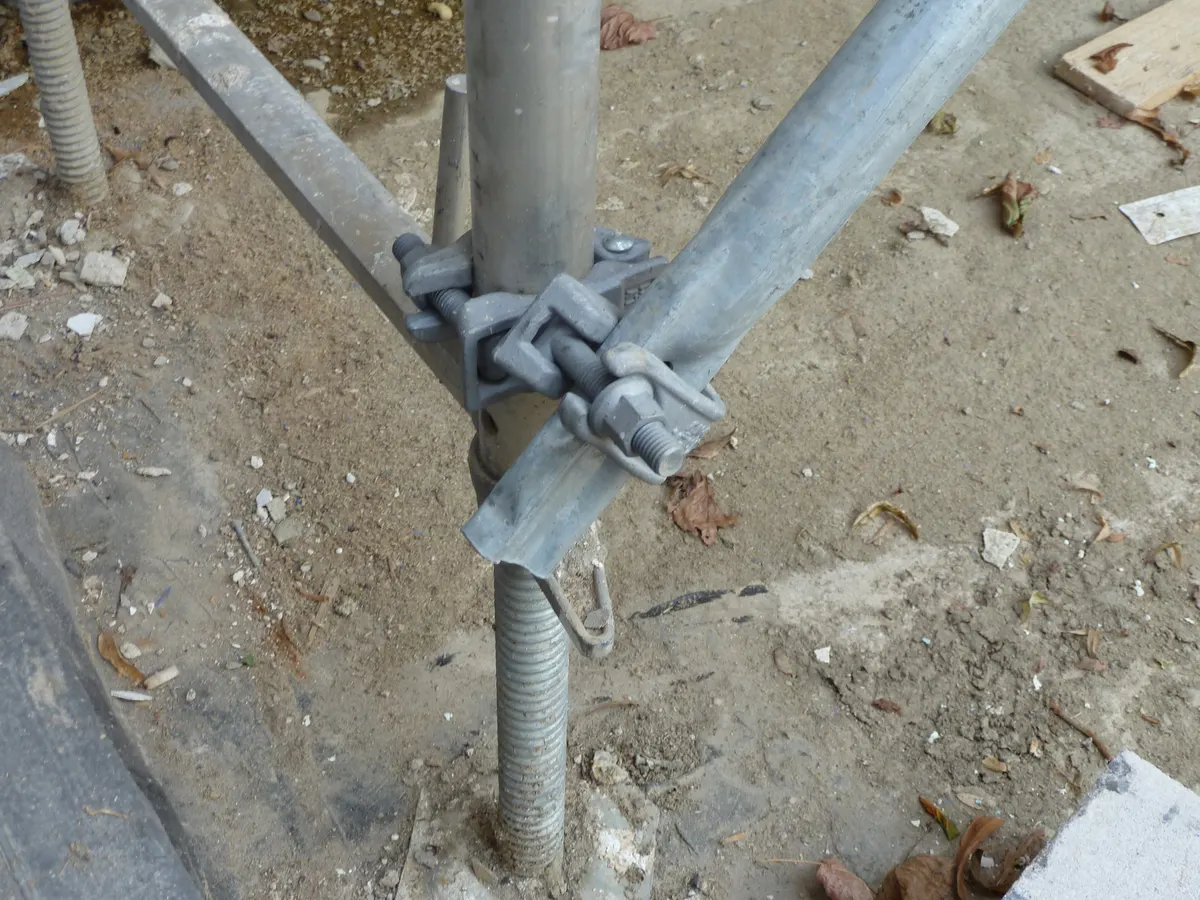
A coupler fixing a diagonal brace to a standard near its base jack. On tube and clamp work, every joint like this is a separate fitting to tighten and inspect. Photo: Warburg, CC BY-SA 3.0, via Wikimedia Commons
Speed, labour and inspection
On regular work, system scaffolds are usually quicker to erect because each node is in a set place and there are fewer loose parts. Dubai's code makes the same point about fixed connection locations. This also makes inspection simpler, since a missing wedge or a cup left open is visible. Tube and clamp takes longer, needs more experienced scaffolders, and gives the inspector more joints to check. In Abu Dhabi the competency requirement is the same for all three: a Scaffolding Competency Certificate from an approved third-party trainer for scaffolds over 10 m, and from a registered trainer below that.
The fall risk during erection also differs. Abu Dhabi asks for scaffolding-specific controls such as advance guardrails. Sharjah says scaffold step systems and advance guardrail systems must be used where practicable to protect scaffolders. Where collective protection is not yet in place, harnesses and anchorages are required. Petzl makes full-body fall-arrest harnesses such as the NEWTON, certified to EN 361:2002. Honeywell's Miller range includes full-body harnesses with a published inspection regime. Both appear under fall protection systems on ListGCC.
Galvanising and Gulf conditions
Coastal humidity, salt and industrial atmospheres all matter for steel scaffolds. Abu Dhabi says unprotected steel must not be used where the atmosphere is particularly corrosive, and that protective coatings must be looked after. Dubai asks for coated tubes in high-humidity places and regular greasing of clamp threads. Cup and rosette systems from the makers above are sold galvanised. With tube and clamp, specify galvanised tube and couplers for marine, coastal and petrochemical sites, and include corrosion in the inspection checklist.
Which system for which job
Regular facades, high-rise blockwork and plastering, slab soffit access: cuplock or ringlock. Cuplock also covers shoring if the design allows.
Industrial plant, tanks, pipe racks, curved or stepped structures, stair towers: ringlock, with tube and clamp infill where needed.
Short, awkward or one-off shapes, or repairs inside existing plant: tube and clamp.
Light, short, low-level work: a mobile tower or MEWP may beat all three. See our guide to types of scaffolding.
What to ask suppliers
Which system, which manufacturer, and does the full quantity come from that one manufacturer?
Can you supply the manufacturer's manual and load tables? Sharjah's code requires hire suppliers to supply the manual.
What standards or approvals apply, for example EN 12811-1 or EN 12810-1 for system and facade scaffolds, EN 39 and EN 74-1 for tube and clamp?
What finish do the components have, and in what condition (new, reconditioned)?
Do your scaffolders hold the competency certificates required in the emirate?
How are tie components, anchors and anchor testing handled?
What is the difference between cuplock and ringlock scaffolding?
Cuplock joins ledgers at fixed cups on the standard. BrandSafway says its CUPLOK node connects up to four blades in one action. Ringlock uses a rosette with wedge-head connections. Layher says its Allround connector takes up to eight connections on one level at various angles. Ringlock handles angled layouts more easily, while cuplock suits rectangular grids.
Is cuplock scaffolding faster than tube and clamp?
On regular, rectangular work, generally yes, because the connections sit at fixed points and there are few loose fittings. Dubai's code notes that modular systems need less erection expertise for that reason. Tube and clamp remains more flexible for irregular shapes but needs more fittings, more skill and more inspection time.
Can I mix ringlock components from different brands?
Not without an engineer's confirmation in Abu Dhabi. CoP 26.0 bans mixing manufacturers unless a competent engineer confirms compatible size, strength, deflection and fixings. It warns that modular connection points often differ in shape and tolerance. Some makers claim compatibility with other ring-type systems, but the engineer's check still applies.
Which scaffolding system is best for oil and gas plants?
Rosette (ringlock) systems suit plant work because ledgers and braces can connect at angles around pipework and vessels, with tube and clamp infill for awkward spots. Specify galvanised components for corrosive atmospheres. Abu Dhabi bans unprotected steel where the atmosphere is particularly corrosive.
Does tube and clamp scaffolding need a design?
It needs either a recognised standard configuration or a bespoke design. HSE cites NASC TG20 as an example of a recognised configuration for tube and fitting scaffolds. In Abu Dhabi and Sharjah, any scaffold over 10 m needs an engineer's design. In Dubai, tube and clamp scaffolds above 38 m need a specialised third-party design.
Supported, frame, birdcage, suspended, cantilever and mobile tower scaffolds compared by job, with the Abu Dhabi, Dubai, Sharjah and SASO rules for each, aluminium towers and when to use a MEWP.
Scaffold systems compared, the EN and GSO standards suppliers quote, the scaffolding codes in Abu Dhabi, Dubai, Sharjah and Saudi Arabia, inspection and tags, hire or buy, and an RFQ checklist.
What green, yellow and red scaffold tags mean, what each must show, how often Abu Dhabi, Dubai, Sharjah and SASO require inspection, who the competent person is, and how to keep the register.