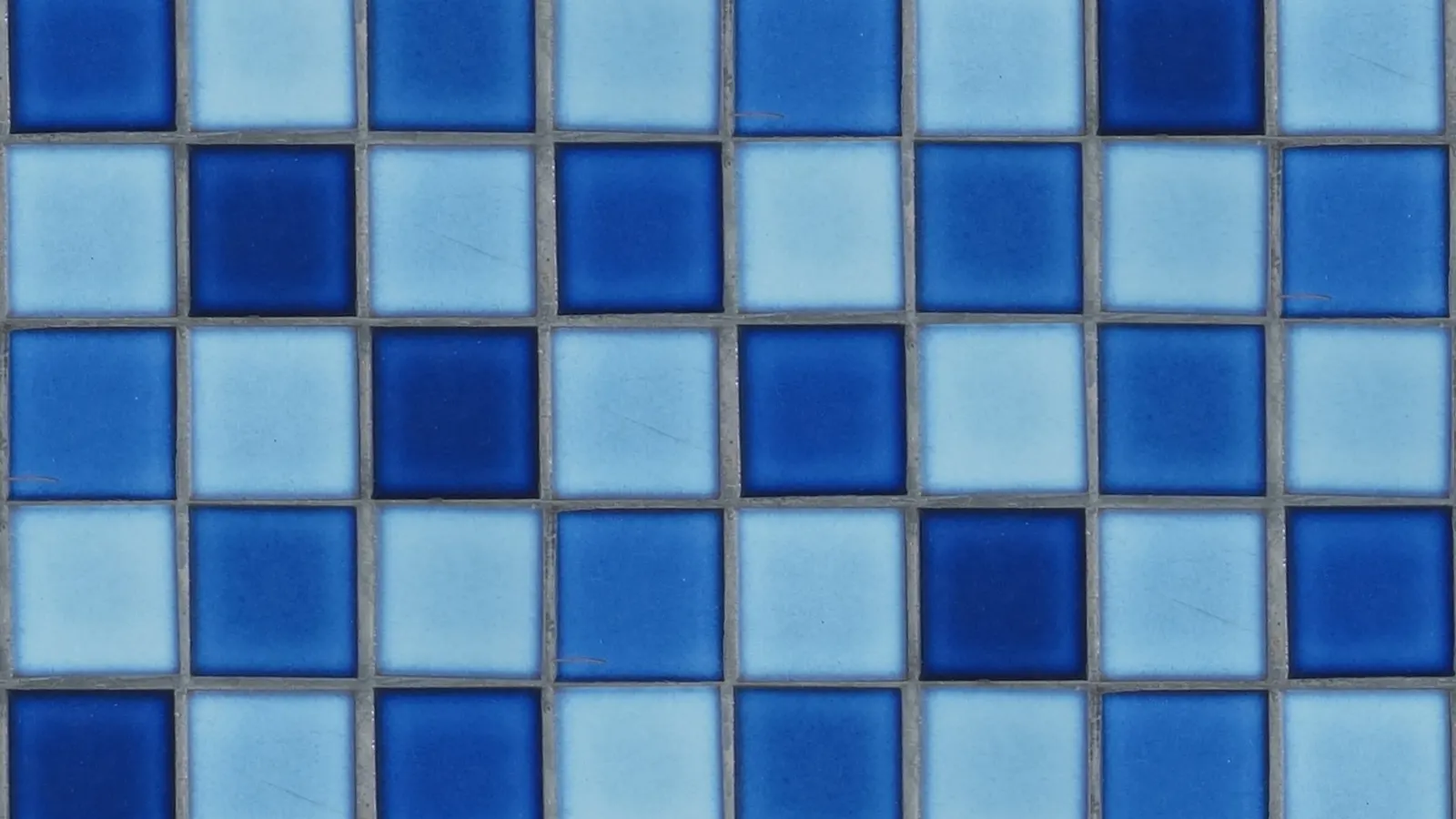
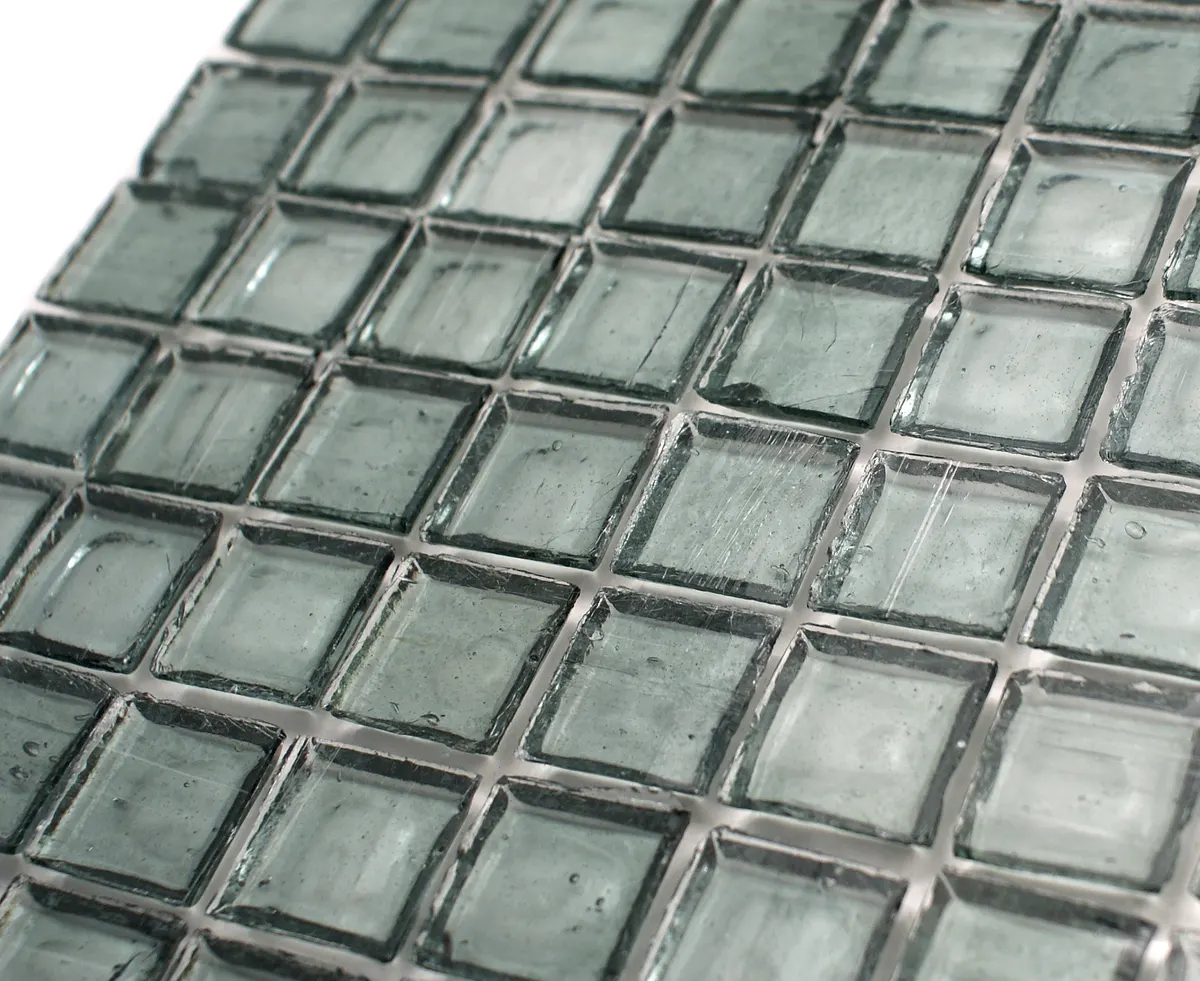
Glass and porcelain mosaic for pools, showers and facades in the UAE and Saudi Arabia: what counts as mosaic, adhesive and grout classes, pool water, curing before filling and facade rules of thumb.
Mosaic tiles are small pieces, often supplied on sheets, that follow curves and falls where full-size tiles cannot. For a pool, a shower floor or a facade, the mosaic itself (glass or porcelain) is only part of the decision: the adhesive, the grout and the waterproofing under it decide whether it lasts. Source the tiles from ceramic and porcelain tile suppliers in the UAE or in Saudi Arabia, and specify the installation system with them.
This spoke is for pool contractors, fit-out teams, facility managers and consultants specifying mosaic for pools, bathrooms, spas and feature walls. It covers what counts as a mosaic, glass against porcelain, adhesives and grouts for immersion, pool water and curing, and facades. For tile groups, abrasion classes and the Saudi and Dubai tile rules, see our main guide to ceramic and porcelain tiles in the UAE and Saudi Arabia. ListGCC did not test any of the products named here; product details come from the makers' data sheets.
What counts as a mosaic
The short answer: a piece that fits inside a 7 cm square. ISO 13006:2018, the standard that classifies ceramic tiles, says it is not applicable to "mosaics (i.e. any piece that can fit into a square, the side of which is less than 7 cm)". That has a practical effect: the BIa, BIb and other groups, and the marking rules that go with them, do not apply to mosaic pieces in the way they apply to field tiles.
So ask mosaic suppliers directly for the properties you need: water absorption of the body (for porcelain mosaic), chemical resistance, the sheet backing and how it bonds, and slip data for floor and pool-floor use. In Dubai, the Dubai Central Laboratory's ceramic tile certification scheme is written to ISO 13006:2018, so check with the authority how mosaic is treated on your project. In Saudi Arabia, SASO's building materials regulation (Part 4) covers ceramic tiles and requires the Saudi Quality Mark for them; confirm with the importer whether the mosaic product falls under that requirement before shipping.
Glass or porcelain mosaic
Both glass and porcelain mosaic are offered for pools, showers and walls. Because the ISO tile groups do not cover mosaic, compare them on the same questions:
Question
Glass mosaic
Porcelain mosaic
Body
Glass
Fired ceramic; ask for water absorption and whether it is 0.5% or less
Slip data for floors and pool floors
Ask for the rating of the exact finish
Ask for the rating of the exact finish, and whether matt or textured versions exist
Adhesive
One its maker lists for glass mosaic and for immersion; ask about colour if the glass is translucent
One its maker lists for porcelain and for immersion
Grout
Epoxy (RG) or improved cementitious (CG2), chosen for the exposure
Epoxy (RG) or improved cementitious (CG2), chosen for the exposure
Sheet backing
Paper face, mesh back or dots; confirm suitability for submerged use
Paper face, mesh back or dots; confirm suitability for submerged use
Whichever you choose, ask the adhesive maker whether the sheet backing is compatible with its product under water, and lay a sample panel before bulk work.
The installation system for pools
A pool tile finish is a layered system: structure, render or screed, waterproofing, adhesive, tile, grout and sealant at movement joints. Build the specification layer by layer.
Use a cementitious adhesive the maker lists for swimming pools and immersion, at least class C2 under EN 12004 (tensile adhesion of 1.0 N/mm² or more), with a deformable S1 or S2 class where its maker requires it. Mapei defines S1 as deformation of 2.5 to 5 mm and S2 as 5 mm or more. Sika's selection guideline, for example, lists only one system for swimming pools, its SikaCeram-98 adhesive with SikaLatex-98, which is also one of its two S1-deformable options. That shows how narrow the choice gets once immersion is a requirement: check the data sheet, not the bag colour.
Grout
Grouts are classified under EN 13888-1 (2022, which superseded EN 13888:2009) and ISO 13007-3: CG for cementitious grouts, with CG1 normal and CG2 improved (W for reduced water absorption, A for high abrasion resistance, so CG2WA has both), and RG for reaction resin (epoxy) grouts, which have their own single class. For pools and spas, reaction resin (epoxy) grout is the type makers position for chemical exposure. Ardex, for example, lists swimming pools and spa facilities among the uses of its RG 12 1-6 fine epoxy grout, for "areas where cement-based mortars are insufficiently resistant or durable", and states that 3 to 4 days after curing it resists chlorinated water, standard cleaning agents and aqueous salt solutions. More on the classes is in the spoke on tile adhesive and grout classes.
Movement joints and sealants
Pools move with filling, emptying and temperature. Movement joints at changes of plane, at the waterline and over structural joints should be shown on the drawings and filled with a sealant rated for immersion, not with grout.
Pool water, curing and filling
Pool water is treated, and the cleaning regime adds its own chemicals, so the grout and adhesive must be rated for both. Three practical rules follow from the data sheets:
Respect curing before filling. Chemical resistance is reached only after full cure: the Ardex grout above reaches its stated chemical resistance 3 to 4 days after curing, and becomes walkable after about 12 hours at 18 to 20°C. Ask the adhesive and grout makers for the minimum time before filling for your temperature, and write it into the programme.
Keep acids off new epoxy. Ardex warns that acid-based cleaners must not be used on RG 12 1-6 within the first 7 days, or irreversible discolouration may occur.
Match the temperature window. The same product should be applied between +10°C and +30°C. In Gulf summers that rules out midday work on an open pool shell; plan grouting for early mornings or shaded conditions.
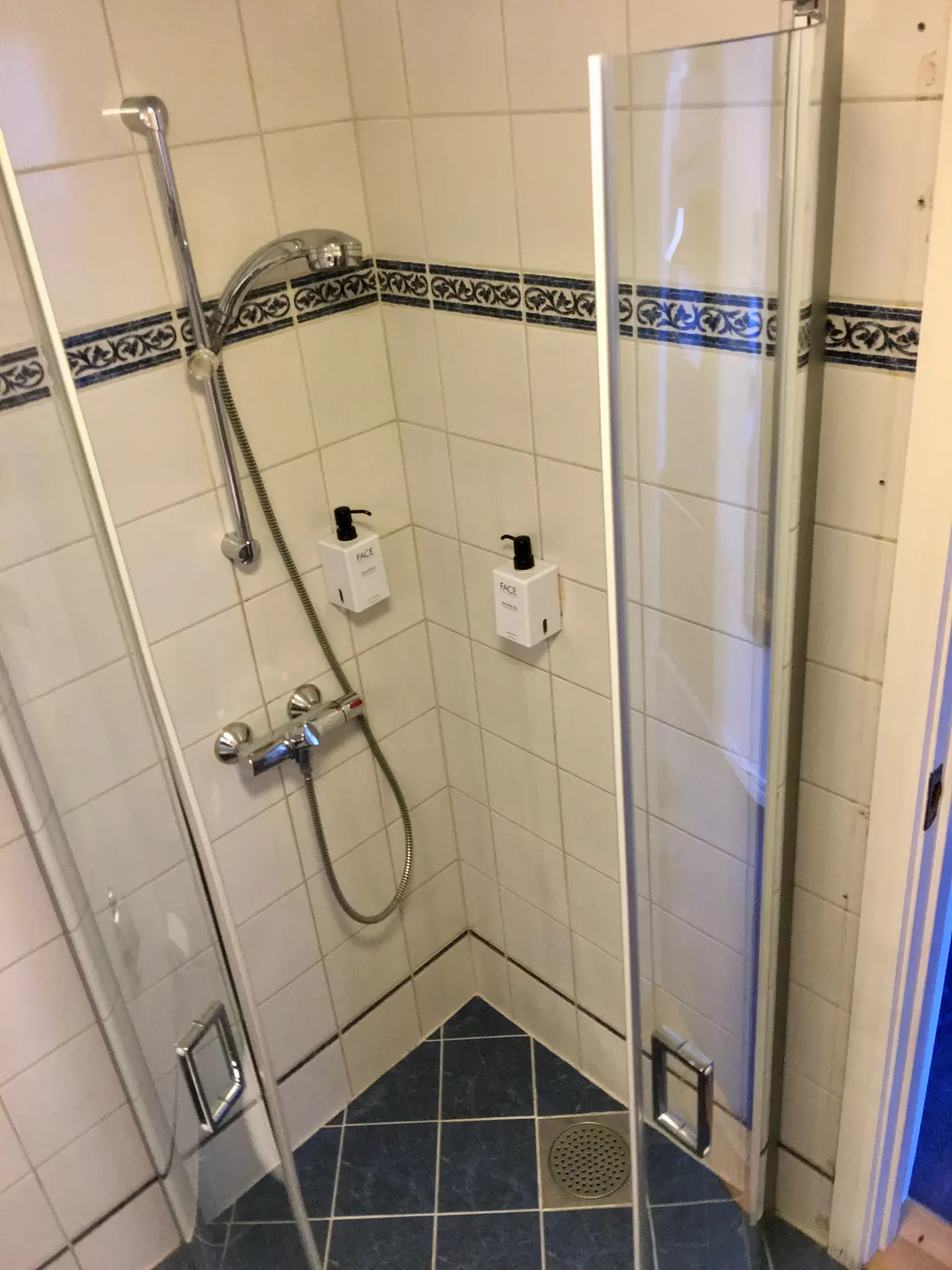
On a shower floor, small pieces can follow the falls to the drain with fewer cuts than large tiles. The system still needs waterproofing under it, turned up the walls at the junction with the floor.
Slip: for barefoot wet areas, ask for a barefoot slip rating (DIN 51097 A, B or C) or a pendulum value with the barefoot rubber slider. See the spoke on anti-slip tiles and R ratings.
Grout: in showers and wet rooms, an epoxy grout or a CG2 grout with the W (reduced water absorption) class; Mapei notes that hygiene grouts contain an additive that "impedes the formation and proliferation of surface mould in damp areas".
Walls: on walls, a non-slip (T) adhesive under EN 12004 stops sheets sliding down; Mapei describes the T class as limiting downward movement to 0.5 mm.
External mosaic on a building face sees sun, heat and wind, and a failure drops pieces onto people below. Treat it as an engineered cladding system:
Use an adhesive its maker lists for external walls. Sika's selection guideline, for example, lists only its two S1-deformable products for exterior use.
Ask the maker for thermal data and confirm the backing sheet is suitable outdoors.
Detail movement joints at each floor line and at changes of material.
Have the substrate (render or concrete) checked for strength and soundness before tiling, and consider pull-off testing on a trial panel.
For large panels, mechanically fixed systems such as ventilated facades with porcelain slabs are an alternative to bonded mosaic; see stone cladding suppliers for comparable systems.
Products named in this guide
Ardex (ARDEX GmbH, Witten, Germany) publishes the RG 12 1-6 epoxy grout data sheet quoted above. Sika publishes the tile adhesive selection guideline quoted above, with SikaCeram-98 and SikaLatex-98 listed for pools. Mapei publishes the explanations of the EN 12004 and EN 13888 classes used here. None of this is a ranking; ask each supplier for the current data sheet for your product and region.
Mosaic RFQ checklist
Area and exposure: pool floor, pool wall, waterline, spa, shower floor, wall, facade.
Mosaic type (glass or porcelain), piece size, sheet size and backing type.
Body absorption (porcelain), chemical resistance, and slip data for floors and pool floors.
Waterproofing system and its compatibility with the adhesive.
Adhesive: EN 12004 class (C2, with T, E and S1 or S2 as needed), listed by its maker for immersion or exterior use.
Grout: EN 13888-1 class (RG epoxy, or CG2 with W and A), colour, and chemical resistance after cure.
Curing time before filling and before cleaning, at the expected site temperature.
ISO 13006, the ceramic tile classification standard, treats as a mosaic any piece that fits inside a square with sides under 7 cm, and excludes mosaics from its scope. Mosaic pieces are usually supplied on paper-faced or mesh-backed sheets so they can be laid like a larger tile. Because the ISO groups do not apply, ask the supplier for absorption, chemical resistance and slip data directly.
Which tiles are best for swimming pools?
Both glass and porcelain mosaic are options for pools. The choice matters less than the system: waterproofing under the tile, an adhesive its maker lists for immersion (at least C2, with S1 or S2 where required), and a grout rated for pool water, often epoxy. Ask for slip data for pool floors and steps.
What grout should be used in a swimming pool?
Reaction resin (epoxy, RG under EN 13888-1) grout is the type makers position for chemical exposure. Ardex, for example, lists swimming pools and spa facilities for its RG 12 1-6 epoxy grout and states resistance to chlorinated water 3 to 4 days after curing. Whatever grout you choose, check that its maker lists it for submerged use in pools.
How long before a newly tiled pool can be filled?
Follow the adhesive and grout makers' data sheets for the site temperature, because chemical resistance comes only with full cure. Ardex's RG 12 1-6 epoxy grout, for example, is walkable after about 12 hours at 18 to 20°C and resists chlorinated water 3 to 4 days after curing. Write the minimum filling time into the programme and do not acid-clean new epoxy for the first 7 days.
Is glass mosaic slippery?
It depends on the finish, so glass mosaic on pool floors, steps and showers needs the maker's slip data for that use. Do not assume that the grout joints make up for a missing test result. For barefoot areas, ask for a DIN 51097 class or a pendulum value with the barefoot slider.
Can mosaic tiles be used on exterior walls in the UAE?
Yes, if they are installed as an engineered system: an adhesive its maker lists for exterior walls (for example a C2 with S1 or S2 deformability), full coverage, a sound substrate, movement joints at floor lines and a backing sheet suitable outdoors. Heat shortens open time, so work in cooler hours. For large areas, consider mechanically fixed ventilated facade panels instead.
How tile sizes work on site: nominal, work and coordinating sizes under ISO 13006, rectified edges, thickness and weight, lippage, substrate flatness and what large-format slabs need.
How to read tile adhesive and grout codes: EN 12004 and EN 13888-1 classes, which to specify for porcelain, large tiles, pools and outdoors, when epoxy grout is worth it and movement joints in heat.
Porcelain and ceramic tiles compared for UAE and Saudi projects: the 0.5% absorption definition, strength and abrasion, outdoor use, adhesives, cutting, cost drivers and which body suits each area.