Porcelain vs Ceramic Tiles: Differences That Matter on Site
Porcelain and ceramic tiles compared for UAE and Saudi projects: the 0.5% absorption definition, strength and abrasion, outdoor use, adhesives, cutting, cost drivers and which body suits each area.
Porcelain and ceramic tiles are both fired clay tiles; the difference that counts is how much water the body absorbs. ISO 13006 calls a tile porcelain only if it is fully vitrified with water absorption of 0.5% or less (groups AIa and BIa). Every other ceramic tile absorbs more. When you compare ceramic and porcelain tile suppliers in the UAE or in Saudi Arabia, ask for the group on the datasheet, not the word on the box.
This spoke is for contractors, consultants and buyers choosing between the two bodies for a specific area. It covers what the standard says, what changes on site (strength, outdoor use, adhesive, cutting) and what drives the price difference. The ISO 13006 group table, abrasion classes and the Saudi and Dubai rules are in our main guide to ceramic and porcelain tiles in the UAE and Saudi Arabia. ListGCC did not test any tiles; the comparison below is drawn from the standards and makers' published information.
The definition: absorption, not appearance
The short answer: porcelain is a water absorption class. ISO 13006:2018 defines a porcelain tile as a "fully vitrified tile with water absorption coefficient less than or equal to a mass fraction of 0,5 %, belonging to groups AIa and BIa". Absorption is measured under ISO 10545-3 (by the vacuum method in the 2018 edition) and expressed as a percentage of the tile's dry mass.
That has three practical consequences:
Glaze does not decide it. Ceramic tiles may be glazed (GL) or unglazed (UGL). A glazed porcelain tile has a porcelain body under the glaze; a glazed wall tile in group BIII has a high-absorption body under a glaze that looks similar. The glaze is impermeable, the body may not be.
"Full body" and "through body" are marketing terms. They describe colour running through the tile, which matters when an edge chips. They do not change the ISO group.
"Vitrified" needs checking. Kajaria, for example, sells glazed and polished vitrified tiles; ISO uses "fully vitrified" inside its porcelain definition. If a datasheet says vitrified, look for the group and absorption figure that go with it.
Porcelain (AIa, BIa)
Other ceramic tiles (AIb to AIII, BIb to BIII)
Water absorption
0.5% or less
Over 0.5%, up to more than 10% in group III
Usual surfaces
Glazed, unglazed, polished, textured
Mostly glazed for walls; some unglazed extruded tiles
Floor abrasion test
ISO 10545-7 if glazed; ISO 10545-6 deep abrasion if unglazed
ISO 10545-7 for glazed floor tiles
Typical places
Floors of every kind, outdoors, facades, pools
Interior walls, light-duty floors, bathroom walls over waterproofing
Adhesive selection
Choose a product the maker lists as suitable for porcelain
Both bodies are tested for breaking strength and modulus of rupture under ISO 10545-4, and the requirements differ by group in the annexes of ISO 13006. Rather than assuming porcelain is "stronger", ask for the tested breaking strength (in newtons) of the exact size and thickness you are buying, because a thin large tile and a thick small tile behave very differently.
For wear, glazed floor tiles carry an ISO 10545-7 class from 0 to 5, set by the number of revolutions before the glaze shows wear. ISO 13006 requires product literature for floor tiles to state that class or the place of use. Unglazed porcelain has no glaze to wear through, so it is tested for deep abrasion (ISO 10545-6) instead, and its colour continues into the body. On a mall floor, a station concourse or a hospital corridor, the abrasion figure for the exact finish matters more than whether the brochure says ceramic or porcelain.
Outdoor use and Gulf heat
Frost resistance (ISO 10545-12) is the property most often quoted for outdoor tiles in Europe, but it rarely decides a choice in the UAE or Saudi Arabia. The Gulf exposures are heat, sun, sand and water: pool splash, irrigation, wash-down and condensation on podium decks.
Absorption: a body that absorbs 0.5% of its mass or less takes up very little of the water from pool splash, irrigation and wash-down, and so carries little of it into the tile. Higher-absorption bodies outdoors deserve a closer look at staining and moisture data.
Thermal behaviour: ISO 10545-8 (linear thermal expansion) and ISO 10545-9 (thermal shock) are the tests to ask for on terraces, roofs and facades. Compare results for the actual series.
Moisture expansion: ISO 10545-10 measures moisture expansion, worth asking about for higher-absorption bodies used anywhere damp.
Slip: outdoor and wet floors need a slip rating as well as the right body. See the spoke on anti-slip tiles and R ratings.
Adhesive and grout
A dense porcelain body gives cement-based adhesives less to key into, which is why adhesive makers state porcelain suitability product by product. Sika's selection guideline, for example, marks porcelain suitability product by product. For porcelain floors, and for any tile outdoors, specify at least an improved cementitious adhesive (C2 under EN 12004) that its maker lists for porcelain, with a deformable S1 or S2 class where the substrate or temperature will move. The classes are explained in the spoke on tile adhesive and grout classes, and you can source products from construction adhesives suppliers in the UAE.
Higher-absorption wall tiles bond readily with standard adhesives, but on bathroom and kitchen walls they still need a waterproofed substrate behind them, because the tile and grout are not the waterproof layer.
Cutting and installation
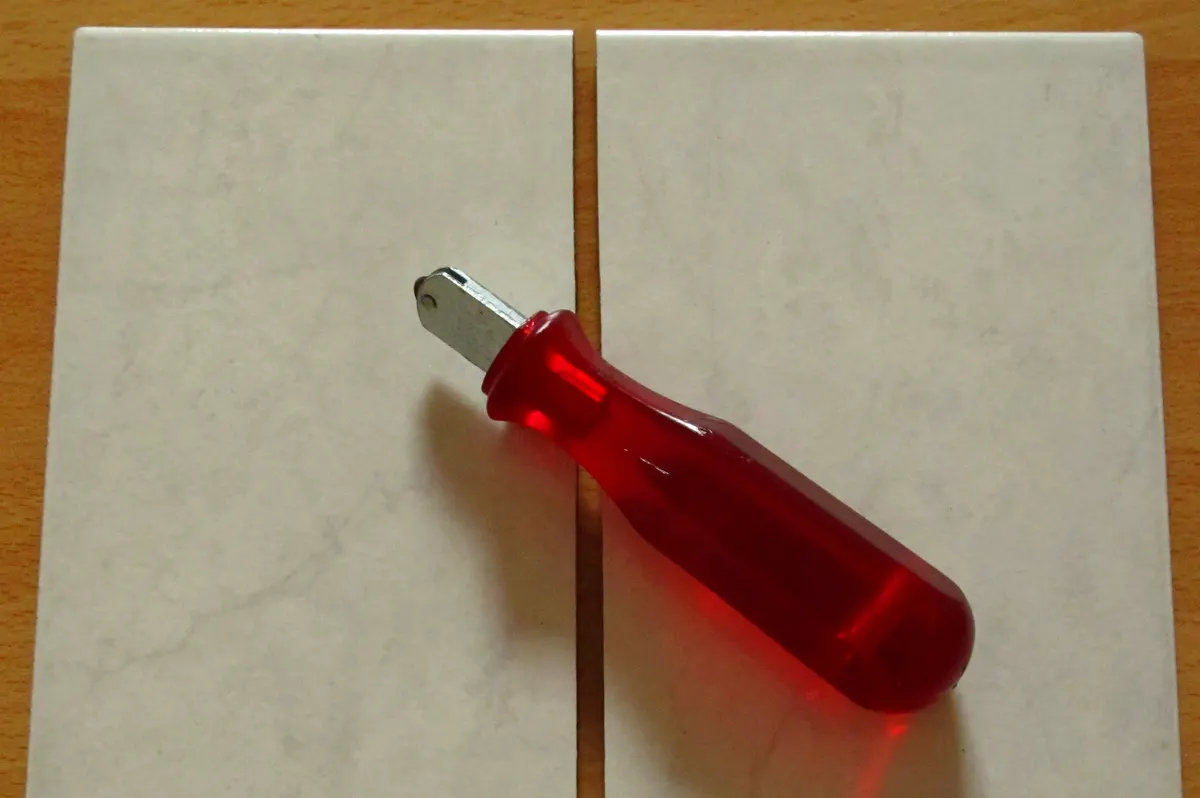
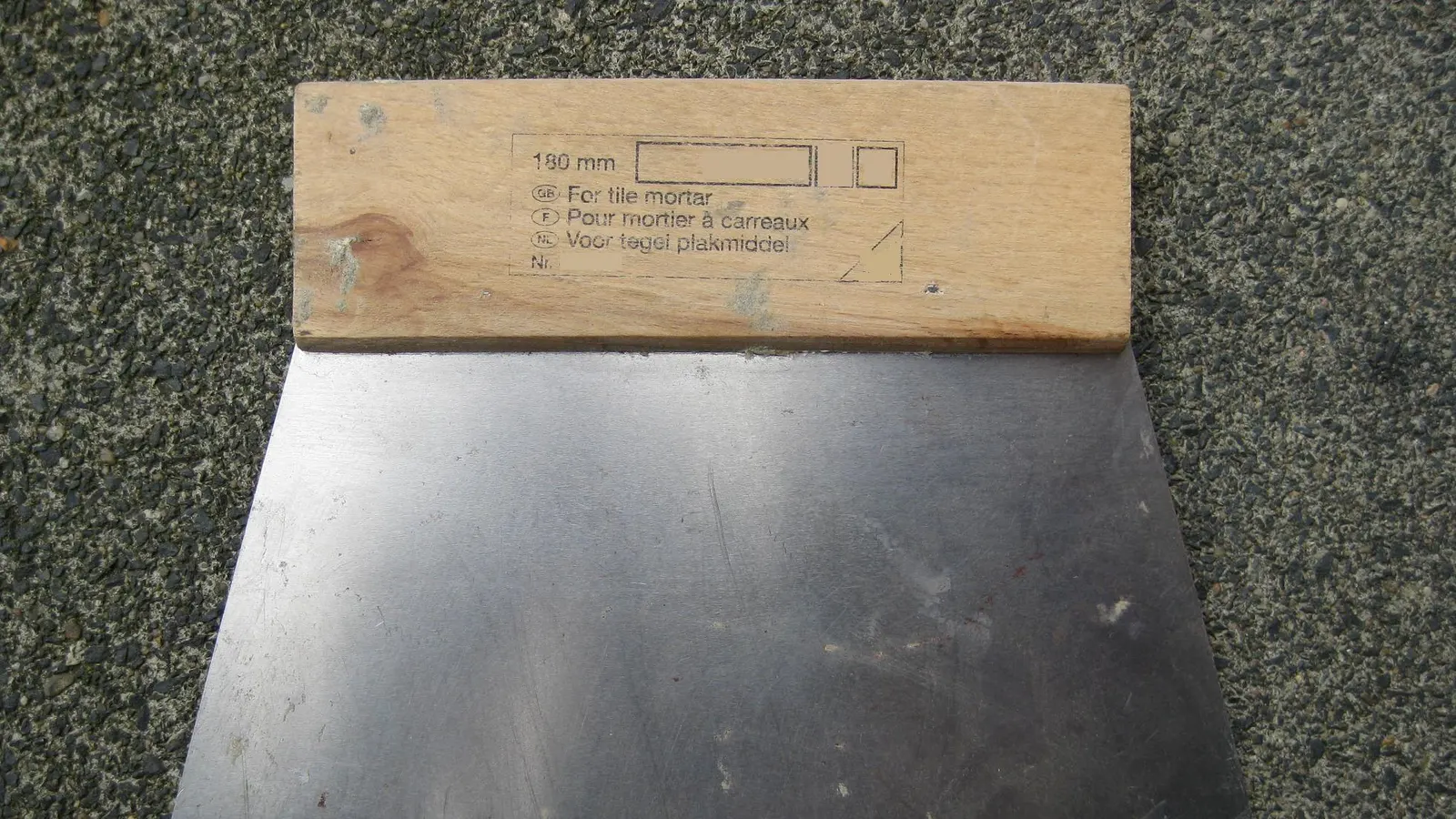
Plan cutting as part of the tile choice. Thin glazed wall tiles can be scored and snapped with a simple hand cutter, as in the photo below. For porcelain, thick tiles and large formats, ask the installer which cutters, saws and core bits they will use and see a cut sample, especially for mitred edges on steps and skirting. ISO 13006 does not cover trim pieces, so where matching trims are not made, they have to be cut from field tiles.
ListGCC does not publish tile prices, because quotes vary with the series, quantity and delivery terms. The difference between a ceramic and a porcelain quote usually comes from these drivers:
Body: porcelain (BIa) or a higher-absorption group, glazed or unglazed.
Size and thickness: large formats and thick outdoor tiles weigh more per square metre to pack, ship and lift.
Edge and surface finishing: rectification, polishing, lapping and structured anti-slip surfaces are extra process steps.
Design: digital print quality, number of faces per design and matching trim pieces.
Origin and logistics: local production in Ras Al Khaimah or Riyadh against imports from India, Europe or East Asia, with freight, duty and certification costs.
Installation system: the adhesive class, cutting method and, for large formats, the labour and lifting equipment the tile needs.
Compare total installed cost per square metre, not tile price alone. A cheaper body that needs replacing in a high-traffic area is not the economical choice.
Makers that offer both
Most large makers sell both bodies, so the choice is per area, not per supplier. RAK Ceramics, based in the UAE, describes its range as ceramic and gres porcelain wall and floor tiles. Kajaria Ceramics in India makes ceramic wall and floor tiles alongside glazed and polished vitrified tiles. Saudi Ceramics in Riyadh lists indoor, outdoor and porcelain tiles. Whichever maker you choose, ask for the ISO 13006 group, the abrasion class and the slip data for each series, and check that Saudi supply carries the SASO Quality Mark that the building materials regulation requires for ceramic tiles.
Which to choose, area by area
Living areas and bedrooms: either body on floors where traffic is light; porcelain where you want one tile through the whole unit including balconies.
Bathroom walls: glazed ceramic over waterproofing is common and economical; porcelain where the same tile runs onto the floor.
Bathroom and kitchen floors: porcelain with a slip rating suited to wet use.
Commercial floors: porcelain, with the abrasion and slip data written into the specification.
Outdoor terraces, roofs, pool surrounds, facades: porcelain, often in thicker formats, with thermal and slip data and a deformable adhesive.
Porcelain is not better in every place; it is denser. Under ISO 13006 it absorbs 0.5% of its dry mass or less, which suits floors, outdoor areas, pools and facades. Glazed ceramic wall tiles with higher absorption are a sound, lower-cost choice for interior walls over a waterproofed substrate. Choose by the area's traffic, water and temperature, then check the abrasion and slip data.
How can I tell if a tile is really porcelain?
Look for the ISO 13006 group on the datasheet or box: AIa or BIa means water absorption of 0.5% or less, the standard's definition of porcelain. ISO 13006 requires packaging to state the group or annex, so a box without it is incomplete. For large orders, ask for a water absorption test report to ISO 10545-3 on the delivered batch.
Is vitrified tile the same as porcelain?
Not automatically. "Vitrified" and "glazed vitrified" are trade names used, for example, by Kajaria in India, while ISO 13006 uses "fully vitrified" as part of its porcelain definition with a 0.5% absorption limit. Ask for the group and the measured absorption figure, and treat the tile as porcelain only if it falls in AIa or BIa.
Can ceramic tiles be used outdoors in the UAE?
Some can, but porcelain is the safer specification outside because it absorbs 0.5% of its mass or less, so it takes up little of the water from irrigation, pools and wash-down. Frost is rarely the deciding factor in the UAE or Saudi Arabia; heat, sun and water are. Whatever the body, ask for thermal expansion and thermal shock data, a slip rating and a deformable adhesive.
Why does porcelain need a different adhesive?
A dense, low-absorption body gives a cement-based adhesive less to bond into, so adhesive makers state which products suit porcelain. For porcelain floors and outdoor work, specify at least an improved C2 adhesive under EN 12004 that its maker lists for porcelain, with S1 or S2 deformability where movement is expected. Check the adhesive maker's data sheet for the tile size and substrate.
Is polished porcelain slippery?
It can be when wet. Polishing gives a glossy mechanical finish, and the slip rating depends on the finish, not the body. For dry interiors a polished tile may be acceptable; for entrances, wet areas and outdoors, ask for an R rating or pendulum value for the exact finish, and consider matt or structured versions of the same series.
How tile sizes work on site: nominal, work and coordinating sizes under ISO 13006, rectified edges, thickness and weight, lippage, substrate flatness and what large-format slabs need.
How to read tile adhesive and grout codes: EN 12004 and EN 13888-1 classes, which to specify for porcelain, large tiles, pools and outdoors, when epoxy grout is worth it and movement joints in heat.
Glass and porcelain mosaic for pools, showers and facades in the UAE and Saudi Arabia: what counts as mosaic, adhesive and grout classes, pool water, curing before filling and facade rules of thumb.