Hot-Weather Concreting in the UAE and Saudi Arabia
How to pour concrete through a Gulf summer: temperature limits, cooling the mix with chilled water and ice, retarding admixtures, pour timing and the midday work ban, curing and testing.
Hot-weather concreting in the UAE and Saudi Arabia means keeping the fresh concrete cool and wet: chill the mix with cold water or ice, slow the set with a retarding admixture, pour in the cooler hours, protect the surface from sun and wind, and start curing straight after finishing. Agree the temperature limit, the admixtures and the curing method with your ready-mix concrete supplier in the UAE or in Saudi Arabia before the first summer pour.
This guide is for site engineers, contractors, ready-mix producers and QA/QC teams who place concrete through a Gulf summer. It covers what heat does to concrete, how to cool the mix, admixtures, pour timing and the midday work ban, curing, and testing. Cement and binder choice is covered in our main guide to cement types, brands and rules in the UAE and Saudi Arabia; here we deal with what happens from batching to curing.
What hot weather does to concrete
The American Concrete Institute's Guide to Hot Weather Concreting (ACI PRC-305-20) treats hot weather as a combination of conditions, not just air temperature: high ambient temperature, low humidity, high wind, or low humidity and high wind together. These affect mixing, transporting and placing. ACI lists the potential problems as:
Faster setting, which makes handling, compacting and finishing harder.
Faster evaporation from the surface, which raises the risk of plastic shrinkage cracking and leaves less water for curing.
Slump loss, and lower ultimate strength if water is added on site to restore it.
Thermal cracking when the surface cools faster than the interior.
Behind all four are two causes: faster cement hydration at high temperature and faster moisture loss from the surface. A Gulf summer brings both, so the measures below are routine there, not exceptional.
The temperature limit: agree it before you pour
ACI's companion Specification for Hot Weather Concreting (ACI SPEC-305.1-14(20)) sets requirements for a preplacement conference, mixture proportions, the maximum temperature of fresh concrete at discharge, measurement of the surface evaporation rate, evaporation control and curing. The limit that applies to your job is whatever the project specification states; ASTM C94, the specification for ready-mixed concrete, says that where the purchaser's requirements differ from it, the purchaser's specification governs. So:
Find the maximum concrete temperature at discharge in the project specification, and the method of measurement (ASTM C1064 covers measuring the temperature of freshly mixed concrete).
Put the limit, the testing frequency and what happens to a load that exceeds it into the ready-mix purchase order.
For mass pours, also agree the maximum peak temperature and the maximum difference between core and surface, and how they will be monitored.
Cooling the mix
Most of the cooling happens at the batching plant. The usual methods:
Method
What it does
Points to agree
Chilled mixing water
Replaces part of the mix water with cold water. ConcreteNetwork puts the reduction at up to about 10°F (about 5.5°C).
Chiller capacity at the plant for your pour rate
Ice
Replaces part of the mix water with ice; up to about 20°F (about 11°C) reduction, by the same source.
Ice must melt completely before mixing is finished
Liquid nitrogen
Injected into the mixer for larger drops in extreme conditions.
Availability and cost; usually for critical pours
Shaded or sprayed aggregates
Aggregates are most of the volume, so keeping them cool lowers mix temperature.
Stockpile shading and water spraying at the plant
Cool cement
Using several silos lets freshly delivered cement cool before use.
Silo rotation at the plant
None of these change the water-cement ratio, which is the point: adding water to make hot concrete workable lowers strength. Ask the plant which methods it runs, and whether its batching plant has the chiller or ice capacity for your peak hourly rate.
Binder choice helps
Slag and fly ash lower heat of hydration. The FHWA says replacing cement with fly ash reduces heat rise in mass concrete without sacrificing long-term strength, EMSTEEL says its slag improves workability in warm weather, and Dubai Municipality warns that CEM I mixes may increase heat of hydration and thermal cracking risk in mass or restrained elements. Our guide to GGBS and fly ash in Gulf concrete covers the trade-off: slower early strength.
Admixtures for hot weather
ASTM C494, the specification for chemical admixtures, defines seven types. Three matter most in summer:
Type B, retarding: slows setting to give time for transport, placing and finishing.
Type D, water reducing and retarding: retards and keeps workability without extra water.
Type G, high-range water reducing and retarding: for flowing or pumped concrete with long travel times.
Water reducers (Types A and F) also help with slump loss without raising the water-cement ratio. Dose rates depend on concrete temperature and travel time, so agree a summer and a winter dosage at trial-mix stage with the concrete admixture supplier and the ready-mix plant, not on site.
Several construction chemical makers serve the Gulf. Sika's GCC business, based in Dubai Industrial City with companies in the UAE, Saudi Arabia and other Gulf states, lists retarders, plasticisers and superplasticisers among its concrete admixtures and says it formulates products for hot climates. Fosroc, a global construction chemicals manufacturer, lists concrete admixtures and a range of curing compounds. In Saudi Arabia, compare concrete admixture suppliers for local stock.
Pour timing and the midday work ban
Schedule pours for early morning or evening and night, when air temperature and solar heating are lowest. Both countries also restrict outdoor work in summer:
UAE: the Ministry of Human Resources and Emiratisation's midday break bans outdoor work in direct sun from 12.30 pm to 3 pm between 15 June and 15 September. Gulf News reports that work which cannot be paused for technical or public safety reasons, including concrete pouring, may continue.
Saudi Arabia: the Ministry of Human Resources and Social Development bans outdoor work in direct sun from 12 pm to 3 pm between 15 June and 15 September.
A large pour that runs through midday therefore needs planning: shaded rest areas, water and cooling for the crew, and a check that the activity qualifies for any exemption. Our guide to heat stress and PPE for outdoor work in the Gulf covers the worker side.
Hold the preplacement meeting. ACI 305.1 makes it a requirement: agree temperature limits, admixture dosing, pour sequence, finishing and curing before the day.
Keep trucks moving. Plan pump and crew capacity so trucks are not waiting in the sun.
Cool the subgrade. Wet down the subbase before the pour, without leaving standing water.
Shade and shelter. Use sunshades and windbreaks over slabs where you can.
Do not add water on site beyond what the mix design allows. Use the agreed admixture instead.
Use an evaporation retarder sprayed on the surface during finishing, to slow moisture loss before curing starts.
Watch the evaporation rate. ACI's guide includes a method for calculating the estimated evaporation rate, and ACI 305.1 calls for measuring it. When it is high, step up protection.
Curing in Gulf heat
Curing keeps water in the concrete so the cement can keep hydrating. In hot, dry, windy conditions moisture loss is fast, and poorly cured concrete may not reach its strength and can suffer plastic shrinkage cracking, scaling and lower durability. Start as soon as finishing allows. The main methods:
Membrane-forming curing compounds sprayed on the finished surface. ASTM C309 covers them; its Type 2 compounds are white-pigmented, and the standard notes that white pigment also reduces the temperature rise of concrete exposed to the sun.
Wet coverings such as hessian or curing blankets, kept continuously damp. ConcreteNetwork recommends at least 7 days of wet curing.
Misting or fogging, often combined with coverings.
Polyethylene sheeting secured over the surface to hold moisture in.
Check that any curing compound is compatible with later finishes, coatings or waterproofing, and follow the curing period in the project specification. Mixes with slag or fly ash gain strength more slowly, so do not cut curing short on them.
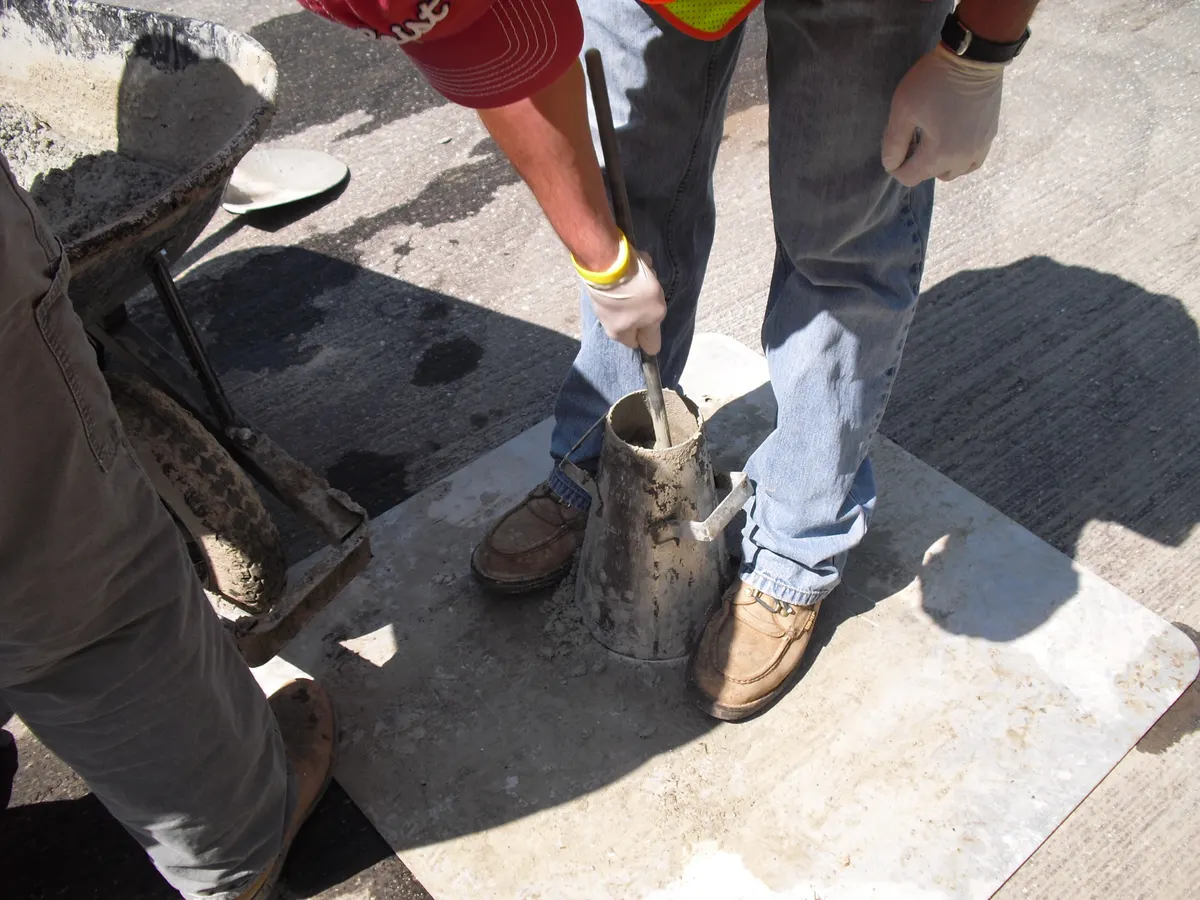
Temperature on arrival, to ASTM C1064, alongside slump, for every load or at the frequency the specification sets. Reject loads above the limit as agreed in the order.
Test specimens made and cured in the field to ASTM C31 (or the European equivalent in your specification). Lab-cured specimens do not show how the in-place concrete behaved in the heat.
In-place strength for striking or stressing decisions can be estimated from the concrete's temperature history with the maturity method (ASTM C1074).
Mass pours: log core and surface temperatures to check the agreed peak and differential limits.
Hot-weather pour checklist
Maximum concrete temperature at discharge and its test method, written into the purchase order.
Mix design with the agreed binder (SCM content where required) and summer admixture dosing from trial mixes.
Plant cooling: chilled water, ice or both, sized for the pour rate.
Pour start time, sequence, pump capacity and truck spacing; midday work ban plan.
Sunshades, windbreaks and evaporation retarder on site.
Curing method, materials and duration, with someone responsible for it.
Testing plan: temperature, slump, specimens, and temperature monitoring for mass pours.
What is the maximum concrete temperature in hot weather?
The limit is set by the project specification. ACI's Specification for Hot Weather Concreting (ACI 305.1) includes a maximum temperature of fresh concrete at discharge, and ASTM C94 lets the purchaser's specification govern ready-mixed concrete. Write the limit, the test method (ASTM C1064) and the action for loads above it into the purchase order.
How do you cool concrete in summer?
Replace part of the mixing water with chilled water or ice, shade and spray the aggregates, and let cement cool in the silos before use. For extreme conditions, liquid nitrogen can be injected into the mixer. On site, pour in the cooler hours, wet down the subbase and use sunshades and windbreaks.
Can you pour concrete during the UAE midday break?
The UAE bans outdoor work in direct sun from 12.30 pm to 3 pm between 15 June and 15 September. Gulf News reports that work which cannot be paused for technical reasons, including concrete pouring, may continue. Plan large pours to avoid midday where possible and provide shade, water and rest for workers when they cannot.
How long should concrete be cured in hot weather?
Follow the project specification. ConcreteNetwork recommends at least 7 days of wet curing in hot weather, and mixes with slag or fly ash need curing for the full period because they gain strength more slowly. Start immediately after finishing, using wet coverings, misting, sheeting or a membrane-forming compound.
What causes plastic shrinkage cracking?
Water evaporating from the surface of fresh concrete faster than it can be replaced. High air temperature, low humidity and wind all raise the evaporation rate. Prevent it with an evaporation retarder during finishing, sunshades and windbreaks, cooler concrete and prompt curing.
Which admixtures are used for hot weather concreting?
Retarders (ASTM C494 Type B), water-reducing retarders (Type D) and high-range water-reducing retarders (Type G) slow setting and keep workability without adding water. Dosage depends on concrete temperature and travel time, so agree it at trial-mix stage with the admixture supplier and the ready-mix plant.
When to specify OPC, sulphate resisting cement or white cement in the UAE and Saudi Arabia: the chemistry, the standard names, why SRC alone does not stop chloride corrosion, and where white cement fits.
How GGBS and fly ash work in concrete, how much cement they replace, what they do for heat and durability, the standards and Dubai and Saudi rules, and who supplies them in the Gulf.
Which UAE cement factories make OPC, SRC, white cement, GGBS and clinker, where each plant is, which producers are listed on ADX, and how to buy in bulk, bags or for export.