Cement in the UAE and Saudi Arabia: OPC, SRC, Blended Types and Producers
Who makes cement in the UAE and Saudi Arabia, how OPC, SRC, white and blended cements differ, what Dubai Municipality and SASO require, and what to put in a cement RFQ.
The UAE and Saudi Arabia both make their own cement. In the UAE you will meet Holcim UAE (formerly Lafarge Emirates Cement), Fujairah Cement Industries, Sharjah Cement and UltraTech's Star Cement. In Saudi Arabia the main names are listed producers such as Yamama, Southern Province, Yanbu, City and Arabian Cement. Most of what they sell falls into three groups: ordinary Portland cement (OPC), sulphate resisting cement (SRC) and blended cements. Compare Portland cement suppliers in the UAE or in Saudi Arabia on ListGCC. Choose by type, by the standard it is certified to and by the rules where you build. Do not choose by brand alone.
This guide is for contractors, ready-mix and precast producers, consultants and procurement teams buying cement for projects in the UAE and Saudi Arabia. It explains the cement types and how they are labelled under the European and ASTM systems. It covers why Gulf specifications push for slag and fly ash, the current Dubai Municipality mix rules and the Saudi technical regulation for cement. It also shows what the main producers list on their own websites and what to put in an RFQ.
Cement types at a glance
Gulf specifications use two naming systems side by side. You will see European designations (EN 197-1, written as CEM I, CEM II and so on, followed by a strength class such as 42.5N) and American ones (ASTM C150 Type I to Type V, ASTM C595 for blended cements). Many producers certify the same product to both. Fujairah Cement Industries, for example, lists its ordinary Portland cement as BS EN 197-1 CEM I 42.5N and as ASTM C150 Type I.
What buyers call it
European designation
ASTM designation
Typical use
Ordinary Portland cement (OPC)
CEM I, e.g. 42.5N
C150 Type I
General structural concrete, blocks, precast, mortar
Moderate sulphate resisting
No direct equivalent
C150 Type II (moderate sulphate resistance or moderate heat of hydration)
Concrete with moderate sulphate exposure
Sulphate resisting cement (SRC)
CEM I-SR (e.g. SR5)
C150 Type V (high sulphate resistance)
Foundations and buried concrete in sulphate-bearing ground or groundwater
Low heat cement
No direct equivalent
C150 Type IV (low heat of hydration)
Mass concrete where temperature rise must be limited
Portland-limestone or "finishing" cement
CEM II/A-L
C595 Type IL
Plaster, render, block work and, where allowed, structural concrete
Portland-pozzolana cement
CEM II/A-P, CEM II/B-P
C595 blended types
General concrete with lower clinker content
Slag and fly ash cements
CEM II/B-S, CEM II/B-V, CEM III/A
Blended at the batching plant using slag (C989) or fly ash (C618)
Durable concrete in chloride and sulphate exposure
The ASTM type descriptions in this table follow the scope of the Gulf standard for Portland cement, GSO 1914, which lists Types I to V and the air-entraining variants IA, IIA and IIIA. Type III is the high early strength cement.
Ordinary Portland cement
OPC is the default. It is CEM I under EN 197-1 and Type I under ASTM C150. The strength class matters as much as the type: 42.5N is the grade most Gulf producers list, and some also make a higher grade. Yanbu Cement, for example, lists OPC 42.5N and a "Premium Portland Cement" at OPC 52.5R. Specify the class your mix design was based on, because a ready-mix plant cannot simply swap 42.5N for 52.5R without new trial mixes.
Sulphate resisting cement
SRC is the cement for concrete exposed to sulphates in soil or groundwater. ASTM C150 calls it Type V, "high sulfate resistance". Fujairah Cement lists its SRC as ASTM C150 Type V and to BS 4027 Class 42.5N. Qatar National Cement lists its SRC to BS EN 197-1 CEM I 42.5N SR5. Sulphate resistance and chloride resistance are not the same thing. Where groundwater carries both sulphates and chlorides, as in the coastal sabkha soils of eastern Saudi Arabia, researchers have studied plain Type I and Type V cements against blends with fly ash, silica fume and slag. Dubai's rules, covered below, go further and require GGBS or fly ash in all substructure concrete.
Blended cements and supplementary materials
Blended cements replace part of the clinker with ground granulated blast furnace slag (GGBS), fly ash, natural pozzolana or limestone. In the Gulf the replacement is often done at the ready-mix plant rather than in the bag: the batching plant weighs OPC and GGBS or fly ash separately. Under the European system, the same idea appears as factory-made cements such as CEM II/B-S (Portland-slag), CEM II/B-V (Portland fly ash) and CEM III/A (blast furnace cement).
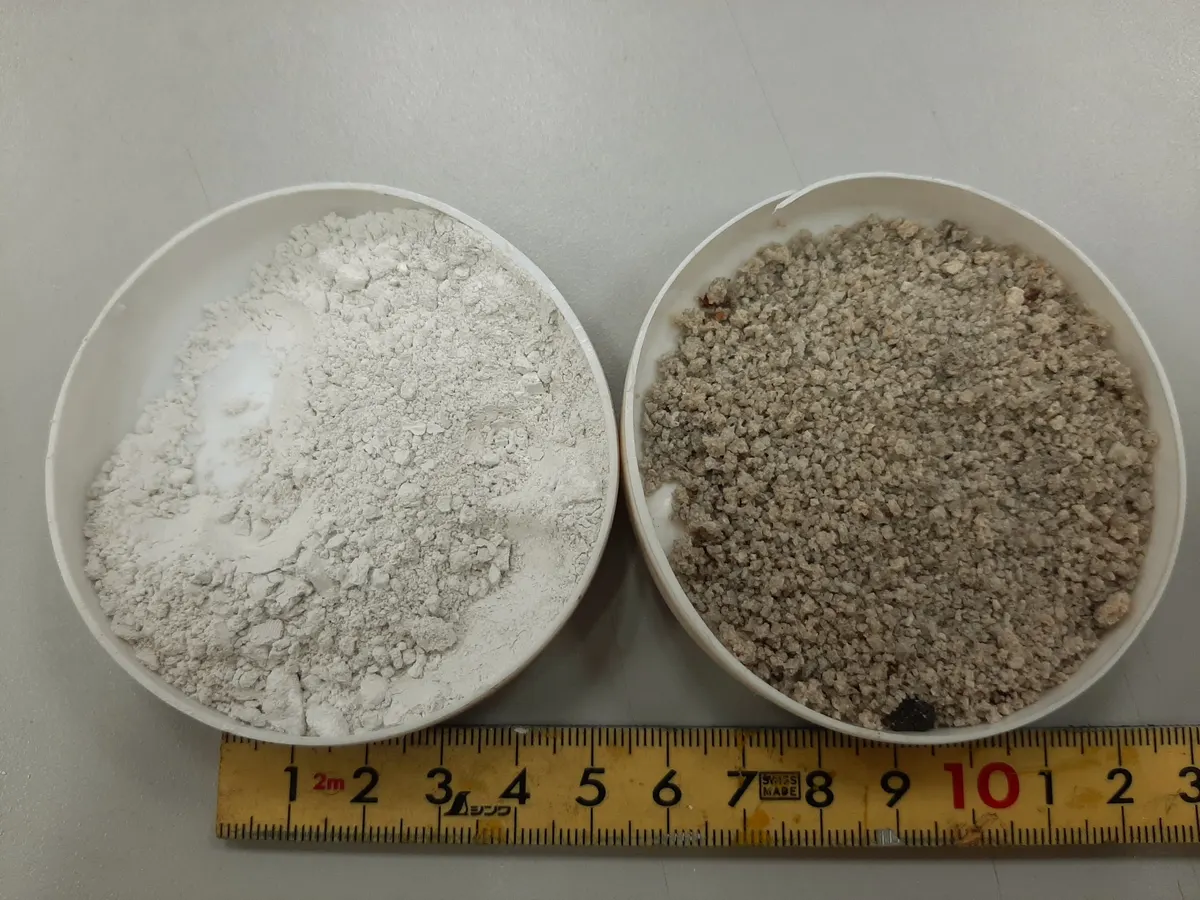
Ground granulated blast furnace slag (left) next to unground granulated slag (right). GGBS is the powder that replaces part of the cement in many Gulf concrete mixes. Photo: Giám Định, CC BY-SA 4.0, via Wikimedia Commons
Saudi Arabia's building materials regulation lists the standards these materials must meet. They include SASO-GSO-EN 15167-1 for GGBS, SASO-ASTM C618 for fly ash and natural pozzolan, and SASO-ASTM-GSO C989 for slag cement. It also lists SASO-ASTM C1240 for silica fume and SASO-ASTM C595 for blended hydraulic cements. Ask for these certificates alongside the cement certificate when you buy SCMs separately.
White cement
White cement is a Portland cement used for architectural and decorative work where colour matters. Qatar National Cement lists a white cement to EN 197-1 CEM I 42.5N. UltraTech sells white cement under the Birla White brand, with 3.5 million tonnes a year of white cement capacity according to its website.
Why Gulf specifications push slag and fly ash
Gulf concrete faces high temperatures, chloride-laden air near the coast, saline groundwater and, in places, sulphate-rich soils. Dubai Municipality says it introduced mandatory supplementary cementitious materials "to enhance the durability of concrete structures in Dubai's aggressive service environment and to support sustainable concrete practices". DM's 2026 circular adds that where heat of hydration is a concern, lower-clinker cements containing pozzolana may offer an advantage over CEM I. Replacing clinker also cuts embodied carbon, which is why low-carbon products such as Holcim's ECOPlanet are marketed on it.
Ask the ready-mix supplier for strength development and workability data for any high-replacement mix before you fix formwork striking times and pour sequences. Concrete admixtures such as superplasticisers and retarders are part of that mix design, so agree them at trial-mix stage.
UAE rules for cement and concrete
Dubai: SCMs are the baseline, with a temporary relaxation for superstructures
In Dubai, cement selection is driven by Dubai Municipality (DM) rules on concrete mixes. Section F.6.2.3 (Table F.3) of the Dubai Building Code and DM Circular 7.2.1 (Attachment 7.2.1.4) mandate GGBS or fly ash in structural concrete mixes in the emirate.
In 2026 DM issued Attachment 7.2.2.1 (Rev 03), a temporary amendment for superstructures. Its main points:
Substructures are unchanged. Foundations, pile caps, rafts, basement walls and retaining walls must still contain GGBS or fly ash. The amendment grants no relaxation for substructures.
Superstructures may use higher-clinker cements for now. Columns, walls, beams and suspended slabs above ground floor may use BS 8500-1:2023 Combined Performance Category A1 or B1 cements without GGBS or fly ash. Category A1 includes CEM I and CEM II/A-P, and B1 includes CEM II/A-L of strength class 42.5 or higher.
Coastal work has extra limits. For XS1 exposure (within about 1 km of the coast), A1 or B1 cements need 45 mm minimum cover. Lower cover requires a Category A2 slag or fly ash cement such as CEM III/A or CEM II/B-V.
Approved products only. Except for CEM I and CEM I-SRC, only cement products approved under the Dubai Sustainable Concrete Baseline (DSCB) scheme may be used.
Minimum strength. Structural concrete must reach the Dubai Building Code minimum cube strength of 35 MPa (C28/35). Blinding can be C16/20 with CEM I, CEM II/A-P, CEM II/A-L or SRC.
The circular stays in force until DM withdraws it. After that, mixes revert to full SCM requirements. DM also asks consultants not to over-specify strength and cement content. It warns that CEM I mixes raise heat of hydration and thermal cracking risk in mass or heavily restrained elements. For a buyer, the practical point is simple. Your cement and SCM order depends on which element the concrete is for, so ask the consultant for the exposure class and cement category on each drawing before you place an order with a ready-mix concrete supplier in the UAE.
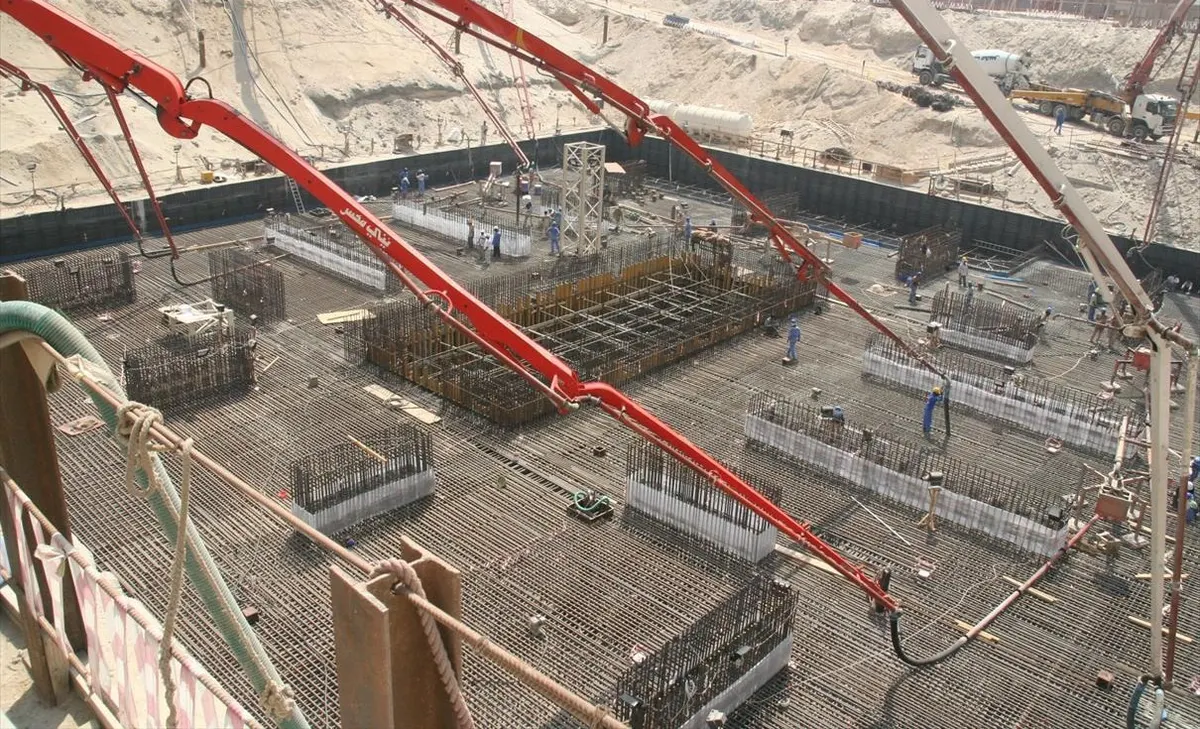
Concrete pumps over a reinforced raft foundation at Sulafa Tower, Dubai Marina, in 2007. Substructure concrete like this still needs GGBS or fly ash under Dubai rules. Photo: Imre Solt, CC BY-SA 3.0, via Wikimedia Commons
Other emirates
Abu Dhabi, Sharjah and the northern emirates have their own building authorities and project specifications. Do not assume Dubai's circular applies outside Dubai. Get the cement and SCM requirements from the project specification and the relevant authority before you commit to a mix.
Saudi rules for cement
In Saudi Arabia, cement is covered by the SASO Technical Regulation for Building Materials, Part 3: Hydraulic Connections and Related Products (regulation 02-07-17-161). SASO's board approved it in 2017, and an amendment was published in the Official Gazette in January 2022. Its scope covers cement, ready-mix concrete, mortars, aggregates, admixtures, concrete blocks and precast products.
Quality mark. The supplier that places cement or ready-mix concrete on the Saudi market must hold the Saudi Quality Mark or its equivalent. Other products in the regulation need a certificate of conformity from a SASO-approved notified body.
Standards. Annex 1 lists the standards products must meet. Portland cement is listed under SASO-GSO 1914, blended cements under SASO-ASTM C595, and there are entries for masonry, expansive and rapid-hardening cements. The annex warns that the list is revised and suppliers must use the latest editions. The GSO catalogue now shows the 2009 edition of GSO 1914 as historical, so ask which edition a certificate refers to.
Labelling. Labels must be in Arabic, or Arabic and English. They must show the supplier's name and commercial registration, country of origin, storage requirements, and validity period and batch number where required. Packaging must follow the relevant standard and be free of lead and heavy metals.
Enforcement. Regulatory authorities can sample at ports, plants and markets, charge suppliers for testing, and withdraw non-conforming product.
In practice Saudi producers label to SASO-adopted ASTM standards. Yamama Cement, for example, lists its OPC as SASO-ASTM C150 Type I, its SRC as SASO-ASTM C150 Type V and its finishing cement as SASO-ASTM C595 Type IL. Our guide to sourcing industrial suppliers in the UAE and Saudi Arabia covers how to check supplier credentials. Local ready-mix concrete suppliers in Saudi Arabia fall under the same quality mark requirement.
Cement producers in the UAE
Producers are described from their own websites or, where noted, news reports. The order is not a ranking.
Lafarge Emirates Cement rebranded as Holcim UAE in November 2025, Khaleej Times reported. It is part of the Holcim group. The report says the company runs integrated operations from its quarry in Fujairah to job sites in Dubai, and supplies Dubai and Sharjah. On its website Holcim UAE says it has been in the UAE "for over forty years". Its headline cement product is ECOPlanet, which the company describes as made in the UAE from UAE materials, with "a 30% reduction in carbon emissions compared to traditional cement" and EPD verification. Suits contractors and developers who want a lower-carbon cement with an environmental product declaration for LEED, BREEAM or Estidama credits.
Fujairah Cement Industries was established in the Emirate of Fujairah on 20 December 1979. Its plant is at Dibba. The company lists OPC (BS EN 197-1 CEM I 42.5N and ASTM C150 Type I), sulphate resisting Portland cement (BS 4027 Class 42.5N and ASTM C150 Type V), moderate sulphate resisting cement (ASTM C150 Type II) and clinker. It supplies "both in bulk and 50 kg bags". Suits buyers who need dual BS EN and ASTM certification, or a Type II cement.
UltraTech, the cement company of India's Aditya Birla Group, says its operations span the UAE, Bahrain, Sri Lanka and India. It describes itself as the world's largest cement company by sales volume and capacity outside China. Its timeline records the "Acquisition of Star Cement in the Middle East" in 2010. UltraTech also makes white cement under the Birla White brand. Suits buyers who want a large group behind a Gulf supply source, including white cement.
Sharjah Cement
Sharjah Cement and Industrial Development Co. (PJSC) was incorporated in Sharjah in 1977 and is listed on the Abu Dhabi Securities Exchange. It makes cement, paper sacks and plastic ropes, and sells in the UAE and other markets in the Middle East, Africa and Asia.
Cemex makes cement, ready-mix concrete and aggregates. On its locations page it lists a UAE entity, Cemex Topmix LLC, in Al Quoz Industrial Area 3, Dubai. Its Vertua range is its lower-carbon concrete line.
Other producers with ListGCC brand pages
Union Cement also has a brand page. Its own website could not be reached when this guide was researched, so ask it directly for its current product list and certificates. Qatar National Cement is based in Qatar, with plants at Umm Bab, 82 km from Doha. It lists OPC and SRC to BS EN 197-1, white cement to EN 197-1 CEM I 42.5N and GGBS to BS EN 15167-1.
Cement producers in Saudi Arabia
Several large Saudi producers are listed on the Saudi Exchange (Tadawul). The table summarises what each producer's own website states.
Producer
Base and plants
Products listed
Listing
Yamama Cement
Riyadh; established 1956; plant capacity up to 20,000 tonnes a day
OPC (Type I), SRC (Type V), finishing cement (Type IL)
Yamama Cement, established in 1956 and based in Riyadh, lists three cements, each to a SASO-adopted ASTM standard: OPC (Type I), SRC (Type V) and a finishing cement (C595 Type IL). Suits contractors and block makers in the central region who want a clear Type I, Type V and Type IL choice.
Southern Province Cement runs three plants. Jazan, its first, began production in 1982. Bisha began in 1997. Tihama, in Al Qunfudhah governorate, is its largest. The company states total clinker capacity of about 30,400 tonnes a day. It lists sulphate resisting, ordinary Portland, finishing and Portland pozzolana cements. Suits projects in the south and west of the Kingdom.
Other producers with ListGCC brand pages
Saudi Cement also has a brand page. Its website could not be reached when this guide was researched, so ask it directly for its product list and current Saudi Quality Mark certificates.
Bags or bulk
Bagged cement (Fujairah Cement, for example, supplies 50 kg bags) suits block making, masonry, plastering and small sites. Bulk cement goes by tanker to silos at cement and concrete plants, ready-mix plants and precast concrete plants. It needs silo capacity and a steady draw, but it avoids bag handling and waste.
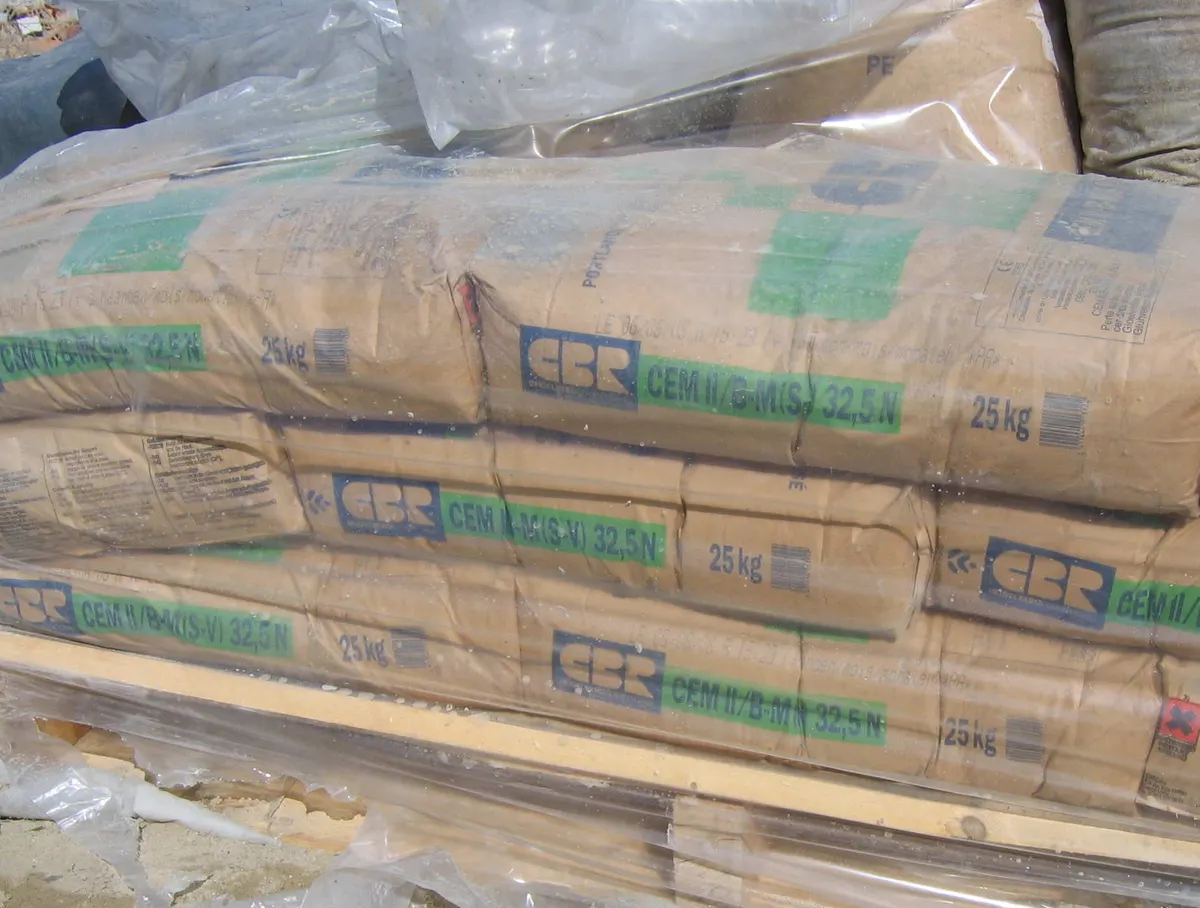
A pallet of 25 kg bags printed with an EN 197-1 designation, CEM II/B-M (S-V) 32.5N, a composite cement containing slag and fly ash. Check the designation on the bag against your specification. Photo: KVDP, public domain, via Wikimedia Commons
Whichever you buy, the type, strength class and standard should be printed on the bag or the delivery ticket. Saudi rules also require Arabic labelling, origin and storage requirements. Concrete block and paver makers are some of the largest bagged and bulk buyers outside the ready-mix sector, and their own product standards depend on consistent cement.
Hot weather and Gulf conditions
Summer heat is the condition that most often changes a cement choice in the Gulf. ACI's Guide to Hot Weather Concreting (ACI PRC-305-20) covers material selection, precooling, batching, placing, curing and testing in hot weather, and how to estimate evaporation rate. In practice this means:
Prefer lower-heat binders (slag, fly ash or pozzolana blends) for thick sections. DM's circular warns that CEM I mixes raise thermal cracking risk in mass concrete.
Plan for slower early strength with blended mixes, and cure longer.
Agree retarder and superplasticiser dosing with the ready-mix supplier for the travel time and the time of day you will pour.
Store bagged cement off the ground, under cover and away from humidity, and use it in delivery order.
What drives the cement price
This guide does not quote prices. Cement prices in the UAE and Saudi Arabia move with fuel and power costs, clinker supply, freight distance from the plant, bag or bulk delivery, order volume and payment terms. Specialty products such as SRC, white cement and low-carbon cements usually price differently from OPC. Ask for quotes on the same basis (type, class, standard, bag or bulk, delivered or ex-works) so you can compare like with like.
Buying checklist and RFQ
Cement type and designation, in the system your specification uses (for example CEM I 42.5N, ASTM C150 Type V, ASTM C595 Type IL).
The standard and edition the product is certified to, with the certificate. In Saudi Arabia, include the Saudi Quality Mark or equivalent. In Dubai, include DSCB approval for any cement other than CEM I and CEM I-SRC.
The element and exposure class (substructure, superstructure, coastal XS1), so the supplier can confirm the cement category is allowed.
SCMs if bought separately: GGBS, fly ash or silica fume, with their own certificates.
Quantity, delivery schedule, and bag size or bulk tanker delivery, plus silo arrangements.
Mill test certificates per batch, sampling and third-party testing arrangements.
Labelling and packaging requirements (Arabic labels, batch number, storage instructions).
Delivered or ex-works price, validity period and payment terms.
To get quotes from several producers and traders at once, post your cement requirement on ListGCC with the type, standard, quantity and delivery location.
Cement Factories in the UAE: Producers and What They Make: Which UAE cement factories make OPC, SRC, white cement, GGBS and clinker, where each plant is, which producers are listed on ADX, and how to buy in bulk, bags or for export.
OPC vs SRC vs White Cement: Which Type for Which Job: When to specify OPC, sulphate resisting cement or white cement in the UAE and Saudi Arabia: the chemistry, the standard names, why SRC alone does not stop chloride corrosion, and where white cement fits.
GGBS and Fly Ash in Gulf Concrete: Blended Cements Explained: How GGBS and fly ash work in concrete, how much cement they replace, what they do for heat and durability, the standards and Dubai and Saudi rules, and who supplies them in the Gulf.
Hot-Weather Concreting in the UAE and Saudi Arabia: How to pour concrete through a Gulf summer: temperature limits, cooling the mix with chilled water and ice, retarding admixtures, pour timing and the midday work ban, curing and testing.
Frequently asked questions
What are the main cement companies in the UAE?
Producers include Holcim UAE (formerly Lafarge Emirates Cement), which has a quarry in Fujairah, and Fujairah Cement Industries, with a plant at Dibba. Sharjah Cement and Industrial Development Co. is listed on the Abu Dhabi Securities Exchange. Star Cement has been part of India's UltraTech since 2010. Cemex also has a UAE entity in Dubai. Check each producer's current certificates rather than relying on its name.
Which companies make cement in Saudi Arabia?
Several large Saudi producers are listed on the Saudi Exchange. Their own websites show Yamama Cement (symbol 3020), Southern Province Cement (3050) and City Cement (3003). Yanbu Cement and Arabian Cement are also listed in Saudi Arabia. Cement sold in the Kingdom must meet SASO's building materials regulation, and the supplier must hold the Saudi Quality Mark or its equivalent.
What is the difference between OPC and SRC?
Ordinary Portland cement (CEM I or ASTM C150 Type I) is the general-purpose cement. Sulphate resisting cement (ASTM C150 Type V or CEM I-SR) is designed for high sulphate resistance, for concrete in contact with sulphate-bearing soils and groundwater. Use SRC for buried concrete where the soil report shows sulphates. Where chlorides are also present, check whether the specification adds slag or fly ash; in Dubai they are mandatory in substructures.
Is GGBS mandatory in Dubai concrete?
For substructures, yes. Dubai Municipality requires GGBS or fly ash in foundations, rafts, pile caps, basement and retaining walls. A temporary 2026 circular lets superstructure elements use CEM I, CEM II/A-P or CEM II/A-L 42.5 cements without SCMs, subject to cover and strength limits. Coastal XS1 elements with less than 45 mm cover still need a slag or fly ash cement.
What standard does cement need to meet in Saudi Arabia?
SASO's Technical Regulation for Building Materials, Part 3 lists the applicable standards. They include SASO-GSO 1914 for Portland cement and SASO-ASTM C595 for blended cements, plus standards for GGBS, fly ash and silica fume. The supplier must hold the Saudi Quality Mark or its equivalent, and labels must be in Arabic or Arabic and English.
What is white cement used for?
White cement is used where colour matters: architectural concrete, terrazzo, decorative plaster, tile grout and precast panels. It is sold as a Portland cement in its own right, not as an ASTM C150 type. In the region, Qatar National Cement lists a white CEM I 42.5N, and UltraTech sells white cement under the Birla White brand.
Should I buy cement in bags or bulk?
Buy bulk if you run a ready-mix, precast or block plant with silos and a steady demand. It avoids bag handling, tearing and waste. Buy bags for small sites, masonry and plastering, or where there is no silo. Many producers offer both; Fujairah Cement, for example, supplies cement in bulk and in 50 kg bags.
When to specify OPC, sulphate resisting cement or white cement in the UAE and Saudi Arabia: the chemistry, the standard names, why SRC alone does not stop chloride corrosion, and where white cement fits.
How to pour concrete through a Gulf summer: temperature limits, cooling the mix with chilled water and ice, retarding admixtures, pour timing and the midday work ban, curing and testing.
How GGBS and fly ash work in concrete, how much cement they replace, what they do for heat and durability, the standards and Dubai and Saudi rules, and who supplies them in the Gulf.