Compressed Air Dryers: Refrigerated vs Desiccant for Humid Gulf Sites
How to pick a compressed air dryer for Gulf heat and humidity: pressure dew point, refrigerated vs heatless and heated desiccant, correction factors at 45°C, purge losses, drains and condensate.
For general plant air in the UAE and Saudi Arabia, a refrigerated dryer giving a pressure dew point of about +3 °C is usually enough, provided it is sized for Gulf inlet and ambient temperatures, not catalogue conditions. Choose a desiccant dryer when air lines pass through cold or air-conditioned spaces, or when the process needs a dew point below freezing. Compare air dryer suppliers in the UAE on corrected capacity, purge loss and service.
This guide is for maintenance engineers, plant managers and buyers choosing or replacing the dryer behind a compressor. It goes deeper on one question than our guide to industrial air compressors in the UAE and Saudi Arabia, which covers compressor types, sizing, brands and the rules in each country. Here we cover dew point, dryer types, heat derating, purge losses, filters, drains and condensate disposal, with a worked sizing example. Buyers in the Kingdom can go to air dryer suppliers in Saudi Arabia.
Why compressed air needs drying at all
All atmospheric air carries water vapour, and compressing it concentrates that water. Atlas Copco states that warmer air holds more water vapour than cooler air, and gives a worked example: a compressor delivering 200 l/s at 7 bar, drawing in air at 20 °C and 80% relative humidity, releases about 10 litres of water per hour. A Gulf plant room in summer is far warmer than 20 °C, so the water load on the system is heavier.
Some of that water drops out in the compressor's aftercooler. Atlas Copco says an integrated aftercooler can remove up to 70% of the moisture. The rest leaves the aftercooler as saturated air, and it will condense wherever the air cools further downstream: in pipework, valves, cylinders, instruments and spray guns. The dryer's job is to lower the pressure dew point so that this does not happen anywhere in your system.
Pressure dew point: the number to specify
Specify the dryer by pressure dew point (PDP), the temperature at which water vapour in the compressed air starts to condense at line pressure. Lower is drier. Do not confuse it with atmospheric dew point: Atlas Copco's example is that a PDP of +2 °C at 7 bar corresponds to about -23 °C at atmospheric pressure.
ISO 8573-1 turns dew point into a water class. The classes most buyers meet are Class 4 (+3 °C or lower), Class 2 (-40 °C or lower) and Class 1 (-70 °C or lower); the main guide has the full table. Write the required class into the RFQ, then let the dryer type follow from it.
A practical rule for choosing the PDP: it must be below the lowest temperature any pipe or component will reach. In the Gulf that is rarely outdoor air. It is the chilled room, the air-conditioned control room or packing hall, the instrument line running past an air handling unit, or the line laid in a cold store. If any line drops below +3 °C, or sits in a space cooled close to that, a refrigerated dryer is the wrong choice for that line.
Refrigerated or desiccant: the main choice
Dryer type
Typical pressure dew point
Compressed air used for regeneration
Where it fits
Refrigerated (non-cycling, cycling or VSD)
+2 to +10 °C; many models rated +3 °C
None
General plant air in warm pipework; workshops, packaging, general manufacturing
Heatless desiccant
-40 °C, down to -70 °C on some models
About 15 to 20% of rated flow
Low running hours, backup duty, remote or hazardous sites, high inlet temperatures
Externally heated desiccant
-40 °C
About 8% (Sullair average)
Medium and large flows where purge loss matters
Heated blower purge desiccant
-40 °C
About 2%, or zero on zero-purge designs
Large flows running continuously
Heat of compression (rotary drum)
-25 to -45 °C depending on model
Zero by design
Behind oil-free screw or centrifugal compressors
Purge figures are the makers' own: Atlas Copco gives 16 to 20% of rated flow for heatless dryers, and Sullair's brochure gives averages of 15% heatless, 8% externally heated and 2% heated blower purge.
Refrigerated dryers
A refrigerated dryer cools the compressed air in a closed refrigeration circuit so that water condenses and is separated, then reheats the dry air, usually against the incoming warm air, so that the outlet pipe does not sweat. Atlas Copco gives the usable dew point range as +2 to +10 °C, and its FX range is rated as low as +3 °C. They cannot go much lower because the condensed water would freeze inside the heat exchanger.
They are cheap to buy and simple to maintain. The control type matters for running cost:
Non-cycling units run the refrigerant compressor all the time the dryer is on. Lowest purchase price, steady dew point.
Cycling units (thermal mass, digital scroll or variable speed) match refrigeration to the air load. Atlas Copco says they cost more but are more efficient to run, and also notes that they do not necessarily save much if your plant runs at full load all day.
Desiccant (adsorption) dryers
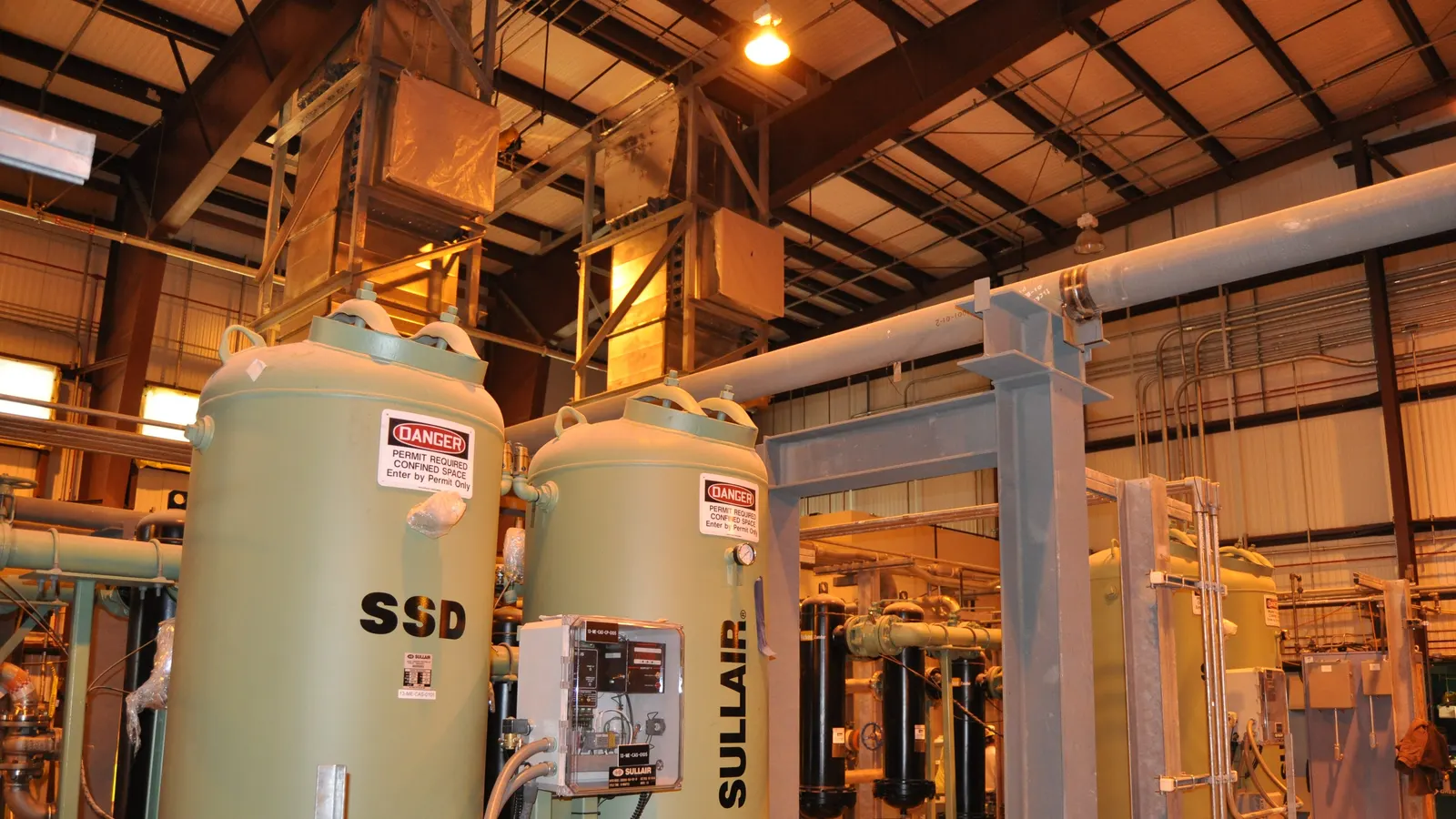
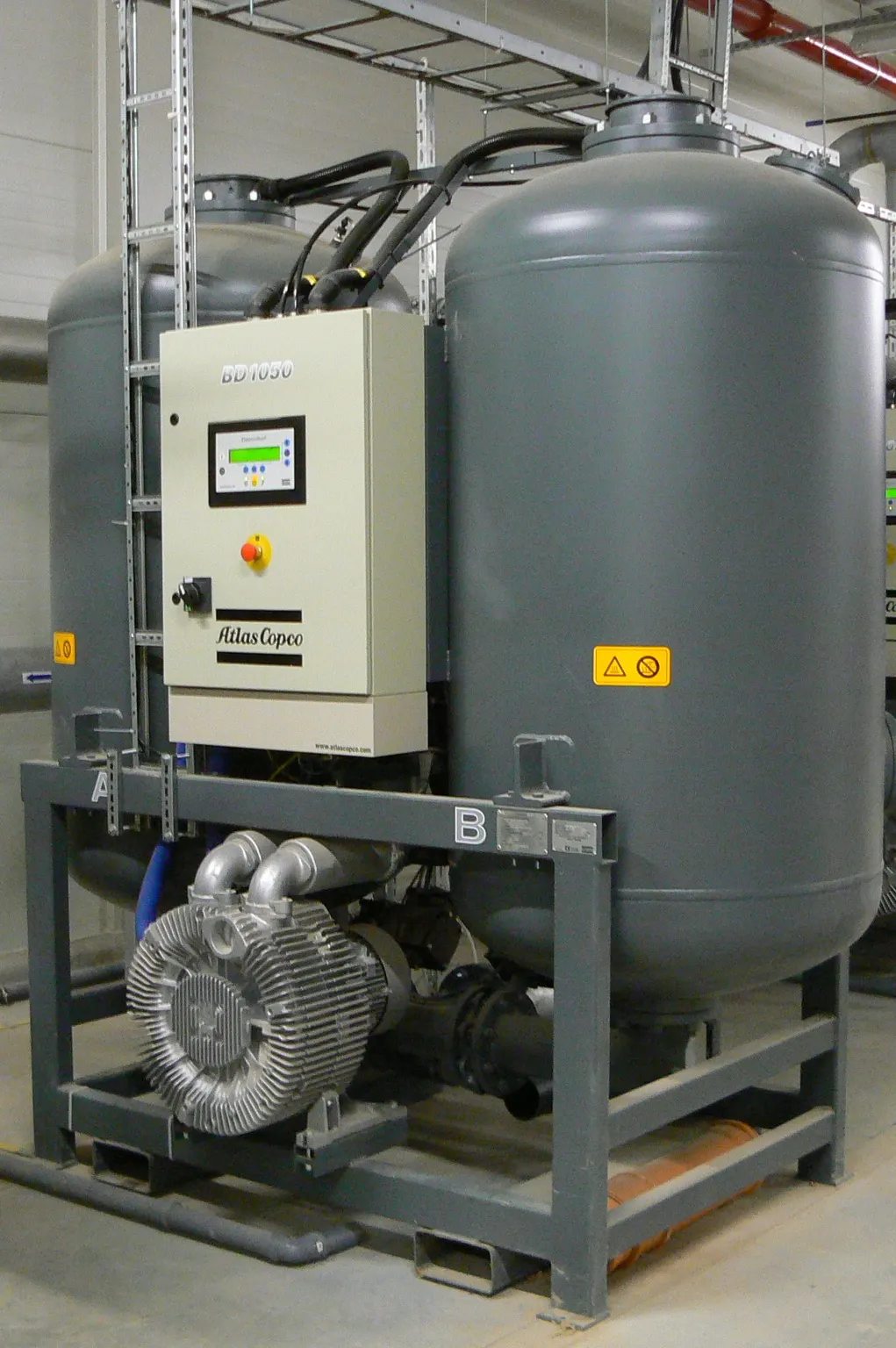
A desiccant dryer has two towers filled with an adsorbent. Wet air flows through one tower while the other is regenerated, then the towers swap. The regeneration method decides most of the running cost.
Heatless dryers regenerate by expanding part of the dried air to atmosphere and blowing it back through the wet tower. Atlas Copco calls the design simple and reliable, and says it is often preferred for remote sites, hazardous areas and high inlet air temperatures, and for low running hours or as a standby to the main dryer.
Externally heated dryers add an electric heater, which cuts the compressed air used for purge.
Heated blower purge dryers use ambient air from a blower plus heat, with little or no compressed air. Zero-purge versions add cooling that uses no compressed air either.
On life-cycle cost, Atlas Copco states that over ten years a heated blower purge dryer has roughly a 40% total cost of ownership advantage over a heatless dryer, and that lost purge air accounts for 80% of that difference. On a plant running around the clock, the cheaper heatless dryer is often the more expensive one to own. Two features reduce the loss further: dew point dependent switching, which only changes towers when the desiccant is actually loaded (Atlas Copco claims savings of up to 90% from it), and a dryer pressure drop low enough not to force a higher compressor setpoint; Atlas Copco targets below 0.2 bar for most of its desiccant models.
Heat of compression dryers for oil-free compressors
Plants running oil-free screw or centrifugal compressors have another option. Atlas Copco's MD, MDG and ND rotary drum dryers use the heat generated in compression to regenerate the desiccant, with zero purge by design. The maker lists dew points of -25 °C for the MD, -40 °C and lower for the MDG and to -45 °C for the ND, and says the MDG's only electrical load is a 120 W drum motor. If you are buying an oil-free compressor and need a sub-zero dew point, ask whether a heat of compression dryer can be packaged with it.
Gulf heat: why catalogue capacity is not your capacity
This is where most dryer problems in the region start. Dryer capacity is published at reference conditions, and those conditions are cooler than a Gulf compressor room in summer. As one example, Hertz Kompressoren's HRD refrigerated dryer datasheet states capacity to ISO 7183 at 7 bar, 35 °C inlet and 25 °C ambient. Above those temperatures the dryer has to remove more water with less cooling margin, so its real capacity falls.
The same datasheet publishes the correction factors, which show how fast the capacity drops:
Condition
Value
Correction factor
Inlet air temperature
35 °C (reference)
1.00
Inlet air temperature
40 °C
0.92
Inlet air temperature
45 °C
0.78
Inlet air temperature
50 °C
0.65
Ambient temperature
25 °C (reference)
1.00
Ambient temperature
35 °C
0.93
Ambient temperature
40 °C
0.84
Ambient temperature
50 °C
0.70
Working pressure
7 bar (reference)
1.00
Working pressure
6 bar
0.94
The datasheet's sizing method divides the compressor flow by each factor. A worked example for a summer case:
Compressor free air delivery: 10 m3/min at 7 bar (factor 1.00).
At 50 °C inlet and 50 °C ambient the same 10 m3/min needs a dryer rated at about 22 m3/min, more than twice the compressor's output. Factors differ between makers and models, so treat these figures as an illustration of scale and ask every bidder for their own correction table and the dryer's maximum rated inlet and ambient temperatures. The HRD range, for instance, is rated for up to 60 °C inlet and 50 °C ambient; a dryer with lower limits may trip or pass wet air in August.
Three site measures reduce the derating: duct the compressor's hot cooling air out of the room so the dryer is not breathing it; keep the aftercooler and the dryer's condenser clean, because dust on the fins raises temperatures; and put the dryer where it draws the coolest air in the room. Desiccant dryers have inlet temperature limits too, so ask for them.
Filters: before and after the dryer
The dryer handles water vapour. Particles and oil need filters, and the dryer needs protecting from them. A typical train, as shown in maker datasheets such as Hertz's, is:
Pre-filter (coalescing) before the dryer, removing liquid oil, water droplets and particles so they do not foul a refrigerated heat exchanger or coat desiccant.
Fine coalescing filter after the dryer for lower oil aerosol and particle levels.
Particle (dust) filter after a desiccant dryer, to catch desiccant fines.
Activated carbon filter where oil vapour or odour must be removed.
A dryer that cannot get rid of its water is not drying anything. Drains are fitted at the aftercooler, receiver, dryer and filters, and the type decides how much compressed air leaks away with the water. A Compressed Air Challenge article on Compressed Air Best Practices calls timer drains a quick fix: they may not open long enough to clear all the condensate, or stay open and waste air. Its worked example shows a quarter-inch timer drain open 10 seconds every 3 minutes at 100 psi wasting about 3.6 cfm on average. The same article treats float drains as no-waste (with the float replaced yearly) and electronic level-sensing drains as more reliable still. On humid coastal sites, where condensate volumes change sharply between seasons, level-sensing drains are the safer specification.
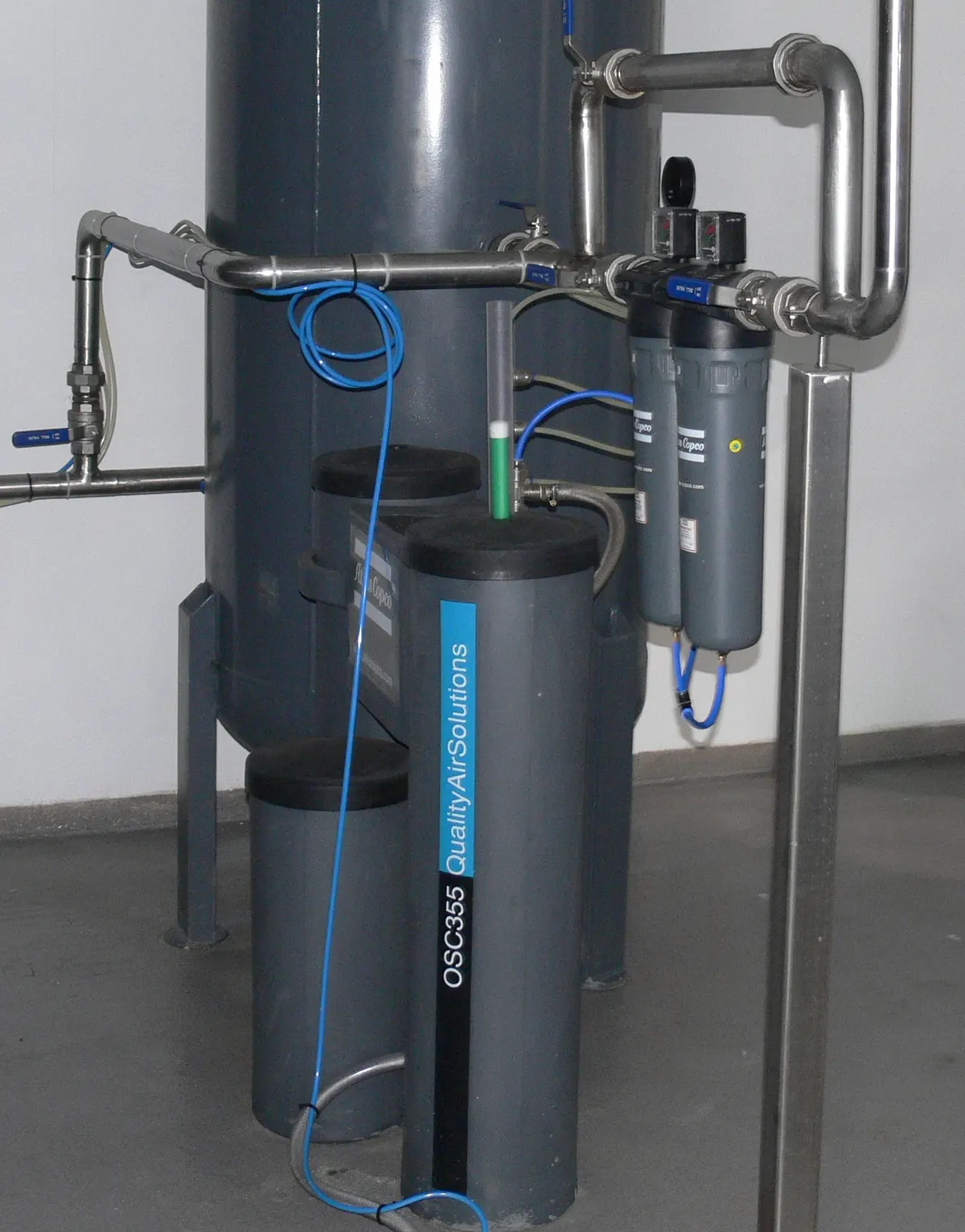
Condensate from an oil-injected compressor carries oil. Atlas Copco's oil-water separator literature says an oil-water separator removes the oil before the water enters the sewer, and that condensate treatment is a legal requirement in most countries. Ask your free zone, municipality or industrial city authority what applies to discharge at your site.
Size the separator for Gulf conditions as well. Atlas Copco's OSC leaflet rates capacity at 25 °C inlet air, 60% relative humidity and 12 running hours a day, and publishes correction factors of 0.50 at 35 °C ambient, 0.30 at 40 °C, 0.74 at 80% humidity and 0.5 for 24-hour running. A separator picked from the headline capacity can be badly undersized for a humid site running around the clock.
Most compressor makers sell dryers, and specialist treatment makers sell them too. Two examples from makers' own literature:
Atlas Copco
Atlas Copco offers refrigerated dryers (the FX and FD ranges, including FD VSD), twin-tower desiccant dryers including the BD+ heated blower purge and BDZP zero-purge ranges, and the MD, MDG and ND heat of compression drum dryers for oil-free compressors. It also makes OSC oil-water separators. It suits plants that want the compressor, dryer and treatment from one service organisation.
Sullair
Sullair lists desiccant dryers in four series: SAV heated blower purge (500 to 7,500 cfm), SAH externally heated (500 to 3,000 cfm), SA heatless (55 to 3,000 cfm) and DMD modular (3 to 240 cfm), all rated at -40 °C dew point. Its website also lists compressed air dryers, filters, separators and drains among its product categories.
Dryer RFQ checklist
Compressor free air delivery and working pressure, and whether the dryer serves one compressor or a header.
Required pressure dew point and ISO 8573-1 water class, with the lowest pipe temperature that set it.
Maximum inlet air temperature and maximum ambient temperature at the dryer location, summer design values.
The bidder's correction factor table and the corrected capacity at your conditions, with the ISO 7183 reference conditions behind the rating.
For desiccant dryers: regeneration type, purge or blower energy at your flow, dew point dependent switching, and desiccant replacement interval.
Pressure drop across the dryer and each filter at full flow.
Pre- and after-filters, filter element life and spares.
Drain type at every drain point, and an oil-water separator sized for your humidity, temperature and running hours.
Supply voltage and frequency: 50 Hz in the UAE, 60 Hz in Saudi Arabia.
Service response, refrigerant type, warranty and dew point monitoring or alarms.
To get quotes against this list, post your air dryer requirement and suppliers in the UAE and Saudi Arabia can respond. If the dryer is part of a new compressor package, the main screw air compressor category lists the suppliers who package both.
Almost always for industrial use. Compressing air concentrates its water vapour, and Atlas Copco's example of a 200 l/s compressor at 20 °C and 80% humidity releases about 10 litres of water per hour. An aftercooler removes up to about 70% of it; the rest condenses in pipes and tools unless a dryer lowers the pressure dew point below the coldest point in the system.
Is a refrigerated or desiccant dryer better?
Neither is better in general. A refrigerated dryer gives a pressure dew point of about +2 to +10 °C at low cost and suits warm plant pipework. A desiccant dryer reaches -40 °C or lower and is needed for instrument air, lines through cold or air-conditioned spaces, and many food, pharmaceutical and electronics uses. Choose from the dew point you need.
What pressure dew point does a refrigerated dryer give?
Atlas Copco gives a range of +2 to +10 °C, and many models, including its FX range, are rated as low as +3 °C, which matches ISO 8573-1 water Class 4. Refrigerated dryers cannot go much below that because condensed water would freeze in the heat exchanger. If you need a sub-zero dew point, use a desiccant dryer.
How much compressed air does a desiccant dryer waste?
It depends on the regeneration method. Atlas Copco puts heatless dryer purge at about 16 to 20% of rated flow, and Sullair gives averages of 15% heatless, 8% externally heated and 2% heated blower purge. Zero-purge and heat of compression designs use no compressed air for regeneration. On continuous duty, purge loss usually outweighs the price difference.
How does high ambient temperature affect a dryer?
It cuts capacity. Ratings are given at reference conditions such as 35 °C inlet and 25 °C ambient. One maker's table derates a refrigerated dryer to 0.78 at 45 °C inlet and 0.84 at 40 °C ambient, so a 10 m3/min compressor needs a dryer rated around 15 m3/min. Ask every bidder for their correction factors and maximum temperatures.
Which condensate drain should I use?
Avoid timer drains except as a stop-gap: a Compressed Air Challenge example shows one wasting about 3.6 cfm of compressed air on average. Float drains waste little if the float is replaced yearly, and electronic level-sensing drains are more reliable still. Route oily condensate from oil-injected compressors through an oil-water separator sized for your humidity and running hours.
Rotary screw or reciprocating piston: how duty cycle, Gulf heat, noise, oil carry-over, pressure and maintenance decide the choice, and when a small piston compressor is the right buy.
When food, pharmaceutical and electronics plants need an oil-free compressor, what Class 0 certification means, how heat affects oil-injected filtration, which oil-free technology fits, and how to test the air.
How to size and source a portable diesel compressor for breakers, sandblasting and drilling in the UAE and Saudi Arabia: tool air demand, pressure classes, aftercoolers, Gulf heat and whether to rent or buy.