Portable Diesel Air Compressors and Compressor Rental in the UAE and Saudi Arabia
How to size and source a portable diesel compressor for breakers, sandblasting and drilling in the UAE and Saudi Arabia: tool air demand, pressure classes, aftercoolers, Gulf heat and whether to rent or buy.
To choose a portable diesel compressor, add up the air your tools use at their working pressure, add a reserve, then pick a unit whose free air delivery covers that total at that pressure: around 7 bar for breakers and blasting, 14 bar or more for most drilling. Rent for short or one-off jobs and buy when the machine will be busy most of the year. Compare portable air compressor suppliers in the UAE on air delivered, heat rating and service cover.
This guide is for site engineers, plant managers, blasting and drilling contractors, and rental buyers. It goes deeper on site compressors than our guide to industrial air compressors in the UAE and Saudi Arabia, which covers fixed plant compressors, air quality, brands and country rules. Here we cover what portable units are used for, how to work out cfm and pressure for breakers, blasting and drilling, tow and skid formats, air treatment on site, diesel versus electric, Gulf heat and dust, and when to rent rather than buy. Contractors in the Kingdom can compare portable air compressor suppliers in Saudi Arabia.
What portable compressors do on Gulf sites
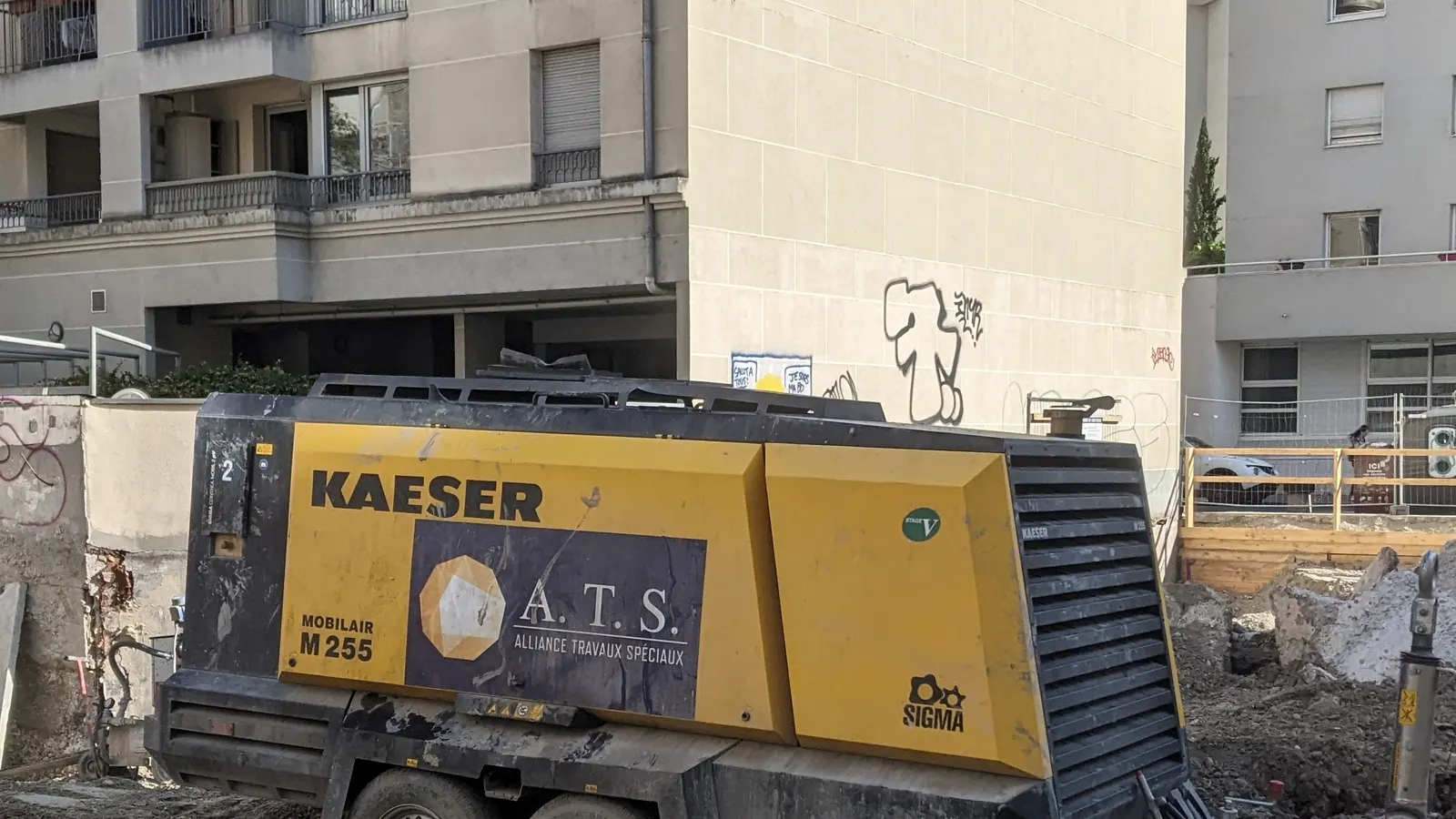
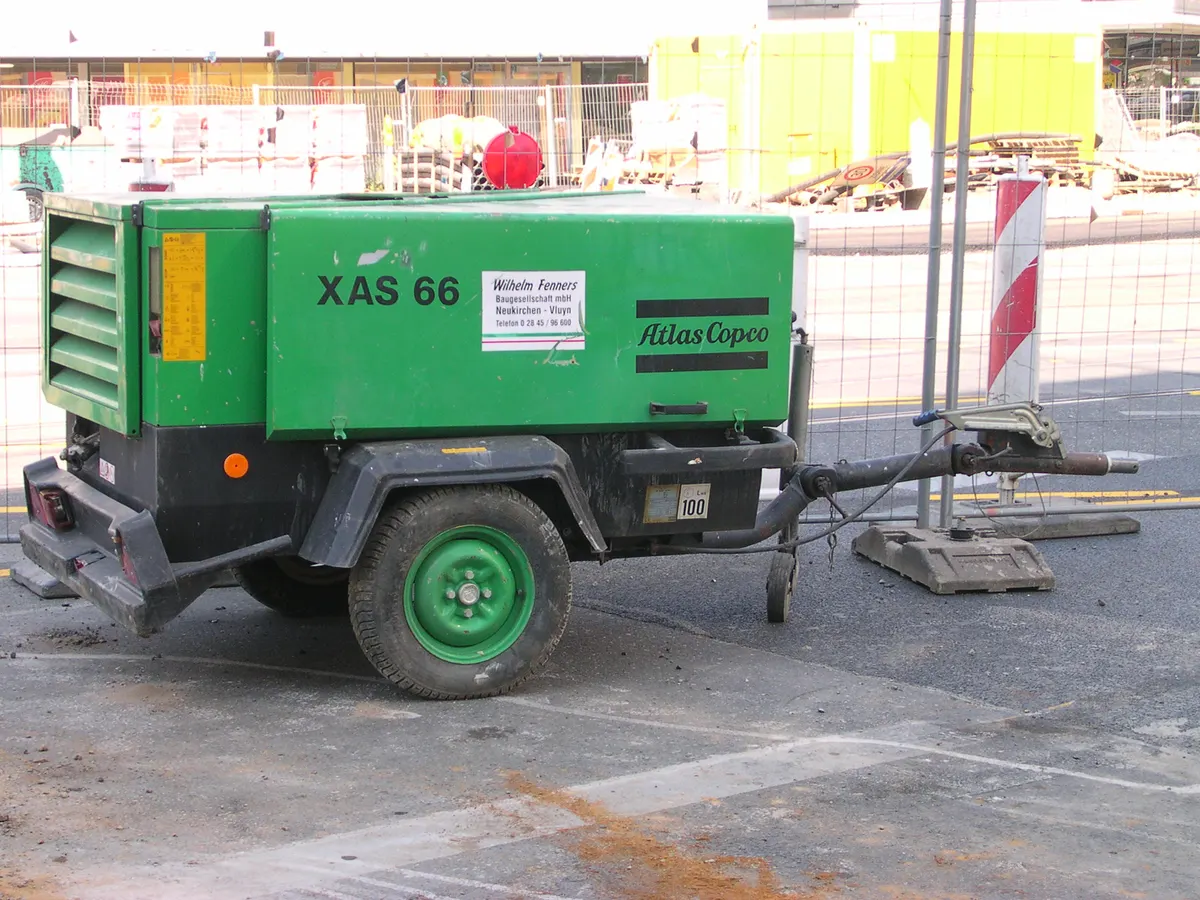
A portable compressor is a complete air station on wheels or a skid: engine or motor, airend, cooler, fuel tank and controls in one weatherproof canopy. Makers list the same core jobs: Kaeser names sandblasting, pavement breaking and air tools; ELGi names jackhammers, rock drills, impact wrenches, chipping tools, sandblasting and water well drilling; Atlas Copco adds exploration, blasthole, geothermal and ground engineering drilling, pipeline testing and cleaning, cable blowing, road paint spraying, tunnelling and quarrying. Atlas Copco's rental pages also describe portable units used as emergency air when a plant compressor fails, connected straight into the factory air system.
Step 1: add up the air your tools need
Size on the tools, not the compressor's name plate. Every pneumatic tool has a rated air consumption at its working pressure; add them for the tools that will run at the same time.
Breakers and hand tools
Atlas Copco's published data for its handheld pneumatic breakers gives an idea of scale:
Breaker (Atlas Copco data)
Weight
Air consumption
TEX 150PE / 190PE (light)
19 kg
25 l/s (53 cfm)
TEX medium range (230PE to 60PS)
25.5 to 37 kg
30 to 36 l/s (63.5 to 76 cfm)
TEX 40PE (heavy)
42 kg
40 l/s (85 cfm)
RTEX 25 (reduced vibration)
25 kg
17.5 to 19 l/s
RTEX 35
33.2 kg
21.5 l/s
So two heavy 40 l/s breakers running together need 80 l/s, about 4.8 m3/min or 170 cfm, before any reserve or hose loss. Use your own tools' data sheets; as the table shows, consumption differs widely between models of similar weight.
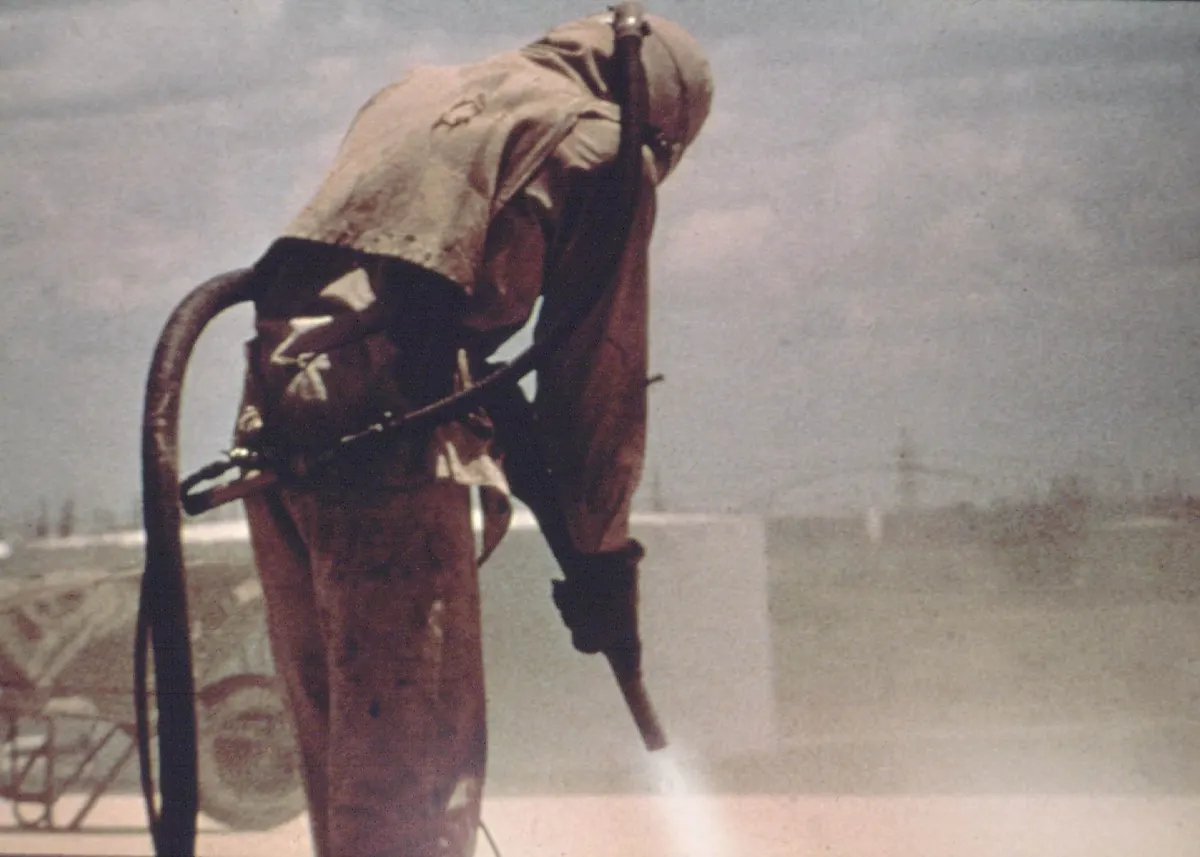
Abrasive blasting
Blasting is the most air-hungry common site job, and consumption is set by nozzle size and pressure. Clemco, the blasting equipment maker, publishes these figures:
Nozzle
Orifice
Air at 100 psi (about 7 bar)
Minimum air with helmet supply and 50% reserve
Minimum air line
No. 4
1/4 in (6.5 mm)
81 cfm
151 cfm (4.2 m3/min)
1 in (25 mm)
No. 5
5/16 in (8 mm)
137 cfm
236 cfm (6.6 m3/min)
1.25 in (32 mm)
No. 6
3/8 in (9.5 mm)
196 cfm
324 cfm (9.0 m3/min)
1.5 in (38 mm)
No. 7
7/16 in (11 mm)
254 cfm
411 cfm (11.6 m3/min)
2 in (50 mm)
No. 8
1/2 in (12.5 mm)
338 cfm
537 cfm (16.1 m3/min)
2 in (50 mm)
Clemco's estimate adds 20 cfm for the operator's supplied-air helmet and a 50% reserve on top of the nozzle's air. The reserve is not padding. Clemco's nozzle wear chart shows why: as a nozzle wears up one size, air use jumps, by 69% from a No. 4 to a No. 5 and by 43% from a No. 5 to a No. 6. A compressor sized exactly for a new nozzle runs short within days. Air use also rises with pressure: a No. 6 nozzle uses 161 cfm at 80 psi and 237 cfm at 125 psi, so decide the blast pressure before sizing. Use the air line sizes in the table as minimums; an undersized line loses the pressure you paid the compressor to make. Contractors can find blasting gear under shot blasting and sand blasting.
Drilling needs both more flow and more pressure than breakers, and the drill rig maker specifies both for the hammer and hole size. The compressor ranges reflect that: Atlas Copco's large diesel units run from 19 to 60 m3/min at 7 to 35 bar, and its rental XR units cover 14 to 35 bar with up to 38.8 m3/min. ELGi lists skid-mounted units of 500 to 1,500 cfm for water well drilling. Take the figure from the rig's data sheet and do not substitute a lower-pressure machine: a hammer starved of pressure drills slowly and can stall.
Step 2: choose the pressure class
Portable compressors come in broad pressure bands, and the band matters as much as the flow. A compressor's rated flow applies at its rated pressure, so check the flow at the pressure your tools need. Makers' current ranges, as published:
Maker
Portable range as stated
Atlas Copco
Diesel 2 to 5 m3/min at 7 to 12 bar; 7 to 22 m3/min at 7 to 14 bar; 19 to 60 m3/min at 7 to 35 bar; battery units 3.7 to 5.3 m3/min at 5 to 12 bar
Kaeser MOBILAIR
Diesel up to 48.1 m3/min at up to 14 bar; electric up to 25 m3/min at up to 15 bar
Sullair
Diesel 185 to 1,600 cfm at 100 to 500 psi
ELGi
Diesel trolley 185 to 1,200 cfm (single and two-stage); diesel skid 500 to 1,500 cfm; electric trolley 131 to 550 cfm
Bobcat (formerly Doosan Portable Power)
185 to 1,350 cfm at 7 to 25 bar
Atlas Copco's selection advice is to fix flow and pressure first, and it notes that a unit with adjustable pressure output is more flexible when the same machine moves between jobs. For a rental fleet or a contractor who does both breaking and blasting, a machine that can be set between about 7 and 14 bar covers most work; drilling needs the high-pressure class.
Step 3: tow, skid or truck mount
Towable (trolley) units are the default for construction and rental, moved between sites behind a pickup or truck. ELGi's trolley range runs to 1,200 cfm.
Skid-mounted units are lifted onto a truck, drill rig or barge, or set down for long jobs. ELGi offers skids from 500 to 1,500 cfm for drilling; Kaeser lists skids or machine feet for stationary versions, lifting eyes on its larger units and optional forklift pockets.
Small compact units suit utilities and repair crews. Kaeser says its compact units can be loaded onto a transporter by hand.
Before you rent, check what the towing vehicle and driver are licensed to pull, and whether the job needs a skid, because a skid unit needs a crane or forklift at both ends.
A standard portable compressor delivers hot, wet air with some oil. That is fine for breakers, but not for blasting and painting. Atlas Copco's selection guide warns that for abrasive blasting even minor moisture, dust or excess heat cause problems, and recommends units with filters and aftercoolers that remove contaminants and lower the air temperature. Ask for:
an integrated aftercooler with water separator for blasting and coating work;
line filters, and a dryer for coating or instrument work; our guide to compressed air dryers explains the options;
an oil-free portable unit where the air touches product or process. Kaeser lists oil-free MOBILAIR units up to 45.8 m3/min, and Atlas Copco's rental fleet includes diesel and electric oil-free compressors.
Breathing air for blast helmets must meet its own standard and needs dedicated breathing-air filtration and monitoring; agree this with your HSE team, never take it straight from an untreated compressor.
Diesel, electric or battery
Most portable compressors are diesel, which suits remote and new sites without power. Electric units make sense where there is a supply and fumes or noise are a problem: Kaeser aims its electric MOBILAIR at tunnels, excavation pits and work inside buildings, and Atlas Copco describes its electric and battery units as emission-free at the point of use and quieter than diesel. For a long job on a site with grid or generator power, compare fuel and refuelling labour against the cost of a power connection.
Fuel quality is a Gulf-specific question. Kaeser states that its non-CE MOBILAIR versions, built for less regulated markets, offer options for high-sulphur diesel, extreme temperatures and high humidity, while its CE units for Europe meet EU Stage V emission rules. Ask which engine and emission build is being offered for your country, whether it suits the diesel you will actually buy, and whether parts for that engine are stocked locally.
Gulf heat and dust
A portable compressor works in the sun, often on sand. Atlas Copco says its diesel rental compressors were developed and tested for high or low ambient temperatures, dust and humidity, and its selection guide says temperature extremes need designs that avoid efficiency loss and wear, and reliable filters in dusty settings. That is a general statement, not a rating, so for every unit ask:
The maximum ambient temperature at which it delivers full rated flow and pressure, and whether it derates or trips above that.
The engine and compressor air intake filtration, and whether a heavy-duty or pre-cleaner option is fitted.
The cooler cleaning interval on dusty sites, and who does it on a rental unit.
Fuel tank size and running time at your load, so refuelling fits the shift.
Park the machine with its cooling air intake out of the dust plume from the work, and do not box it in; recirculating its own hot exhaust air is the quickest way to a high-temperature shutdown.
Rent or buy?
Treat this as a utilisation question. Rental cost covers the machine, its maintenance and, usually, breakdown support; ownership cost covers purchase, maintenance, transport, insurance, idle time and resale. Rent when:
the job is short, one-off or seasonal, such as a shutdown, a blasting package or emergency backup;
you need a size or pressure class you rarely use, such as a 25 to 35 bar drilling unit;
you have no workshop or mechanic to keep a diesel engine and airend serviced;
you need a replacement within hours when a plant compressor fails. Atlas Copco, for example, offers 24/7 emergency support from its rental business, which the main guide notes has bases in Mussafah, Abu Dhabi, and Jubail.
Buy when the machine will be working on most days of the year, when you run your own fleet maintenance, or when air quality or pressure needs are specific enough that rental units rarely match. Many contractors do both: own the everyday 7 bar units for breakers and tools, rent high-pressure, oil-free or very large machines as jobs need them. Search compressor rental companies in the UAE, compressor rental in Saudi Arabia and general equipment rental.
Makers of portable compressors
Atlas Copco
Atlas Copco makes diesel, electric and battery portable compressors from 2 to 60 m3/min and up to 35 bar, and runs a rental fleet of oil-injected and oil-free units including the XA, XR and TwinAir families.
Kaeser
Kaeser MOBILAIR compressors run from 1 to 48.1 m3/min, in diesel, electric and oil-free versions, with non-CE builds offered for high-sulphur fuel and extreme climates.
Sullair
Sullair lists portable diesel compressors from 185 to 1,600 cfm at 100 to 500 psi, with Caterpillar, Kubota and Perkins engine options, for construction, mining, oil and gas and plant backup.
ELGi
ELGi lists diesel trolley and skid units and electric trolley units on its UAE site, aimed at construction tools, sandblasting and water well drilling.
Bobcat, formerly Doosan Portable Power
Doosan Portable Power compressors now carry the Bobcat brand. Bobcat's Middle East site lists 185 to 1,350 cfm at 7 to 25 bar for construction, utilities, abrasive blasting and drilling.
Portable compressor rental or purchase checklist
Tools and how many run at once, with each tool's air consumption and working pressure.
Total flow plus reserve (Clemco uses 50% for blasting) and the pressure class needed.
Hose length and diameter from compressor to tool.
Air treatment: aftercooler, water separator, filters, dryer, oil-free or breathing air.
Tow, skid or truck mount, and the vehicle and lifting equipment needed.
Maximum ambient rating, intake filtration and fuel tank running time.
Engine build and emission level, and suitability for local diesel.
For rental: minimum hire period, delivery and collection, who refuels and services, breakdown response time and replacement policy.
For purchase: service network, parts stock and warranty in your country.
What size portable compressor do I need for a jackhammer?
Check the breaker's data sheet. Atlas Copco's pneumatic breakers use from about 17.5 l/s for an RTEX 25 to 40 l/s (85 cfm) for a heavy TEX 40PE. Add the consumption of every tool running at the same time and allow a reserve for hose losses and wear. Two heavy breakers together need about 80 l/s, roughly 170 cfm.
What size compressor do I need for sandblasting?
Size from the nozzle. Clemco's figures at 100 psi run from 81 cfm for a No. 4 nozzle to 338 cfm for a No. 8, and its recommended minimum, adding 20 cfm for the operator's helmet and a 50% reserve, is 151 cfm for a No. 4 and 324 cfm for a No. 6. The reserve covers nozzle wear, which raises air use quickly.
What pressure do portable diesel compressors deliver?
Standard units deliver about 7 bar, which suits breakers and blasting. Versatile units reach 12 to 14 bar, and high-pressure drilling units 20 to 35 bar. Atlas Copco's large diesel range covers 7 to 35 bar and Bobcat's 7 to 25 bar. Choose the pressure class from the tool or drill rig data sheet.
Do I need an aftercooler on a portable compressor?
For blasting, painting and coating work, yes. Atlas Copco's selection guide says moisture, dust and heat cause problems in abrasive blasting and recommends units with filters and aftercoolers to remove contaminants and lower air temperature. For breakers and general hand tools, untreated air is normally acceptable.
Is it cheaper to rent or buy a portable compressor?
It depends on how many days a year the machine will work. Rent for short, one-off or specialised jobs, high-pressure drilling or emergency backup, and when you have no workshop to maintain a diesel engine. Buy when the unit will be busy most of the year and you can service it. Many contractors own standard units and rent the rest.
Can a portable compressor replace a plant compressor during a breakdown?
Yes, for the duration of the repair. Atlas Copco describes its diesel rental compressors as ready to run once connected to the existing air system, with 24/7 emergency support. Match the rental unit's flow and pressure to the plant demand, and if the plant needs dry or oil-free air, rent the matching treatment or an oil-free unit as well.
Rotary screw or reciprocating piston: how duty cycle, Gulf heat, noise, oil carry-over, pressure and maintenance decide the choice, and when a small piston compressor is the right buy.
When food, pharmaceutical and electronics plants need an oil-free compressor, what Class 0 certification means, how heat affects oil-injected filtration, which oil-free technology fits, and how to test the air.
How to pick a compressed air dryer for Gulf heat and humidity: pressure dew point, refrigerated vs heatless and heated desiccant, correction factors at 45°C, purge losses, drains and condensate.