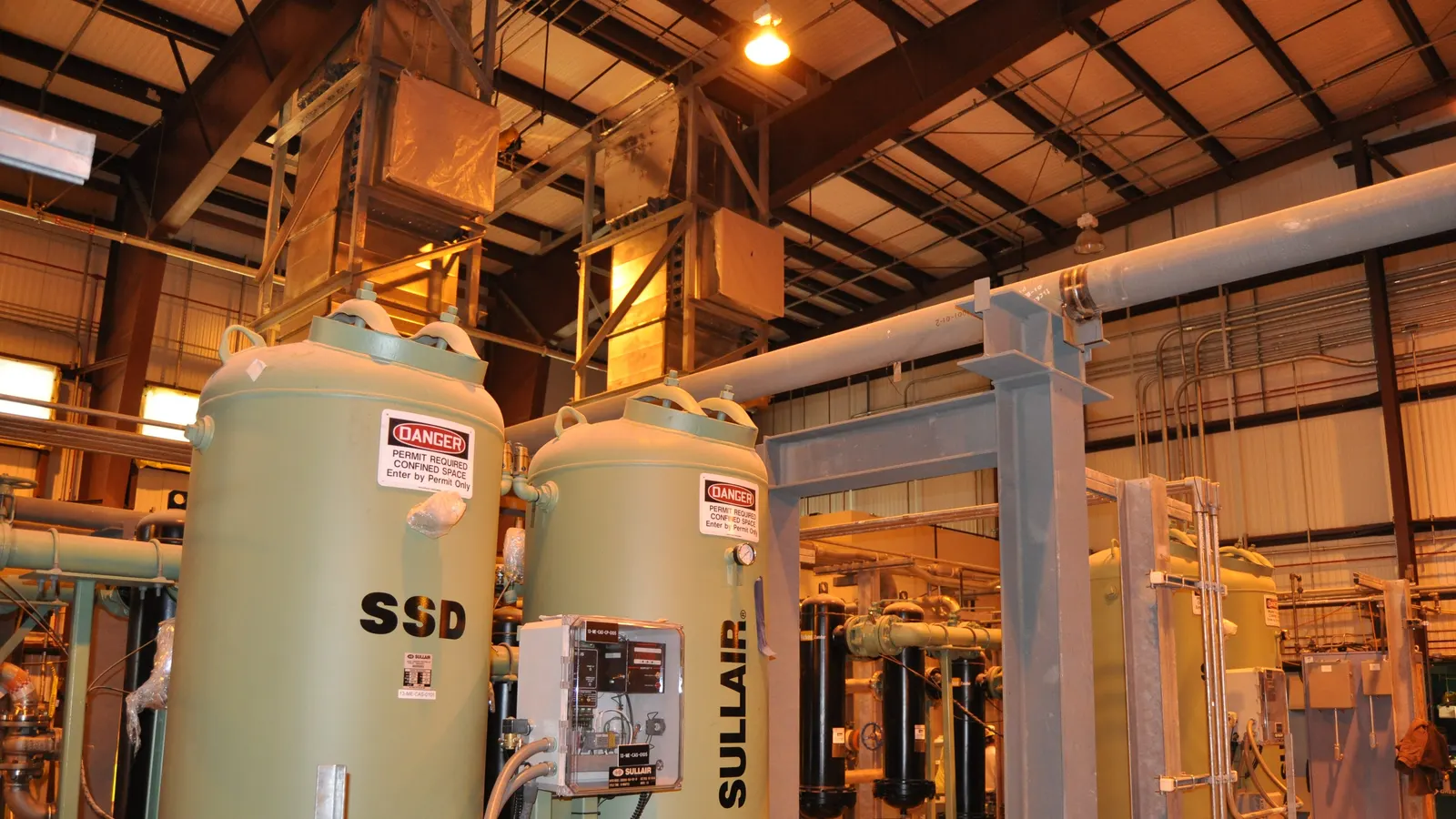
Oil-Free Air Compressors for Food, Pharma and Electronics Plants
When food, pharmaceutical and electronics plants need an oil-free compressor, what Class 0 certification means, how heat affects oil-injected filtration, which oil-free technology fits, and how to test the air.
Choose an oil-free compressor when compressed air touches your product, its packaging or a sterile process, and when a filter failure would mean a recall. It removes the compressor as the source of oil, but not the need for dryers, filters and testing. Set the ISO 8573-1 air class from your food safety or quality system first, then compare oil-free compressor suppliers in the UAE against oil-injected packages with filtration.
This guide is for quality managers, plant engineers and buyers in food and beverage, pharmaceutical, medical device and electronics plants. It goes deeper on oil-free air than our guide to industrial air compressors in the UAE and Saudi Arabia, which sets out the ISO 8573-1 class table, compressor types, sizing and brands. Here we cover where oil comes from, oil-free versus oil-injected with filters, what a Class 0 certificate proves, the oil-free technologies, microbes, GMP expectations and how to test the air. Plants in the Kingdom can compare oil-free compressor suppliers in Saudi Arabia.
Where oil in compressed air comes from
There are three sources, and an oil-free compressor deals with only the largest one.
The compressor's own lubricant. In an oil-injected screw compressor, oil is in the compression chamber and must be separated and filtered out afterwards. In an oil-free compressor, no oil enters the compression chamber.
The intake air. Atlas Copco notes that ambient air carries very small traces of oil from vehicles and industry, normally not above 0.003 mg/m3 even in contaminated areas, and that in its oil-free compressors this is almost completely removed with the intercooler and aftercooler condensate.
The distribution system. Pipework, receivers and equipment downstream of the compressor are part of the air path too, so include them in the air quality plan and in testing.
Oil-free compressor or oil-injected with filters?
Both routes can deliver clean air. The difference is how the risk is managed. Atlas Copco states that a correctly maintained oil-injected system with coalescing filters, which can remove oil down to 0.001 mg/m3, and activated carbon filters for vapour, can reach ISO 8573-1 Class 1, and it recommends oil-injected machines for general manufacturing where cost control matters. It recommends oil-free machines for food and beverage, pharmaceutical, medical and electronics plants, where contamination affects product quality or safety.
Factor
Oil-free compressor
Oil-injected compressor with filtration
Oil in the compression chamber
None
Yes; removed by separator and filters
Risk of oil contamination
Compressor is not an oil source
Possible if a filter fails or is not maintained
Effect of high room temperature
Air quality not dependent on oil filter performance
Carryover and carbon filter life worsen with heat (see below)
Downstream treatment
Dryer and particle filters still needed; smaller oil treatment
Coalescing and carbon stages needed, with their pressure drop
Purchase price
Higher
Lower
Maintenance
Fewer oil-related parts
Regular oil, separator and filter changes
Source for the table: Atlas Copco's comparison of oil-free and lubricated compressors. Atlas Copco sells both types, but its oil-free guidance naturally argues for oil-free air, so weigh it alongside your own risk assessment.
Why heat matters more in the Gulf
The filtration route is most fragile where compressor rooms are hot. Atlas Copco's Class 0 FAQ states that oil carryover through filter media rises exponentially with temperature: in its example, a compressor room at 30 °C can mean a compressor outlet at 40 °C and carryover of up to 20 times the filter's specified value. It adds that a rise from 20 °C to 40 °C can cut activated carbon filter life by up to 90%, that a saturated carbon filter gives no warning, and that higher temperatures also raise the oil vapour content of the air. Gulf compressor rooms regularly run hotter than that example. If you choose oil-injected air for a product-contact duty, design the filter stages for your real air temperature, shorten carbon change intervals accordingly and monitor oil content continuously.
What a Class 0 certificate does and does not prove
ISO 8573-1 Class 0 has no fixed limit: as the main guide explains, the user and supplier agree a limit stricter than Class 1 and write it into the specification. Two practical consequences follow.
Ask what was tested. Atlas Copco's Class 0 FAQ says certification needs both ISO 8573-2 testing (oil aerosol and liquid) and ISO 8573-5 testing (oil vapour), so all three forms of oil are measured.
Ask how it was tested. The same FAQ describes two sampling methods: the partial-flow B2 method samples only the centre of the air stream, while the full-flow B1 method captures the whole flow, including oil travelling along the pipe wall. It says most manufacturers prefer B2 and that it tested its own oil-free range with B1.
So a supplier's "Class 0" claim is only as good as the certificate behind it. Ask for the test report naming the model, the ISO 8573-1 edition, the parts tested, the sampling method, the test conditions and the agreed limits. Note also that a Class 0 compressor certificate covers the compressor outlet, not the air at your filler or tablet press.
Take the class from your own quality system, not from a brochure. Sources point in the same direction but differ in detail:
Food and beverage. Atlas Copco's food industry page says Class 0 or Class 1 is typically required, and recommends Class 0 and an oil-free system for direct-contact uses such as pneumatic conveying of food. It places compressed air inside the food safety management system covered by ISO 22000, which applies to every organisation in the food chain. The main guide notes that a Parker guide puts typical food applications at Class 2.2.1 or 2.1.1, which is why the class must come from your HACCP study.
Food and pharmaceutical codes of practice. The British Compressed Air Society publishes a food and beverage grade compressed air best practice guideline and a pharmaceutical grade compressed air guide. Their full text is distributed by BCAS rather than published openly, so obtain a copy before relying on any class quoted secondhand.
Sterile medicines. EU GMP Annex 1 (2022 revision) requires gases that contact the product or primary container surfaces to be of appropriate chemical, particulate and microbial quality, with all relevant parameters including oil and water content specified, and to comply with the relevant pharmacopoeia monograph where applicable. Gases used in aseptic processes must pass a sterilising grade filter of 0.22 µm maximum nominal pore size at the point of use, and gas used in the process must be microbially monitored periodically at the point of use. If you export to or are inspected against EU GMP, design to this.
Electronics. Set particle, water and oil classes from the process owner's specification; Atlas Copco lists electronics among the sectors where it recommends oil-free air.
Microbes: dry air is the main control
An oil-free compressor does not make air sterile. Atlas Copco's guidance on microorganisms in compressed air explains that the heat inside oil-free compression elements significantly reduces microorganisms but does not last long enough to count as sterilisation. The main lever is moisture: it states that most microorganisms need relative humidity of 75% or more, some grow between 50 and 75%, and below 50% there is normally no proliferation, and it treats a dew point that keeps relative humidity in the air below 10 to 20% as food and hygiene safe. That points to a dryer specified for a low dew point plus sterile filtration at the point of use where the process needs it. Our guide to compressed air dryers covers dew point and dryer choice in Gulf heat, including heat of compression dryers that suit oil-free compressors. Find dryers under air dryers in the UAE.
Oil-free compressor technologies
Technology
How it stays oil-free
Typical fit
Example ranges stated by makers
Dry screw or tooth
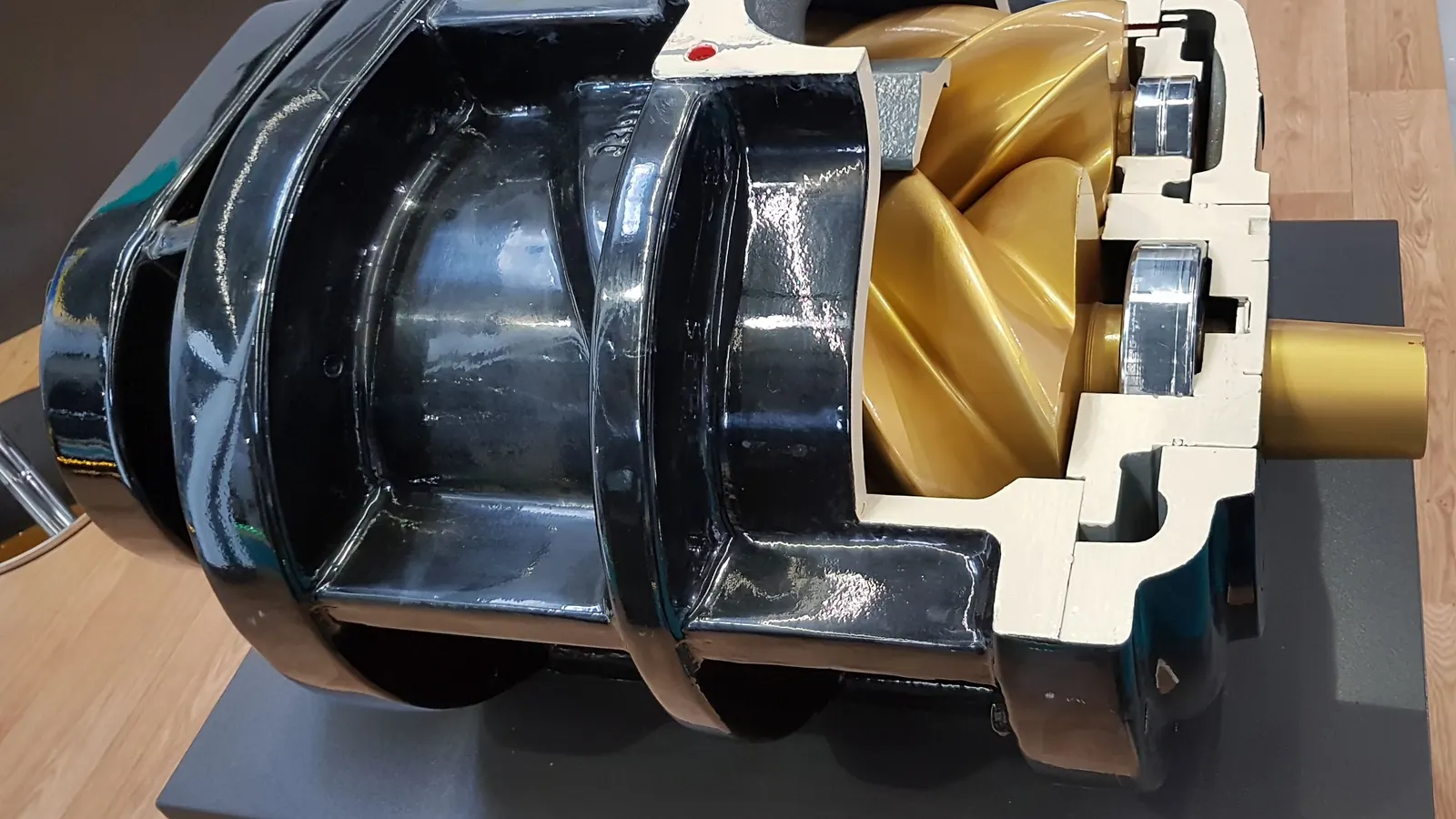
No oil in the compression chamber; tooth machines use synchronising gears and several stages with intercooling for higher pressure
Medium to large plant air
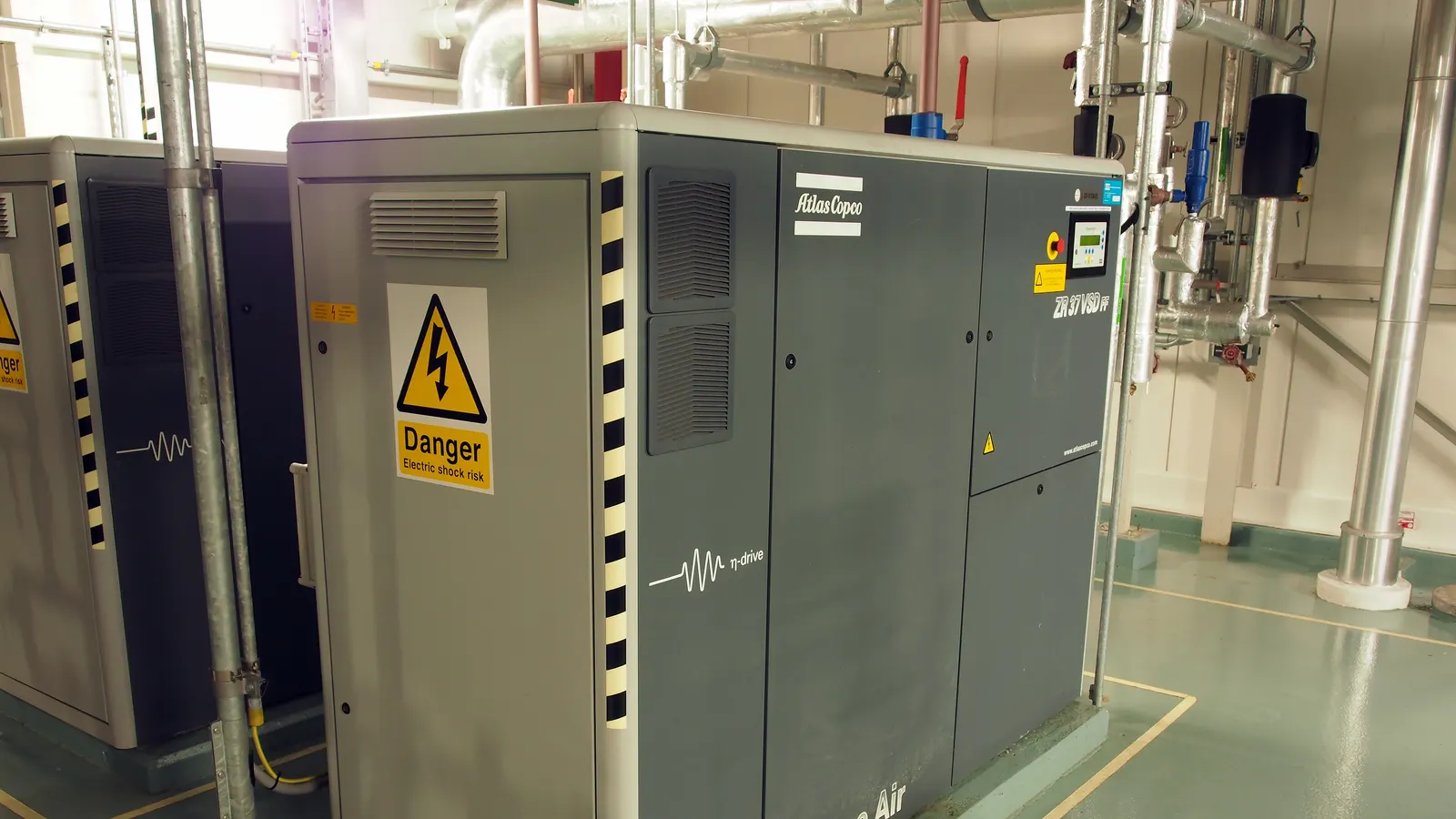
Atlas Copco ZR/ZT screw and tooth; ELGi two-stage oil-free screw 45 to 450 kW
Water-injected screw
Water, not oil, is injected to cool the compression
Small to medium plants wanting single-stage oil-free air
Atlas Copco AQ: 15 to 55 kW, 3.3 to 9.1 m3/min, 7.25 to 12.75 bar; ALUP WisAIR
Scroll
Orbiting spiral compresses air with no oil in the chamber
Laboratories, medical, small food and packaging demands; quiet
Atlas Copco SF: 1.9 to 7.6 l/s, 10 bar, down to 53 dB(A); ALUP SpiralAIR
Oil-free piston
No oil in the cylinder
Small and intermittent demands
ALUP CleanAIR (stated as Class 0); ELGi oil-free piston
Centrifugal
Designed for large oil-free flows
Large, steady oil-free demand
See the main guide
Atlas Copco notes the limits of scroll machines: they cost more per unit of air and do not suit high-capacity duty, where screw machines are more efficient. For tooth compressors it explains that the pressure ratio per stage is limited by discharge temperature, so higher pressures need several stages with cooling between them. For sizing the machine itself, see our guide on how to size an air compressor.
Testing and validating the air
A specification is only real once the air at the point of use has been measured against it. Atlas Copco's overview of compressed air quality testing lists the main methods:
Water: capacitive dew point sensors for continuous monitoring; chilled mirror instruments for precise readings, with cleaning, trained operators and calibration.
Oil: glass detector tubes for oil vapour down to Class 1 levels; photoionisation detectors for continuous monitoring; gas chromatography as the method for the most stringent requirements.
Particles: laser particle counters on a sample of the air, where correct sampling is critical for Class 1.
A validation plan should name the sampling points (at least after treatment and at each critical point of use), the parameters and methods for each, the acceptance limits from your specification, the testing frequency, and what happens when a result fails. Microbial sampling belongs in the plan wherever air contacts product. Run the first full set at the hottest time of year, when dryers and filters are working hardest.
Atlas Copco makes oil-free screw and tooth (ZR/ZT), water-injected screw (AQ), scroll (SF), piston and centrifugal compressors, publishes its Class 0 test approach, and cites Al Ain Farms in the UAE as a user of its oil-free VSD compressors.
ELGi
ELGi offers oil-free screw and oil-free piston compressors, including a two-stage water-cooled oil-free screw range from 45 to 450 kW, states that its oil-free compressors are ISO 8573-1 Class 0 certified, and has its regional company in Sharjah.
ALUP
ALUP lists the CleanAIR oil-free piston compressor, stated as delivering Class 0 air, the SpiralAIR scroll compressor and the WisAIR water-injected screw compressor.
Fusheng
Fusheng lists oil-free air compressors, including its GW series, in a range it has built since 1953.
Oil-free compressed air RFQ checklist
Required ISO 8573-1:2010 class at each point of use (particles, water, oil), plus microbial requirements, from your HACCP or quality system.
For Class 0: the agreed numerical limits and the certificate (model, ISO 8573 parts 2 and 5, sampling method B1 or B2, test conditions).
Compressor technology and FAD at your pressure, measured to ISO 1217.
Dryer type and pressure dew point, rated at your maximum room and inlet temperatures.
Filter train, including sterile filters at points of use where required, with pressure drops.
For any oil-injected alternative: filter design at your real air temperature, carbon change intervals and continuous oil monitoring.
Air quality testing at commissioning and the routine monitoring plan.
Maximum ambient rating, supply frequency (50 Hz UAE, 60 Hz Saudi Arabia) and local service support.
Not necessarily, but they must deliver air of a defined quality. Atlas Copco says food applications typically need ISO 8573-1 Class 0 or Class 1 and recommends Class 0 oil-free air for direct contact such as pneumatic conveying. An oil-injected compressor with well-maintained filtration can reach Class 1. The class should come from your HACCP study under your food safety system.
Can an oil-injected compressor with filters reach Class 1?
Yes, according to Atlas Copco, if the coalescing and activated carbon filter stages are correctly maintained. The risk is in the word maintained: filter failure or late changes let oil through, and Atlas Copco states that carryover rises sharply with temperature and that a saturated carbon filter gives no warning. In hot Gulf compressor rooms, design and monitor for that.
Does an oil-free compressor give sterile air?
No. Atlas Copco states that the heat in oil-free compression elements significantly reduces microorganisms but does not last long enough to sterilise. Keep the air dry, since most microorganisms need relative humidity above about 50 to 75% to grow, and use sterilising grade filters at the point of use where the process requires sterile air.
What does EU GMP require for compressed air in sterile manufacturing?
EU GMP Annex 1 (2022) requires gases contacting the product or primary container to be of appropriate chemical, particulate and microbial quality, with oil and water content specified and pharmacopoeia monographs met where applicable. Gases used in aseptic processes must pass a sterilising grade filter of 0.22 µm maximum nominal pore size at the point of use, with periodic microbial monitoring.
Is a water-injected compressor oil-free?
Yes. Water rather than oil is injected for cooling, so there is no oil in the compression chamber. Atlas Copco's AQ water-injected range, 15 to 55 kW at 7.25 to 12.75 bar, is certified to ISO 8573-1 Class 0 (2010) according to the maker, and ALUP sells a water-injected screw under the WisAIR name.
How often should compressed air quality be tested?
No single frequency applies to every plant. Set it in your validation plan from the risk to the product: continuous dew point and oil monitoring where the risk is high, plus periodic laboratory testing of particles, oil and microbes at critical points of use. EU GMP Annex 1 requires periodic microbial monitoring of process gases in sterile manufacturing.
Rotary screw or reciprocating piston: how duty cycle, Gulf heat, noise, oil carry-over, pressure and maintenance decide the choice, and when a small piston compressor is the right buy.
How to size and source a portable diesel compressor for breakers, sandblasting and drilling in the UAE and Saudi Arabia: tool air demand, pressure classes, aftercoolers, Gulf heat and whether to rent or buy.
How to pick a compressed air dryer for Gulf heat and humidity: pressure dew point, refrigerated vs heatless and heated desiccant, correction factors at 45°C, purge losses, drains and condensate.