Steel Rebar in the UAE and Saudi Arabia: Grades, Standards and Mills
How to buy rebar in the UAE and Saudi Arabia: B500B and Grade 60 explained, UAE ECAS and Saudi Quality Mark rules, bar marks and mill certificates, the main Gulf mills, coated bars and pricing terms.
Rebar for UAE and Saudi projects is specified to one of two families of standards: BS 4449 (usually grade B500B), or ASTM A615 Grade 60 and its low-alloy, weldable sibling ASTM A706, which Saudi Arabia adopts as SASO ASTM standards. Before you compare steel rebar suppliers in the UAE or rebar suppliers in Saudi Arabia, confirm the grade your drawings call for and check that the mill holds the country's mandatory certification: an ECAS certificate from MoIAT in the UAE, or the Saudi Quality Mark from SASO.
This guide is for contractors' procurement teams, quantity surveyors, site engineers and steel traders buying reinforcement for buildings, infrastructure and industrial work in the Gulf. It covers grades, bar marks and mill certificates, the UAE and Saudi rules, the main mills, cut-and-bend, coated and GFRP bars, pricing terms and an RFQ checklist. It does not quote prices, which change monthly; it explains what drives them.
Which rebar grade does your project need?
The design code usually decides it: British or European designs call for BS 4449, ACI 318 designs for ASTM A615 or A706. Match the exact standard, grade and ductility class on the drawings, not an "equivalent".
Standard and grade
Minimum yield / tensile (MPa)
Ductility requirement
Typical use
BS 4449:2005+A3:2016 B500B
500 / 540
Tensile to yield ratio at least 1.08; elongation at maximum force (Agt) at least 5%
General building and infrastructure on British-standard designs; widely made by Gulf mills
BS 4449 B500C
500 yield
Ductility class C; confirm the values on the mill's certificate
Where the designer asks for class C ductility; Qatar Steel lists it as its nuclear and British grade
ASTM A615/A615M Grade 60 (Grade 420)
420 / 550
Tensile to yield ratio at least 1.1; elongation is size-dependent, minimum 7%
General construction on ACI designs; listed by the main Saudi mills as SASO ASTM A615 Grade 60
ASTM A615 Grade 80 (Grade 550)
550 / 690
Tensile to yield ratio at least 1.1; elongation minimum 6%
Heavily reinforced members where the designer wants fewer bars
ASTM A706/A706M Grade 60
420 / 550
Tensile to yield ratio at least 1.25; elongation minimum 12%; carbon 0.30% max, carbon equivalent 0.55 max
Tall buildings, transfer slabs and congested members, only when the designer has specified them
Figures are from the EMSTEEL rebar catalogue and Qatar Steel's specification page; check them against the edition your specification names. A B500B bar and a Grade 60 bar are not interchangeable: strengths, ductility measures and test methods differ (BS 4449 uses Agt, ASTM uses elongation over 200 mm), so substitution needs the engineer's written approval. Weldability is not automatic either. Qatar Steel describes its BS 4449 B500B and other low carbon equivalent grades as weldable, but lists ASTM A615 Grades 60, 75 and 80 as non-weldable. If bars will be welded, specify A706 or a weldable BS 4449 grade.
GSO ISO 6935-2 (grades such as B500BWR) is a third family on some mill certificates; treat it as a separate standard and check your specification allows it.
How to read bar marks, bundle tags and certificates
Rolled-in bar marks
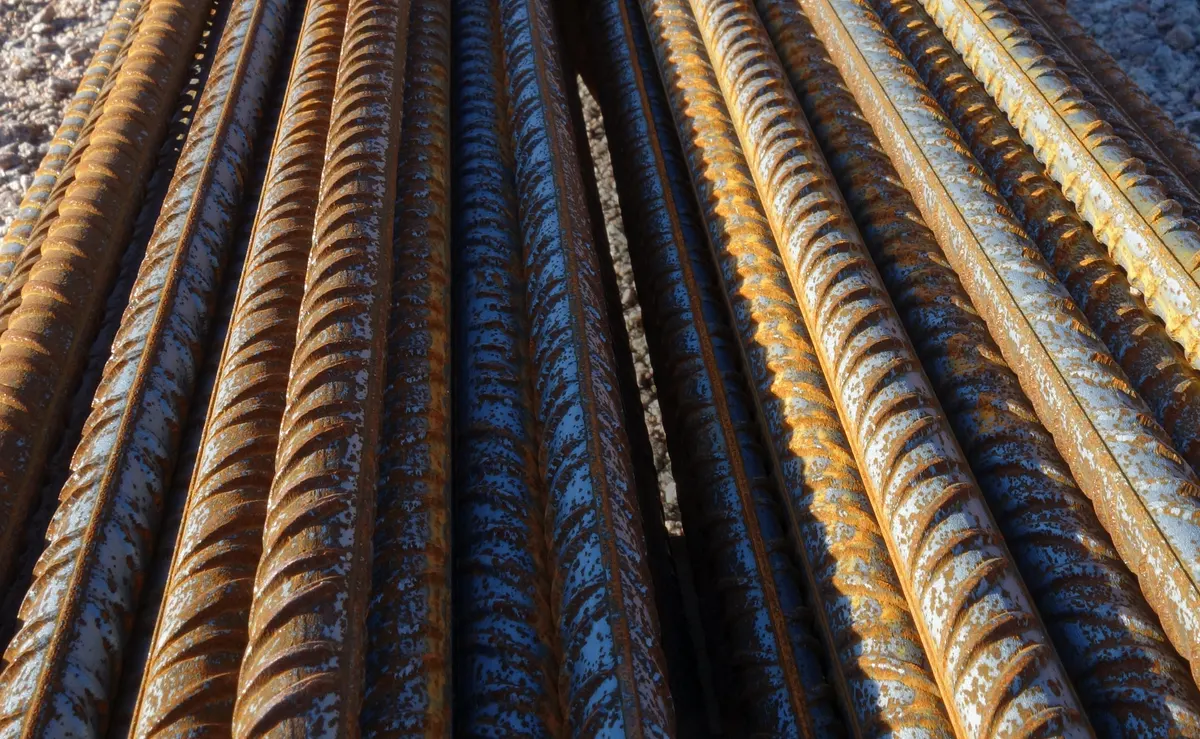
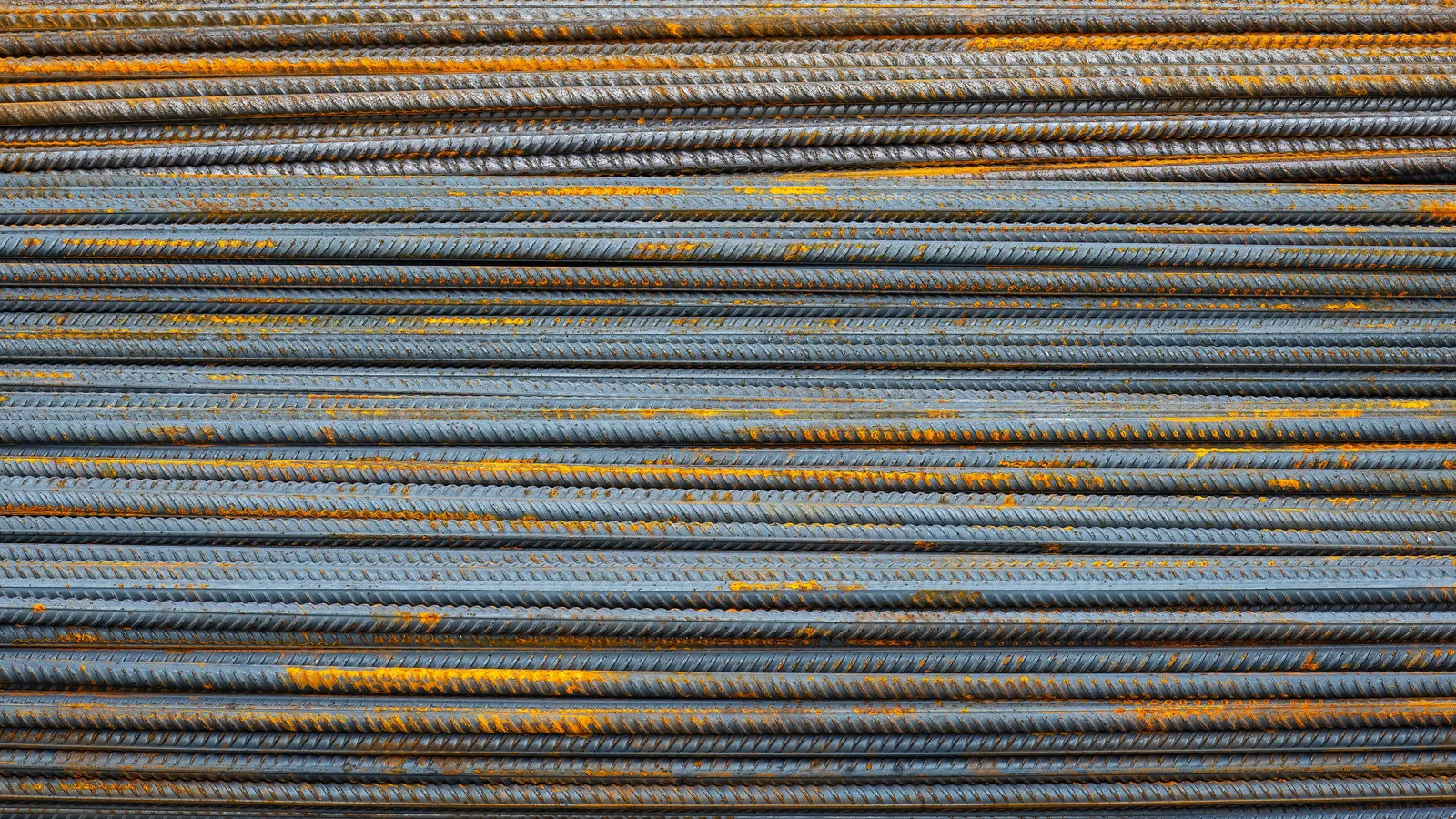
Rolled-in marks are your first check at the delivery gate. For BS 4449 bars certified by CARES (the UK Certification Authority for Reinforcing Steels), the marks repeat at intervals of no more than 1.5 m. After the CARES mark, the number of ribs between two dots gives the country of origin (9 means outside Europe), and the number of ribs between the next two dots gives the mill number, which you can look up in the CARES online certificate database. The rib pattern on the reverse side shows the ductility class: ribs sloping in the same direction for B500A, in opposite directions for B500B, and a more complex double rib pattern for B500C.
SASO says Saudi bars must carry marks showing the steel grade code, the standard used in manufacture, the bar diameter and the manufacturer's symbol. Al Rajhi Steel, for example, publishes its bar marking as "KSA // راجحي".
Bundle tags and the UAE digital product passport
SASO also requires a data label on each bundle stating the standard number, steel grade and size, country of origin and number of bars. In the UAE, Cabinet Resolution No. 121 of 2023 goes further: each product must have a digital identification card, reached by scanning a QR code, holding at minimum the manufacturer's name, place of manufacture, the product standard and its issue date, the steel grade, nominal diameter, batch number, the ECAS mark and the name or number of the notified body. The record also holds each batch's chemical analysis and mechanical properties. EMSTEEL states that it uses the CARES dynamic bundle QR code to generate the MoIAT digital product passport.
Mill test certificates
A mill test certificate records the heat or batch number, chemistry and mechanical test results. The UAE resolution lists EN 10204 (types of inspection documents) among its reference standards, so ask for the certificate type your specification names. Match the heat number on the certificate to each bundle tag; a certificate that cannot be tied to a tag proves nothing about the steel on site.
UAE rules for rebar
Cabinet Resolution No. 121 of 2023, the UAE Scheme for Steel Bars for Concrete Reinforcement, was issued on 27 November 2023 under the federal standards law and is administered by the Ministry of Industry and Advanced Technology (MoIAT). Its main provisions for buyers and importers:
Scope. Carbon steel bars and coils for concrete reinforcement, and the billets made for rolling them, whether imported or made in the UAE, including in free zones.
Certificate before sale. The applicant, which the resolution defines to include the manufacturer, importer, agent, store and any distributor, must obtain an ECAS certificate of conformity under Module H of the Emirates Conformity Assessment Scheme before the product is placed on the market. Applications are made online to MoIAT.
Factory requirements. The mill must hold ISO 9001 and ISO 14001 certification and provide an independently verified environmental product declaration (EPD) to EN 15804. Incoming steelmaking raw materials must be screened for radioactivity.
Audits. The notified body audits the mill at least once a year; BS 4449 bars also need fatigue and bond checks.
Reference standards. Annex 3 lists BS 4449:2005+A3:2016, ASTM A615/A615M-20, ASTM A706/A706M-22, GSO ISO 6935-2:2022, EN 10204:2004, ISO 1461:2022 (hot-dip galvanized coatings) and others, and states that later updates of these standards apply.
Penalties. They include cancelling the certificate, cancelling the trade licence of the responsible supplier in coordination with the licensing authority, and charging the cost of removing non-conforming product.
Steel plants had 365 days from its entry into force to comply, and federal and local authorities can both carry out market surveillance. Before you issue a purchase order, ask the supplier for the ECAS certificate number for the exact mill, size range and grade, and check it is current. EMSTEEL, for instance, lists separate ECAS certificates for straight bars and for coils.
Saudi rules for rebar
In Saudi Arabia, rebar falls under SASO's Technical Regulation for Building Materials, Part 1: Sectors of Metals and their Alloys for Buildings and Constructions. Version 2 was adopted by SASO's board on 20 June 2019 and published in the Official Gazette on 27 December 2019. Its key points:
Saudi Quality Mark. Article 6/1 requires the supplier placing reinforcing steel (rebar) on the market to obtain the Saudi Quality Mark or its equivalent. Most other metal products in the regulation need a certificate of conformity from a SASO-approved notified body instead.
Standards. Annex 1 lists SASO ASTM A615/A615M (carbon steel bars), SASO ASTM A706/A706M (low-alloy bars), SASO ASTM A184M (welded bar mats), SASO ASTM A1064/A1064M (wire and welded wire reinforcement), SASO ASTM A767/A767M (galvanized bars), SASO ASTM A775/A775M (epoxy-coated bars) and A884/A884M (epoxy-coated wire and welded wire). BS 4449 is not on the list, so a Saudi project should not assume a BS 4449 bar is acceptable.
Labelling. Labels must be in Arabic, or Arabic and English, and every statement on them must be correct and verified.
Inspection. Regulatory authorities at ports and factories may take random samples, charge the supplier for the tests, and withdraw non-conforming products.
The regulation notes that the product list and customs codes on the SABER platform are the updated, certified version, so check the current requirement for your HS code on SABER before shipping imported bars. Some suppliers still quote the old Saudi standard SASO 2/1992 on their product pages; ask which standard the Quality Mark licence was actually issued against, and make sure it matches the grade in your drawings, usually SASO ASTM A615 Grade 60. Concrete itself is a separate purchase: see cement and concrete suppliers in Saudi Arabia.
Rebar mills serving the UAE and Saudi Arabia
The table shows what each mill publishes on its own website. Always ask for the certificate covering your exact grade and size.
Mill
Base
Rebar standards listed on its site
Sizes listed
EMSTEEL (formerly Emirates Steel Arkan)
Abu Dhabi, UAE
BS 4449 B500B; ASTM A615 Gr 40, 60, 80; SASO ASTM A615 Gr 60, 80; ASTM and SASO ASTM A706; ES600
Straight bars 8 to 40 mm; coil 8 to 16 mm
Conares
Dubai, UAE
Not stated on the product page; request certificates
Bars 8 to 50 mm; coil 6 to 16 mm
Hadeed (Saudi Iron and Steel Company)
Jubail Industrial City, Saudi Arabia
SASO ASTM A615M Gr 280, 420, 550; SASO ASTM A706M Gr 420; BS 4449 B500B; GSO/ISO 6935-2 B500BR and B500BWR
Bars 10 to 40 mm, plus rebar in coil
Al Rajhi Steel
Riyadh office, Saudi Arabia
SASO 2/1992, ASTM A615/A615M, BS 4449:2005
Bars 8 to 40 mm; coil 6 to 16 mm
Qatar Steel
Mesaieed, Qatar; QS Dubai in Jebel Ali Free Zone
BS 4449 B500B and B500C; ASTM A615 Gr 40, 60, 75, 80; ASTM A706 Gr 60; SASO ASTM A615; QS600
Coil 7 to 16 mm; bar range not stated
Emirates Steel Arkan (EMSTEEL)
Emirates Steel Arkan now trades as EMSTEEL Building Materials PJSC, listed on the Abu Dhabi Securities Exchange, with its plant at Abu Dhabi Industrial City (ICAD) in Musaffah. It states a steel capacity of 3.5 million tonnes a year, made by direct reduced iron and electric arc furnace, and rolls bars 12 m long by default. Its catalogue lists ECAS, CARES, Dubai Central Laboratory and SASO certificates, and says it was the first company to receive MoIAT ECAS certification through UK CARES. It also makes ES600, a 600 MPa bar evaluated under ICC-ES report ESR-4800, plus seismic and nuclear grades used at the Barakah nuclear plant. It suits UAE projects wanting a domestic source for both British and ASTM grades.
Conares
Conares is a Dubai-based steel producer that has been in the industry since 1988. Besides rebar and coil it makes wire rod, ERW pipes and colour-coated coil. It lists bars in lengths of 6 to 18 m and a rebar capacity of 500,000 tonnes a year. Its product page does not list standards, so ask for the ECAS certificate and the grade it covers. The 50 mm top size and long lengths suit heavy foundations.
Hadeed
Hadeed, the Saudi Iron and Steel Company, was established in 1979 and has made rebar and wire rod at Jubail Industrial City since 1983. It states a capacity of 3.8 million tonnes a year of long products. SABIC sold Hadeed to the Public Investment Fund (PIF): the deal was signed in September 2023 at an enterprise value of SAR 12.5 billion, and SABIC told Tadawul on 26 May 2024 that the transfer was complete. Hadeed then acquired 100% of AlRajhi Steel Industries, paid for in Hadeed shares, bringing the two brands into one group; older specifications may still say "SABIC Hadeed". Its range of standards suits Saudi projects and exporters needing several standards from one mill.
Al Rajhi Steel
Al Rajhi Steel (Rajhi Steel) was founded in 1984 and, since the 2024 transaction, is owned by Hadeed. It makes rebar, rebar coil and plain wire rod, listing bars in grades 280 (40), 420 (60) and 520 (75) and coil to BS 4449 B500B and ASTM A615M. Its page still cites SASO 2/1992, so confirm the current Quality Mark scope.
Qatar Steel
Qatar Steel was established in 1974 as the first integrated steel plant in the Arabian Gulf, at Mesaieed, and has been a wholly owned subsidiary of Industries Qatar since 2003. It operates QS Dubai in Jebel Ali Free Zone through Qatar Steel Company FZE. Its specification page is explicit about which grades it considers weldable, and it suits buyers who want a GCC mill offering B500C.
Tata Steel and JSW Steel
Tata Steel sells rebar under the Tata Tiscon brand, launched in 2000 as what it calls India's first TMT rebar, including a corrosion-resistant CRS550D bar. JSW Steel lists TMT bars in its product range. A TMT grade name on its own is not one of the standards in either Gulf regulation, so imported bars need certification to BS 4449 or ASTM A615/A706 (SASO ASTM in Saudi Arabia), plus a UAE ECAS certificate or Saudi Quality Mark, exactly like a local mill.
Cut-and-bend, couplers and fabrication
Many contractors send bar bending schedules to a fabricator and receive tagged, shaped bars or cages. CARES' model specification requires reinforcement to be cut and bent to BS 8666, welding of prefabricated assemblies to follow BS EN ISO 17660 and BS 8548, and mechanical coupler suppliers to hold CARES approval to its Appendix 8 or an equivalent scheme. On ACI-based projects the project specification governs. In either case:
Ask the fabricator which mill's bars it will use and require the mill certificates and ECAS or Quality Mark evidence for that mill, not just the fabricator's own ISO certificate.
Require tags linking each schedule bar mark to its heat number.
Confirm the coupler system is tested with the bar grade and size you are buying, and that bars to be threaded or welded are of a suitable grade.
Rebar is rarely the only structural package. If the same project needs structural steel or steel beams and columns, ask whether the mill or stockist can supply both, and coordinate delivery with your ready-mix concrete supplier so placed steel is not left exposed for weeks before the pour.
Coated rebar and GFRP for corrosive exposure
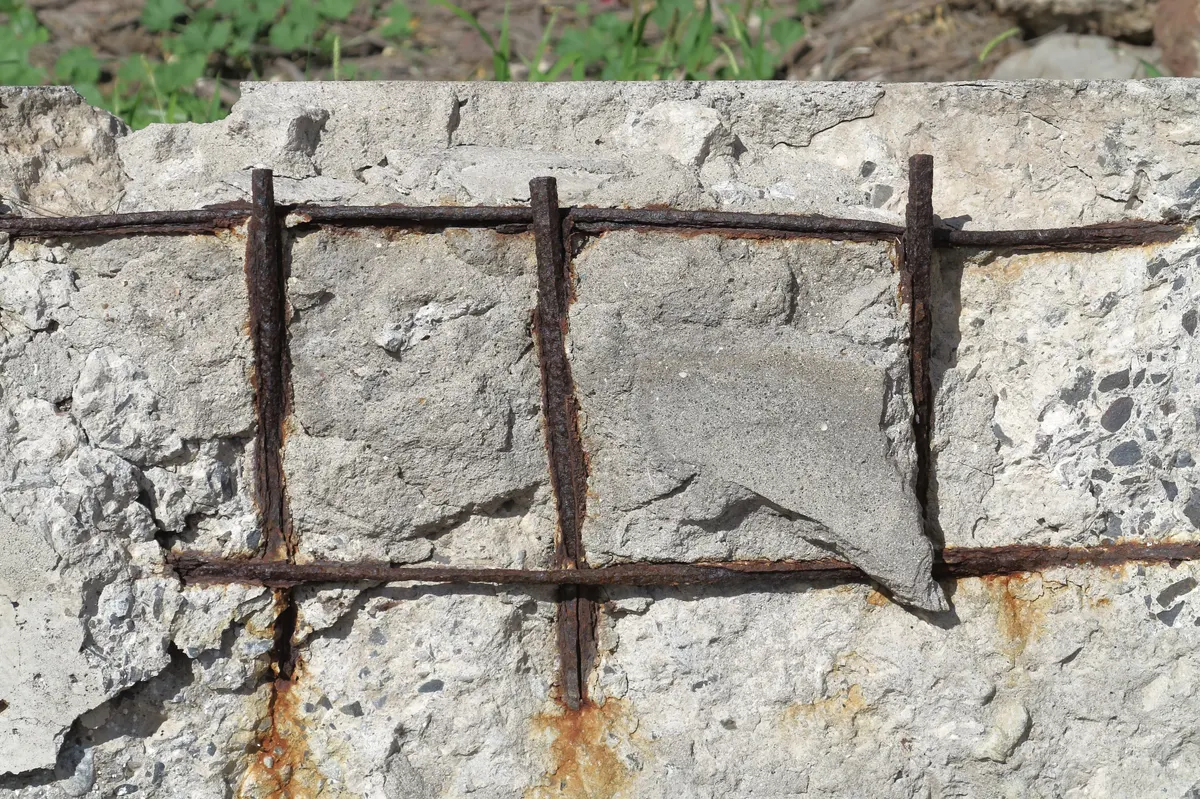
Steel corrodes when carbonation or chlorides break down the concrete's protection, a risk for structures near the sea or in saline ground. Cover and concrete quality, set by the designer, come first. When the specification also calls for protected bars, the options are:
Epoxy-coated bars to ASTM A775/A775M (SASO ASTM A775 in Saudi Arabia). The coating must not be damaged during bending, handling and placing, so ask how coated bars are bent, bundled and lifted, and what repair coating is supplied for cut ends and damage.
Galvanized bars to ASTM A767/A767M (SASO ASTM A767). The UAE resolution also lists ISO 1461 for hot-dip galvanized coatings and ISO 2178 for coating thickness measurement.
GFRP bars. Glass fibre reinforced polymer bars do not rust. ACI CODE-440.11-22, the American Concrete Institute's building code for structural concrete reinforced with GFRP bars, applies to bars conforming to ASTM D7957-22. The code does not address earthquake-resistant design, diaphragms or strut-and-tie design, so GFRP is a designer's decision, not a buyer's substitution.
Storage matters too: CARES' specification asks for identified, contamination-free storage with no dropping or shock loading, and coated bars need more care than plain steel.
How rebar is priced
Rebar is quoted per tonne and prices are revised regularly, so compare quotes on the same basis:
Theoretical or actual weight. Ask whether the invoice weight is calculated from nominal mass per metre or weighed. The standards allow a mass tolerance (EMSTEEL lists plus or minus 4.5% for 10 to 40 mm B500B bars and 6% for 8 mm), so the basis can change what you pay for the same bars.
Standard and grade. Special grades such as A706, B500C or high-strength bars are made in smaller volumes.
Size and length. Very small or very large diameters and non-standard lengths may be quoted separately; EMSTEEL, for example, rolls 12 m bars by default and other lengths on request.
Form. Straight bars, coil, cut-and-bent shapes, prefabricated cages, coated bars and couplers are priced differently.
Terms. Ex-mill or delivered, partial deliveries and credit terms.
Price validity. Check how long the quote holds and whether it is tied to the mill's next monthly price.
Buying checklist and RFQ
Standard, edition, grade and ductility class exactly as on the drawings (for example BS 4449:2005+A3:2016 B500B, or SASO ASTM A615 Grade 60), and whether bars will be welded.
Tonnage by diameter and length, and the form: straight bars, coil, cut-and-bent shapes or cages.
Mill of origin, and the ECAS certificate number (UAE) or Saudi Quality Mark licence (Saudi Arabia) covering that grade and size range.
Third-party certification if your specification asks for it, such as CARES, with the mill number.
Mill test certificates per heat, of the EN 10204 type your specification names, matched to bundle tags; in the UAE, access to the QR digital product passport.
Coating (epoxy to A775, galvanized to A767) or GFRP to ASTM D7957 if specified, with handling and repair instructions.
Couplers: system, approval and compatibility with the bar grade.
Weight basis (theoretical or actual), delivery schedule, site access, unloading and price validity.
Independent delivery testing, if required, and who pays for retests.
Each of these guides takes one question from this page further.
Rebar Weight Chart: Steel Bar Weight per Metre for Every Size: Rebar weight for every size from 6 to 50 mm: kg per metre, per 12 m bar and per tonne, the d²/162 formula explained, mass tolerances by standard, ASTM bar numbers and a bar bending schedule example.
Rebar Sizes and Bar Marks: BS 4449 and ASTM A615 Explained: Metric rebar sizes and what Gulf mills roll, ASTM bar numbers in mm, what makes a bar deformed, reading the grade from ribs and rolled marks, what a delivery certificate must contain, and what CARES means.
GFRP, Epoxy-Coated and Galvanised Rebar for Corrosive Gulf Exposure: How GFRP, epoxy-coated and hot-dip galvanised rebar protect concrete from chlorides, their standards and design codes, bending, cutting and repair rules, cost drivers and what UAE and Saudi regulations cover.
Rebar Cutting and Bending Machines and Cut-and-Bend Shops: Manual, electric and automatic rebar bending and cutting machines, when a cut-and-bend shop beats a site yard, BS 8666 shape codes, minimum bend radius rules, coil versus straight bar, safety and a buying checklist.
Frequently asked questions
What kind of steel is in rebar?
Standard rebar is ribbed carbon steel. ASTM A615 (SASO ASTM A615 in Saudi Arabia) covers deformed and plain carbon steel bars, and BS 4449 covers weldable reinforcing steel. ASTM A706 covers low-alloy bars with tighter chemistry limits for welding and seismic detailing. Epoxy-coated, galvanized and GFRP bars are used where corrosion risk is high.
What grade of rebar is used in the UAE?
Both BS 4449 B500B and ASTM A615 Grade 60 are common, and the UAE federal rebar regulation lists BS 4449, ASTM A615 and ASTM A706 as reference standards. The design code decides: British-standard designs use B500B or B500C, ACI designs use Grade 60 or A706. Buy what the drawings specify, from a mill with a valid ECAS certificate.
Is a SASO certificate required for rebar in Saudi Arabia?
Yes. SASO's Technical Regulation for Building Materials, Part 1, requires the supplier placing rebar on the Saudi market to hold the Saudi Quality Mark or its equivalent. The listed standards are SASO ASTM A615/A615M for carbon steel bars and SASO ASTM A706/A706M for low-alloy bars, and labels must be in Arabic, or Arabic and English.
What is ECAS certification for rebar in the UAE?
ECAS is the Emirates Conformity Assessment Scheme run by MoIAT. Under Cabinet Resolution No. 121 of 2023, reinforcing bars, coils and billets, imported or local, need an ECAS certificate under Module H before sale. The mill needs ISO 9001, ISO 14001, a verified EPD and annual audits, and products carry the ECAS mark and a QR-linked digital record.
What is the difference between ASTM A615 and A706 rebar?
Both offer Grade 60 with a 420 MPa minimum yield. A706 adds a 0.30% carbon limit, a 0.55 carbon equivalent limit, a tensile to yield ratio of at least 1.25 (against 1.1) and higher elongation. That makes A706 the choice for welded bars and seismic frames. Never swap one for the other without the engineer's approval.
How much is 1 ton of rebar in the UAE or Saudi Arabia?
Prices follow mill price lists and the steel market, so ask several suppliers for current quotes. Compare them on the same terms: ex-mill or delivered, theoretical or actual weight, standard and grade, whether cut-and-bend or couplers are included, and price validity. These terms often explain more of the gap between quotes than the headline price per tonne.
Who are the main rebar producers in the UAE and Saudi Arabia?
In the UAE, EMSTEEL (formerly Emirates Steel Arkan) in Abu Dhabi and Conares in Dubai make rebar. In Saudi Arabia, Hadeed in Jubail is the largest and, since 2024, also owns Al Rajhi Steel. Qatar Steel supplies the region from Qatar and runs QS Dubai in Jebel Ali Free Zone. Check that each certificate covers your grade and size.
Can GFRP bars replace steel rebar?
Only where the structural engineer designs for them. GFRP bars do not corrode, but they behave differently from steel. ACI CODE-440.11-22 covers concrete reinforced with GFRP bars conforming to ASTM D7957-22, and it does not address earthquake-resistant design. Treat GFRP as a design decision, never as a like-for-like substitution on site.
How GFRP, epoxy-coated and hot-dip galvanised rebar protect concrete from chlorides, their standards and design codes, bending, cutting and repair rules, cost drivers and what UAE and Saudi regulations cover.
Metric rebar sizes and what Gulf mills roll, ASTM bar numbers in mm, what makes a bar deformed, reading the grade from ribs and rolled marks, what a delivery certificate must contain, and what CARES means.
When to use a rebar coupler instead of a lap, the main coupler types, ACI 318 Type 1 and Type 2 and other performance classes, how systems are approved and tested, and what to check on site.