Welding Machines in the UAE and Saudi Arabia: MIG, TIG, Stick and Brands
How to choose a welding machine for UAE and Saudi work: which process fits the job, duty cycle at Gulf temperatures, power supply, codes, fume safety, import rules, the main brands and what to put in an RFQ.
To buy the right welding machine in the UAE or Saudi Arabia, start with the welding process the job needs (stick, MIG/MAG, flux-cored, TIG or submerged arc), then size the machine for the current you need at the duty cycle you need, at Gulf temperatures, not at the 40 °C on the rating plate. Then check the input voltage and the import paperwork. Compare welding equipment suppliers in the UAE once that specification is fixed.
This guide is for procurement officers, fabrication and maintenance managers, and pipeline and MEP contractors. It covers the processes, inverter versus transformer, duty cycle in heat, engine-driven welders, welding codes, fume and heat safety, power supply, the conformity rules in each country, the main brands and an RFQ checklist. Saudi buyers can find local sellers on the welding equipment page for Saudi Arabia.
Which welding process do you need?
Choose the process before the machine: MIG, TIG and stick need different power sources, and multi-process units cover only some combinations.
Process
Power source
Best suited to
Site or shop
Main limitation
Stick (SMAW, MMA)
Constant current, AC or DC; mains or engine-driven
Structural repair, maintenance, pipe roots and fills with cellulosic electrodes, any thickness from about 1.5 mm up with multiple passes
Site, including where there is no mains power
Low productivity: the arc is on for roughly a quarter of the welder's time
MIG/MAG (GMAW)
Constant voltage with a wire feeder and gas
Carbon steel, stainless and aluminium fabrication; short-circuit transfer for thin sheet, spray for plate above about 6.4 mm, pulsed for thin work with low heat input
Shop, or sheltered site areas
Moving air strips the shielding gas, so it is rarely used outdoors
Flux-cored (FCAW)
Mostly constant voltage with a wire feeder
Structural steel and heavier fabrication at high deposition; self-shielded wire needs no gas
Self-shielded wire on open sites; gas-shielded wire in shops
Gas-shielded wire has the same wind problem as MIG
TIG (GTAW)
Constant current; DC for steels, AC for aluminium
Thin stainless and non-ferrous metals, root passes in piping, high-quality visible welds
Mostly shop and controlled site areas
Much slower than other processes; wind increases gas use
Submerged arc (SAW)
Mechanised power source, wire feeder and flux system
Long straight seams, rotated pipe and vessels, thick carbon steel plate
Shop
Normally limited to flat and horizontal fillet positions
Stick welding (SMAW or MMA)
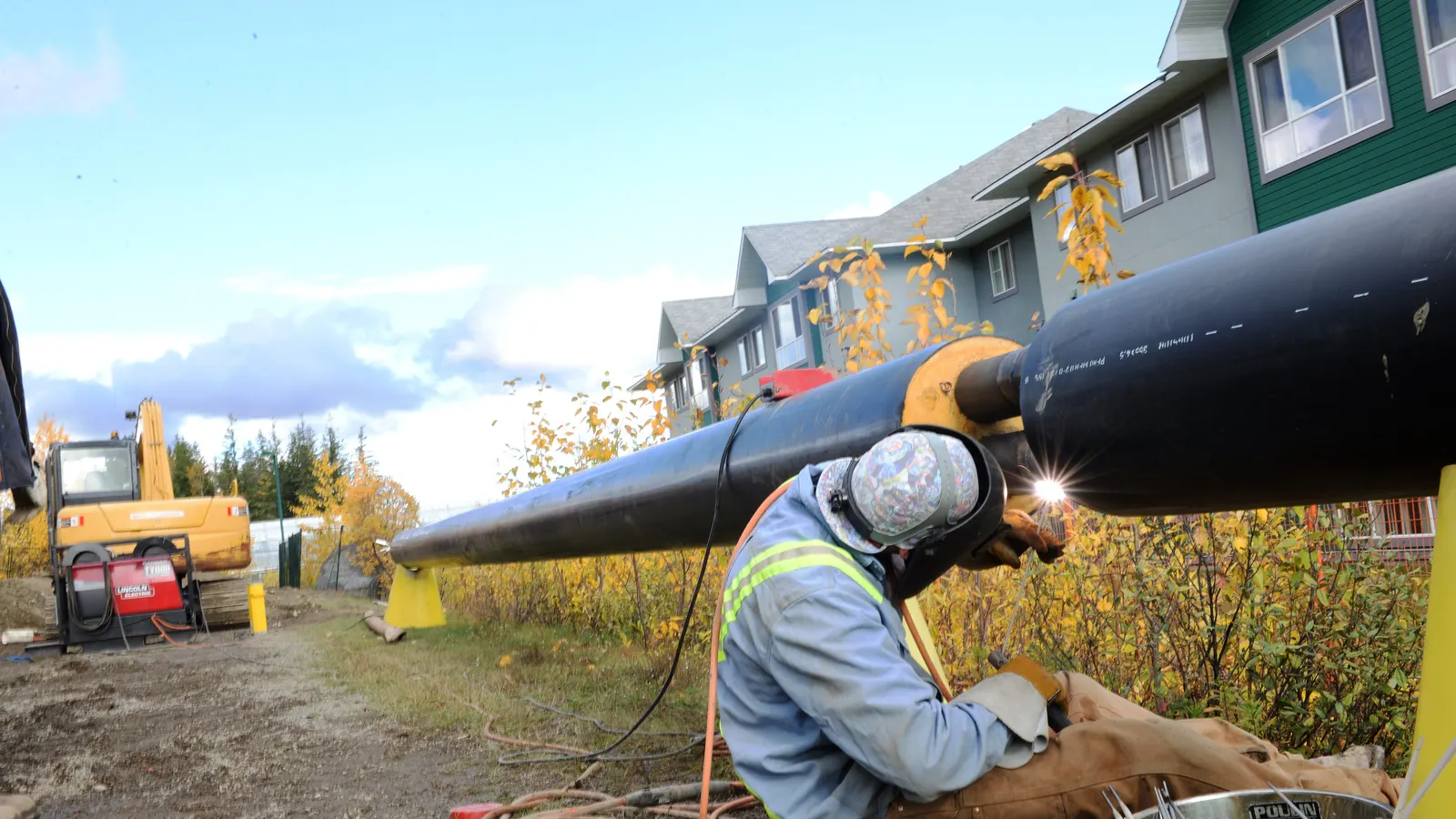
Stick is still the default for Gulf site work because the electrode carries its own shielding and the constant-current power source keeps the heat steady as arc length varies. Engine-driven units cover sites with no mains supply. The cost is speed: the arc is on for only about a quarter of the welder's time. For maintenance and repair, compare arc welding machines with hot start and anti-stick functions.
MIG/MAG welding (GMAW)
MIG (metal inert gas) and MAG (metal active gas) are the two forms of gas metal arc welding. A constant-voltage source and wire feeder take over the filler feeding a stick welder does by hand, which makes the process fast and easy to mechanise. Carbon steel is usually welded under argon and carbon dioxide mixes, often 75/25 to 90/10; pure inert gas is used for non-ferrous metals. Compare MIG welding machines on current at your duty cycle, the wire feeder, and pulsed programmes for stainless and aluminium.
Flux-cored wire runs on MIG-type equipment. Self-shielded wire needs no gas and suits windy open sites; gas-shielded ("dual shield") wire, developed mainly for structural steel, cannot be used in wind. Because the welder does not stop to change electrodes, deposition is higher than with stick.
TIG welding (GTAW)
TIG suits thin stainless steel and non-ferrous metals and is often used for root passes in piping. Steels are welded on DC, aluminium most often on AC, so an aluminium shop needs an AC/DC machine. Compare TIG welding machines, and for repeatable welds on high-purity tube, orbital welding equipment.
SAW buries the arc under granular flux and is normally mechanised. Reported deposition rates approach 45 kg per hour, against about 5 kg per hour for stick, but it is limited to flat and horizontal fillet positions on long seams or rotated pipe, so it belongs in shops as part of welding automation systems.
Inverter or transformer welding machine?
For most new purchases the answer is an inverter. A transformer machine works at the mains frequency of 50 or 60 Hz, which makes its transformer large and heavy. An inverter switches at 10 kHz or higher, so its transformer is far smaller, and inverter machines are typically more efficient and give finer control of the arc. That control is what makes pulsed MIG, synergic programmes and AC TIG waveform settings possible.
Duty cycle in Gulf heat
Duty cycle is the share of a 10-minute period that the machine can deliver a given current without overheating. A 60% rating at 150 A means 6 minutes of welding and 4 minutes of cooling in every 10 minutes.
The rating plate figures are based on an ambient temperature of 40 °C. Fronius states this in its operating instructions for the Ignis stick inverters and adds that if the ambient temperature is higher, either the duty cycle or the output must be reduced. On a Gulf summer site, or inside an unventilated steel shed, the air around the machine can be hotter than that, and the machine will then deliver less than its plate suggests. The international safety and performance standard for these machines is IEC 60974-1:2021, Arc welding equipment, Part 1: Welding power sources (sixth edition, published June 2021), which covers power sources for industrial and professional use; machines for lay users fall under IEC 60974-6 instead.
Buy for the 100% current, not the headline current. The same Ignis 180 manual lists, for stick welding at 10 min/40 °C, 180 A at 40%, 150 A at 60% and 120 A at 100%. If your welders run 4 mm electrodes for long periods, the 100% figure is the one that matters.
Estimate other points with the square rule. A note hosted by the American Welding Society, citing the AWS Welding Handbook, gives the estimate: required duty cycle = (rated current ÷ actual current)² × rated duty cycle. Its example is a 200 A machine rated at 60% and run at 250 A, which works out at about 38%, or 3.8 minutes in each 10. Treat this as an estimate and ask the manufacturer for derating data above 40 °C.
Dust also matters on site: ask about the enclosure protection (IP) rating and any filters, and set a cleaning interval.
Engine-driven welders and pipeline work
Pipelines, remote tie-ins and many sites have no mains supply, so engine-driven welder-generators are the usual answer. Compare welding output at your duty cycle, auxiliary power for grinders and lights, fuel use, noise, and the processes your procedure calls for.
Pipeline welding is commonly done with cellulosic electrodes, which give deep penetration; because of their high moisture content, special procedures are needed to limit the risk of cracking. Low-hydrogen electrodes are the other common family; they absorb moisture and must be stored dry, which in humid coastal sites means heated quivers and ovens. The AWS classification is marked on the electrode: in a code such as E6010, the first two or three digits give the minimum tensile strength of the weld metal in ksi, the next digit the permitted welding positions, and the last two digits together the coating type and current.
Codes for welding procedures and welders
The machine does not qualify a weld; the procedure and the welder do. Check which code the project specification names before you buy, since a procedure can limit the process or polarity.
API Standard 1104, Welding of Pipelines and Related Facilities (22nd edition, 2021): covers gas and arc welding in the construction and in-service repair of pipelines carrying crude oil, petroleum products, fuel gases, carbon dioxide and nitrogen, including procedures, welder competence and inspection.
ASME Boiler and Pressure Vessel Code, Section IX: rules for qualifying welding, brazing and fusing procedures as required by the other BPVC sections; common on process piping and pressure vessel work.
ISO 15614-1:2017, Specification and qualification of welding procedures for metallic materials, Welding procedure test, Part 1: Arc and gas welding of steels and arc welding of nickel and nickel alloys (with Amendment 1).
ISO 9606-1:2012, Qualification testing of welders, Fusion welding, Part 1: Steels.
Owners often add their own welding standards, so ask for the project specification and approved procedure list before choosing a machine. For the flanges and fittings those welds join, see our guide to pipe fittings and flange standards.
Consumables, gas and accessories
Match consumable classifications to the procedure, buy traceable stock with batch certificates, and store low-hydrogen electrodes and flux-cored wire dry. Confirm the feeder's wire size range and drive rolls for MIG, and the tungsten type and torch cooling for TIG. Compare suppliers on the welding consumables page.
Fume, PPE and heat safety
Welding fume is a recognised cancer hazard. The International Agency for Research on Cancer evaluated welding in its Monographs Volume 118 (2018), and on that evidence the UK Health and Safety Executive states that exposure to mild steel welding fume can cause lung cancer and possibly kidney cancer. HSE expects engineering controls, typically local exhaust ventilation, for all indoor welding, says general ventilation does not achieve adequate control, and expects respiratory protective equipment where extraction does not control the residual fume, including for outdoor welding. These UK expectations are a sound benchmark for Gulf workshops. Budget for fume extraction or fume-extraction torches with the machine, and source helmets, gloves and respirators from welding PPE and accessories suppliers.
Heat changes the work plan as well as the machine choice. In the UAE, the Ministry of Human Resources and Emiratisation bans outdoor work in direct sun from 12:30 pm to 3:00 pm between 15 June and 15 September (the 2026 ban was its 22nd year), with exemptions for work that cannot be stopped for technical or safety reasons. In Saudi Arabia, the Ministry of Human Resources and Social Development's ban on work under the sun ran from noon to 3 pm between 15 June and 15 September in its 2024 notice. A welder in leathers and a helmet carries a heavy heat load; our guide to PPE and heat stress for outdoor work in the Gulf covers how to manage it.
Power supply and generator compatibility
Check the input side as carefully as the output. Saudi Arabia's low-voltage system has been moving from 220/127 V to 400/230 V since Council of Ministers decree No. 324 of 20/09/1431H, which SASO cites in its plug and socket standard, so check the actual supply at older plants and sites built before the change. In the UAE, confirm the site voltage and frequency with the electrical consultant or the utility (DEWA in Dubai, ADDC or AADC in Abu Dhabi, or the local utility elsewhere).
Ask for the rated input voltage and the tolerance band. The Fronius Ignis 150, for example, is rated for 1 × 230 V with a tolerance of -20% to +15%, at 50/60 Hz.
Check the rated frequency on the plate (50 Hz, 60 Hz or 50/60 Hz) against the local supply.
Ask for the maximum input current, fuse or breaker rating and RCD type (the Ignis manual specifies Type B).
If the machine will run from a site generator, ask the manufacturer for the minimum generator size in kVA and whether the machine is approved for generator use. Fronius lists power factor correction (PFC) on its Ignis range; ask whether the model you are offered has it.
UAE rules for welding machines
The Ministry of Industry and Advanced Technology (MoIAT) runs product conformity for regulated products. Its published list of technical requirements includes a Low Voltage Electrical Products regulation (Board Chairman Decision No. 26 of 2009), for which applicants submit IEC CB test reports and certificates, photos of the rating plate and a user manual in Arabic and English. The same list covers the Gulf Technical Regulation for Low Voltage Electrical Equipment and Appliances (BD-142004-01, the G-Mark route) and the UAE restriction of hazardous substances (RoHS) regulation under Cabinet Resolution No. 10 of 2017. Whether a particular welding machine falls in scope depends on its classification, so ask the importer which certificate covers the model and request a copy before delivery.
Saudi rules for welding machines
All imports into Saudi Arabia go through SABER, the electronic certification platform of the Saudi Standards, Metrology and Quality Organization (SASO). Regulated products are registered and assessed by a SASO-approved certification body, which issues a product certificate of conformity (PCoC), and each consignment then needs a shipment certificate (SCoC).
Welding machines are named directly in SASO's Technical Regulation for Electromagnetic Compatibility, approved on 28 September 2023 and published in the Official Gazette on 17 November 2023. Its list of standards includes SASO IEC 60974-10, Arc welding equipment, Part 10: Electromagnetic compatibility (EMC) requirements, and its product list includes customs heading 8515, electric welding machines and apparatus. Ask the supplier for the SABER registration and the PCoC that covers your model, and confirm with the certifier whether the Gulf low-voltage regulation also applies.
Welding machine brands in the UAE and Saudi Arabia
Listed in no particular order, with facts from each maker's site or a published company profile. Check local stock, spares and service before you buy.
Brand
Origin
Arc welding range
Lincoln Electric
United States
Equipment, consumables, cutting, robotics
ESAB
Sweden (ESAB Corporation, US)
Welding, cutting, gas control, PPE, robotics
Miller Electric
United States
Equipment, automation, safety, consumables
Kemppi
Finland
Welding equipment
Fronius
Austria
MIG/MAG, TIG, stick
EWM
Germany
MIG/MAG, TIG, microplasma, stick
Lorch
Germany
MIG-MAG, TIG, stick, cobot welding
Migatronic
Denmark
MIG/MAG, TIG, stick, plasma
Telwin
Italy
MMA, MIG-MAG, TIG, multiprocess, spot welding
GYS
France
Welding and cutting, charging, body repair
Jasic
China
Arc welding, handheld laser welding
OTC Daihen
Japan
MIG/MAG, TIG, stick, welding robots
Lincoln Electric
Lincoln Electric was founded in 1895 by John C. Lincoln and is headquartered in Euclid, Ohio. It makes arc welding equipment, welding consumables, plasma and oxy-fuel cutting equipment and robotic welding systems, and by 2012 had 42 manufacturing locations across North America, Europe, the Middle East, Asia and Latin America. Its Fleetweld E6010 electrode, introduced in 1927, is the product its company history credits with making its fortune.
ESAB
ESAB was founded in Gothenburg, Sweden, in 1904 by Oscar Kjellberg. Its parent today is ESAB Corporation, listed on the New York Stock Exchange with its principal office in North Bethesda, Maryland, after a spin-off from Colfax in 2022. Its fabrication technology business covers welding, cutting, gas control, PPE, software and robotic equipment.
Miller Electric
Miller Electric was founded in 1929, when Niels Miller designed a small stick welder, and is based in Appleton, Wisconsin. It has been part of Illinois Tool Works since 1993. Its site groups its range into equipment, automation, safety products and consumables.
Kemppi
Kemppi is a Finnish welding equipment maker founded in 1949 by Martti Kemppi and based in Lahti. It has subsidiaries in 13 countries, sales in more than 70, and production plants in the Lahti region and in Chennai, India.
Fronius
Fronius was founded in 1945 by Günter Fronius in Pettenbach, Upper Austria, and welding is one of its two business segments. Its TPS/i MIG/MAG platform runs up to 600 A in gas- or water-cooled versions, and its Ignis stick inverters come in 150 A, 180 A and 250 A sizes for mobile use.
EWM
EWM is based in Mündersbach, Germany, and says it has made welding machines for 60 years. Its range covers MIG/MAG, TIG and microplasma machines and portable stick welders, with its own arc processes including forceArc, coldArc and rootArc.
Lorch
Lorch was founded in 1957 and manufactures its systems in Germany. Its range includes MIG-MAG series such as the S-Series and MicorMIG, TIG series such as the T-Pro, stick machines, and collaborative robot (cobot) welding packages aimed at medium-sized fabricators starting with automation.
Migatronic
Migatronic lists its Danish base in Fjerritslev and describes half a century of making welding equipment. Its range covers MIG/MAG, TIG and stick machines, plus plasma welding and cutting.
Telwin
Telwin is an Italian maker based in Villaverla, in business since 1963. It makes stick (MMA), MIG-MAG, multiprocess and TIG machines, plasma cutters, spot welding and body repair systems, and battery chargers and starters.
GYS
GYS describes itself as a French manufacturer since 1964. Its range spans welding and cutting, battery charging, collision repair and induction heating, so it suits vehicle workshops as well as general fabrication.
Jasic
Jasic is a Chinese welding machine maker listed on the Shenzhen Stock Exchange (code 300193). Its company history reports annual welding machine capacity passing one million units and lists handheld laser welding products alongside its arc welding ranges.
OTC Daihen
OTC Daihen is the welding brand of the Japanese DAIHEN Corporation. Its European subsidiary lists MIG/MAG, TIG and stick processes, the Welbee range of digital power sources and dedicated welding robots.
Buying checklist and RFQ
State the processes (stick, MIG/MAG, flux-cored, TIG, SAW), base metals and thickness range, and whether the work is shop, site or pipeline.
Name the code and procedure the welds must meet (API 1104, ASME Section IX, ISO 15614-1 or the owner's standard) and any limits it puts on process or polarity.
Give the current you need and the duty cycle at that current, and ask for the duty cycle at 40 °C and the manufacturer's derating above 40 °C.
Specify the supply: voltage, phases, frequency, tolerance, and whether the machine will run from a generator (ask for the minimum generator kVA).
Process details: for MIG and flux-cored, wire feeder, wire sizes and pulsed or synergic programmes; for TIG, AC/DC or DC, arc start and torch cooling; for site machines, IP rating, dust filtering, weight and, for engine drives, auxiliary power, fuel use and noise.
Ask for the conformity documents: MoIAT certificate for the UAE where the model is in scope, SABER PCoC and SCoC for Saudi Arabia, and the IEC 60974-1 and IEC 60974-10 test reports.
Warranty, local service, spares and validation for qualified welding.
Include fume extraction and PPE in the same package so the cell is safe on day one.
If you weld reinforcement, check the bar grade first; our guide to steel rebar grades explains which are weldable.
Go deeper
Each of these guides takes one question from this page further.
MIG vs TIG vs Stick Welding: Which Process for Which Job: How MIG, TIG and stick welding differ in metals, thickness, speed, finish, wind tolerance and skill, and which process fits shop, site and pipe work in the UAE and Saudi Arabia.
Welding Rods: E6013 vs E7018 and How to Choose Electrodes: What the numbers on a welding rod mean, when to use E6013 or E7018, how to store and redry low-hydrogen electrodes on humid Gulf sites, and which rods suit stainless steel and cast iron.
Welding Helmets and PPE: Shades, Standards and Heat in the Gulf: Which filter shade each welding process needs, what to check on an auto-darkening helmet, the standards for helmets, jackets and gloves, respirators for fume, and PPE rules in the UAE and Saudi Arabia.
Welder Qualification and Certification in the UAE and Saudi Arabia: How welder certification works on UAE and Saudi projects: WPS, PQR and WQTR, which code applies, what the test involves, 1G to 6G positions, how long qualifications last, AWS and CSWIP, and third-party witnessing.
Laser Welding Machines: Handheld and Automated Systems Explained: How laser welding works, what thickness 1 to 2 kW handheld units weld, handheld versus automated cells, Class 4 laser safety, fit-up, cost drivers, and when MIG or TIG is still the better tool.
Frequently asked questions
Which welding machine is best for site work in the UAE and Saudi Arabia?
For open sites, stick welding and self-shielded flux-cored wire are the usual choices because neither depends on a shielding gas that wind can blow away. Where there is no mains supply, an engine-driven welder-generator is the practical option. MIG and TIG need shelter from moving air. Whatever the process, size the machine on its duty cycle at your working current, remembering that rating plates assume a 40 °C ambient.
What is the difference between MIG and TIG welding machines?
A MIG (GMAW) machine is usually a constant-voltage power source with a wire feeder that feeds filler wire continuously through the torch, which makes it fast and easy to mechanise. A TIG (GTAW) machine is a constant-current source that uses a non-consumable tungsten electrode, with filler added separately. TIG is slower but suits thin stainless steel, non-ferrous metals and pipe root passes; aluminium needs an AC/DC TIG machine.
Is an inverter welding machine better than a transformer machine?
For most buyers, yes. An inverter switches at 10 kHz or more, so its transformer is far smaller and lighter than one running at mains frequency, and inverters are typically more efficient with finer arc control, which enables pulsed MIG and advanced TIG settings.
What does duty cycle mean on a welding machine?
Duty cycle is the percentage of a 10-minute period a machine can weld at a stated current without overheating; 60% at 150 A means 6 minutes welding and 4 cooling. Plate values assume 40 °C ambient, and above that the current or duty cycle must be reduced. Compare machines on their 100% current.
Do welding machines need SASO or SABER certification in Saudi Arabia?
Yes. All imports clear through the SABER platform, and SASO's Technical Regulation for Electromagnetic Compatibility (published November 2023) lists electric welding machines under customs heading 8515 and the arc welding EMC standard SASO IEC 60974-10. The importer needs a product certificate of conformity (PCoC) for the model and a shipment certificate (SCoC) for each consignment.
Which code is used to qualify pipeline welders?
Cross-country pipelines are commonly welded to API Standard 1104, Welding of Pipelines and Related Facilities, 22nd edition (2021), which covers procedures, welder competence and inspection. Process piping and pressure equipment usually refer to ASME Section IX; ISO 15614-1 and ISO 9606-1 cover procedure and welder qualification for steels. Owners often add their own standards.
Do I need fume extraction for welding in a workshop?
Plan for it. On IARC's evaluation of welding (Monographs Volume 118), the UK HSE states that mild steel welding fume can cause lung cancer. It expects local exhaust ventilation for all indoor welding, says general ventilation is not enough, and expects respiratory protection where extraction does not control the residual fume, including outdoors.
What voltage do welding machines need in Saudi Arabia?
Saudi Arabia is moving its low-voltage system from 220/127 V to 400/230 V under Council of Ministers decree No. 324 of 1431H, so new industrial supplies are usually 400 V three-phase, but older sites may differ. Choose a machine with a wide input tolerance, check its rated frequency, and confirm the site supply before ordering.
How welder certification works on UAE and Saudi projects: WPS, PQR and WQTR, which code applies, what the test involves, 1G to 6G positions, how long qualifications last, AWS and CSWIP, and third-party witnessing.
Which filter shade each welding process needs, what to check on an auto-darkening helmet, the standards for helmets, jackets and gloves, respirators for fume, and PPE rules in the UAE and Saudi Arabia.
What the numbers on a welding rod mean, when to use E6013 or E7018, how to store and redry low-hydrogen electrodes on humid Gulf sites, and which rods suit stainless steel and cast iron.