Telehandler vs Forklift: Which for Construction Sites and Yards?
When a telehandler beats a forklift and when it does not: boom versus mast, load charts, stabilisers and load moment control, fixed and rotating models, attachments, operator training and Gulf rules.
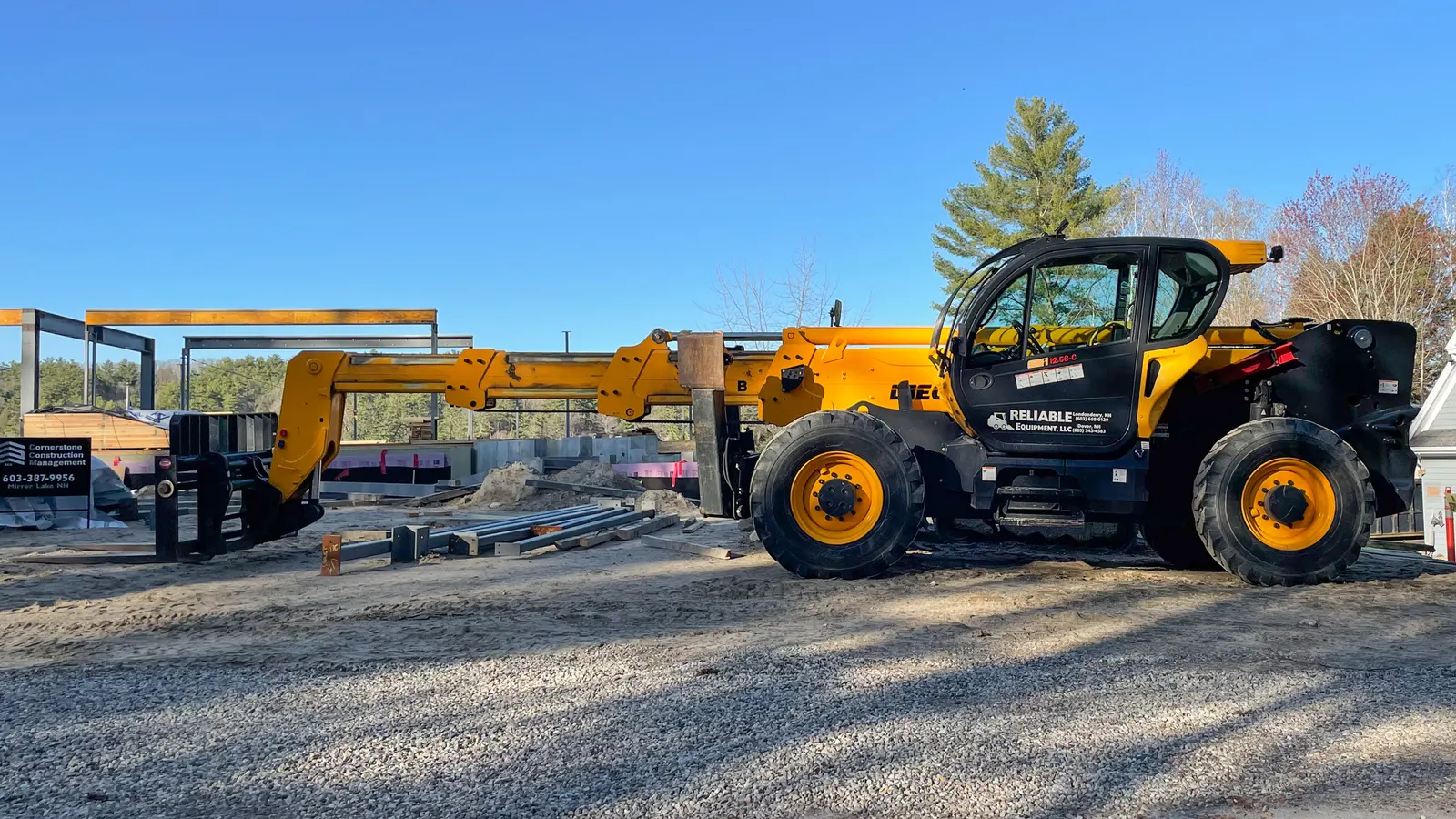
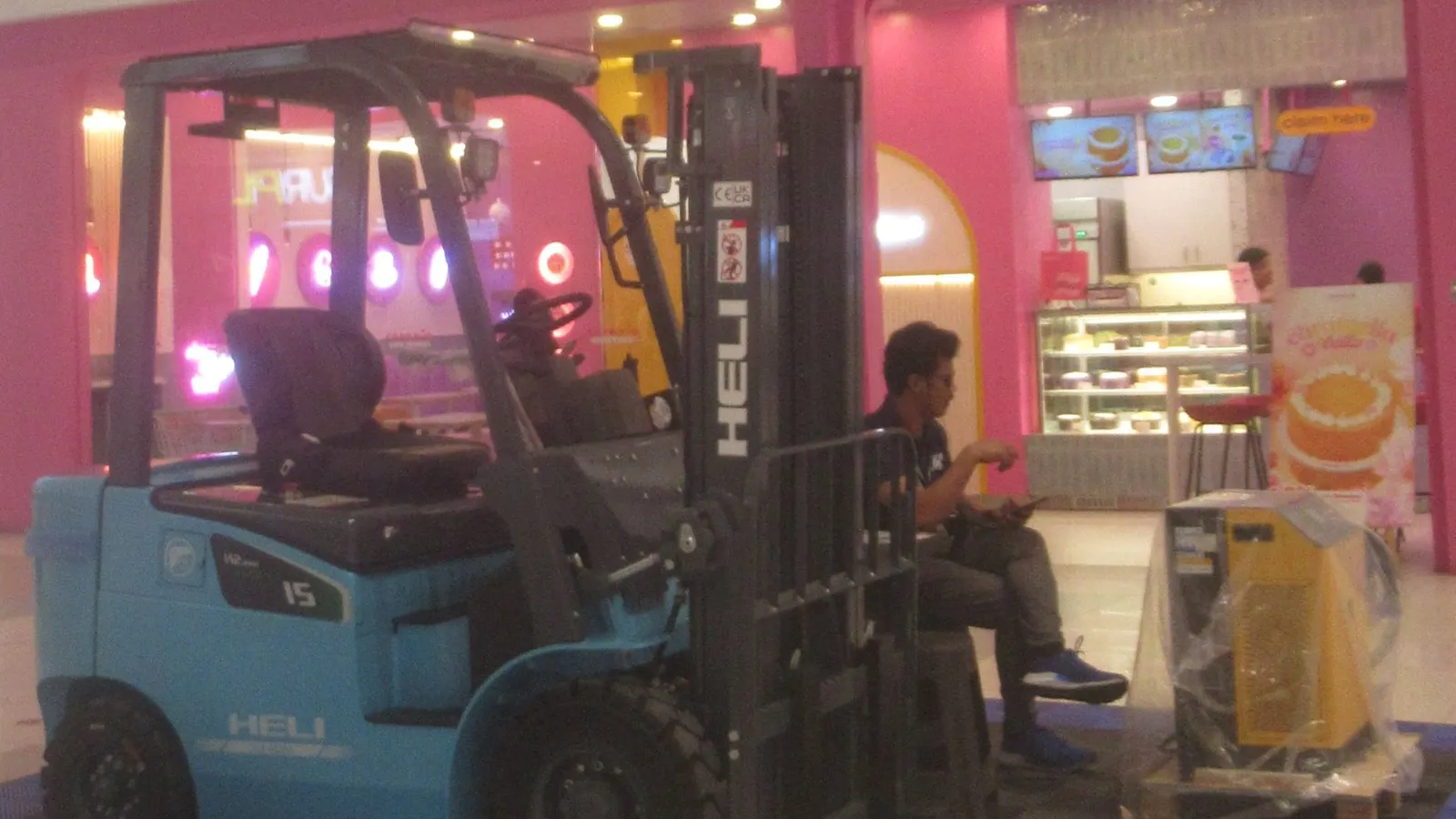
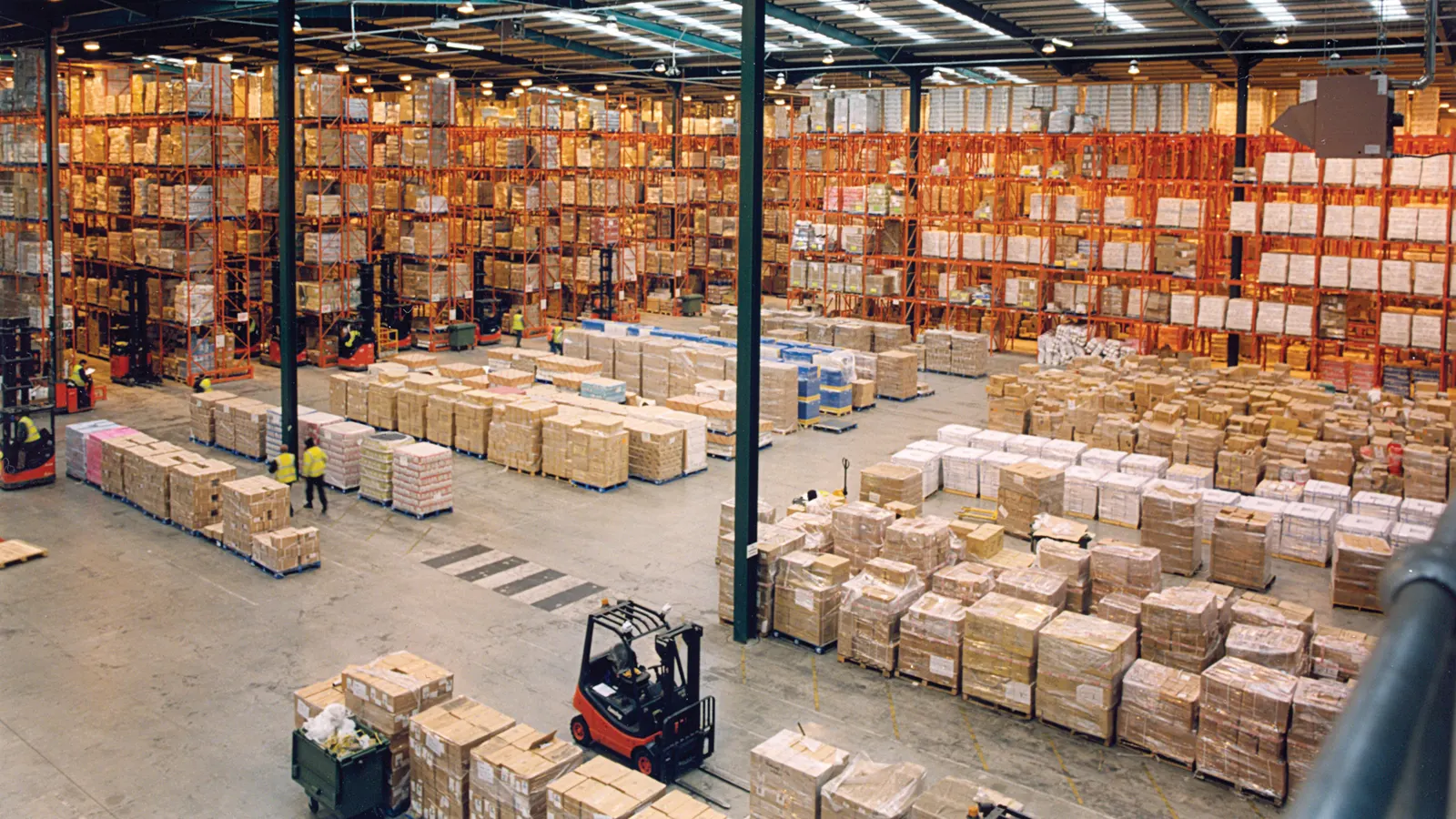
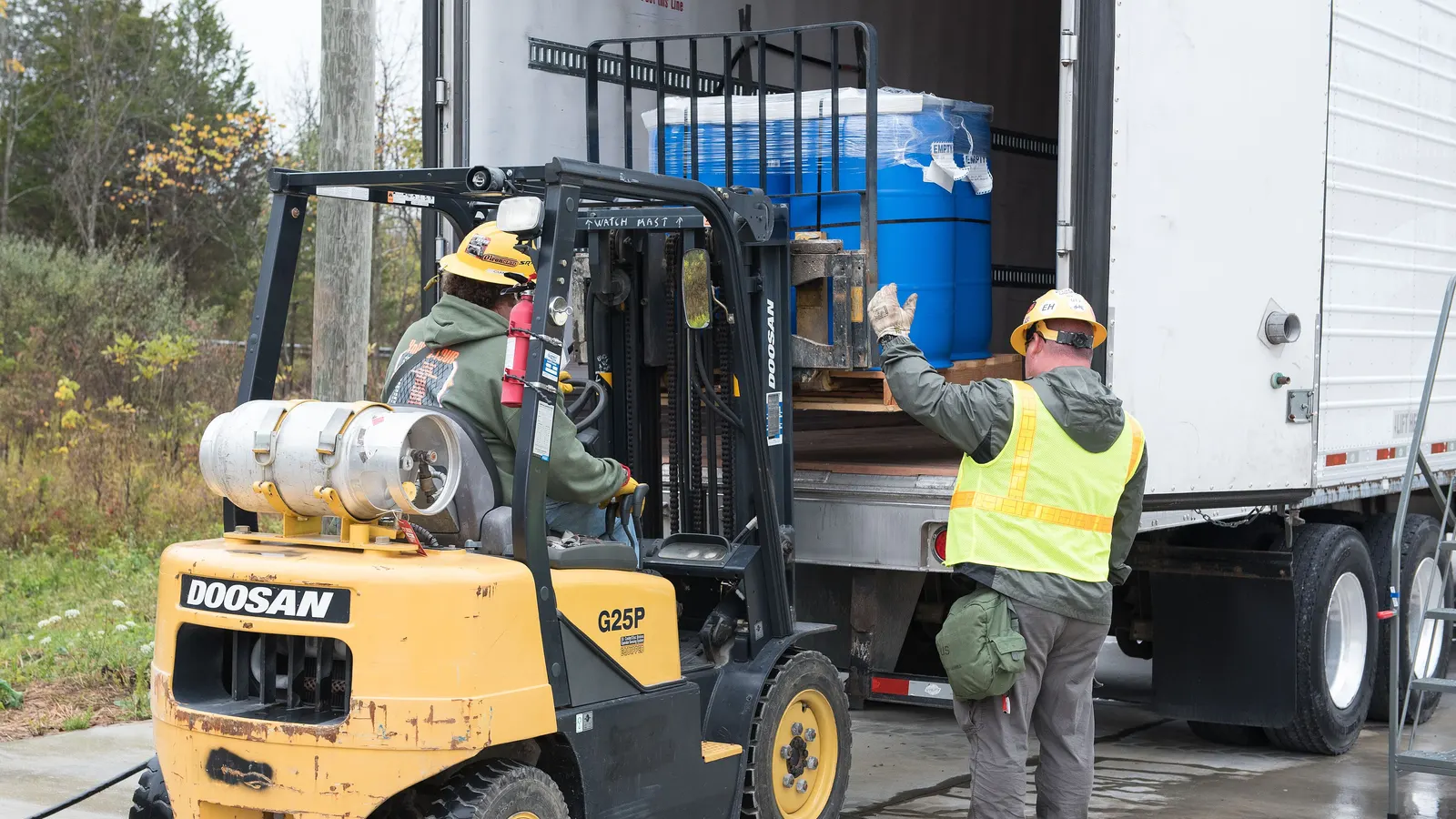
A telehandler lifts with a telescopic boom that reaches forwards as well as up, so it places loads over obstacles and onto upper floors, and takes buckets, winches and other attachments. A forklift lifts on a vertical mast close to its front wheels, which keeps it compact for stacking on firm ground. Choose by where the load must go, then compare forklift and telehandler suppliers in the UAE.
This guide is for contractors, site managers, plant managers and yard operators deciding between the two machines for a project or fleet. It covers how each lifts, how to read a telehandler load chart, stability, attachments, ground conditions, operator training and the rules that apply in the UAE and Saudi Arabia. For forklift types, power options and brands in general, see our forklift buying guide for the UAE and Saudi Arabia.
Are forklifts and telehandlers the same?
No. Both are lift trucks with forks, but they move the load differently. JCB, which says it has developed telehandlers since 1977, defines a telehandler as "a lifting machine equipped with a telescopic boom and a lifting attachment, allowing it to function as a forklift and a crane". Sharjah's code of practice for mobile plant puts it the same way: a telescopic handler (also called a telehandler or teleporter) "is similar to a forklift truck but has a boom or telescopic cylinder, making it more a crane than a forklift".
Safety guidance treats them as a separate class. The UK HSE's lift truck code (L117) lists variable reach trucks (telehandlers) as their own type alongside counterbalanced, reach and rough-terrain counterbalanced trucks, and OSHA's forklift eTool has a separate class for rough terrain forklift trucks. SASO's lifting equipment regulation, which covers fork-lift trucks, lists different safety standards for each: the ISO 10896 series for rough-terrain variable-reach trucks, ISO 3691-2 for self-propelled variable-reach trucks, and ISO 22915-11 for the stability of industrial variable-reach trucks.
Telehandler vs forklift at a glance
Question
Counterbalance forklift
Telehandler
How it lifts
Vertical mast at the front; load stays close to the front wheels
Telescopic boom that raises and extends forwards
Where it places loads
Straight up: racking, trucks, stacks
Up and forwards: over walls and trenches, onto scaffolds, roofs and upper floors
Capacity
Rated at a load centre and lift height on the capacity plate
Varies with how far the boom is extended and how high; read from the load chart
Ground
Firm, level floors and yards; pneumatic tyres for rougher yards
Built for rough terrain, but HSE and Sharjah guidance stress firm, level ground for lifting
Attachments
Side shift, clamps, rotators, fork positioners
Forks, buckets, winches and other tools, depending on the model
Stability aids
Counterweight; rated plate
Load moment indicator or control; some have stabilisers or chassis levelling
Where it is used
Warehouses, docks, yards, factories
Construction, agriculture, industrial sites with height and reach needs
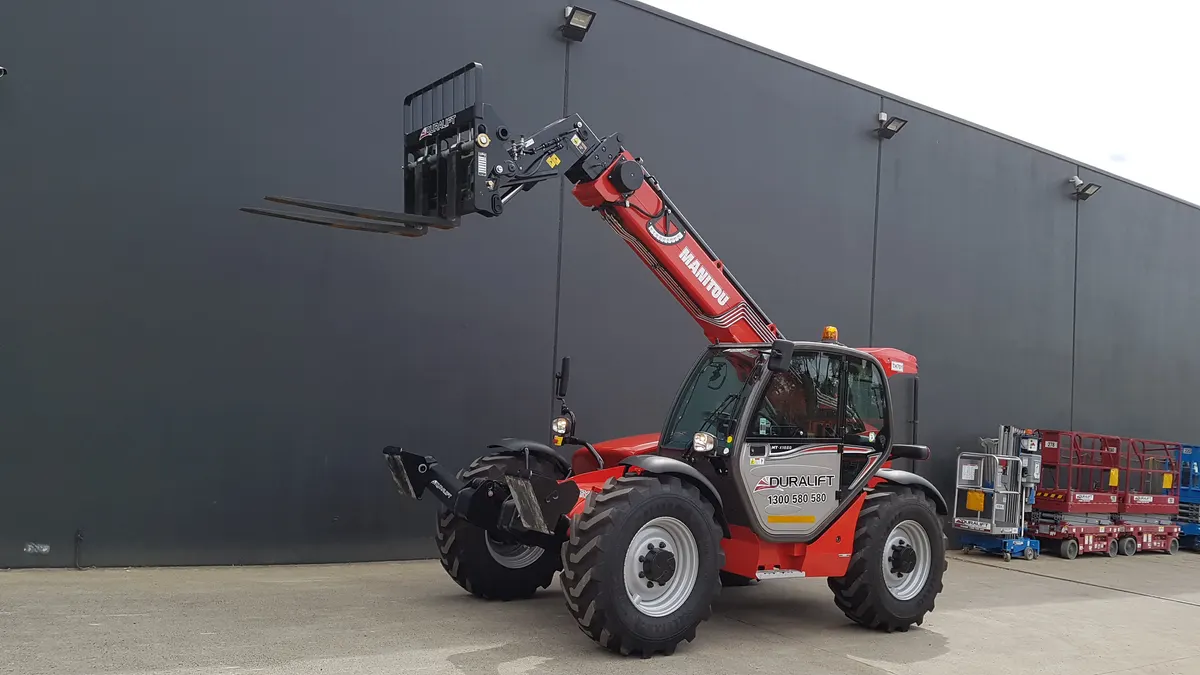
A 3 tonne telehandler with its boom raised and front stabilisers. Some telehandlers have stabilisers or chassis levelling; capacity depends on how far and how high the boom is extended. Photo: ERab123, CC BY-SA 4.0, via Wikimedia Commons
Reach and capacity: how to read a telehandler load chart
The headline capacity of a telehandler applies only with the boom close in. HSE's L117 says telehandlers can raise loads to greater heights and reaches than conventional lift trucks, which increases operating hazards, particularly overturning, and that "the load capacity of the truck will vary according to how far the boom is extended and to what height". The load chart in the cab shows that relationship: find where the load must be placed (height and forward distance) and read the maximum load allowed at that point.
Manufacturer figures show the range. JCB says its telehandler range covers reach from 4 to 20 m depending on machine size; that its construction machines handle loads up to 4,100 kg, rising to 6,000 kg for its largest agricultural model; and that its rotating 360 models lift up to 5,500 kg, with the 558R PRO reaching 25.5 m with a maximum reach of 21.4 m. Those are maximums at different boom positions, not the load you can place at full reach.
For your RFQ, give suppliers:
the heaviest load and its dimensions;
the highest placement point and the forward distance from where the machine can stand (for example, over a trench, a scaffold or a parapet);
the attachment you will use, since attachments change the chart;
the ground the machine will stand on when lifting.
Then ask for the load chart extract that shows your load at your placement point. If the load sits close to the limit, choose the next size up.
Load moment warnings and stabilisers
L117 says a telehandler will be fitted with a device that warns of approaching overload: a longitudinal load moment indicator (LLMI) or, on new machines, longitudinal load moment control (LLMC). Operators must never ignore its warnings, and its calibration should be checked periodically following the manufacturer's instructions. Some telehandlers have stabilisers or chassis levelling devices. L117 also says the boom should be fully retracted for travelling, except at creep speed and only on relatively hard and level ground, because extending the boom increases the danger of tipping forwards or sideways. SASO's list of standards for lifting equipment includes ISO 10896-7 on longitudinal load moment systems for rough-terrain trucks.
Stability and ground conditions
Telehandlers are built for rough ground, but they are not built to lift on it carelessly. Sharjah's mobile plant code lists when telehandlers are at risk of overturning:
when overloaded;
when operating on sloping, uneven or unstable ground;
when operating with raised loads;
when operating at excessive speed and turning.
The same code says these machines "normally require flat, graded surfaces to operate safely and have strict operational limits", and warns of poor rear visibility and, with the boom raised, a significant blind spot to the front right-hand side, which should be covered in the risk assessment with visibility aids where needed. Genie describes telehandlers as able to move over rough terrain and remain level on uneven ground, which refers to travel and levelling features, not permission to lift on soft or sloping ground.
On Gulf sites, plan the lifting position before the machine arrives: compacted, level ground clear of trenches and soft backfill, and a route with no overhead power lines. L117 notes that pneumatic tyres are generally fitted to rough-terrain trucks, and that since 2002 rough-terrain trucks (in the UK) must have an operator restraining system such as a seat belt, which should be used.
Fixed and rotating telehandlers
Most telehandlers have a fixed boom that points forward over the front axle. Rotating (slewing) telehandlers mount the boom on a turret that turns, so the machine can place loads to the side without moving, closer to how a small mobile crane works.
JCB says its 360 rotating models provide full rotational flexibility and lift up to 5,500 kg.
Dieci lists both fixed and rotating telehandlers for agriculture and for construction, renovation and logistics.
JLG offers telehandlers under the JLG and SkyTrak brands, plus rotating telehandlers.
SASO's standards list includes a separate part of ISO 10896 for slewing rough-terrain trucks. A rotating telehandler suits sites where the machine cannot reposition easily; a fixed telehandler is simpler and suits most material placement.
Attachments: forks, buckets, winches and platforms
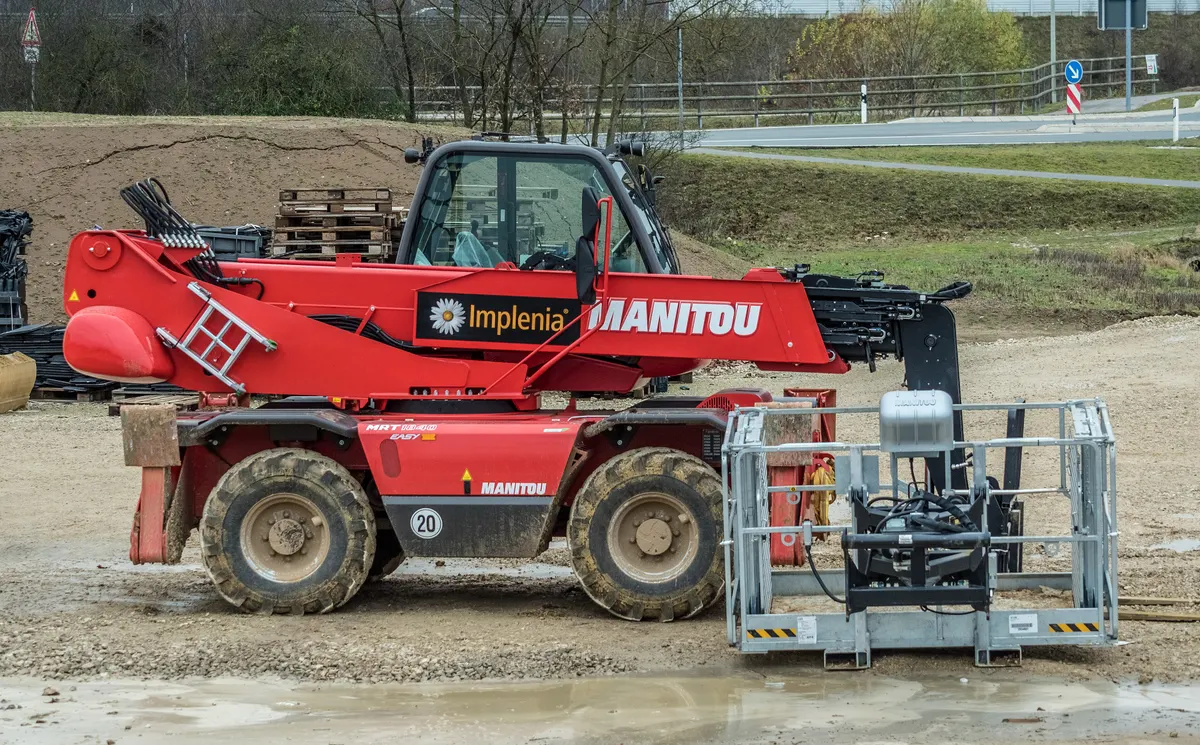
The boom of a telehandler can take different tools. Sharjah's code lists a bucket, pallet forks or a winch as examples, and JCB's range page lists access, agricultural, forestry, snow and specialist attachments. This versatility is the main reason a site chooses a telehandler over a forklift: one machine can unload pallets, move loose material and lift suspended loads.
A Manitou MRT 1840 telehandler on a construction site, with a personnel basket attachment on the ground. Each attachment changes what the machine may lift, and working platforms and suspended loads are covered by their own standards. Photo: ermell, CC BY-SA 4.0, via Wikimedia Commons
Two uses need particular care, and SASO's list of standards gives each its own part of ISO 10896:
Freely suspended loads (crane-type lifting with a hook or winch): ISO 10896-4, additional requirements for variable-reach trucks handling freely suspended loads.
Personnel platforms: ISO 10896-5, the interface between a rough-terrain truck and an integrated personnel work platform.
Use only attachments the manufacturer approves for the model, with the matching load chart. L117's general rule for lift trucks also applies: fitting an attachment reduces the truck's capacity, and the manufacturer or authorised supplier should be consulted. For dedicated work at height, a purpose-built aerial work platform is often the better tool.
Operator training and certification
A forklift certificate is not enough to operate a telehandler. L117's training principles apply to telehandler operators, and its basic training objectives include using safety devices such as stabilisers, level indicators and load indicators where fitted, and operating on rough terrain where applicable. It says training areas for rough terrain trucks need an appropriate surface and obstacles representative of real conditions. Training providers run separate courses: Jungheinrich UK, for example, lists telehandler courses separately from its forklift courses.
In Dubai, Dubai Municipality's lifting equipment guideline requires operators of lifting equipment "such as cranes, hoists, forklifts, cradles, etc." to be certified by a third party accredited by the Emirates International Accreditation Center (EIAC); it does not name telehandlers, so ask the certification body for a telehandler-specific certificate. Sharjah's mobile plant code, which has a section on telescopic handlers, requires formal training on specific mobile plant. In Saudi Arabia, SASO's regulation requires operators of lifting equipment to be competent and hold the licences the competent authorities require. Our guide to forklift operator licences in the UAE and Saudi Arabia sets out what each authority requires.
Rules on the machine itself
Saudi Arabia: SASO's Technical Regulation for Machinery Safety, Part 3: Lifting Equipment covers fork-lift trucks and trucks fitted with lifting or handling equipment (customs code 8427), and its standards annex lists the rough-terrain and variable-reach truck standards above. Ask the supplier for the SASO certificate of conformity and, for used machines, the inspection certificate from a SASO-approved notified body.
Dubai: the Dubai Municipality guideline requires cranes, lifting equipment and forklifts "etc." used in workplaces to be tested and certified by an EIAC-accredited third party every 12 months, with the certificate kept on site.
Sharjah: the mobile plant code applies to owned and hired plant, and says plant not designed, licensed and insured for public roads must not be used on them.
Which should you choose?
Loads go up and over something (a trench, wall, scaffold or parapet), or onto an upper floor: telehandler.
Loads go straight up into racking or onto a truck bed, on firm ground: forklift. It is more compact and simpler to operate for repetitive stacking.
The site has rough, unpaved ground and loads must move across it: telehandler or a rough-terrain forklift; check the ground where you will lift.
You need several jobs from one machine (pallets, loose material, suspended loads): telehandler with approved attachments.
Indoors or in tight buildings: forklift, or a compact or electric telehandler. JCB says its smallest model, the 514-40, fits through a 1.8 m doorway and lifts up to 1,400 kg, and its all-electric 525-60E has a 24 kWh lithium-ion battery designed for a full day's work.
JCB builds its Loadall telehandler range, including compact, rotating and electric models. Genie, a Terex brand, makes the GTH line, which it describes as delivering the benefits of both a forklift and a crane. Dieci and JLG are covered above. Other makers with ListGCC pages include Manitou, Caterpillar and Liebherr; compare dealer support and parts stock in your city whichever you shortlist. See also construction equipment suppliers in the UAE and forklift suppliers in Saudi Arabia.
Telehandler RFQ checklist
Heaviest load, dimensions and the attachment needed.
Highest placement height and forward reach from the machine's standing position.
Fixed or rotating; stabilisers or chassis levelling required.
Ground conditions where the machine travels and where it lifts.
Load chart extract showing your load at your placement point.
Power: diesel or electric; cab, air conditioning and filtration for Gulf summers.
Certificates: SASO conformity (Saudi Arabia), current third-party inspection certificate, and operator certification.
Rental or purchase terms, service response and replacement machine.
What is the maximum weight a telehandler can lift?
It depends on the model and on where the load is placed. JCB, for example, says its construction telehandlers handle up to 4,100 kg, its largest agricultural model up to 6,000 kg, and its rotating models up to 5,500 kg. Those maximums apply with the boom close in; capacity falls as the boom extends and rises, so always check the load chart at your placement point.
Can a telehandler be used as a crane?
Some can, with a manufacturer-approved hook or winch attachment and the matching load chart. Sharjah's mobile plant code describes the telehandler as "more a crane than a forklift" and lists a winch among its attachments, and SASO's standards list includes ISO 10896-4 for variable-reach trucks handling freely suspended loads. Plan such lifts like crane lifts, with a competent person and signaller.
Do I need a separate licence to operate a telehandler?
Plan on separate training and certification. HSE's L117 treats telehandlers as their own truck type with specific safety devices, and training providers run separate telehandler courses. In Dubai, lifting equipment operators must be certified by an EIAC-accredited third party, and Sharjah's code requires formal training on the specific plant. Confirm the certificate your client or authority accepts before work starts.
How far can a telehandler reach?
Reach varies by model. JCB says its range covers 4 to 20 m of reach depending on machine size, and its 558R PRO model reaches 25.5 m high with a maximum reach of 21.4 m. The weight it can hold falls as reach increases, so the useful figure is the load allowed at your required reach on the load chart.
Is a telehandler more stable than a forklift?
Not inherently. HSE says telehandlers raise loads higher and further than conventional lift trucks, which increases the risk of overturning, and Sharjah's code says they need flat, graded surfaces and have strict operating limits. Load moment indicators, stabilisers and correct use of the load chart manage that risk. On firm ground for straight-up lifts, a forklift is the simpler choice.
Can a telehandler work indoors?
Compact and electric models can. JCB says its 514-40 fits through a 1.8 m doorway, and its all-electric 525-60E has a 24 kWh lithium-ion battery designed for a full day's work. Diesel telehandlers produce exhaust, so indoor use needs ventilation planning; for repetitive indoor stacking, a forklift or reach truck is usually the better machine.
Lithium-ion or lead-acid for electric forklifts in Gulf warehouses: opportunity charging, what heat does to each, charging room ventilation, lithium safety, total cost drivers and converting existing trucks.
How counterbalance forklifts, reach trucks, VNA turret trucks, order pickers, pallet trucks and stackers work, what lift heights makers publish, what VNA stores need from the floor, and which type fits which job.
Which licence and certificate a forklift operator needs in Dubai, Abu Dhabi, Sharjah, the other emirates and Saudi Arabia, according to official sources, and where no official rule could be found.