Laser Welding Machines: Handheld and Automated Systems Explained
How laser welding works, what thickness 1 to 2 kW handheld units weld, handheld versus automated cells, Class 4 laser safety, fit-up, cost drivers, and when MIG or TIG is still the better tool.
A laser welding machine joins metal with a focused laser beam, usually from a fibre laser, giving narrow welds with little distortion and fast travel on thin to medium sheet. Handheld units of 1 to 2 kW weld steel up to about 8 mm and aluminium up to about the same, while automated cells handle repeat production. It needs tight fit-up and Class 4 laser safety controls. Compare welding equipment suppliers in the UAE once you know the thickness and volume you weld.
This guide is for fabrication shop owners, production engineers and buyers deciding whether laser welding fits their work, and whether to buy a handheld unit or an automated system. It covers how laser welding works, power and thickness, handheld versus robotic systems, laser safety, fit-up, cost drivers and where MIG or TIG is still the better tool. Arc welding machines, duty cycle and import rules are covered in our welding machine buying guide for the UAE and Saudi Arabia. Saudi buyers can compare sellers on the welding equipment page for Saudi Arabia.
How laser welding works
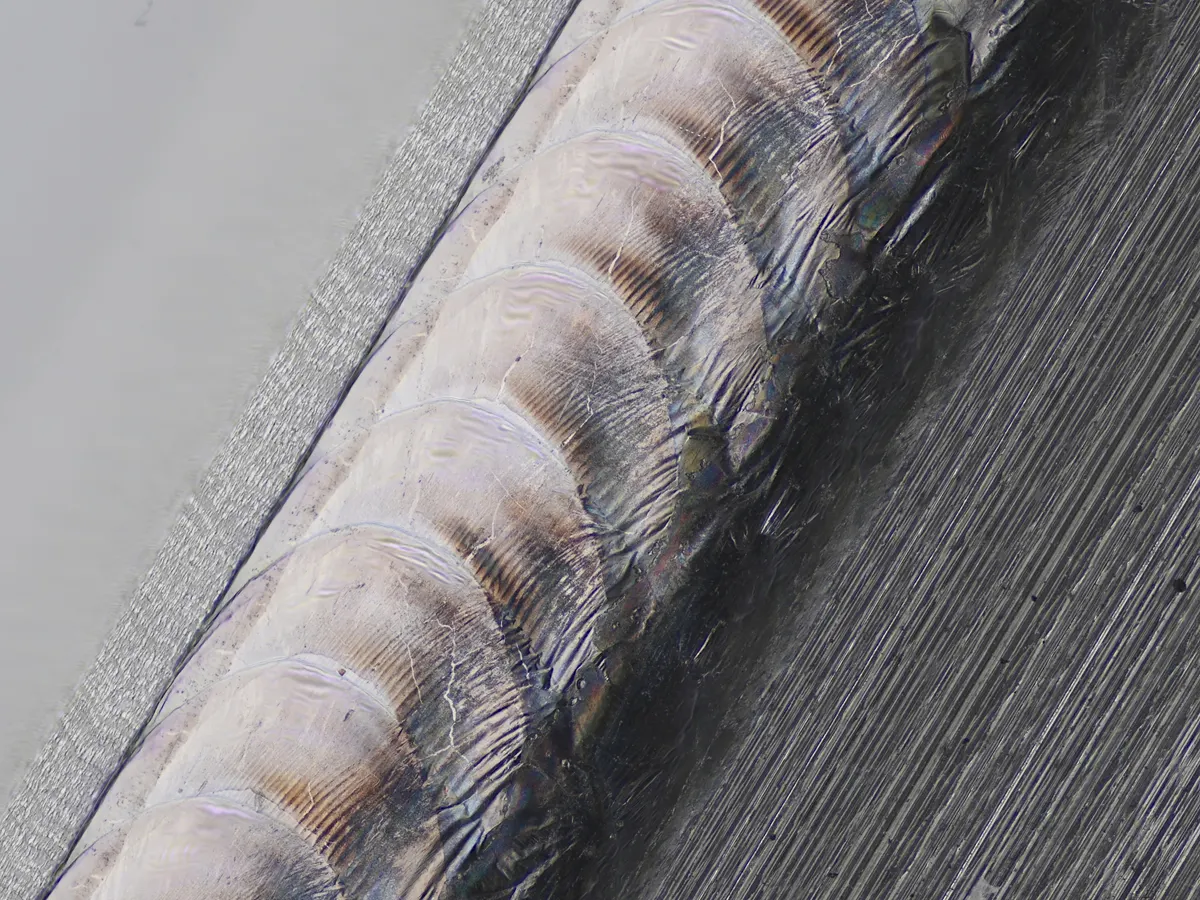
A laser concentrates energy into a very small spot, with a power density in the order of 1 MW per square centimetre. That gives small heat-affected zones and very fast heating and cooling. There are two modes:
Conduction mode stays below the vaporisation point of the metal. TRUMPF describes heat conduction welding as a quick, easy way to join thin parts and visible edges.
Keyhole (deep penetration) mode runs above the vaporisation point: vapour pressure opens a narrow cavity that carries the energy deep into the joint. TRUMPF says this produces narrow seams with a large depth-to-width ratio and minimal distortion.
Spot welds can be as small as about 1 mm in diameter, and seams can run for metres. Filler wire is added when the joint needs it.
Laser sources
Laser type
Wavelength
Notes
Fibre
Near infrared; ask the maker for the exact figure
Gain medium is a doped optical fibre; powers up to 50 kW; increasingly used in robotic welding
CO2
10.6 micrometres
Up to 25 kW; fibre cannot carry this wavelength, so the beam is delivered with rigid mirrors and lenses
Nd:YAG (solid-state)
About 1 micrometre
0.04 W to 6 kW, pulsed or continuous; needs special eyewear or screens
Unlike CO2 lasers, whose wavelength optical fibre cannot carry, solid-state sources can be delivered to the head by flexible cable, which is what makes light handheld guns and robot heads practical.
Which metals and what thickness?
Laser welding handles carbon steel, high-strength low-alloy steel, stainless steel, aluminium and titanium. TRUMPF lists low-spatter deep penetration processes for mild steel, stainless steel, copper and aluminium, and says the short, controlled melt can make some hard-to-weld materials weldable. Two cautions from the reference literature: high-carbon steels are prone to cracking because of the high cooling rates, and pulsed welding can cause hot cracking in aluminium alloys.
Thickness depends on laser power. IPG Photonics publishes maximum thicknesses for its LightWELD handheld range, which gives a realistic picture for this class of machine:
Material
1,000 W
1,500 W
2,000 W
Steels
4.0 mm
5.9 mm
8.0 mm
Aluminium (3xxx and 5xxx series)
3.3 mm
5.8 mm
8.3 mm
Aluminium (6xxx series)
3.3 mm
5.2 mm
5.8 mm
Nickel alloy
Not listed
5.2 mm
7.1 mm
Titanium
Not listed
5.2 mm
5.9 mm
Copper
Not listed
2.1 mm
3.3 mm
Values converted from IPG's inch figures. These are maximums for one maker's machines; ask any supplier for its own table, and for the thickness it can weld at the speed and quality you need, not just the limit.
Handheld or automated laser welding?
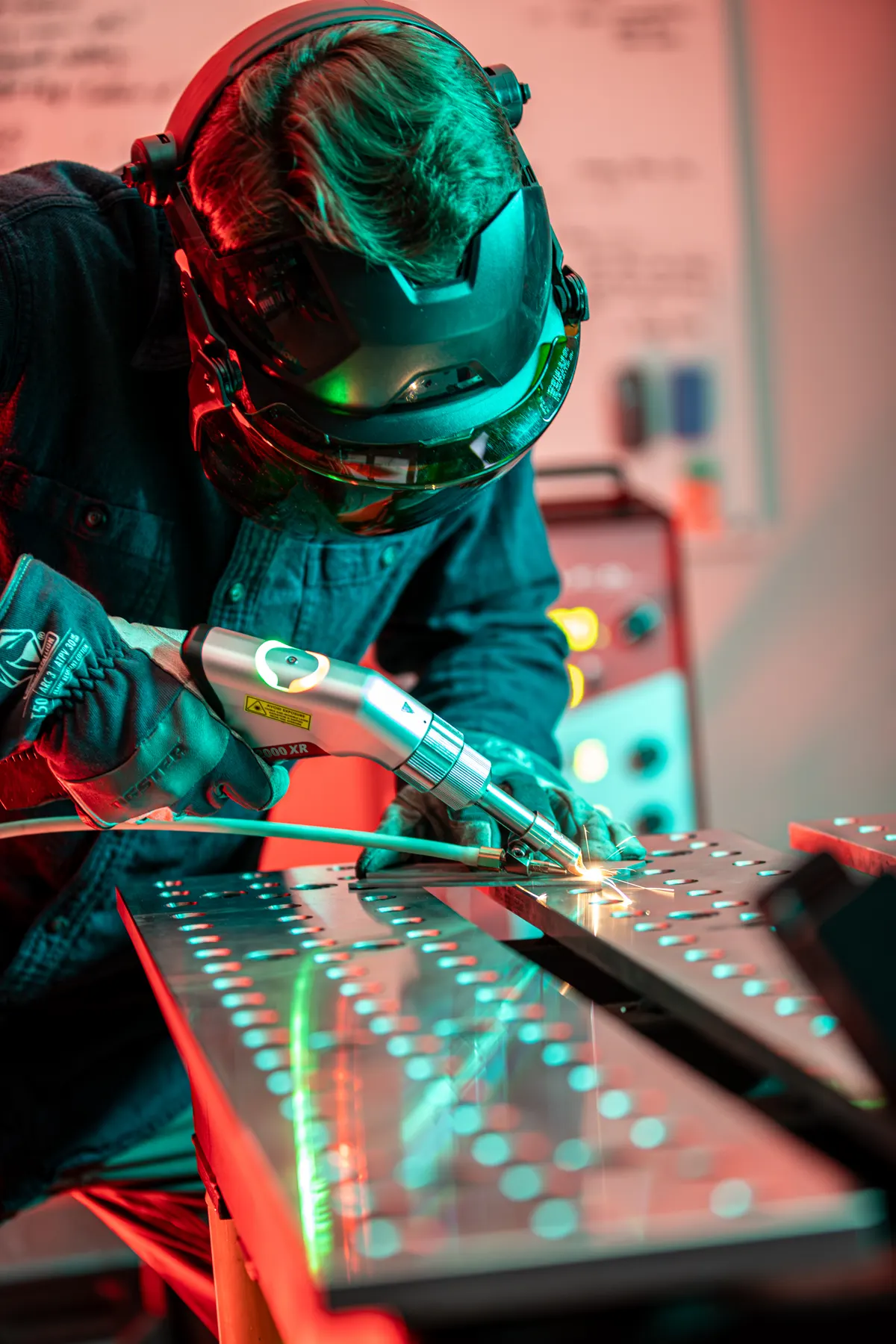
Handheld laser welders put a laser gun, fed by a cable from the source, in the welder's hand. Automated systems move the beam with a robot, a gantry or a scanner inside an enclosed cell.
Factor
Handheld laser welder
Automated laser cell or robot
Typical power
About 1 to 2 kW (IPG LightWELD range)
Fibre sources up to 50 kW exist
Best for
Manual work on varied parts and short runs
Repeat production; tubes, profiles and strip; small precision assemblies
Operator
Manual welder, trained on the laser and its safety
Programmer and operator
Laser safety
Open beam at the work: needs a controlled laser area, eyewear and interlocks
Beam inside an enclosure
Fit-up
Beam wobble and filler wire widen the tolerance
Repeatable fit-up and fixturing
What a handheld unit includes
IPG's LightWELD is a well-documented example of the features to compare:
Models at 1,000, 1,500 and 2,000 W, all air-cooled, on a 220 V supply.
Wobble welding (the beam oscillates to widen the seam) up to about 5 mm wide, wire-fed welding, and laser cleaning before and after welding up to about 15 mm wide.
Laser power, gas and gun control through a single cable, and 100 factory presets for welding and cleaning.
Safety features: key switch, emergency stop, an interlock checking the beam delivery to the gun, a two-step trigger, firing only while the nozzle touches the part, shutdown if no welding plume is detected, and door interlocks that stop the laser if someone enters the area. A helmet and laser safety glasses are supplied.
IPG claims the units weld four times faster than TIG. Treat speed claims as the maker's, and ask for a trial weld on your own parts.
Most laser welding is automated. Traditionally a robot carries the laser head along the seam; in remote welding a scanner moves the beam instead, which increases speed and precision. TRUMPF's range shows the spread of system types: the TruLaser Weld 3000 and 5000 for automated laser welding of varied components, the TruLaser Station 7000 for small assemblies such as sensors and medical devices, the TruLaser Cell 1100 for continuous welding of tubes, profiles and strip, and 3D laser machines that combine cutting and welding. TRUMPF claims virtually distortion-free parts and seams that need hardly any rework, and says laser welding can cost less than conventional welding when parts are suited to it. Integrators and cells are listed under welding automation systems.
Laser-hybrid welding combines a laser with MIG/MAG in one head: the arc adds filler metal and tolerance to joint position, and the laser adds speed and reduces undercut.
Laser safety: Class 4 and IEC 60825-1
Laser safety is the biggest change for a shop moving from arc to laser welding. Laser products are classified under IEC 60825-1:2014 (edition 3.0), Safety of laser products, Part 1: Equipment classification and requirements, which covers lasers emitting between 180 nm and 1 mm and requires classification, labels, safety information and protective features.
Class 4. Class 3B is limited to 0.5 W for continuous lasers in the visible to far-infrared range; anything above is Class 4, the most hazardous class. A 1 to 2 kW welding laser is far above that limit. For Class 4, even diffuse reflections from matte surfaces can harm skin and eyes within the hazard zone, and the beam can start fires.
Invisible beam. Near-infrared welding lasers can be invisible: people exposed to the invisible 1,064 nm radiation of high-power Nd:YAG lasers may not feel pain or notice immediate damage, and a pop or click may be the only sign of retinal injury.
Eyewear. Laser eyewear is rated by optical density at specific wavelengths; OD 3 cuts power by a factor of 1,000. It must be rated for the laser's wavelength; IPG supplies laser safety glasses as well as a helmet with LightWELD.
Organisation. Many jurisdictions require a laser safety officer for organisations operating hazardous lasers. Plan a controlled laser area: LightWELD, for example, has door interlocks that stop the laser if someone enters, and Class 4 reflections mean the area must be screened from other workers.
Enclosed systems. A product that fully contains a higher-class beam can be rated Class 1, which is how enclosed cells remove the open-beam hazard.
Fume still needs extraction: laser welding melts and vaporises metal like any fusion process. For helmets and respiratory protection, see our guide to welding helmets and PPE.
Fit-up, shielding and joint preparation
The laser's narrow beam is both its strength and its limit. TRUMPF's own comparison says that with MIG/MAG welding, gaps in the seam can be bridged with filler metal and component tolerances can be much higher than with laser welding, and that MIG/MAG can weld sheets up to 30 mm thick with suitable joint preparation. For laser welding, plan for:
Accurate cutting and fixturing. Precisely cut edges and clamping that holds the gap closed; precision blanks can be bought from laser cutting services.
Clean surfaces. Some handheld units include laser cleaning before and after welding.
Beam wobble or filler wire where gaps cannot be held tight.
Shielding gas delivered through the gun or head, as specified by the machine maker and the procedure.
Focus position. Penetration is greatest with the focal point slightly below the surface.
No prices here; they depend on power, brand and configuration. What drives cost:
laser power (1, 1.5 or 2 kW for handheld units; much more for automated sources) and the thickness range it buys;
handheld gun versus robot, gantry, scanner or enclosed cell, plus fixtures;
wire feeder, wobble head and laser cleaning options;
laser safety: enclosure or controlled area, interlocks, screens, certified eyewear, training and a laser safety officer;
cooling (air-cooled handheld units avoid a chiller) and the power supply;
consumables such as protective windows, nozzles and gas;
local service for the laser source and optics.
Brands making laser welding machines
Listed in no particular order. Jasic, the Chinese arc welding maker, lists the launch of successive generations of handheld laser products in its company history. TRUMPF of Germany makes automated laser welding systems and laser sources for welding, alongside its cutting and bending machines. IPG Photonics makes the LightWELD handheld and cobot laser welding systems described above. Check local service for the laser source before buying any brand.
Rules in the UAE and Saudi Arabia
In Saudi Arabia, SASO's Technical Regulation for Electromagnetic Compatibility lists among its products customs heading 8515 (described as electric welding machines and apparatus working by electron beam or magnetic pulse) and heading 9013 (lasers other than laser diodes), so ask the importer which heading and certificate covers the machine and for the SABER registration. In the UAE, electrical equipment conformity routes through MoIAT are covered in the main guide. In both countries, ask for the IEC 60825-1 classification, laser warning labels and the safety manual in Arabic and English.
Buying checklist for a laser welding machine
List materials, thickness range and joint types, with sample parts or drawings.
Ask for the maker's thickness table at your target speed, and a trial weld on your parts.
Decide handheld or automated, and the fixturing you need for fit-up.
Specify wire feed, wobble and cleaning options, and the shielding gas.
Ask for the IEC 60825-1 class, interlocks, eyewear specification and training content; plan the controlled laser area.
Confirm supply voltage, cooling, and fume extraction.
Ask for SASO or MoIAT conformity documents and local service for the source and optics.
It depends on power and material. IPG publishes maximums for its LightWELD range of about 4 mm of steel at 1,000 W, 5.9 mm at 1,500 W and 8 mm at 2,000 W, with similar figures for 3xxx and 5xxx aluminium and less for copper. Ask each supplier for its own table and test welds at production speed.
Is laser welding better than TIG welding?
For thin sheet in volume, laser welding is faster and gives narrow seams with little distortion; IPG claims its handheld units are four times faster than TIG. TIG is better where fit-up varies, sections are thicker, the work is on site, or welds must follow existing qualified procedures. TIG equipment also needs no laser safety controls.
Are handheld laser welders safe?
They are safe only with proper controls. A 1 to 2 kW welding laser is far above the 0.5 W Class 3B limit, so it falls in Class 4, where even diffuse reflections can harm eyes and skin, and near-infrared beams can be invisible. Use a controlled area with interlocks, wavelength-rated laser eyewear, trained operators and a laser safety officer.
Can a laser welder weld aluminium and copper?
Yes. TRUMPF lists deep penetration laser welding for aluminium and copper as well as steels, and IPG gives handheld maximums for both. Aluminium alloys can hot crack with pulsed welding, and copper's maximum thickness is lower than steel's at the same power, so test the specific alloy.
Does laser welding need shielding gas?
Handheld systems deliver gas to the gun along with power and control, as IPG's LightWELD does through a single cable. Use the gas type and flow the machine maker and the welding procedure specify for each material.
What fit-up does laser welding need?
Tighter than arc welding. TRUMPF notes that MIG/MAG can bridge gaps with filler metal and accept much higher component tolerances than laser welding. Laser welding works best with accurately cut edges and fixturing that holds the gap closed; beam wobble and filler wire extend the tolerance on handheld units.
How welder certification works on UAE and Saudi projects: WPS, PQR and WQTR, which code applies, what the test involves, 1G to 6G positions, how long qualifications last, AWS and CSWIP, and third-party witnessing.
Which filter shade each welding process needs, what to check on an auto-darkening helmet, the standards for helmets, jackets and gloves, respirators for fume, and PPE rules in the UAE and Saudi Arabia.
What the numbers on a welding rod mean, when to use E6013 or E7018, how to store and redry low-hydrogen electrodes on humid Gulf sites, and which rods suit stainless steel and cast iron.