Transformer Testing and Maintenance: Oil Tests, DGA and Routine Checks
A practical guide to transformer testing: factory routine and type tests, FAT and SAT, oil breakdown voltage, water and acidity, DGA interpretation, thermography and Gulf maintenance points.
Transformer testing happens at three stages: routine and type tests at the factory to the IEC 60076 series (witnessed at the factory acceptance test for important units), site checks before energising, and condition monitoring in service. For oil-immersed units the oil does most of the in-service work: breakdown voltage to IEC 60156, water and acidity, and dissolved gas analysis interpreted to IEC 60599. Write the test plan into the purchase order when you buy from distribution transformer suppliers in the UAE.
This how-to is for consultants, commissioning engineers, maintenance teams and facility managers who need to specify, witness or schedule transformer tests. It covers factory tests, FAT and SAT, oil testing, DGA, thermography, routine inspection and Gulf-specific points. For transformer types, ratings, standards and makers, see the main guide to transformers in the UAE and Saudi Arabia. ListGCC does not provide testing services and has not tested any product; acceptance limits must come from the standards, the maker and the owner's specification.
The three stages at a glance
Stage
Tests
Who sets the rules
Factory: routine tests
On every unit before dispatch, to IEC 60076-1 and related parts (IEC 60076-11 for dry-type)
IEC 60076 series, utility or owner specification
Factory: type and special tests
On a representative unit of the design: for example lightning impulse, temperature rise, short circuit, sound level
IEC 60076-2, -3, -5, -10 and the specification
Factory acceptance test (FAT)
Client witnesses routine tests (and any special tests ordered)
Purchase order
Site acceptance test (SAT)
Checks after transport and installation, before energising
Consultant, utility energisation procedure
In service
Oil tests and DGA, thermography, inspections, temperature monitoring
IEC 60422, IEC 60599, maker's manual, owner's plan
Factory tests: routine, type and special
Routine tests are carried out on every transformer. SEC's specification for its oil-immersed network units requires routine tests to the applicable clauses of IEC 60076-1 and related parts on all units, and tests of the insulating fluid. Its specification for cast resin units lists the routine tests for each transformer:
Insulation test
Impedance voltage test
No-load loss
Polarity and phase rotation
Separate-source AC withstand voltage test
Induced AC withstand voltage test
Partial discharge measurement
For partial discharge, ask for the measured value against the limit in the specification.
Type tests prove a design once, on a representative unit, and are then certified for identical units. SEC's cast resin specification requires type tests to IEC 60076-1, -2, -3 and -11, starting with the lightning impulse test. For its oil units, SEC requires type tests at SEC-approved laboratories and reserves the right to ask for them to be repeated every five years, or sooner if supplied units show frequent faults. It also requires special tests, including the temperature rise test, on selected samples.
Tank and leak tests. IEC 60076-1:2011 added tank vacuum, pressure and leak tests. SEC's oil specification sets a practical leak criterion: no discolouration by oil of whitewash applied to the outside of the tank at an oil temperature of 90 °C, or another method SEC approves, and a hermetically sealed tank that withstands an internal pressure of 30 kN/m² without permanent deformation.
Makers' own test capability is worth checking. Emirates Transformer & Switchgear states its test laboratory scope is accredited to ISO/IEC 17025, and Federal Transformers Company states it has carried out type tests on more than 48 transformer types at independent laboratories in Europe. Ask any bidder for type test certificates that match the rating and design offered, not a similar one.
Factory acceptance test (FAT)
For a building substation transformer, the FAT is the last chance to catch a problem before the unit is shipped and lifted into a basement. Plan it in the order:
State which routine tests you will witness and which special tests (temperature rise, sound level) are to be performed.
Ask for the test procedure and the acceptance limits in advance, taken from the specification and the IEC 60076 part concerned.
Check guaranteed losses and impedance against the tender: SEC, for example, treats tendered losses as guaranteed values and does not accept increases at testing.
Check the rating plate, accessories, dimensions and paint against the approved drawings.
Collect signed test reports for each serial number.
Utilities can go further. SEC reserves the right to witness routine tests for each batch, may retest 20% of each batch in its own laboratory, and can reject the whole batch if one unit fails.
Site acceptance test (SAT) and commissioning
Transport, lifting and storage can damage a transformer that passed every factory test. Before energising, repeat the checks that would reveal it:
Inspect for transport damage, oil leaks, damaged bushings or resin surfaces, and loose connections.
Check the rating plate, tap position and vector group against the drawings.
Carry out insulation tests and, for oil units, take an oil sample for breakdown voltage and water content.
Function-test the temperature indicators and relays, pressure relief device, oil level indicator and any BMS or SCADA links. SEC's dry-type specification, for example, calls for PT100 sensors with alarm at 130 °C and trip at 140 °C.
Energise following the utility's procedure and record the first readings as the baseline.
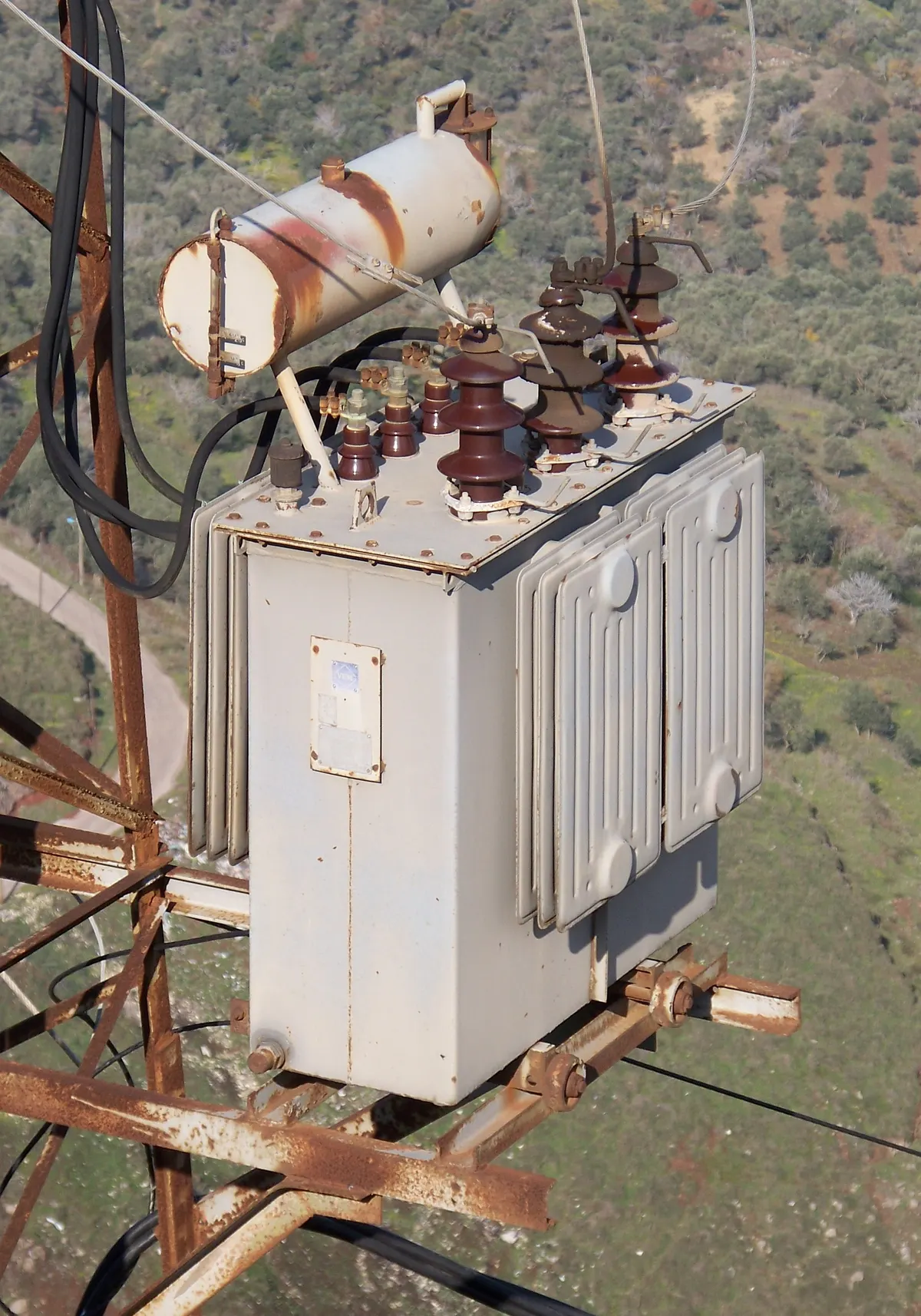
A three-phase pole-mounted oil-filled transformer in Syria, with a conservator tank above the main tank; rust on fittings and exposed tanks are what routine inspections look for. Photo: High Contrast, CC BY 3.0 de, via Wikimedia Commons
Oil testing: breakdown voltage, water and acidity
Transformer oil insulates and cools, and its condition is a direct read-out of the transformer's health. IEC 60422:2024 gives the monitoring guidance and procedures for mineral insulating oils in service, including recommended tests and evaluation, and methods for reconditioning, reclaiming and PCB decontamination of oil. Typical oil tests include:
Test
What it shows
Method note
Breakdown voltage (BDV)
Dielectric strength; falls with water and particles
IEC 60156:2025: the sample is placed in a set apparatus and subjected to a rising AC field until it breaks down; used for new oil on delivery and for samples in service
Water content
Moisture in oil, which degrades insulation quickly
On a BDV test set, the electrodes are typically about 2.5 mm apart, the voltage rises at a constant rate, and the result is the mean of several breakdowns with stirring between them. Acceptance limits for BDV, water and acidity depend on the equipment and its voltage: take them from IEC 60422 or the owner's specification, not from a single number.
As insulation breaks down it releases gases that dissolve in the oil. The mix of gases points to the type of fault and the rate of production to its severity, so DGA is the main early-warning test for oil-immersed transformers. A yearly DGA is a commonly suggested interval, with shorter intervals once a trend appears.
Gas
Usually indicates
Hydrogen
Partial discharge
Methane and ethane
Overheating of the oil
Ethylene
Thermal faults in oil
Acetylene
Arcing, the most severe condition; even low levels matter
Carbon monoxide and carbon dioxide
Overheating of cellulose (paper) insulation
Interpretation methods include the key gas method, the Rogers ratio method, the Duval triangle (methane, ethylene and acetylene) and the Duval pentagon. IEC 60599:2022, edition 4.0, is the IEC guidance on interpreting dissolved and free gas analysis in mineral oil-filled equipment with paper or pressboard insulation; it stresses that results are guidance and that action needs engineering judgement. IEEE C57.104 is the North American equivalent. DGA cannot locate a fault, and a recent oil change can hide one, so trend results from the same lab and combine methods.
Online DGA monitors fitted to the transformer give continuous readings and are worth considering for large or critical units, such as power transformers at grid and plant substations.
Thermography
Thermal imaging finds overheating joints and connections before they fail, and transformer yards and distribution panels are a standard application. Scan the HV and LV terminations, cable boxes, busbar connections and radiators under load, and compare phases with each other. ASTM E1934 is the standard guide for examining electrical and mechanical equipment with infrared thermography. Emissivity and reflections can distort readings from shiny surfaces, so the person doing the scan needs training. Browse infrared thermometers and thermal cameras if you plan to do it in-house.
Routine inspection checklist
Between tests, regular inspections catch the problems that tests only confirm later. The SEC oil specification shows which fittings a distribution transformer carries: an oil temperature dial readable from the ground, a pressure relief vent, an oil level indicator and earthing studs.
Oil-immersed: oil level and temperature readings, leaks at gaskets, valves and radiators, condition of bushings, pressure relief device, corrosion of the tank and fittings, earthing connections.
Dry-type: dust on coils and in the enclosure, winding temperature readings and alarm history, fan operation where fitted, signs of tracking or discolouration on resin surfaces, tightness of connections.
Both: room ventilation or air conditioning working, room temperature, access kept clear, and the load compared with the rating.
Gulf conditions that change the plan
Heat. Transformers in the Gulf run closer to their thermal limits in summer. SEC treats surfaces in direct sun as 75 °C plus internal heating and requires units to operate at 55 °C ambient. Schedule thermography and oil sampling before and during the peak cooling season, when load and ambient are highest.
Dust and sand. Dust on dry-type coils and blocked radiator fins reduce cooling. Increase cleaning frequency on dusty sites and check room filters.
Coastal salt and pollution. SEC's specification calls up IEC TS 60815-3 for insulators in polluted conditions; inspect bushings and outdoor insulation more often near the coast and industrial zones.
Moisture. High humidity and air conditioning can cause condensation in rooms and enclosures; check heaters and seals.
Routine tests are carried out on every unit to IEC 60076-1 and related parts. SEC's cast resin specification, for example, lists insulation test, impedance voltage, no-load loss, polarity and phase rotation, separate-source AC withstand, induced AC withstand and partial discharge measurement. Type tests such as lightning impulse and temperature rise are done once on a representative unit of the design.
What is transformer oil BDV testing?
BDV is the breakdown voltage of the insulating oil, measured to IEC 60156:2025. A sample is placed between electrodes in a test cell and the AC voltage is raised at a constant rate until it breaks down; the result is the mean of several breakdowns. Low BDV indicates water or particles in the oil. It is used on new oil at delivery and on samples taken in service.
What does DGA tell you about a transformer?
Dissolved gas analysis measures the gases formed as insulation breaks down. Hydrogen points to partial discharge, ethylene to thermal faults in oil, acetylene to arcing, and carbon monoxide and dioxide to overheated paper insulation. The pattern and rate of change, interpreted to IEC 60599:2022 or IEEE C57.104, indicate the type and severity of a fault before it causes a failure.
How often should transformer oil be tested?
A yearly dissolved gas analysis is a commonly suggested interval, with furan analysis about every two years to track paper ageing, and more often once results start to trend. IEC 60422:2024 gives supervision and maintenance guidance for mineral oils in service. Large, critical or heavily loaded units in Gulf heat justify shorter intervals or online monitoring.
What is the difference between FAT and SAT for a transformer?
The factory acceptance test (FAT) is the client's witnessing of the routine tests, and any special tests ordered, at the maker's works before dispatch. The site acceptance test (SAT) repeats the key checks after transport and installation, before energising: inspection, insulation tests, oil sampling on oil units and function tests of the temperature and protection devices.
Do dry-type transformers need maintenance?
Yes, though no oil testing. Keep the coils and enclosure clean, check connections for tightness and heating, watch the winding temperature system and its alarms, make sure the fans and room ventilation work, and use thermography on terminations. Partial discharge is measured at the factory as a routine test on cast resin units under SEC's specification.
A buyer's guide to transformers in the UAE and Saudi Arabia: types, data sheet ratings, IEC 60076, DEWA and SEC specifications, losses, Gulf heat derating, makers and what to put in an RFQ.
Size a transformer in kVA: formulas, load schedule, demand and diversity, power factor, harmonics, motor starting, Gulf heat derating to SEC practice, standard ratings and LV fault level.
How step-up and step-down transformers differ, where each is used at Gulf power plants, solar sites and buildings, and what isolation, auto, K-rated, earthing and instrument transformers do.