Rebar Sizes and Bar Marks: BS 4449 and ASTM A615 Explained
Metric rebar sizes and what Gulf mills roll, ASTM bar numbers in mm, what makes a bar deformed, reading the grade from ribs and rolled marks, what a delivery certificate must contain, and what CARES means.
Metric rebar in the UAE and Saudi Arabia is made in diameters from 6 to 50 mm, with 8, 10, 12, 16, 20, 25, 32 and 40 mm the preferred sizes, while ASTM bars are numbered No. 3 to No. 18 (9.5 to 57.3 mm). You identify a delivered bar by its rolled-on marks and rib pattern, then tie it to its certificate. Check both before you accept bars from steel rebar suppliers in the UAE or rebar suppliers in Saudi Arabia.
This guide is for site engineers, storekeepers, QA/QC inspectors and buyers who receive, check and specify bars. It goes deeper than our main guide to rebar grades, standards and mills in the UAE and Saudi Arabia, which covers the regulations, the ECAS and Saudi Quality Mark rules and the UAE digital product passport. Here we cover the size systems, what makes a bar "deformed", how the grade shows on the bar, what a delivery certificate must contain, and what a CARES approval tells you.
Metric rebar sizes and what Gulf mills roll
Hong Kong's Construction Standard CS2:2012, which EMSTEEL lists alongside BS 4449 B500B in its catalogue, sets the range of nominal diameters at 6 to 50 mm. It names 8, 10, 12, 16, 20, 25, 32 and 40 mm as preferred sizes, recommends 6 mm if a bar smaller than 8 mm is needed and 50 mm if one larger than 40 mm is needed. Gulf mills also roll intermediate sizes:
Two practical points follow. First, the intermediate sizes (14, 18, 22 and 28 mm) are not offered by every mill, so a design that uses them narrows your supplier list; check before the drawings are frozen. Second, small diameters come both as straight bars and as coil, which a cut-and-bend shop straightens on its machines. If your specification forbids decoiled bar for some members, say so in the RFQ. For the mass of each size, see our rebar weight chart.
ASTM bar numbers and how they compare with metric bars
ASTM A615 and A706 bars are named by number. In inch-pound units, sizes No. 2 to No. 8 give the diameter in eighths of an inch, so No. 4 is half an inch (12.7 mm). Larger bars keep their number but do not follow the eighths rule. In metric (A615M) form the same bar is named by its diameter rounded to the nearest millimetre, a "soft" conversion, so No. 4 becomes No. 13. The bar itself does not change.
Inch-pound size
Soft metric size
Nominal diameter
Nominal area (mm²)
Nearest metric bar
No. 3
No. 10
3/8 in (9.5 mm)
71
10 mm (78.5 mm²)
No. 4
No. 13
1/2 in (12.7 mm)
129
12 mm (113.1 mm²)
No. 5
No. 16
5/8 in (15.9 mm)
200
16 mm (201.1 mm²)
No. 6
No. 19
3/4 in (19.1 mm)
284
20 mm (314.2 mm²)
No. 7
No. 22
7/8 in (22.2 mm)
387
22 mm (380.1 mm²)
No. 8
No. 25
1 in (25.4 mm)
510
25 mm (490.9 mm²)
No. 9
No. 29
1.128 in (28.7 mm)
645
28 mm (615.8 mm²)
No. 10
No. 32
1.270 in (32.3 mm)
819
32 mm (804.3 mm²)
No. 11
No. 36
1.410 in (35.8 mm)
1,006
No preferred metric equivalent
No. 14
No. 43
1.693 in (43.0 mm)
1,452
40 mm (1,256.6 mm²)
No. 18
No. 57
2.257 in (57.3 mm)
2,581
50 mm (1,963.5 mm²)
The ASTM figures are from the US size table on Wikipedia's rebar page; the metric areas are from CS2:2012 Table 2 or calculated as π × d²/4. Look at the area column before anyone proposes a swap. No. 5 and 16 mm are almost identical in area, but No. 6 has about 10% less area than a 20 mm bar and No. 4 has about 14% more than a 12 mm bar. Area is what the engineer designed for, so a size substitution between the two systems is a design change that needs written approval, never a site decision.
The common questions answer themselves from the table: half-inch rebar is No. 4 (12.7 mm); 10 mm rebar is not half an inch but close to No. 3 (3/8 inch, 9.5 mm), and still not the same bar.
A deformed (ribbed) bar carries load into concrete through its ribs, so the standards control rib shape, not just strength. CS2:2012 is a freely published example of how a BS 4449-type standard defines them:
Two or more rows of transverse ribs, evenly distributed around the bar and evenly spaced within each row. Longitudinal ribs are optional.
Rib height between 0.03d and 0.15d, rib spacing between 0.4d and 1.2d, and transverse rib inclination between 35° and 75° to the bar axis (d is the nominal diameter).
Transverse ribs projecting over at least 75% of the bar's circumference, with a flank angle of at least 45° and a radiused transition to the core.
Longitudinal ribs, where present, no higher than 0.10d.
A minimum characteristic relative rib area (fR) of 0.035 for bars up to 6 mm, 0.040 above 6 mm up to 12 mm and 0.056 above 12 mm.
Bond performance is proven either by measuring surface geometry or by a beam test, and the result must appear on the delivery documents. The same standard covers plain round bars only in grade 250 and only up to 12 mm. On site you cannot measure rib area, but you can see whether ribs are worn, flattened or missing, which may point to a damaged or non-standard product.
Reading the grade from the bar
Both families of standards make the grade visible on the bar, but in different ways.
BS 4449 and CS2-type bars: the rib pattern
Under CS2:2012 the grade shows in the arrangement of transverse ribs. A 500B bar has two or more series of parallel transverse ribs, with one series at a contrary angle to the others (or two series contrary, if there are four). A 500C bar has the same arrangement, but within each series the ribs alternate between a higher and a lower angle to the bar axis, at least 10° apart. CARES describes the BS 4449 classes the same way: ribs on the reverse side sloping in the same direction for class A, in opposite directions for class B, and a more complex double pattern for class C. CARES also notes that B500 grades are distinguished from the old grade 460 by a trailing dash in the bar mark.
Every bar must also carry rolled-on identification marks at intervals of no more than 1.5 m showing its origin. For CARES-certified bars, those marks encode the country and mill number, as our main guide explains.
ASTM bars: letters, numbers and lines
The Concrete Reinforcing Steel Institute (CRSI) describes the ASTM marking sequence in order: a letter or symbol for the producing mill, then the bar size, then a symbol for the type of steel ("S" for carbon steel to ASTM A615, "W" for low-alloy steel to A706), then the grade. Grade is shown either as a number (60, 75, 80, 100 or 120) or as continuous lines: one line for Grade 60, two for 75, three for 80 or 100, and four for 120. Each grade line must be at least five deformations long.
What you see on the bar
BS 4449 / CS2 type bar
ASTM A615 / A706 bar
Who made it
Rolled-on marks every 1.5 m or less; CARES country and mill code where certified
First letter or symbol: producing mill
Size
Read the bundle tag, or weigh a measured length
Bar size number rolled on
Steel type
Implied by the standard
"S" (A615 carbon steel) or "W" (A706 low-alloy)
Grade or ductility class
Rib pattern (500B, 500C); trailing dash for B500 in CARES marks
Number, or 1 to 4 grade lines
CRSI notes that its board encourages producers to return to inch-pound marking for all sizes and grades, so you may see either No. 4 or No. 13 rolled onto the same bar size depending on the mill. Check the mill's marking key against the certificate.
A mill certificate is only useful if it covers the bars in front of you and has the data you need. CS2:2012 lists what the manufacturer must supply with each delivery, a useful checklist under any standard:
Manufacturer's name and place of production.
Nominal diameter and grade.
Heat (cast) number and cast analysis, including every element used to calculate the carbon equivalent value.
The carbon equivalent value.
Tensile test and rebend test results.
Mass per metre.
Surface geometry measurement or beam test result.
Manufacturing process route.
For ribbed bars, the rolled-on identification mark.
Fatigue test result, if the purchaser asked for it.
CS2:2012 also defines traceability: each delivered batch must be traceable to the manufacturer and its production data, including country of origin, manufacturer, standard, grade, nominal length, nominal diameter and heat number, and the manufacturer's tag on the bundle is an acceptable way to prove it. It separates bars that are fully traceable to their heat number from bars traceable only to the manufacturer. Ask for the first kind, and reject certificates that cannot be matched to a heat number on a bundle tag.
Mills publish what their tags show. EMSTEEL, for example, states that its coils carry two rip-proof plastic labels with the manufacturer's name, heat number, size, grade and coil weight, that straight bars are delivered in bundles with five straps, and that each delivery comes with an inspection certificate giving chemical composition and mechanical properties.
What a CARES approval means
CARES is the UK Certification Authority for Reinforcing Steels, a third-party certification body. Under its Steel for the Reinforcement of Concrete scheme, manufacturers, processors and suppliers hold a Certificate of Approval; reinforcement must meet BS 4449, BS 4482, BS 4483 and BS 6744 as appropriate and be cut and bent to BS 8666. Reinforcement delivered to site must be traceable to its cast or heat number, and each item must carry a tag or label with a CARES static QR code. CARES says specifiers can name CARES-approved suppliers without the need for costly on-site testing.
What it means for a Gulf buyer:
CARES is third-party product certification that a specification may call for. It does not replace the UAE's mandatory ECAS certificate or Saudi Arabia's Quality Mark; it sits on top of them when a specification asks for it.
It covers British Standard products. A CARES approval tells you nothing about an ASTM A615 bar from the same mill unless the certificate scope says so.
Check the certificate yourself in the CARES online database or the CARES Cloud app, searching by company and scope, and match the mill number rolled onto the bar.
Stainless steel bars and threaded GEWI bars use non-standard marking systems, so the usual country and mill rib count does not apply; check them through CARES directly.
Checks at the delivery gate
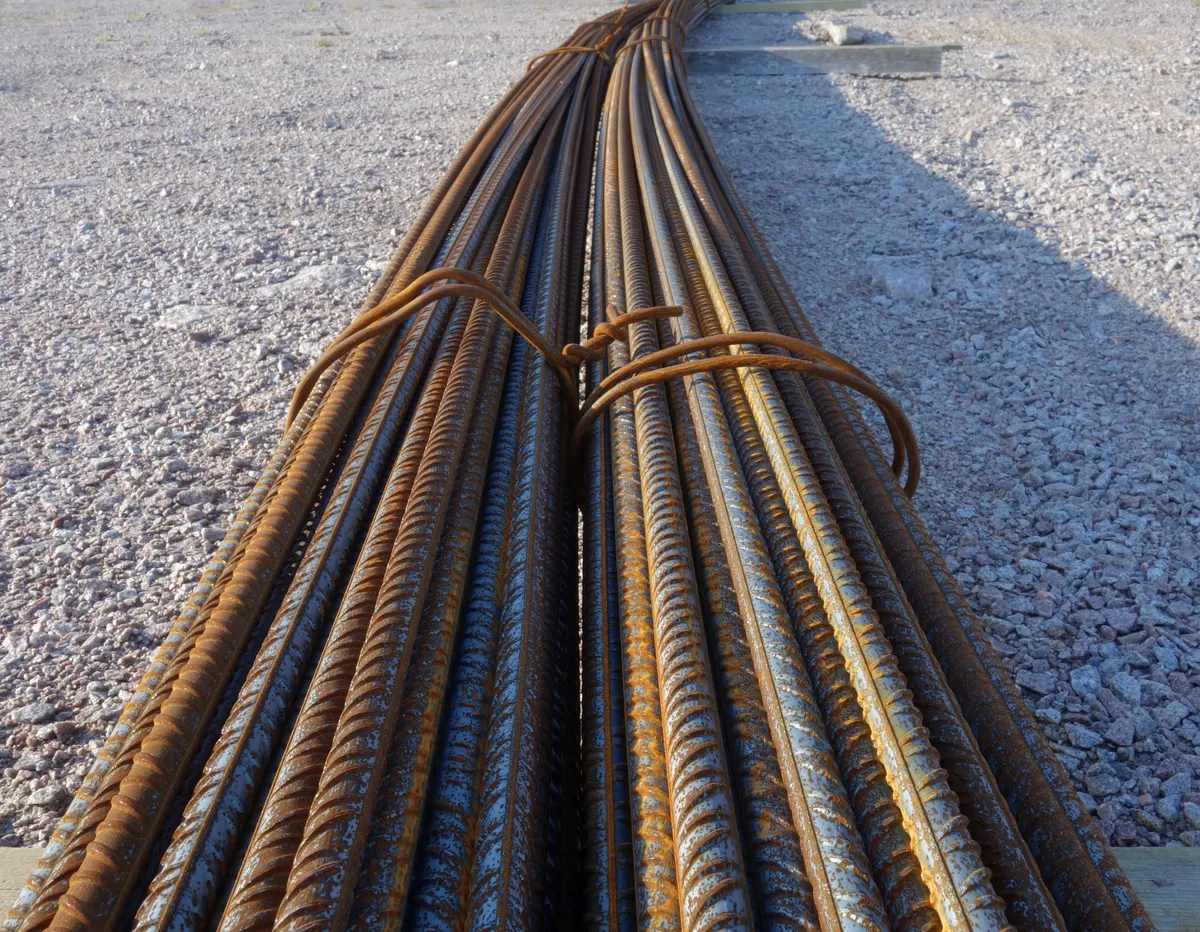
Read the bundle tag: standard, grade, diameter, length, heat number, number of bars.
Find the rolled-on marks on a bar and confirm the mill (and, for CARES bars, the country and mill number).
Confirm the grade from the rib pattern (BS 4449 type) or the letter, number or lines (ASTM).
Weigh a measured length and compare it with the weight chart if sizes might be mixed, especially near-equivalent pairs such as 12 mm and No. 4.
Match the tag's heat number to the certificate and check the certificate covers every item in the list above.
Store sizes and grades apart, with tags left on until the bars are fixed.
If you are buying for a new package, post your rebar requirement with the sizes, standard and grade, and ask each supplier for a sample certificate and tag photo with the quote. If the package also includes structural steel, ask whether the same supplier can quote it, and plain bar and plate are listed under carbon steel suppliers in Saudi Arabia.
Metric rebar is made from 6 to 50 mm. The preferred sizes in CS2:2012, a BS 4449-type standard, are 8, 10, 12, 16, 20, 25, 32 and 40 mm, with 6 mm and 50 mm as non-preferred options. Some Gulf mills also roll 14, 18, 22 and 28 mm. ASTM bars run from No. 3 (9.5 mm) to No. 18 (57.3 mm).
What is 1/2 inch rebar in mm?
Half-inch rebar is ASTM No. 4, with a nominal diameter of 12.7 mm and an area of 129 mm². In metric ASTM designation it is No. 13. It is not the same as a 12 mm metric bar, which has an area of 113.1 mm², about 14% less. The two can only be swapped with the structural engineer's written approval.
Is 10mm rebar the same as 3/8 inch?
No. ASTM No. 3 is 3/8 inch, or 9.5 mm, with an area of 71 mm², and is designated No. 10 in metric ASTM sizes. A 10 mm metric bar has an area of 78.5 mm², about 10% more. The shared "10" in the names causes mix-ups, so always state the standard alongside the size on schedules and orders.
What is a deformed steel bar?
A deformed bar has rolled-on ribs that grip the concrete. Standards control the ribs closely: CS2:2012, for example, requires two or more rows of transverse ribs, rib height of 0.03d to 0.15d, spacing of 0.4d to 1.2d, and a minimum relative rib area. Plain round bars have no ribs and are limited to small sizes in low grades.
How do you identify the grade of ASTM rebar?
Read the rolled-on marks. After the mill symbol and bar size, "S" means carbon steel to ASTM A615 and "W" means low-alloy steel to A706. The grade is then shown as a number (60, 75, 80, 100 or 120) or as lines: one line for Grade 60, two for 75, three for 80 or 100, four for 120.
How do you tell B500B from B500C rebar?
By the rib pattern. On a B500B bar, one series of transverse ribs slopes against the others. A B500C bar has the same arrangement, but within each series the ribs alternate between a steeper and a shallower angle, at least 10° apart. Confirm the class on the mill certificate, which should match the heat number on the bundle tag.
Does CARES certification replace ECAS or the Saudi Quality Mark?
No. CARES is a UK third-party certification for British Standard reinforcement. The UAE requires an ECAS certificate from MoIAT and Saudi Arabia requires the Saudi Quality Mark, whatever other certificates a mill holds. CARES can be an extra requirement in a specification, and its database lets you check a mill's approval.
How to buy rebar in the UAE and Saudi Arabia: B500B and Grade 60 explained, UAE ECAS and Saudi Quality Mark rules, bar marks and mill certificates, the main Gulf mills, coated bars and pricing terms.
How GFRP, epoxy-coated and hot-dip galvanised rebar protect concrete from chlorides, their standards and design codes, bending, cutting and repair rules, cost drivers and what UAE and Saudi regulations cover.
When to use a rebar coupler instead of a lap, the main coupler types, ACI 318 Type 1 and Type 2 and other performance classes, how systems are approved and tested, and what to check on site.