Fire Extinguisher Signs, Stands and Placement: Heights, Distances and Rules
Where to put fire extinguishers and how to mark them: travel distances, mounting heights in UAE and NFPA guidance, ISO 7010 F001 signs, brackets, stands and cabinets, SASO rules for cabinets, and Gulf heat.
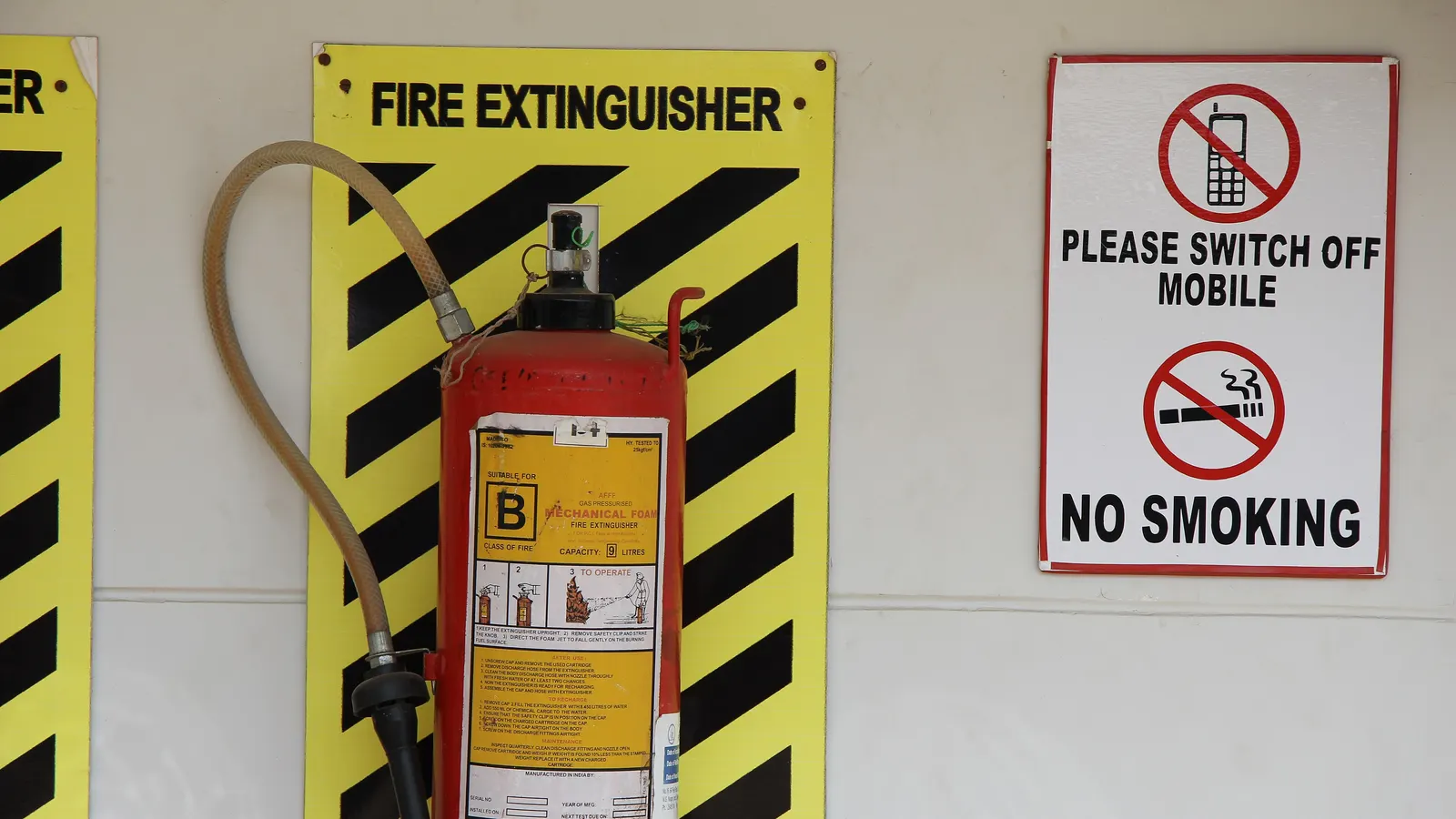
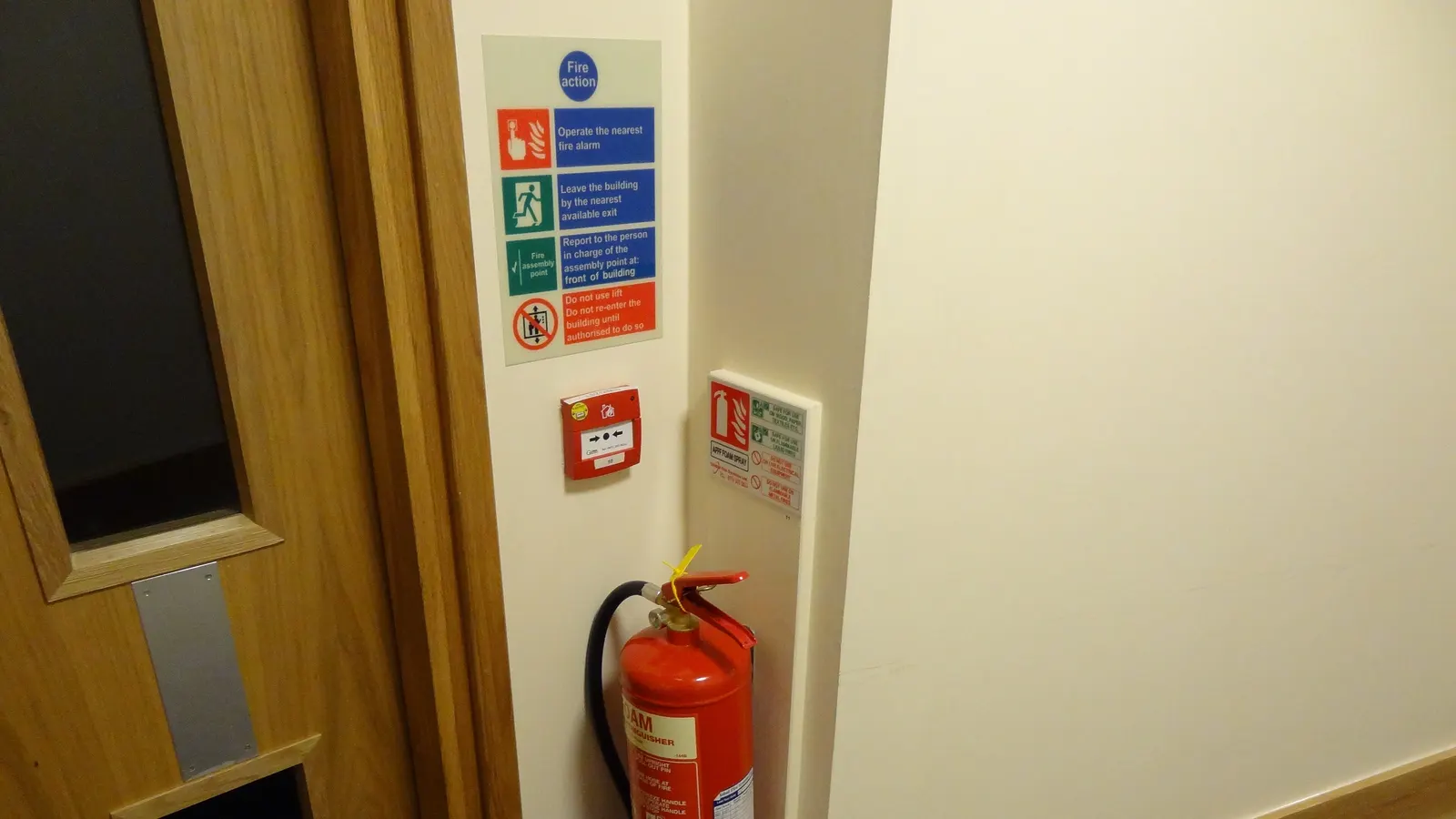
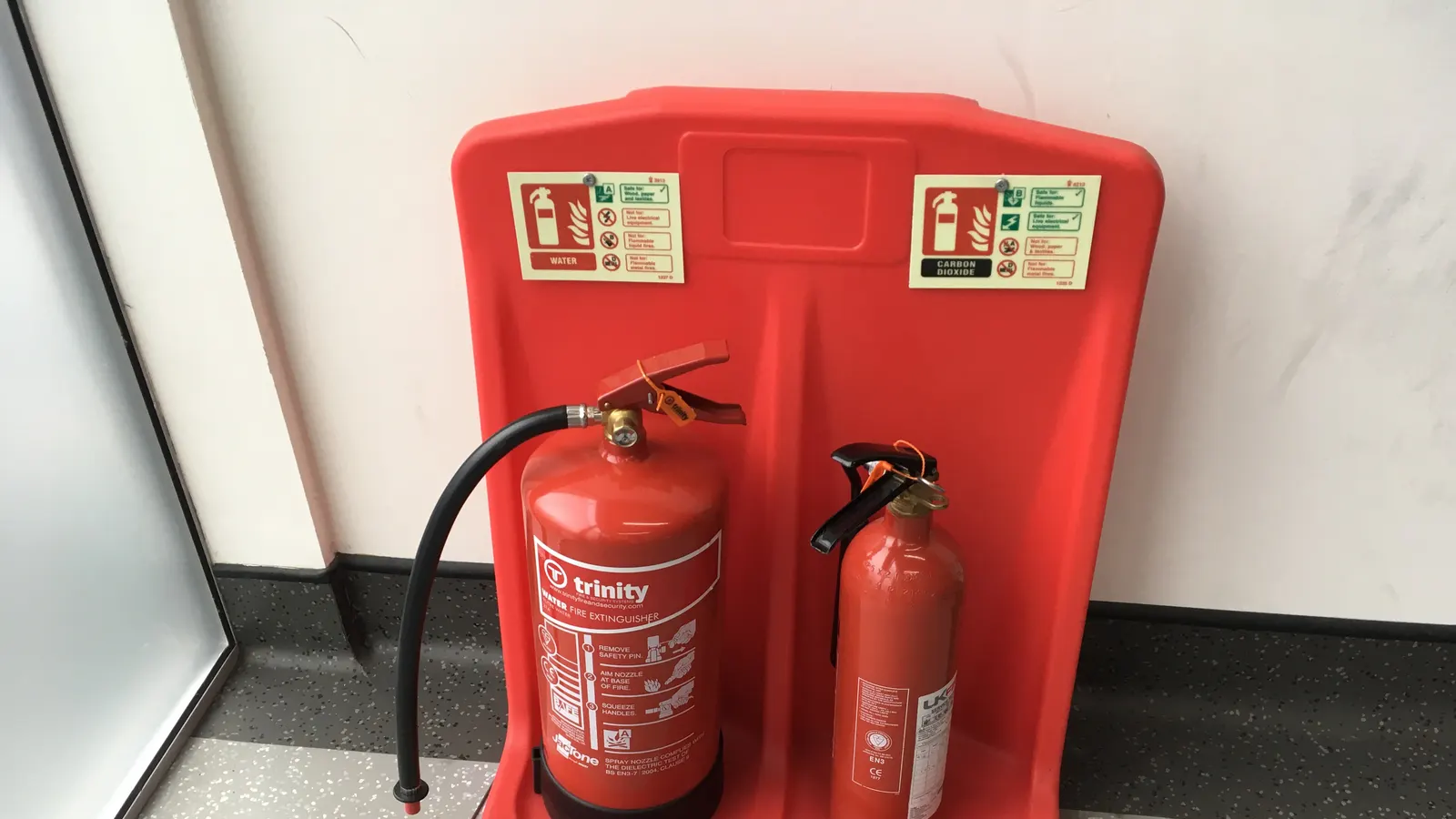
Put fire extinguishers on escape routes near exits and next to the hazards they cover, with at least one on every floor, close enough that nobody walks far to reach one. In DMCC's UAE guidance the top of the unit sits no more than 1.5 m above the floor and the bottom at least 30 cm clear. Mark any unit that is not in plain view with the red ISO 7010 F001 fire extinguisher sign, and use stands or cabinets where walls or weather make brackets impractical. The rules below apply to every type of fire extinguisher.
This how-to is for facility managers, fit-out contractors, HSE officers and consultants laying out extinguishers in offices, shops, warehouses, plants and sites. It covers travel distances, mounting heights, signs, stands and cabinets, and outdoor heat. Which agent goes where, the codes in each country and approvals are covered in the main fire extinguisher guide for the UAE and Saudi Arabia. The figures here are reference points; the civil defence authority and your consultant have the final say.
Where should fire extinguishers be placed?
Four principles recur in every code and guidance note:
On escape routes, near exits. London Fire Brigade guidance says extinguishers should normally be in conspicuous positions on escape routes, preferably near exit doors, so people move towards safety to fetch one. DMCC's bulletin says the same: near a door or exit that can be used as an escape route.
Near the hazard. Put the matching unit beside the specific risk: CO2 at the electrical room door, wet chemical by the cooking line, powder or foam by fuel storage.
On every floor. Trakhees requires portable extinguishers on each floor and, in multi-storey buildings, at least one adjacent to the staircase on each level.
Grouped at fire points. London Fire Brigade suggests grouping equipment into fire points where possible, which also makes signs and checks simpler.
Access must stay clear. DMCC requires units to be installed in an accessible spot, free from blocking by storage and equipment, and SASO's maintenance guide includes "visible and reachable without obstruction, with operating instructions facing outward" in the monthly check.
Travel distance: how far apart should extinguishers be?
Travel distance is the walking distance from any point to the nearest suitable extinguisher, measured along the route people actually walk, not in a straight line through walls and racks. The limits below come from documents ListGCC was able to read; the UAE Fire and Life Safety Code and SBC 801 set the limit for your building, so confirm the figure with your consultant.
Situation
Maximum travel distance
Source
Class A hazards (general areas)
22.9 m (75 ft)
OSHA 29 CFR 1910.157, US federal rule
Class B hazard areas (flammable liquids)
15.2 m (50 ft)
OSHA 29 CFR 1910.157
Class D (combustible metal working areas)
22.9 m (75 ft)
OSHA 29 CFR 1910.157
Commercial kitchens (Class K units)
30 ft (about 9 m)
San Diego fire policy table based on California rules
Construction sites, labour camps and site offices (Dubai, Trakhees)
9.15 m to 15.25 m to the nearest unit
Trakhees fire extinguisher guideline
Early childhood centres (Saudi draft standard)
No more than 23 m between extinguishers
SASO FDS 33294:2023 (draft)
Class C (electrical) units in US practice are placed on the pattern for the Class A or B hazards around them, according to OSHA. In UK practice, BS 5306-8:2023 is the code of practice for selection and positioning of portable extinguishers; its 2023 revision allows a single higher-rated extinguisher on storeys or mezzanines under 50 m², according to Chubb Fire and Security.
Mounting height: how high should a fire extinguisher be?
Mount the unit low enough for most people to lift it off the bracket and high enough to clear the floor and cleaning equipment.
Measurement
UAE guidance (DMCC bulletin)
NFPA 10 figures (US, as adopted in California rules)
Top of extinguisher, units up to 18.14 kg gross
Not more than 1.5 m above the floor
Not more than 1.53 m (5 ft)
Top of extinguisher, units over 18.14 kg gross (not wheeled)
Not stated
Not more than 1.07 m (3.5 ft)
Bottom of extinguisher to floor
At least 30 cm
At least 102 mm (4 in)
Where documents differ, the 30 cm floor clearance in DMCC's bulletin is the stricter figure and the safer default for UAE projects. Measure to the top of the extinguisher itself, not to the bracket or sign.
Fire extinguisher signs: ISO 7010 F001 and when you need one
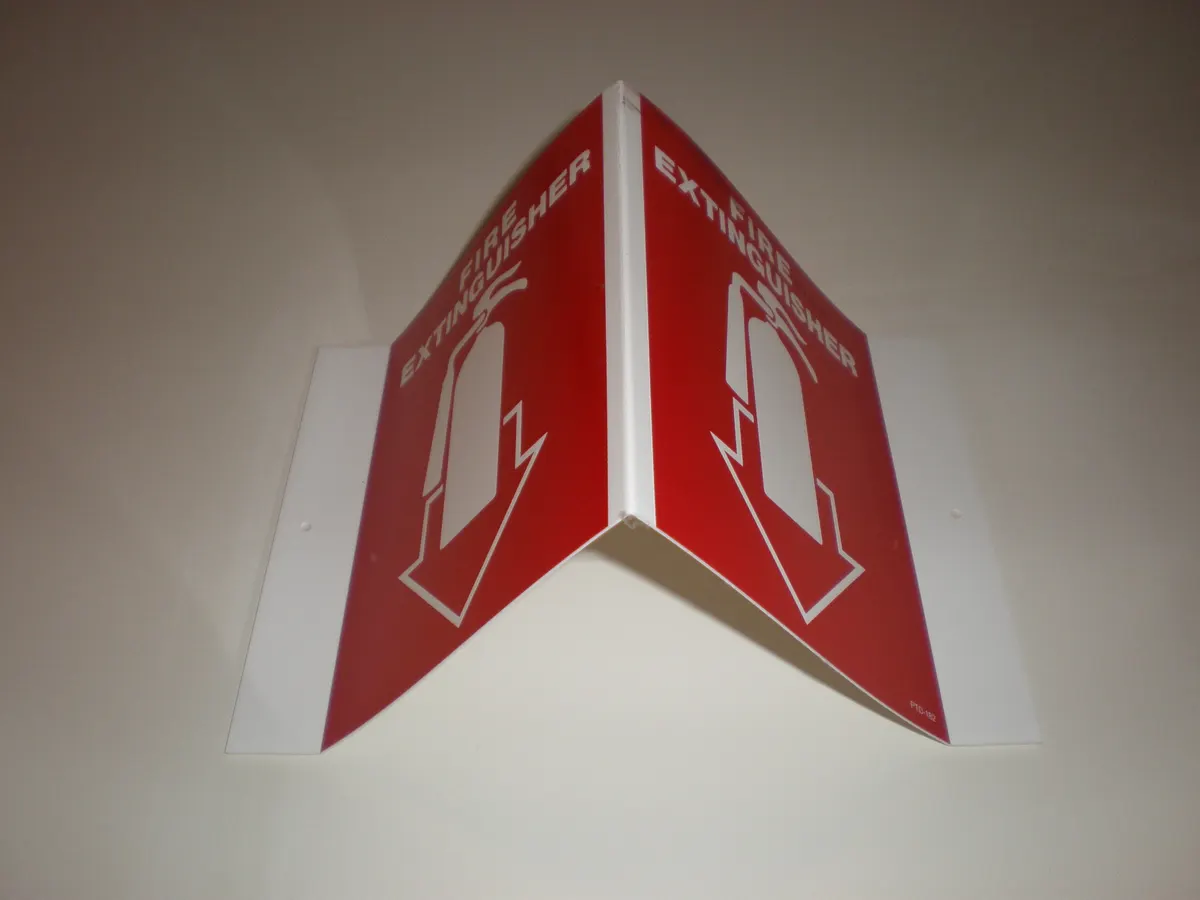
The international fire extinguisher sign is ISO 7010 F001: a white extinguisher pictogram on a red square. Fire equipment signs in ISO 7010 are red squares, using the colours and principles of ISO 3864. The same family includes F002 (fire hose reel), F004 (collection of firefighting equipment) and F005 (fire alarm call point), so one fire point can carry a consistent set.
When do you need a sign? In UK law, London Fire Brigade notes that extinguishers placed out of direct view must have their location shown by signs and, where appropriate, directional arrows. UAE examples of the same principle are written into law: Dubai's school transport bylaw (Administrative Resolution No. 196 of 2015) says the location of a school bus extinguisher must be indicated by a sign. In practice, sign every extinguisher position, use projecting or V-shaped signs above units in long corridors and aisles so they are visible from both directions, and add an identification sign beside each unit stating the agent and the fires it is for.
Extinguisher signs can be ordered from safety signage suppliers with the fire exit and assembly point signs, or from industrial signage makers for large sites; specify ISO 7010 artwork so every sign matches.
Brackets, stands and cabinets
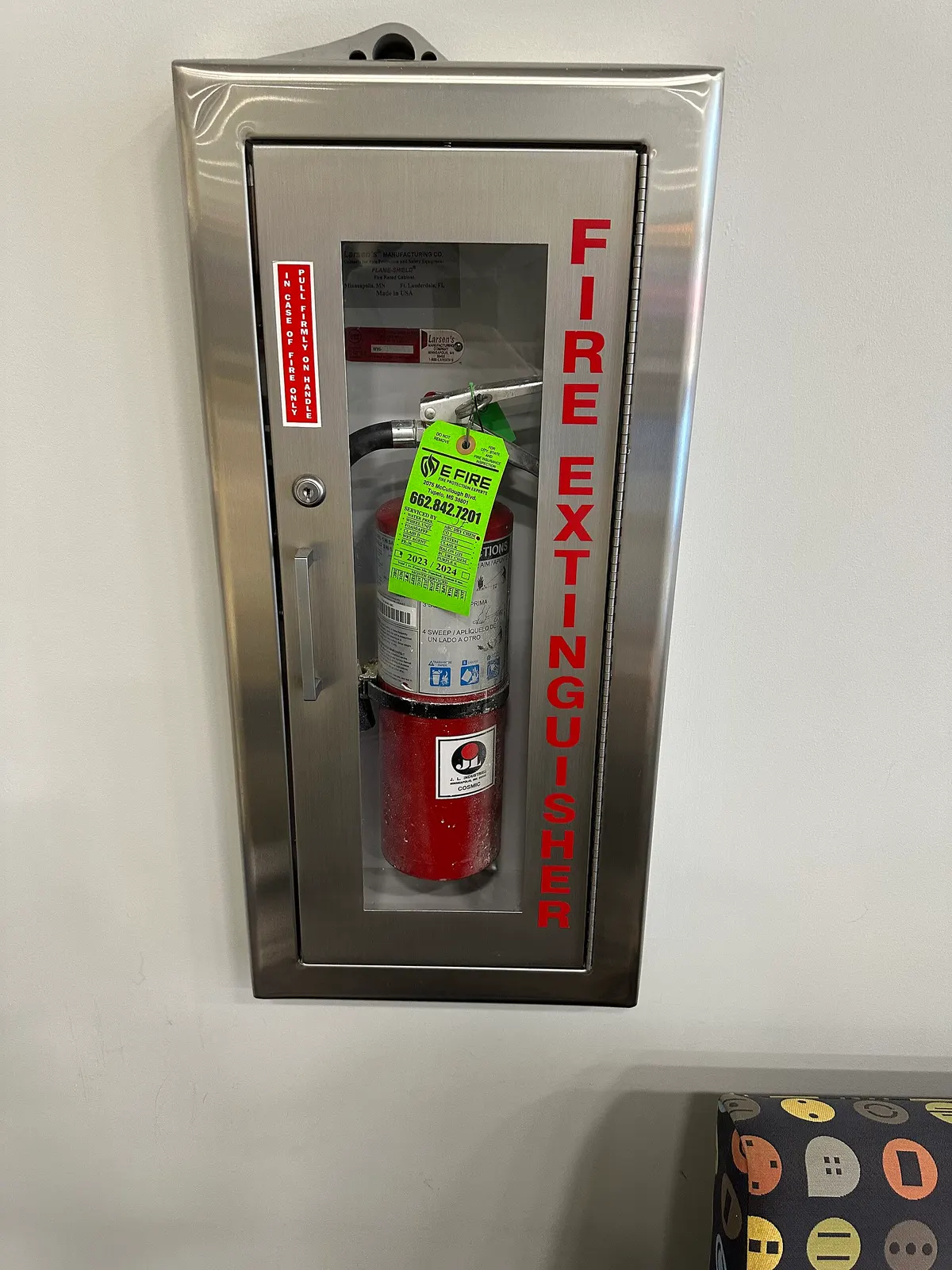
Every non-wheeled extinguisher should sit on something designed for it. DMCC requires hangers or the brackets supplied by the manufacturer, cabinets or shelves; the NFPA 10 based California rule requires hangers, brackets or cabinets for all but wheeled units, which go in a designated location. Manufacturers usually supply a bracket: Gloria's foam extinguisher datasheet, for example, lists a wall bracket with the unit.
Option
Best for
Watch for
Wall bracket
Offices, corridors, plant rooms with solid walls
Secure fixing for the full weight; height limits above
Floor stand
Glass partitions, showrooms, hotel lobbies, rented spaces where drilling is restricted
Keep it out of the walking line; London Fire Brigade notes an empty stand shows at once that a unit is missing
Surface or recessed cabinet
Public areas, car parks, outdoors, places with tampering or theft
Cabinet must be signed and easy to open; do not lock it
Fire point board or trolley
Construction sites, workshops, fuel stations
Keep the board clear of stored materials
In Saudi Arabia, cabinets are themselves regulated. SASO's Technical Regulation for Fire Control Materials and Equipment lists cabinets fixed in building walls to hold extinguishers among the covered products, so ask for the SABER certificate for cabinets as well as for the extinguishers when you buy from fire extinguisher suppliers in Saudi Arabia. NAFFCO is one regional manufacturer that lists cabinets alongside extinguishers in its range.
Outdoor locations and Gulf heat
Extinguishers outdoors, on rooftops and in car parks face sun, heat, dust and humidity. Three checks help:
Temperature rating. Check the label. Amerex lists an upper limit of 120 °F (about 49 °C) for its ABC and CO2 units; Gloria rates its foam units to +60 °C. Choose units and a location whose conditions fall inside the range.
Shade and protection. A cabinet keeps sun off the cylinder and label and protects the gauge from dust; choose a weather-resistant finish. Gloria's datasheet, for example, specifies a weather-resistant coating.
Corrosion checks. Coastal and humid sites corrode cylinders and brackets. SASO's guide says lightly corroded units should be discarded or pressure tested and badly corroded ones discarded, so include outdoor units in the monthly check without fail.
Placement checklist
Mark every hazard on the floor plan and the fire class it presents.
Place general units on escape routes near exits, at least one per floor and one near each staircase.
Add matching units beside each special hazard: electrical rooms, kitchens, fuel and chemical stores.
Check walking distances against the code limit for each hazard class.
Set heights: top no more than 1.5 m, bottom at least 30 cm above the floor.
Specify brackets, stands or cabinets, and an ISO 7010 F001 sign and an identification sign at each position.
Check temperature ratings and shading for outdoor positions.
Record each position in the extinguisher register used for monthly checks.
What height should a fire extinguisher be mounted at?
DMCC's guidance for the UAE says the top of the extinguisher should be no more than 1.5 m above the floor, with at least 30 cm between the bottom of the unit and the finished floor. NFPA 10 figures used in the US set 1.53 m for units up to 18.14 kg, 1.07 m for heavier units and a 102 mm minimum floor clearance. Follow the code your civil defence authority applies.
What is the maximum travel distance to a fire extinguisher?
It depends on the code and the hazard. US federal rules set 22.9 m for Class A areas and 15.2 m for Class B hazard areas. Dubai's Trakhees guideline for construction sites and site offices sets 9.15 m to 15.25 m to the nearest unit. The UAE Fire and Life Safety Code and SBC 801 apply in buildings, so confirm the limit with your consultant.
What does the fire extinguisher sign look like?
The standard sign is ISO 7010 F001: a white fire extinguisher pictogram on a red square. Fire equipment signs in ISO 7010 use red squares and the colour rules of ISO 3864, and related signs cover fire hose reels (F002), collections of firefighting equipment (F004) and fire alarm call points (F005). Many sites add a directional arrow and an identification sign stating the agent.
Does every fire extinguisher need a sign?
Where an extinguisher is out of direct view, guidance such as London Fire Brigade's says its location must be shown by a sign, with directional arrows where needed, and Dubai's school bus rules require a sign at the extinguisher location. Signing every position is the simplest way to meet any code, and it helps people find units quickly in smoke or in a crowded space.
Can a fire extinguisher be kept on the floor?
Not loose on the floor. UAE guidance from DMCC requires extinguishers on hangers, manufacturer brackets, cabinets or shelves, and NFPA 10 based rules require hangers, brackets or cabinets for all but wheeled units. A purpose-made floor stand is an accepted option in UK practice and is useful where walls cannot be drilled; an empty stand also shows a missing unit.
Should outdoor fire extinguishers be kept in cabinets?
Usually, yes. A cabinet shades the cylinder and label from the sun, keeps dust off the gauge and reduces tampering. Check the extinguisher's temperature rating, which for some units tops out at about 49 °C, and choose a weather-resistant unit and cabinet. In Saudi Arabia, extinguisher cabinets fall under SASO's fire equipment regulation, so ask for their SABER certificate.
A buyer's guide to fire extinguishers in the UAE and Saudi Arabia: agents and fire classes, ratings and sizes, placement rules, Civil Defence and SASO approvals, maintenance, Gulf heat and the main brands.
Each fire extinguisher type explained for Gulf buyers: how ABC powder, CO2, foam, water, water mist, wet chemical and Class D units work, what they are rated for, colour codes and where each is wrong.
How to keep fire extinguishers in service in the UAE and Saudi Arabia: the monthly check, annual service, five-year work, hydrostatic test intervals, refilling, tags and records, approved contractors and cost drivers.