Water Pumps in the UAE and Saudi Arabia: Booster, Submersible and Dewatering
How to choose booster, transfer, borehole and dewatering pumps for UAE and Saudi projects: duty point and NPSH, IE3 motor rules, groundwater licences, heat and saline water, brands and an RFQ checklist.
For most Gulf projects, "water pump" means one of three jobs: a booster set that holds constant pressure in a building, a submersible pump that lifts water from a borehole or tank, or a drainage pump that keeps an excavation or basement dry. Fix the job and the duty point (flow and head) first, then choose the pump type, materials and motor. The centrifugal pump suppliers in the UAE listed on ListGCC cover all three.
This guide is for MEP contractors, consultants, facility managers, farm and utility engineers and procurement teams buying in the UAE and Saudi Arabia. It explains the main pump types, how to read a pump curve and check NPSH, what the UAE and Saudi motor efficiency rules require, how groundwater and site water are regulated, how heat and saline water change the specification, which brands make what, and what to put in an RFQ. Fire pumps are a separate, code-driven purchase and are only touched on here.
Start from the application. The same flow and head can be met by very different machines, and the wrong family is the most expensive mistake to correct later.
Job
Usual pump type
What matters most
Typical buyers
Pressure boosting in towers, hotels, hospitals
Booster set of two or more vertical multistage pumps on a common skid, with variable speed drives and a controller
Constant pressure across a wide demand range, duty and standby, low noise, energy use
MEP contractors, consultants, facility managers
Transfer from ground tank to roof tank
End suction or multistage pump, often duty and standby
Correct head, flooded suction, level controls
MEP contractors, building owners
Borehole and well supply (farms, compounds, utilities)
Submersible borehole pump with a submersible motor
Well diameter, water level and drawdown, motor cooling, sand, water temperature and chemistry
Farms, utilities, well contractors
Construction dewatering and site drainage
Portable submersible drainage or dewatering pump; wellpoint or deep-well systems for large pits
Submersible sewage pump, often in a packaged lifting station
Free passage for solids, anti-clogging impeller, materials
Developers, utilities, industrial plants
Fire protection
Fire pump set to NFPA 20 and Civil Defence rules
Approvals and acceptance testing
Fire contractors (see the fire guide linked below)
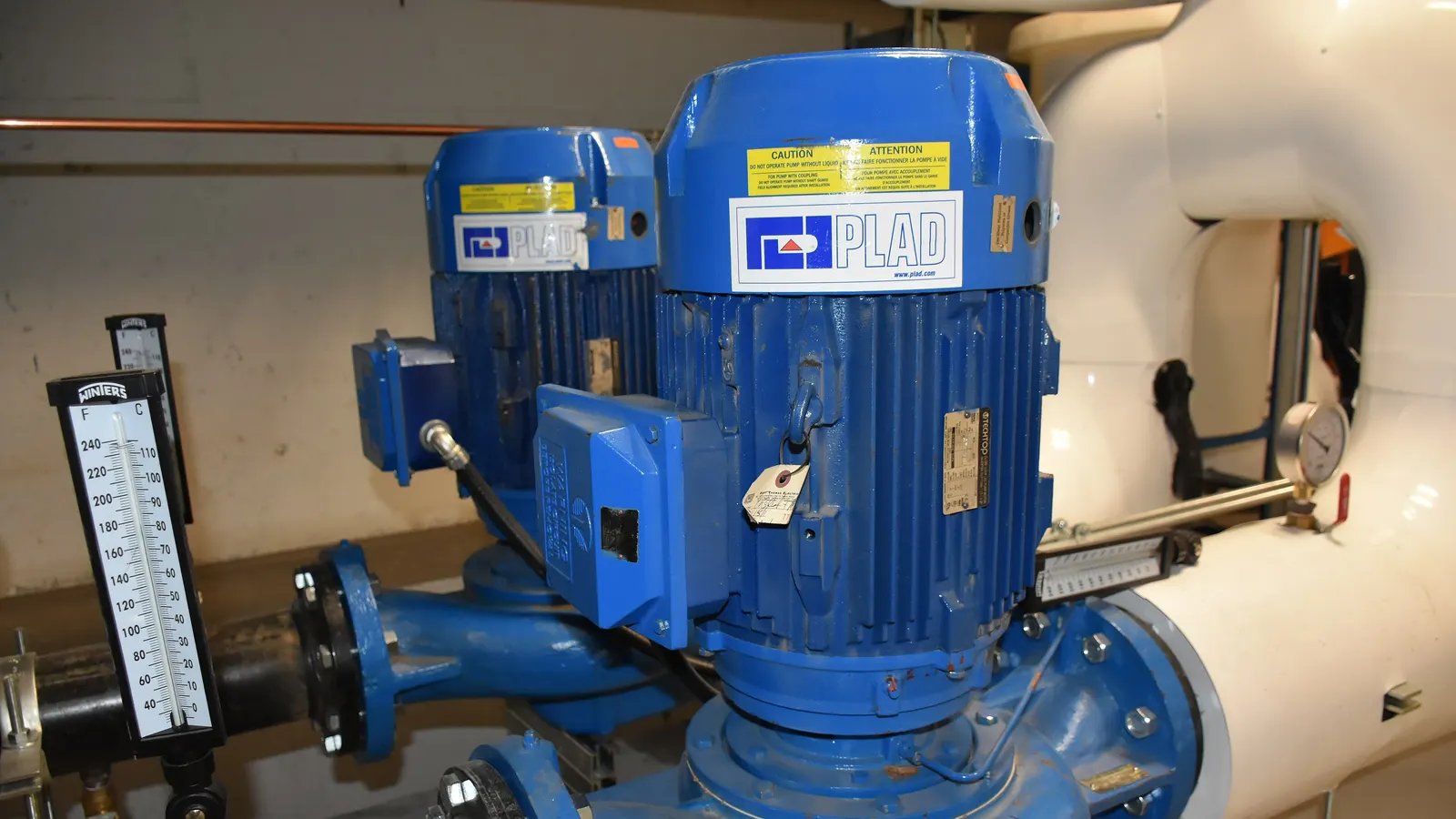
Booster sets for buildings
A booster set keeps pressure steady at the top floors while demand swings from a trickle at night to a peak in the morning. Modern sets use two to four vertical multistage pumps, each with its own variable speed drive, a pressure transmitter on the discharge header and a controller that brings pumps in and out as demand changes. Specify the number of duty and standby pumps, the set pressure, the maximum flow and the minimum flow the set must handle without short cycling. ListGCC lists booster pump suppliers in the UAE separately from general pump traders.
Variable speed is where most of the energy saving comes from. By the pump affinity laws, flow varies with speed, head with the square of speed and power with the cube of speed, so a pump running at 80 percent speed draws roughly half the power it draws at full speed. The laws assume constant efficiency, which is rarely exactly true, so ask for the manufacturer's part-load curves. In a Grundfos case study from Dubai, replacing oversized constant-speed chilled water pumps with variable speed end suction pumps cut pump power at one residential tower from 36 kW to 7 to 10 kW. That was an HVAC circuit rather than a booster set, but the lesson about oversized fixed-speed pumps applies to water systems too.
Transfer pumps
Tank-to-roof transfer is usually a simpler duty: a fixed flow against a fixed static head plus pipe losses. End suction pumps or multistage pumps with level switches in both tanks are common. Where the pump must sit above the water level, a self-priming pump avoids foot valve problems, though a flooded suction is still the better design when the plant room allows it.
Submersible borehole pumps
A borehole pump is a long, narrow multistage pump coupled to a submersible motor below it, hung on the rising main inside the well casing. It is sized by the well's internal diameter, the pumping water level (not the static level) and the flow the well can yield. In Saudi Arabia every such well needs a licence (see the rules below). Browse submersible pump suppliers in Saudi Arabia for well pumps and motors.
Dewatering and drainage pumps
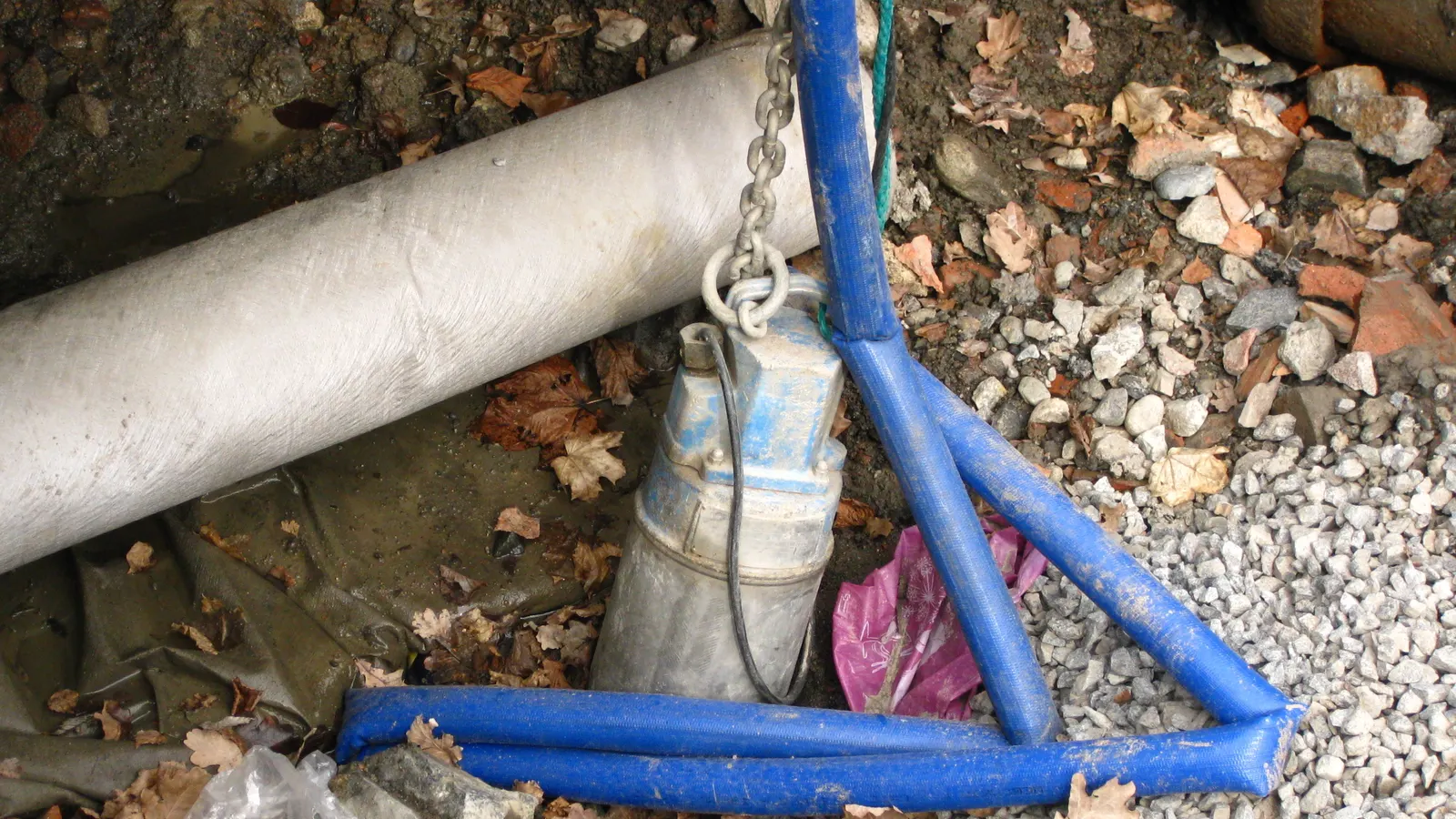
Dewatering pumps are built to pump dirty water with sand and fine solids, often for months on end. They have wear-resistant impellers and diffusers, a strainer stand and, on many models, a float or electrode to stop the motor running dry. For small sumps a single portable pump may do; large deep excavations use a designed system of wells and pumps. Check head, solids size, cable length and whether the pump will run continuously or on level control.
How do you read a pump curve, duty point and NPSH?
Every quotation should come with a performance curve at your duty point. The duty point is where the pump's head and flow curve crosses your system curve (static head plus friction losses, which rise with the square of flow). Ask suppliers to plot your system curve on their pump curve rather than just quoting a flow and head.
Head and flow: state the required flow (m³/h or l/s) and total head (m) at the duty point, plus any minimum and maximum duty.
Best efficiency point: the duty point should sit near the pump's best efficiency point.
Power curve: check that the motor is not overloaded anywhere on the curve, especially at run-out flow when a system starts against an empty pipe.
NPSH: net positive suction head available (NPSHa) is the absolute pressure at the pump suction minus the vapour pressure of the liquid. The pump's required value (NPSHr) is set by the manufacturer, often as the point where head drops by 3 percent. NPSHa must stay above NPSHr with a margin, or the pump cavitates. Hot water, suction lift and suction-side friction all reduce NPSHa, so check it for transfer pumps drawing from ground tanks in summer.
Motor efficiency: IE classes and the Gulf rules
IEC 60034-30-1 defines the IE efficiency classes for line-operated AC motors. The current second edition, published in December 2025, replaces the 2014 edition and adds IE5. It covers single-speed motors from 0.12 kW to 1,000 kW with 2, 4, 6 or 8 poles, rated 50 V to 1,000 V. It specifically excludes submersible motors, so borehole and drainage pump motors are not classified by IE code in the way that surface pump motors are.
Saudi Arabia
SASO 2893/2018 sets minimum energy performance for single-speed, three-phase cage induction motors at IE3, superseding SASO IEC 60034-30:2013. UL reported that it was enforced from 16 August 2018, that motors must be tested by a SASO-registered laboratory and carry the new energy efficiency label for the certificate of conformity, and that Saudi customs would block non-compliant motors. In practice, ask the supplier of any surface pump set for the motor's SASO registration and efficiency class before shipment, not after. For the wider SABER certificate process, see our guide to SASO and SABER certificates for industrial equipment.
UAE
Cabinet Resolution No. 136 of 2023 on technical rules for efficient energy consumption for electric motors took effect on 30 December 2023 and gave concerned entities 365 days to comply. The IEA's policy database summarises the UAE standard as mandating IE3 for industrial motors. Ask suppliers to confirm the motor's IE class and its UAE conformity status in writing, and check the current text with MoIAT for the exact scope and any exemptions.
UAE rules that affect pump projects
Motor efficiency: as above, IE3 motors under Cabinet Resolution No. 136 of 2023.
Construction permits: in Dubai, Local Order No. 3 of 1999 regulating construction works lists dewatering as an "ancillary construction work", alongside piling and plumbing. It is treated as part of the construction works; confirm with Dubai Municipality what approvals the dewatering design and the discharge route need on your site.
Fire pumps: these follow NFPA 20, Standard for the Installation of Stationary Pumps for Fire Protection, and Civil Defence approval. Our guide to UAE Civil Defence approval for fire safety equipment covers that route; do not buy a general water pump for a fire duty.
Drinking water: pumps and booster sets on potable water lines should carry the drinking water material approval that the consultant's specification names. Ask for it at quotation stage, because it can rule out cheaper models.
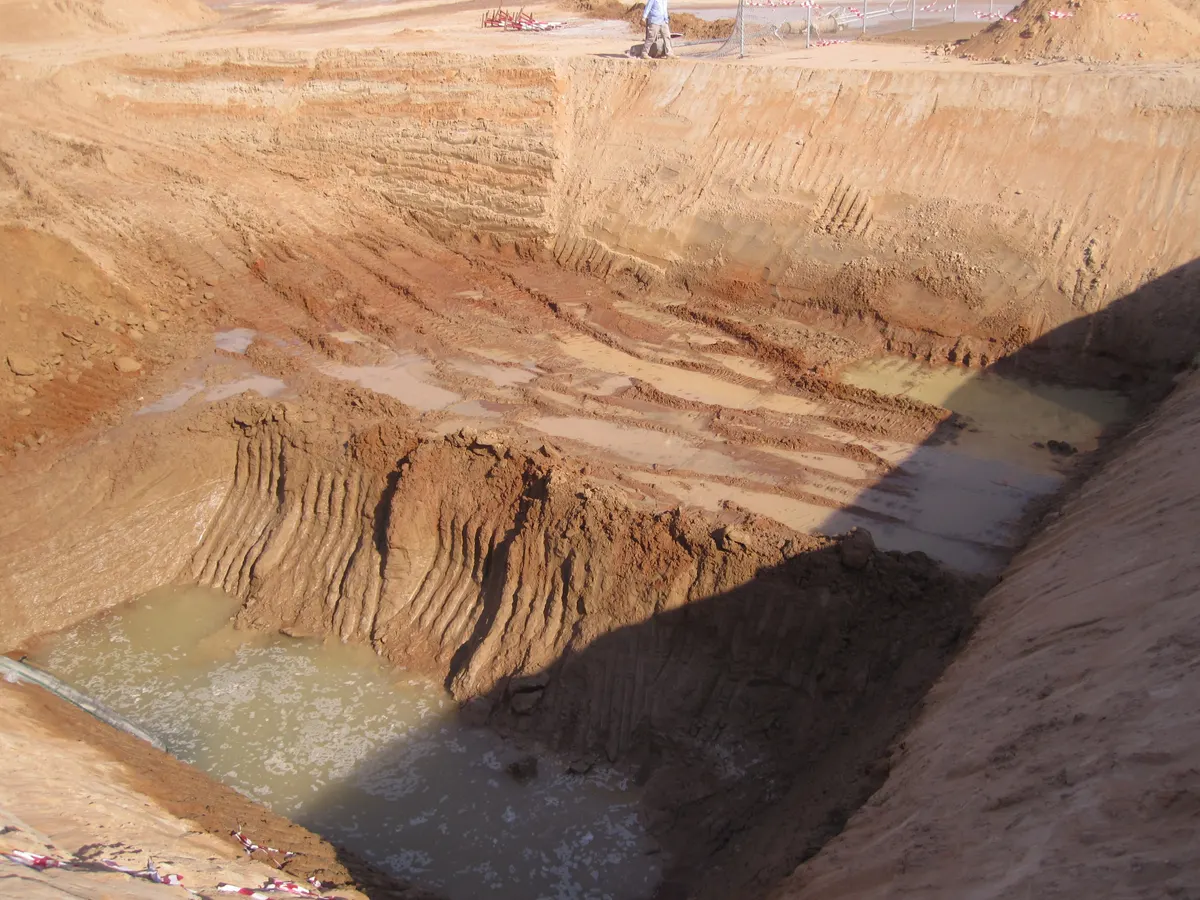
Dubai's coastal water table can sit very close to the surface. A geotechnical contractor describing a current deep excavation in Dubai reports groundwater about 2 m below ground level, an excavation more than 24 m deep, 42 wells in the baseline design and a peak abstraction above 50 l/s. Projects like that need an engineered dewatering design, not just pumps from a rental yard.
Saudi rules for wells and groundwater
Pumping groundwater in Saudi Arabia is licensed. The General Directorate of Water Regulation at the Ministry of Environment, Water and Agriculture (MEWA) issues licences for drilling, deepening and cleaning water wells and licenses drilling contractors. Under regulations reported by Arab News in August 2024, owners of any property with a well must obtain a groundwater use permit through the ministry's Nama portal; licences last two years and are renewable, and anyone who drills, replaces, deepens or cleans a well must apply for or update the licence within 30 days of finishing the work. In July 2025 Argaam reported that the minister had extended the deadline for obtaining groundwater use licences by one year, with exclusions such as licensed wheat growers.
For a buyer this means two checks before ordering a borehole pump: the well is licensed for the purpose and quantity you plan to pump, and the pump is sized to the licensed abstraction rather than the most the well can give.
Center-pivot fields in the Wadi As-Sirhan Basin, northwestern Saudi Arabia, photographed from the International Space Station. NASA's description notes they use water pumped from subsurface aquifers. Photo: NASA, public domain, via Wikimedia Commons
Gulf conditions that change the specification
Hot water and motor cooling
Submersible motors are cooled by the water flowing past them. Franklin Electric's 50 Hz installation manual sets minimum cooling flow velocities past the motor of 0.25 ft/s (7.62 cm/s) for 4-inch motors and 0.5 ft/s (15.24 cm/s) for 6-inch and 8-inch motors, for water up to 30 °C. Where water is hotter than 30 °C, it calls for at least 3 ft/s (0.91 m/s) past a standard motor and a derating of motor power, or a high-temperature motor. A flow inducer sleeve is required when the well is too wide to give that velocity, when water enters from above the pump, when the pump is set in or below screens, and always in an open body of water such as a tank or pit.
Starts, controls and drives
The same manual limits starts: for three-phase motors from 5.5 kW to 22 kW, 100 starts in 24 hours, and it asks for at least 15 minutes between starts on 6-inch and larger motors. Undersized pressure tanks and badly set pressure switches break those limits. Its three-phase submersible motors can run on variable frequency drives within guidelines, including continuous operation between 30 Hz and rated frequency, while its single-phase motors are not recommended for variable speed. Ask any supplier quoting a drive on a submersible pump to confirm the motor maker's drive guidelines, including filtering.
Saline and brackish water
Coastal groundwater and site water can be brackish or saline, which attacks cast iron and even stainless steel. Tsurumi states plainly that stainless steel pumps are not absolutely resistant to seawater and can still suffer crevice and pitting corrosion. Its seawater-duty range uses options such as galvanic anodes, special cast iron or 316 stainless impellers, duplex stainless shafts and multi-layer epoxy coating, and titanium and resin wetted parts on small models. Send suppliers a water analysis (chlorides, total dissolved solids, pH, temperature, sand content) and ask them to state the materials of every wetted part.
Sand in well water wears impellers and bearings and can lock a pump after it stops. Ask for the maximum sand content the pump is rated for, and develop new wells properly before installing the permanent pump. Surface pumps and drives in hot plant rooms need ratings that match the actual ambient temperature.
Water pump brands in the UAE and Saudi Arabia
The brands below are described by what their makers say they produce. Many other makers sell in the region; check your consultant's approved vendor list first.
Brand
Origin
Relevant ranges (per maker)
Gulf note
Grundfos
Denmark
Pumps and water solutions for utilities, industry and buildings
Published Dubai building case study
KSB
Germany
Pumps, valves and service for water, waste water and building services
Not stated on pages checked
Xylem (Flygt)
Xylem brand
Submersible dewatering and wastewater pumps, packaged pump stations
Not stated on pages checked
Wilo
Germany
Pumps, submersible pumps since 2003
Regional headquarters in Dubai and a plant in the UAE
Pedrollo
Italy
Borehole pumps and motors, booster sets, drainage and sewage pumps
Not stated on pages checked
Tsurumi
Japan
Submersible dewatering, sewage and seawater pumps
Tsurumi Pump Middle East FZCO in the UAE
Franklin Electric
USA
Submersible well pumps and motors, booster packages
Not stated on pages checked
Sulzer
Switzerland
Dewatering, drainage, sludge and submersible wastewater pumps
Not stated on pages checked
Davey
Australia
Water transfer pumps and pressure tanks
Not stated on pages checked
Grundfos
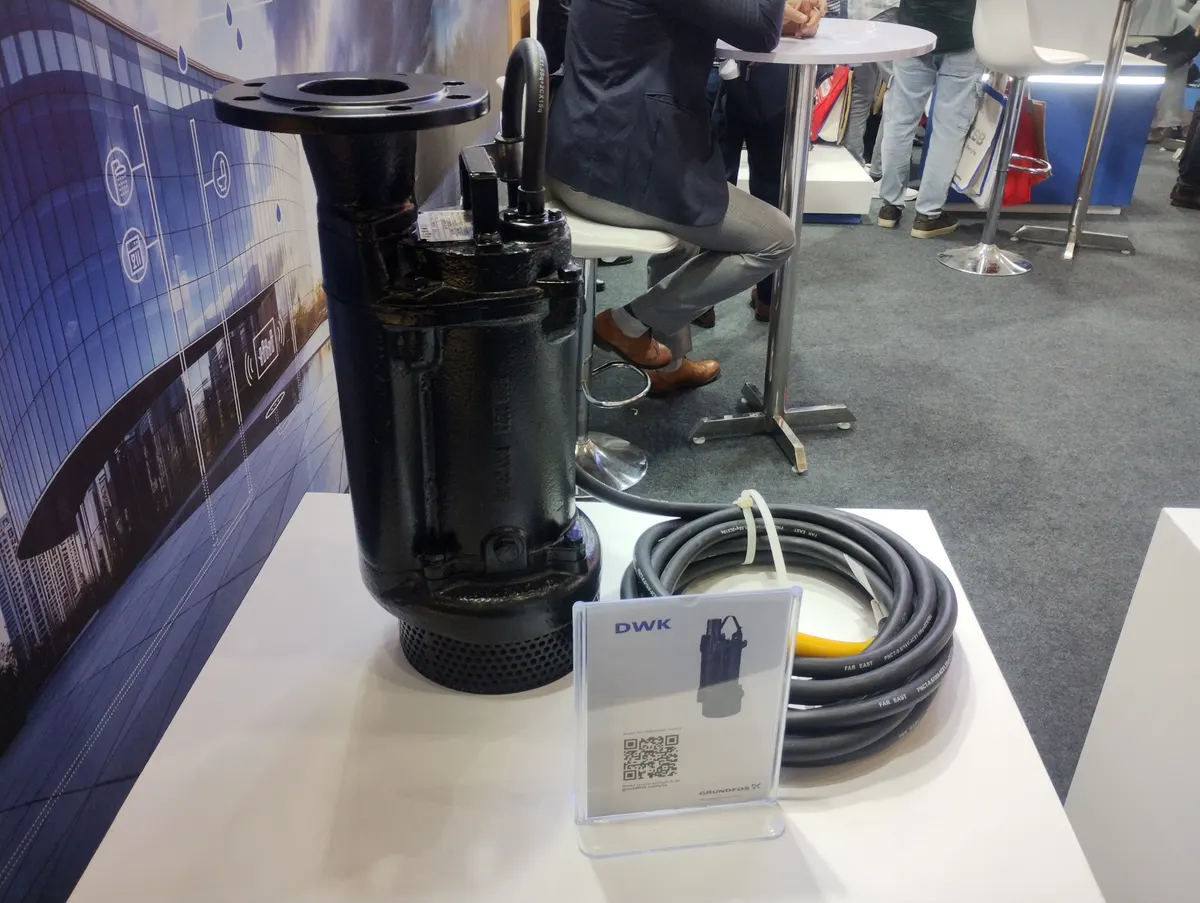
Grundfos was founded in 1945 and is headquartered in Bjerringbro, Denmark. It describes its business as energy-saving pump and water solutions for water utilities, industries and buildings, and the DWK dewatering pump pictured above is one of its submersible models. Suits consultants and contractors who want one maker across building, groundwater and drainage duties.
KSB
KSB is a German pump and valve maker founded in 1871, with more than 15,000 employees. It offers pumps, valves and services for water and waste water "from extraction and transport right through to treatment", and for building services from water supply to drainage and fire protection. Suits utility, industrial and building projects that want pumps and valves from one source.
Xylem (Flygt)
Flygt is Xylem's submersible pump brand. Its range covers submersible dewatering pumps, wastewater pumps including N-technology and channel impeller designs, packaged sewage pump stations, mixers and pump controls. Suits dewatering contractors and wastewater projects.
Wilo
Wilo was founded in Dortmund, Germany, in 1872, where its group headquarters remain. It added submersible pumps in 2003 through the EMU acquisition. Wilo says it opened a regional headquarters in Dubai in 2025 and built a plant in the UAE. Suits building services and water projects that value local presence.
Pedrollo
Pedrollo was founded in 1974 by Silvano Pedrollo and is based in San Bonifacio, Italy. Its catalogue lists 3-inch to 6-inch borehole pumps (some in precision-cast stainless steel), borehole motors, fixed and variable speed booster sets, and submersible sewage and drainage pumps. Suits farms, villas, compounds and light commercial buildings.
Tsurumi
Tsurumi traces its history to 1924 in Japan. It makes submersible pumps for dewatering, sewage and wastewater, plus seawater-resistant versions, surface pumps and wastewater treatment equipment, and lists Tsurumi Pump Middle East FZCO in the UAE. Suits construction dewatering, rental fleets and coastal sites.
Franklin Electric
Franklin Electric is headquartered in Fort Wayne, Indiana, USA. It makes submersible well pumps, 4-inch, 6-inch and 8-inch submersible motors and control boxes, booster pumps and packages, and publishes detailed application and installation manuals for its motors. Suits borehole and irrigation projects, where its motors are often paired with other makers' pump ends.
Sulzer
Sulzer has been headquartered in Winterthur, Switzerland, since 1834. Its pump range includes drainage, centre-line and sludge dewatering pumps, submersible wastewater pumps and lifting stations, as well as end suction and process pumps. Suits municipal wastewater, industrial and dewatering duties.
Davey
Davey is an Australian water pump brand trading since 1934. Its catalogue lists water transfer pumps and pressure tanks. Suits smaller transfer duties; check its range against your flow and head before shortlisting it for larger buildings.
Water pump RFQ checklist
Application and fluid: potable, raw, groundwater, brackish, sewage or site water, with a water analysis and temperature.
Duty point: flow and total head, plus minimum and maximum duties and the system curve if available.
Suction conditions: flooded or suction lift, tank levels, and NPSH available at the worst case.
For boreholes: casing internal diameter, static and pumping water level, setting depth, well yield, sand content and the MEWA licence details in Saudi Arabia.
For booster sets: number of duty and standby pumps, set pressure, controller functions, BMS interface, and noise limits.
Materials of casing, impeller, shaft, diffusers and seals, and any drinking water approval required.
Motor: power, voltage and frequency, IE class and SASO or UAE conformity for surface motors, and drive and filter details.
Documents: performance curve at the duty point, factory test certificate, data sheet, manuals and spare parts list.
Commercial: delivery, warranty, local service and spare parts stock in the UAE or Saudi Arabia.
Types of Pump: Centrifugal vs Positive Displacement and When to Use Each: Centrifugal and positive displacement pumps compared: curves vs flat flow, end suction, split case and multistage pumps, gear, progressing cavity, diaphragm and peristaltic pumps, and a duty-by-duty selection table.
What is the difference between a booster pump and a submersible pump?
A booster pump sits on dry land, usually in a plant room, and raises the pressure of water already in a pipe or tank so that upper floors and fixtures get enough pressure. A submersible pump runs under water, with a sealed motor, inside a borehole, tank or sump, and pushes water up to the surface. Buildings use booster sets; wells, tanks and excavations use submersibles.
What size water pump do I need for a building?
Size comes from the duty point, not horsepower: peak flow from the building demand, and head from the height of the highest outlet, the pressure needed there and pipe friction. The pump is then chosen so the duty point sits near its best efficiency point.
Do submersible pump motors need to meet IE3 in the UAE and Saudi Arabia?
The IE classes come from IEC 60034-30-1, whose current edition explicitly excludes submersible motors. The Saudi rule, SASO 2893, sets IE3 for single-speed three-phase cage induction motors, and the UAE's motor regulation is summarised by the IEA as mandating IE3 for industrial motors. Ask the supplier how the regulation is applied to the specific motor before shipping, especially for surface pump motors.
Do I need a permit to use a borehole pump in Saudi Arabia?
Yes. MEWA licenses well drilling and groundwater use. Property owners with wells must hold a groundwater use permit, applied for through the ministry's Nama portal, valid for two years and renewable. Drilling, deepening or cleaning a well requires the licence to be applied for or updated within 30 days of completing the work. Size the pump to the licensed abstraction.
What causes submersible borehole pumps to fail early?
Common causes include too little cooling flow past the motor, hot water without a derated or high-temperature motor, too many starts from undersized pressure tanks, sand wearing the hydraulics, and corrosion from saline water. Franklin Electric's manual requires a flow inducer sleeve in wide wells, open tanks and top-feeding wells, and limits daily starts by motor size. Give suppliers full well and water data to avoid these.
Which pump is used for dewatering excavations in Dubai?
Small pits and sumps are usually drained with portable submersible dewatering pumps built to pass sand and fine solids. Deep excavations near the coast, where the water table can be about 2 m below ground, need an engineered system of wells and pumps designed by a geotechnical specialist. Dubai's construction works order treats dewatering as ancillary construction work within the project.
Are stainless steel pumps safe for saline or brackish water?
Not automatically. Tsurumi notes that stainless steel pumps are not absolutely resistant to seawater and can suffer crevice and pitting corrosion. For saline duty, makers offer options such as galvanic anodes, duplex stainless shafts, coatings and titanium or resin wetted parts. Send a water analysis with your enquiry and ask the supplier to state the material of every wetted part.
Is a fire pump the same as a water booster pump?
No. Fire pumps are installed to NFPA 20, Standard for the Installation of Stationary Pumps for Fire Protection, and in the UAE fire equipment goes through the Civil Defence approval route described in our fire safety guide. A fire pump set is specified, approved and tested as part of the fire protection system, so a general building booster set should not be used to meet a fire protection requirement.
How to match a submersible pump to clear water, greywater, sewage or site water: impeller types, sump and lifting station design, level controls, alarms, duty and standby pumps, and an RFQ checklist.
How to size a deep well submersible pump from the pump test: pumping level and drawdown, total head, setting depth, check valves, cable voltage drop, protection, solar pumping and an RFQ checklist.
Centrifugal and positive displacement pumps compared: curves vs flat flow, end suction, split case and multistage pumps, gear, progressing cavity, diaphragm and peristaltic pumps, and a duty-by-duty selection table.