Fire Pumps and Jockey Pumps: NFPA 20, Testing and Civil Defence Requirements
How jockey pumps and main fire pumps work together, which fire pump type and driver to choose, what listing and NFPA 25 testing involve, and the UAE and Saudi approval routes.
A jockey pump is the small pressure maintenance pump that sits beside the main fire pump and keeps the sprinkler and hydrant piping topped up to pressure, so the main pump only starts when water is really drawn: a sprinkler opens or a hose is used. The fire pump itself, electric or diesel, is a listed pump installed to NFPA 20. ListGCC's fire fighting equipment suppliers in the UAE include makers and packagers of complete fire pump sets.
This guide is for fire protection contractors, MEP consultants, facility managers and buyers specifying or maintaining a fire pump set. Our guide to water pumps in the UAE and Saudi Arabia covers general water pumps and explains why a building booster is not a fire pump; here we cover only the fire duty: pump types, drivers, the jockey pump's job, controllers, testing and the approval route in each country.
What does a fire pump do, and when do you need one?
NFPA describes fire pumps as an essential part of many water-based fire protection systems, used to raise the pressure of a water source when that source is not adequate for the system it supplies. They are common in buildings with high pressure demand, such as high-rises and storage warehouses. The governing standard is NFPA 20, Standard for the Installation of Stationary Pumps for Fire Protection, whose current edition is 2025. NFPA summarises its purpose as providing requirements for the selection and installation of pumps so that systems deliver adequate and reliable water supplies in a fire emergency. Inspection, testing and maintenance afterwards falls under NFPA 25.
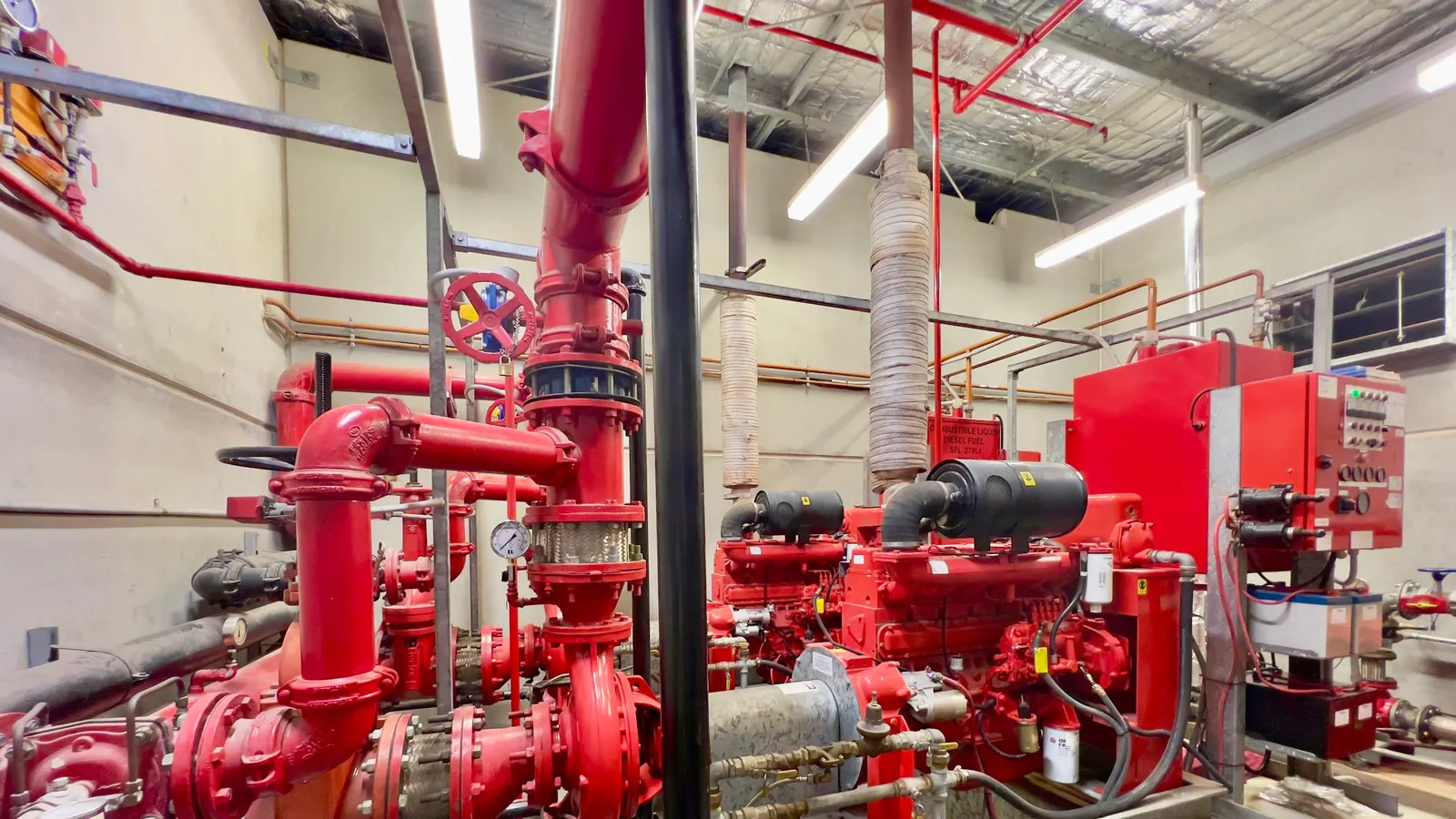
As NFPA's inspection checklists show, a fire pump installation includes the main pump and its driver, a controller (with a transfer switch where there is a second power source), a pressure maintenance (jockey) pump, relief valves and test valves. The water supply (a fire tank or a reliable main) and the fire protection system design come first; the pump is sized to the system demand the designer calculates.
Jockey pump vs main fire pump: what is the difference?
NFPA's own inspection guidance calls it the "pressure maintenance (jockey) pump". It is a small pump connected near the fire pump that holds pressure in the fire protection piping, recovering the slow pressure losses that occur over time, for example from temperature changes. It is deliberately sized for a flow smaller than one sprinkler, so that when a sprinkler opens the pressure falls far enough to start the main fire pump. Jockey pumps are typically small multistage centrifugal pumps and work as part of the fire pump's control scheme.
Jockey (pressure maintenance) pump
Main fire pump
Job
Keeps the system pressurised against small, slow losses
Supplies the design flow and pressure during a fire
Flow
Below the flow of one sprinkler
The system's calculated demand
Typical type
Small multistage centrifugal pump
Split case, end suction, in-line, vertical turbine or multistage multiport
Driver
Electric motor
Electric motor or diesel engine
Starts
Frequently, at a pressure set above the main pump's start point
Only when pressure falls below its own start setting
Weekly check under NFPA 25
Power to the jockey pump is provided
Room, valves, gauges, controller lights, churn test where required
Two practical consequences follow. First, the jockey pump's start and stop pressures must sit above the main pump's start pressure, or every small leak will start the fire pump. Second, a jockey pump that runs very often is telling you something: a leak, a passing valve or a wrong setting. The weekly and monthly test records, which log the starting pressure from the pressure switch or transducer, are where that shows up. Ask the designer for the full pressure schedule (jockey start and stop, main pump start, and any standby pump start) and have it posted in the pump room.
Which type of fire pump?
NFPA's overview of fire pump types divides them into positive displacement and centrifugal pumps, with centrifugal being the most common.
Type
What NFPA notes
Drivers
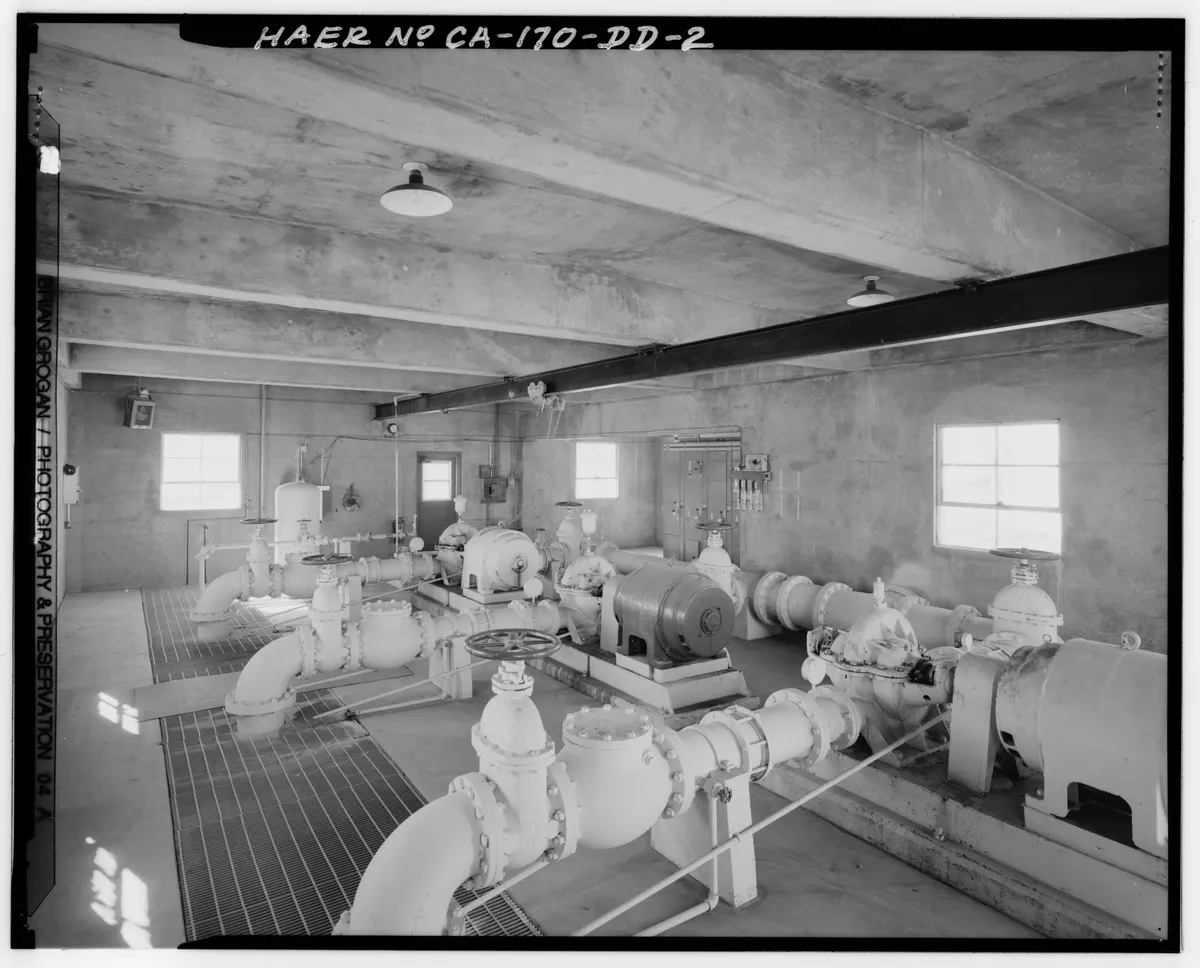
Horizontal split case
Flow enters the impeller from both sides; casing opens for maintenance; reliable, wide range of flows and pressures; needs the most space
Electric or diesel
Vertical turbine
The only type NFPA 20 allows to start with negative suction pressure or take water under lift, such as from a below-grade tank, river or lake
Electric or diesel
In-line
Least space, usually lower cost but harder to repair (motor lifted off for access); typically no more than 1,500 gpm (5,678 L/min)
Electric only
End suction
Discharge perpendicular to suction; more compact than split case; typically up to about 1,500 gpm (5,678 L/min)
Electric or diesel
Multistage multiport
Several impellers in series in one casing with outlets at different pressures, one per zone
Electric or diesel
Positive displacement
Very high pressure, limited flow; mainly water mist and foam-water systems
Per system design
The multiport option matters for Gulf towers. NFPA's example is a 30-floor building split into three zones, with one pump delivering 100 psi (6.9 bar) to floors ground to 9, 175 psi (12.1 bar) to floors 10 to 19 and 300 psi (20.7 bar) to floors 20 to 30. NFPA lists the possible benefits as fewer pumps, less pipework and fewer pressure-reducing devices, no water tanks on intermediate floors, lower structural loads and lower energy use. The vertical turbine rule matters for plant rooms where the fire tank is below the pump: other pump types need positive suction.
Electric or diesel driver?
Fire pumps are most commonly driven by an electric motor or a diesel engine. An electric fire pump may also be fed from an emergency generator through a listed transfer switch. The choice of driver and power arrangement is the fire protection designer's, made against the code and the authority's requirements.
Electric fire pump supplies are unusual. NFPA notes that NFPA 20 discourages a disconnecting means and features that limit overcurrent protection in the power supply to electric fire pumps, to keep power available in a fire. The consequence for maintenance is a higher exposure to shock, arc flash and arc blast. NFPA 25 now requires NFPA 70E (or an equivalent) safe work practices when testing or maintaining fire pump controllers, and avoids tests that would need an energized controller opened. NFPA 70E also requires the owner to label the equipment with the nominal voltage, arc flash boundary and incident energy or PPE category. Ask the panel supplier for external test points and the incident energy analysis at handover.
Listed pumps and controllers
A fire pump is a centrifugal or positive displacement pump tested and listed for fire service by a third-party agency such as UL or FM Global. Makers in the region advertise these listings: NAFFCO, for example, describes UL/FM and LPCB approved split case and end suction fire pumps. When comparing quotations, check that the listing covers the exact pump model, rated flow, pressure and speed offered, and that the controller, driver and relief valves are listed for fire pump service too. NFPA's churn test guidance refers to a circulation relief valve that discharges a small flow to stop the pump overheating at no flow, and to main pressure relief valves; both should be in the scope.
NFPA points out that design, installation and acceptance testing only prove the pump works on the day of the acceptance test; after the keys are handed over, routine inspection, testing and maintenance under NFPA 25 keeps it ready. NFPA defines weekly as once per calendar week.
Weekly inspection
Pump room: heating adequate (not below 4 °C), no water collecting on the floor, coupling guard in place.
Pump system: suction, discharge and bypass valves fully open; no leaks; suction gauge in range; suction reservoir at the required level; wet pit screens in place and clear; test valves closed.
Electrical: controller power light on, transfer switch normal light on, isolation switch closed, reverse phase alarm off, vertical motor oil level correct, and power to the jockey pump provided.
No-flow (churn) test
Frequency: diesel fire pumps generally weekly. Most electric pumps monthly, but weekly where the pump serves a building beyond the fire department's pumping capacity, has a limited service controller, is a vertical turbine, or takes suction from a ground level tank or a source without useful pressure, unless a redundant fire pump is provided.
Start automatically by drawing water from the sensing line to simulate a pressure drop, not with the controller's start button. NFPA 25 allows an automatic timer with a solenoid drain.
Run time: at least 10 minutes for electric pumps and 30 minutes for diesel pumps.
Record the starting pressure, suction and discharge pressures, controller event log highs and lows, motor acceleration time, and for diesels the crank time, time to running speed, oil pressure and temperatures. Check that the circulation relief valve is discharging.
Annual flow tests follow. Weekly inspections can usually be done by trained facility staff; NFPA 25 requires qualified people for the more complex tasks.
UAE and Saudi requirements
UAE
Fire protection products in the UAE go through Civil Defence approval under the UAE Fire and Life Safety Code; our guide to UAE Civil Defence approval for fire safety equipment explains the certificate of conformity route. For fire pump sets, ask each supplier for the Civil Defence approval covering the exact pump, driver and controller combination, alongside the UL or FM listing. Compare fire sprinkler system suppliers and fire hydrant system suppliers for the systems the pump serves.
Saudi Arabia
The Saudi Fire Code is SBC 801, part of the Saudi Building Code, and SASO publishes the list of conformity assessment bodies accepted for inspection activities under the Saudi Building Code, including SBC 801. Confirm with the project's Civil Defence consultant which edition and referenced standards apply, and ask suppliers for the approvals the authority will accept. Browse fire fighting equipment suppliers in Saudi Arabia and fire protection companies in Saudi Arabia.
Gulf plant rooms
Engines and motors are rated for a stated maximum ambient temperature. Ask the supplier to confirm the engine and motor ratings at the real summer pump room temperature, the fuel tank size and the exhaust and ventilation arrangement before the room is built.
Fire pump makers to shortlist
NAFFCO
NAFFCO describes itself as a fire pump manufacturer in the UAE, offering horizontal and vertical fire pumps, UL/FM and LPCB approved split case and end suction pumps, electric motor and diesel engine drivers, controllers, jockey pumps, containerised pump house units built to NFPA 20 and packaged industrial pump sets.
Pentair Aurora
Aurora, founded in Aurora, Illinois, in 1919 and acquired by Pentair in 1997, lists Series 912 horizontal split case and vertical electric drive fire pumps, Series 913 horizontal diesel drive fire pumps, Series 914 vertical turbine fire pumps and an end suction fire pump (Model 384, Series 911.5).
Fire pump RFQ checklist
System demand from the hydraulic calculation: rated flow and pressure, and the code edition used.
Water supply: tank or main, suction condition (positive or under lift), and whether a vertical turbine is needed.
Pump type and driver: electric, diesel, or electric with diesel standby; power source and transfer switch.
Jockey pump duty and the full pressure schedule.
Listings (UL or FM) for pump, driver, controller and relief valves, plus UAE Civil Defence approval or the Saudi authority's accepted approvals.
Factory test curve, field acceptance test support and test equipment (flow meter or test header).
Diesel details: fuel tank, exhaust, cooling, batteries; electrical details: controller type and external test points.
Pump room ambient temperature and ventilation; spares and local service for NFPA 25 testing.
It is a small pressure maintenance pump, usually a multistage centrifugal pump, installed beside the main fire pump. It keeps the fire piping at pressure against slow losses, so the main pump does not start for minor pressure drops. It is sized for less flow than one sprinkler, so a real discharge drops the pressure enough to start the main fire pump.
What is the difference between a jockey pump and a fire pump?
The fire pump is the large listed pump, electric or diesel, that supplies the system's design flow and pressure in a fire. The jockey pump is small, electric and only maintains standby pressure. Its start and stop pressures are set above the fire pump's start pressure, so it handles small losses and the fire pump starts only when real demand occurs.
Why does a jockey pump keep starting?
Frequent starts usually mean the system is losing pressure: a leak, a passing valve or drain, or pressure settings that are too close together. Check the controller's start log and the pressure schedule, then look for the loss. A jockey pump that runs constantly can also hide a leak large enough to matter in a fire.
Which fire pump types does NFPA 20 allow under suction lift?
NFPA's guidance states that the vertical turbine pump is the only type NFPA 20 allows to start with negative suction pressure or to take water under lift, for example from a below-grade tank, pond or river. Horizontal split case, end suction and in-line pumps need a positive suction supply.
How often should a fire pump be run?
Under NFPA 25, diesel fire pumps generally get a no-flow (churn) test every week and most electric pumps every month, with weekly tests for some electric pumps such as vertical turbines and those serving buildings beyond fire department pumping capacity. Electric pumps run at least 10 minutes and diesel pumps at least 30 minutes, started automatically from a pressure drop.
Can an electric fire pump run from a generator?
Yes. An electric fire pump may be supplied from an emergency generator through a listed transfer switch. The fire protection designer decides the power arrangement against the code and the authority's requirements; a diesel engine driven pump is the other common driver.
How to match a submersible pump to clear water, greywater, sewage or site water: impeller types, sump and lifting station design, level controls, alarms, duty and standby pumps, and an RFQ checklist.
How to size a deep well submersible pump from the pump test: pumping level and drawdown, total head, setting depth, check valves, cable voltage drop, protection, solar pumping and an RFQ checklist.
Centrifugal and positive displacement pumps compared: curves vs flat flow, end suction, split case and multistage pumps, gear, progressing cavity, diaphragm and peristaltic pumps, and a duty-by-duty selection table.