Types of Pump: Centrifugal vs Positive Displacement and When to Use Each
Centrifugal and positive displacement pumps compared: curves vs flat flow, end suction, split case and multistage pumps, gear, progressing cavity, diaphragm and peristaltic pumps, and a duty-by-duty selection table.
Pumps fall into two families. Centrifugal (dynamic) pumps spin an impeller to add velocity, then turn it into pressure, so their flow changes with the head they work against. Positive displacement pumps trap a fixed volume and push it out, so their flow stays almost constant whatever the pressure. Centrifugal pumps suit large flows of thin liquids; positive displacement pumps suit viscous fluids, high pressures and dosing. Compare centrifugal pump suppliers in the UAE with the positive displacement makers listed below.
This guide is for plant engineers, maintenance teams and buyers who need to know which pump type fits a duty before asking for quotes. Our guide to water pumps in the UAE and Saudi Arabia covers water duties (boosting, boreholes, dewatering) and how to read a pump curve; here we compare the pump types themselves, including the ones water guides skip: gear, screw, progressive cavity, diaphragm and peristaltic pumps.
What are the main types of pump?
The first split is how the pump moves liquid.
Centrifugal (dynamic) pumps. Liquid enters near the axis of a rotating impeller and is flung outward into a diffuser or volute casing. It gains velocity and pressure in the impeller, and the casing slows it down to raise pressure further. Common uses include water, sewage, agriculture, petroleum and petrochemical pumping.
Positive displacement pumps. They trap a fixed amount of fluid and force (displace) it into the discharge pipe. They come as rotary pumps (gear, screw, lobe, vane, progressing cavity), reciprocating pumps (piston, plunger, diaphragm) and others such as peristaltic pumps, which squeeze a flexible tube with rollers.
NFPA's overview of fire pumps makes the same split for fire duty: centrifugal pumps are the most common because they handle large volumes at high pressure, while positive displacement fire pumps give very high pressure at limited flow and are used mainly for water mist and foam-water systems.
Curve or flat flow: how the two families behave
This is the difference that drives selection and control.
Behaviour
Centrifugal
Positive displacement
Flow vs pressure
Flow falls as head rises, along the pump curve; the operating point is where the pump curve meets the system curve
Theoretically the same flow at a given speed whatever the discharge pressure; slight internal leakage rises with pressure
Closed discharge valve
Can run briefly against a closed valve
Must not run against a closed valve; pressure keeps rising until something fails, so a relief valve is needed
Flow control
Throttling valve or variable speed
Speed (flow is proportional to speed) or bypass; never by throttling
Viscous liquids
Efficiency falls as viscosity rises
Rotary types handle highly viscous fluids well
Priming
Needs liquid in the casing; gas in the casing stops pumping unless it is a self-priming design
Many types self-prime (diaphragm pumps have good suction lift)
Typical duties
Water, sewage, agriculture, petroleum and petrochemical pumping
Oils, fuels, bitumen, sludge, slurries, chemicals dosing, hydraulics, high pressure
For a buyer, the practical rule is: if the duty is a large flow of a thin liquid, start with a centrifugal pump; if the liquid is thick, the pressure very high, the flow must be measured in, or the fluid is shear-sensitive, start with positive displacement.
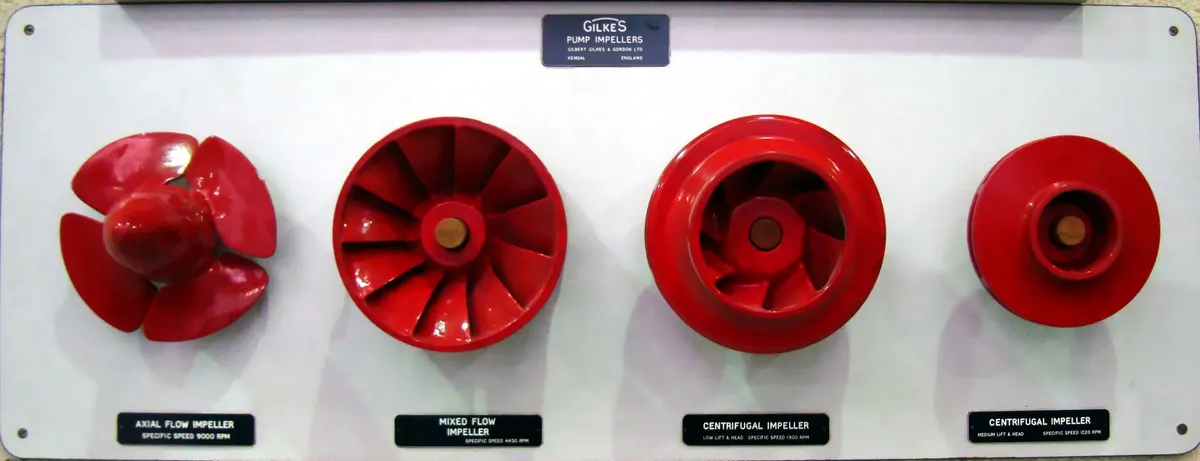
Within the centrifugal family, impellers range from radial through mixed flow to axial designs, as the photo shows, and the maker matches the shape to the duty. The casing and arrangement then define the pump type:
End suction: discharge perpendicular to the suction inlet; NFPA notes it is more compact than a split case pump. Browse end suction pump suppliers.
In-line: suction and discharge flanges on roughly the same plane so the pump drops into a straight pipe; NFPA notes they take little space but the motor must be lifted off for pump repairs.
Split case: the casing splits open for maintenance access, and double suction designs feed the impeller from both sides. NFPA describes them as reliable over a wide range of flows and pressures but needing the most space.
Multistage: two or more impellers in series raise outlet pressure (impellers in parallel raise flow). This is the standard pump for building booster sets and high-pressure water; see our booster pump sizing guide and browse multistage pump suppliers.
Vertical turbine: NFPA notes it is the only fire pump type NFPA 20 allows to take water under suction lift, such as from a below-grade tank or river.
Self-priming: designs able to evacuate air from the suction line, such as side-channel and water-ring types.
Positive displacement pump types
Gear pumps
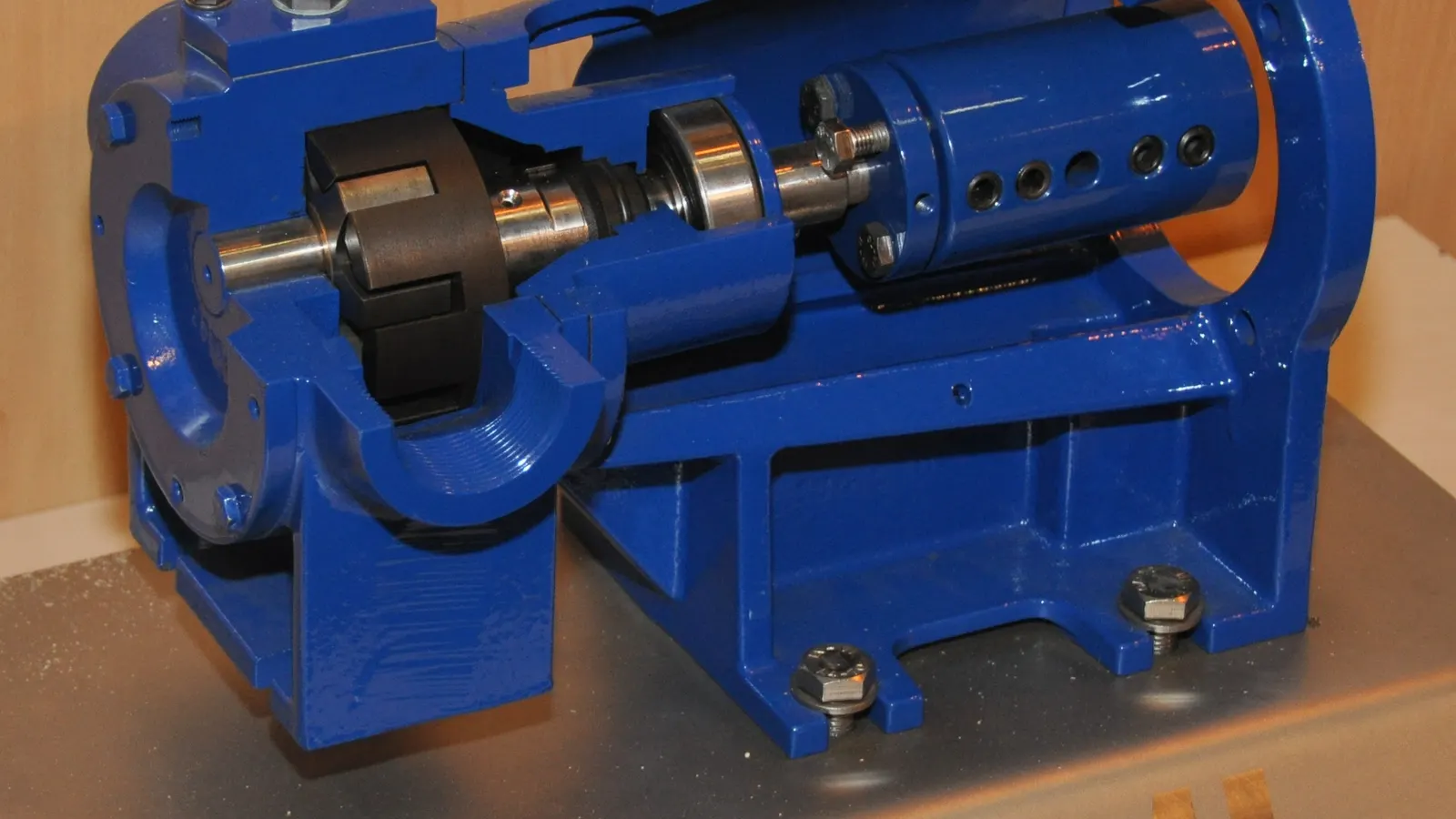
Two meshing gears (external) or a gear running inside a ring gear (internal, often with a crescent seal) carry liquid around the casing; tight clearances stop it leaking back. Flow equals volume per revolution times speed. The rigid design allows very high pressures and highly viscous fluids, and gear pumps are among the most common pumps for hydraulic fluid power. Typical liquids include bitumen, pitch, diesel, crude and lube oil, and in food plants chocolate, vegetable fats and molasses. External precision gear pumps are usually limited to around 210 bar. Browse gear pump suppliers.
Progressing cavity pumps
A helical rotor turns inside a stator, forming sealed cavities that travel along the pump. Flow is proportional to speed, in either direction, and shear is low, so they suit viscous and shear-sensitive materials, sewage sludge and oil transfer. Slurries are possible if the carrier liquid is viscous enough to protect the stator. Abrasives significantly shorten stator life, and running dry destroys the stator quickly, so specify dry-run protection. Browse progressive cavity pump suppliers.
Diaphragm pumps (including AODD)
A rubber, thermoplastic or PTFE diaphragm moves back and forth between check valves. Diaphragm pumps self-prime, have good suction lift, tolerate dry running, and can be designed for abrasive sludges and slurries with high grit and solids content; they handle low to medium viscosity. A wide choice of diaphragm elastomers makes them compatible with very corrosive solutions, and air-operated double diaphragm (AODD) versions typically meet the safety requirements for flammable or explosive atmospheres because no electric motor sits at the pump. Hydraulically driven versions reach discharge pressures up to 1,200 bar. Browse diaphragm pump suppliers.
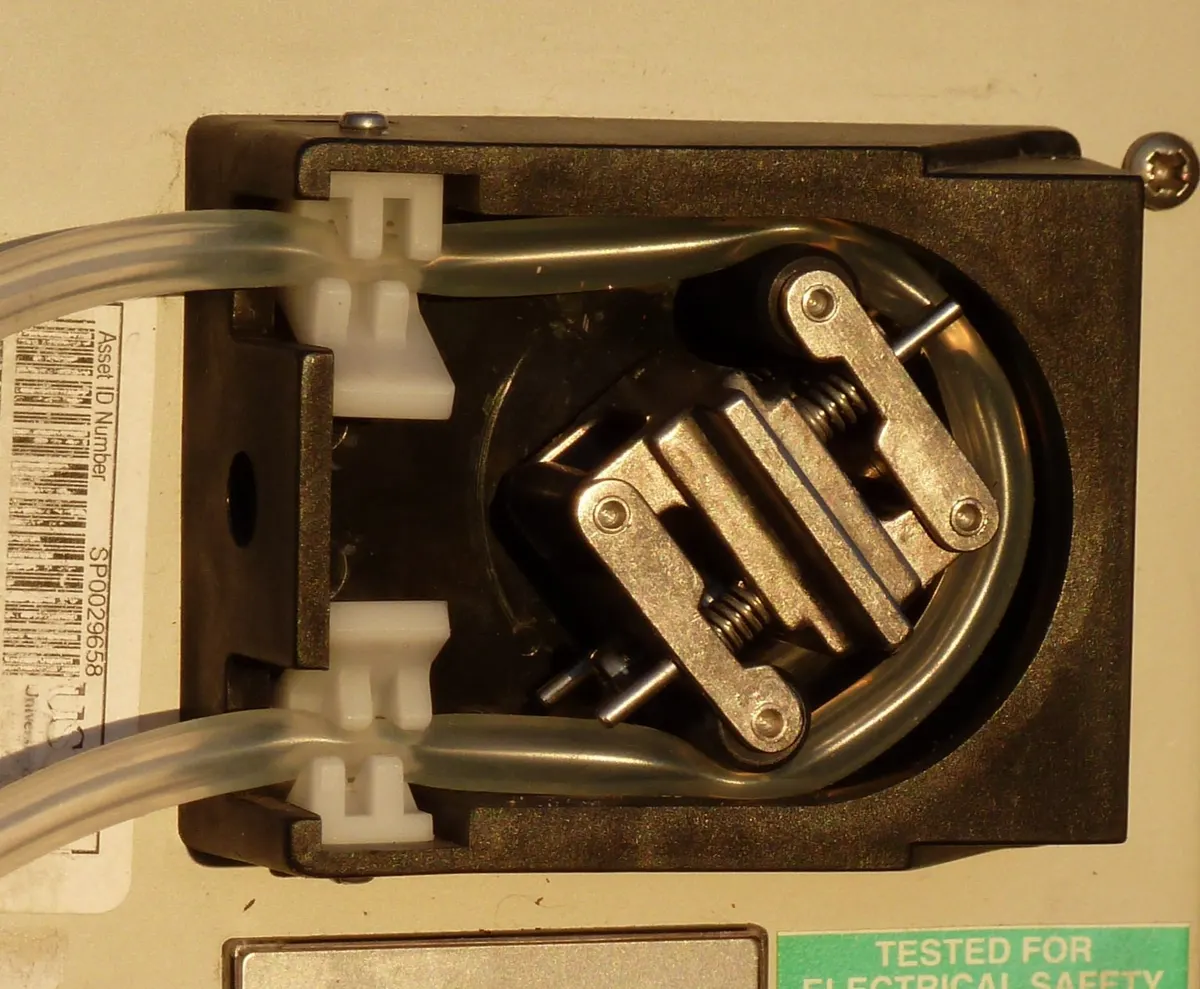
Rollers squeeze a flexible tube against a curved housing, pushing liquid along; the tube recovers and draws more in behind. The liquid touches only the inside of the tube, so there are no seals or valves in contact with it and cleaning is simple. They handle slurries, viscous, shear-sensitive and aggressive fluids, and uses include chemical dosing, food and beverage dispensing, and concrete and sewage sludge. The trade-offs: the tube wears and needs periodic replacement, flow pulses (especially at low speed), viscosity limits performance and pressure depends on tube strength. Browse peristaltic pump suppliers.
Screw, lobe, vane, piston and plunger pumps
Screw, lobe and vane pumps are further rotary positive displacement types, and rotary pumps as a class handle highly viscous fluids well. Reciprocating piston and plunger pumps are typically used for thick materials such as concrete and heavy oils and for very high pressures. Like all positive displacement pumps, they need overpressure protection on the discharge.
Viscosity, solids and metering: matching type to duty
Duty
Usual first choice
Why
Clean water, large flow, moderate head
End suction or split case centrifugal
Efficient at high flow; simple control
Clean water, high pressure
Multistage centrifugal
Impellers in series build pressure
Thick oils, fuels, bitumen, food fats
Gear, screw or lobe pump
Rotary PD handles high viscosity
Sludge, viscous or shear-sensitive product
Progressing cavity pump
Low shear, steady flow proportional to speed
Slurries, corrosive chemicals, hazardous areas, portable transfer
Air-operated double diaphragm pump
Self-priming, dry-run tolerant, elastomer choice, air drive
Three questions settle most borderline cases. First, how viscous is the liquid at the coldest operating temperature? Viscous liquids reduce centrifugal pump efficiency. Second, what solids does it carry, and how abrasive are they? Abrasives significantly shorten progressing cavity stator life. Third, does the flow need to be accurate? Positive displacement pumps whose flow is proportional to speed (gear, progressing cavity, peristaltic) can be used for dosing with a speed controller.
Seals, materials and sealless designs
Where leakage is unacceptable (acids, solvents, toxic liquids), sealless designs remove the shaft seal. Finish Thompson, for example, makes sealless magnetic drive centrifugal pumps, including self-priming versions, alongside mechanically sealed centrifugal pumps, drum pumps and AODD pumps. For any pump, state the liquid, concentration and temperature in the RFQ and ask the supplier to name the material of every wetted part and the seal or diaphragm elastomer.
Finish Thompson lists sealless magnetic drive centrifugal pumps (plastic and ANSI), mechanically sealed centrifugal pumps, vertical pumps, self-priming mag drive pumps, drum and barrel pumps and air-operated double diaphragm pumps under its FTI Air line. It suits chemical transfer and plants handling corrosive liquids.
EDUR
EDUR, based in Kiel, Germany, makes multistage centrifugal pumps, peripheral pumps and multiphase pumps that can transport liquid-gas mixtures.
Pentair Aurora
Aurora, founded in Aurora, Illinois, in 1919 and owned by Pentair since 1997, lists horizontal split case, vertical turbine and end suction pumps, including fire pump versions.
Pump selection RFQ checklist
Liquid: name, concentration, temperature range, viscosity at the coldest condition, density and vapour pressure.
Solids: type, maximum size, concentration and abrasiveness.
Duty: flow and head (or pressure), minimum and maximum flows, and whether flow must be metered.
Suction: flooded or lift, NPSH available, and whether the pump may run dry.
Pump type proposed and why, with the curve (centrifugal) or flow vs speed and pressure data (positive displacement).
Relief valve or bypass for positive displacement pumps; seal type or sealless design.
Materials of all wetted parts and elastomers.
Driver: electric motor with IE class and conformity documents, VFD, or compressed air supply for AODD.
Hazardous area classification, if any.
Spares (stators, tubes, diaphragms, seals) held locally and lead times.
Centrifugal (dynamic) pumps and positive displacement pumps. Centrifugal pumps use a spinning impeller to add velocity and pressure, and their flow changes with head. Positive displacement pumps trap and push a fixed volume each revolution or stroke, so flow stays nearly constant whatever the pressure. Positive displacement pumps divide further into rotary and reciprocating types.
When should I use a positive displacement pump instead of a centrifugal pump?
Use one when the liquid is viscous (oils, bitumen, sludge), when you need very high pressure at modest flow, when the flow must be accurate for dosing, when the product is shear-sensitive, or when the pump must self-prime and tolerate dry running. For large flows of thin liquids such as water, a centrifugal pump is usually more efficient and simpler.
Why does a positive displacement pump need a relief valve?
Because it keeps displacing the same volume whatever the pressure. If the discharge is closed, pressure rises until a pipe bursts or the pump is damaged. A relief valve or bypass protects the system. A centrifugal pump, by contrast, can run briefly against a closed valve because its head is limited by its curve.
What is a diaphragm pump used for?
Diaphragm pumps, especially air-operated double diaphragm (AODD) types, transfer slurries, sludges, corrosive chemicals and liquids in hazardous areas. They self-prime, lift well, tolerate dry running and can use different diaphragm materials for chemical compatibility. Air-driven versions typically meet the requirements for flammable or explosive atmospheres. They suit low to medium viscosity liquids.
What is the difference between a gear pump and a centrifugal pump?
A gear pump is a positive displacement pump: meshing gears carry a fixed volume per revolution, giving steady flow at high pressure and handling thick liquids such as oils and bitumen. A centrifugal pump uses an impeller, gives high flow of thin liquids, and its flow falls as pressure rises. Gear pumps need relief protection; centrifugal pumps do not in the same way.
Can a centrifugal pump handle viscous liquids?
Only up to a point. Viscous liquids reduce a centrifugal pump's efficiency, so the curve published for water no longer applies. Ask the maker for a viscosity-corrected selection, and for thick liquids compare a rotary positive displacement pump such as a gear, lobe or progressing cavity pump.
How to match a submersible pump to clear water, greywater, sewage or site water: impeller types, sump and lifting station design, level controls, alarms, duty and standby pumps, and an RFQ checklist.
How to size a deep well submersible pump from the pump test: pumping level and drawdown, total head, setting depth, check valves, cable voltage drop, protection, solar pumping and an RFQ checklist.
How jockey pumps and main fire pumps work together, which fire pump type and driver to choose, what listing and NFPA 25 testing involve, and the UAE and Saudi approval routes.