Lithium-Ion vs Lead-Acid Forklift Batteries in Hot Warehouses
Lithium-ion or lead-acid for electric forklifts in Gulf warehouses: opportunity charging, what heat does to each, charging room ventilation, lithium safety, total cost drivers and converting existing trucks.
For electric forklifts in hot Gulf warehouses, lithium-ion batteries suit multi-shift work because they charge in short breaks, need no watering and give off no charging gases, so no ventilated battery room is needed. Lead-acid costs less to buy but needs full charge cycles, watering, spare batteries for extra shifts and a ventilated charging area. Check the battery's rated temperature range, then compare electric forklift suppliers in the UAE.
This guide is for warehouse, facilities and fleet managers choosing the energy system for forklifts and warehouse trucks. It goes deeper than our forklift buying guide for the UAE and Saudi Arabia on one question: lithium-ion or lead-acid. It covers charging patterns, heat, charging areas and ventilation, safety, what drives total cost, and converting existing trucks. We quote no prices; the cost section lists what moves the numbers.
Lithium-ion vs lead-acid at a glance
Factor
Lead-acid (flooded)
Lithium-ion
Charging pattern
Full cycles; Linde says only full charging cycles are recommended to protect the battery
Short top-up charges in breaks; Linde gives about 20 to 80% as the ideal state of charge
Charge time
Long full charge; battery change for multi-shift work
Jungheinrich: 50% in 30 minutes and full in 80 minutes for its 24 V battery; STILL: about 60% in about 60 minutes, depending on charger and ambient temperature
Maintenance
Regular watering; Jungheinrich's low-maintenance versions go up to 120 cycles between refills
Maintenance-free, according to STILL, Linde and Jungheinrich
Gases while charging
Hydrogen and oxygen (HSE)
No battery gases, according to STILL, Linde and Jungheinrich
Service life
The baseline
About twice as long (STILL) to three times as long (Jungheinrich), by the makers' own figures
Charging area
Dedicated, well-ventilated area
Chargers can be placed at work areas; Linde and STILL say no separate battery room is needed
Weight
Heavy; part of the truck's counterweight
Lighter; retrofit needs the maker to confirm stability and capacity
Service-life and charging figures are each manufacturer's statements for its own system, not independent tests, and they depend on battery size, charger and conditions.
Opportunity charging and multi-shift work
The biggest operational difference is how the battery is charged across a day.
With lead-acid, the usual pattern is one full charge per shift. Linde says it is recommended to only ever start full charging cycles with conventional batteries to protect them, so a truck working two or three shifts typically needs a second battery and a battery change, with the changing equipment and time that involves.
With lithium-ion, the battery stays in the truck and is topped up whenever it is parked. Linde says even an extremely short interim charge of a few minutes is allowed and preferred, and that its batteries can complete a full charge cycle within an hour. STILL says that with the right charger, 24/7 shifts are possible with one battery, and that it offers an onboard charger that allows charging at normal sockets. Linde also offers two capacities for each battery type, so a heavily used truck can carry a larger battery and run a three-shift operation without charging during that time.
Opportunity charging changes your electrical load. STILL notes that frequent, faster charging changes power consumption, and offers charging management that limits the energy drawn per charger to avoid expensive peak loads. Ask suppliers for the charger rating and the total connected load for the fleet, and check it against the site's supply before you order.
Heat: what Gulf temperatures do to forklift batteries
Heat shortens the life of both technologies, so the battery's temperature rating matters as much as its capacity in a building that is not air-conditioned.
Lead-acid. Battery University, an educational battery website, says "heat is a killer of all batteries" and gives a guideline that each 8 °C rise in temperature cuts the life of a sealed lead-acid battery in half. Forklift traction batteries are usually the flooded (vented) type, such as Jungheinrich's tubular-plate batteries with liquid electrolyte; Battery University says flooded lead-acid batteries are well suited to hot climates, but need watering and good ventilation.
Lithium-ion. STILL states its lithium-ion batteries deliver rated performance between 0 and +45 °C, and that its battery management system protects against overtemperature; Linde says its battery management prevents damage from overheating. STILL also qualifies its operating-hour figures as "depending on the operating conditions and temperatures".
No manufacturer page we read gave Gulf-specific life figures, so ask each supplier in writing: the rated operating and charging temperature range, what the truck and charger do above it (reduced power, charging stopped), and whether the warranty assumes a maximum ambient temperature. Where possible, put chargers in the coolest part of the building and keep trucks out of direct sun when charging.
Lead-acid charging needs a properly designed area, and that space and ventilation are a real cost. The UK HSE's guidance on electric storage batteries (INDG139) explains why and how:
Hydrogen and oxygen are produced during charging, faster as the battery nears full charge; mixtures with air containing 4% to 75% hydrogen will readily ignite and explode.
In most situations, a zone 1 hazardous area should be considered to exist for up to one metre in all directions around batteries under charge, and all equipment in that zone must be suitable for it.
In charging areas people enter, hydrogen should not exceed 0.4% by volume (10% of the lower explosion limit); in enclosures people do not enter, 1%.
Hydrogen rises, so charging areas need air inlets at low level and outlets at high level, in opposing exterior walls or a door and an opposing wall. INDG139 gives a formula for the minimum vent area based on the number of cells, the overcharging current and a dilution factor.
If natural ventilation is not enough, use mechanical ventilation, with an alarm that detects hydrogen build-up or ventilation failure and isolates electrical equipment.
No smoking, hot work or mobile phones in the charging area; do not charge below lights or other equipment that could ignite the gas; raise the battery lid or open the compartment before charging.
INDG139 cites BS EN 50272-2: 2001 for calculating the hazardous zone; ask your MEP designer which current battery installation standard they are designing to.
What the UAE and Saudi guidance says
SASO's Arabic-language occupational safety guide for forklifts sets out battery charging rules that apply to Saudi workplaces: follow the truck maker's instructions on battery type and compatible chargers; use only the battery weight stated on the truck's plate, to protect stability; only designated competent workers may change or charge batteries; charge and change batteries only in areas the employer designates; no smoking or ignition sources in charging areas; switch chargers off before connecting or disconnecting; keep vent caps in place and openings clear; provide adequate ventilation in charging areas; provide eye and body wash facilities separate from the charging area; earth all charging systems; and keep the charging area free of flammable materials.
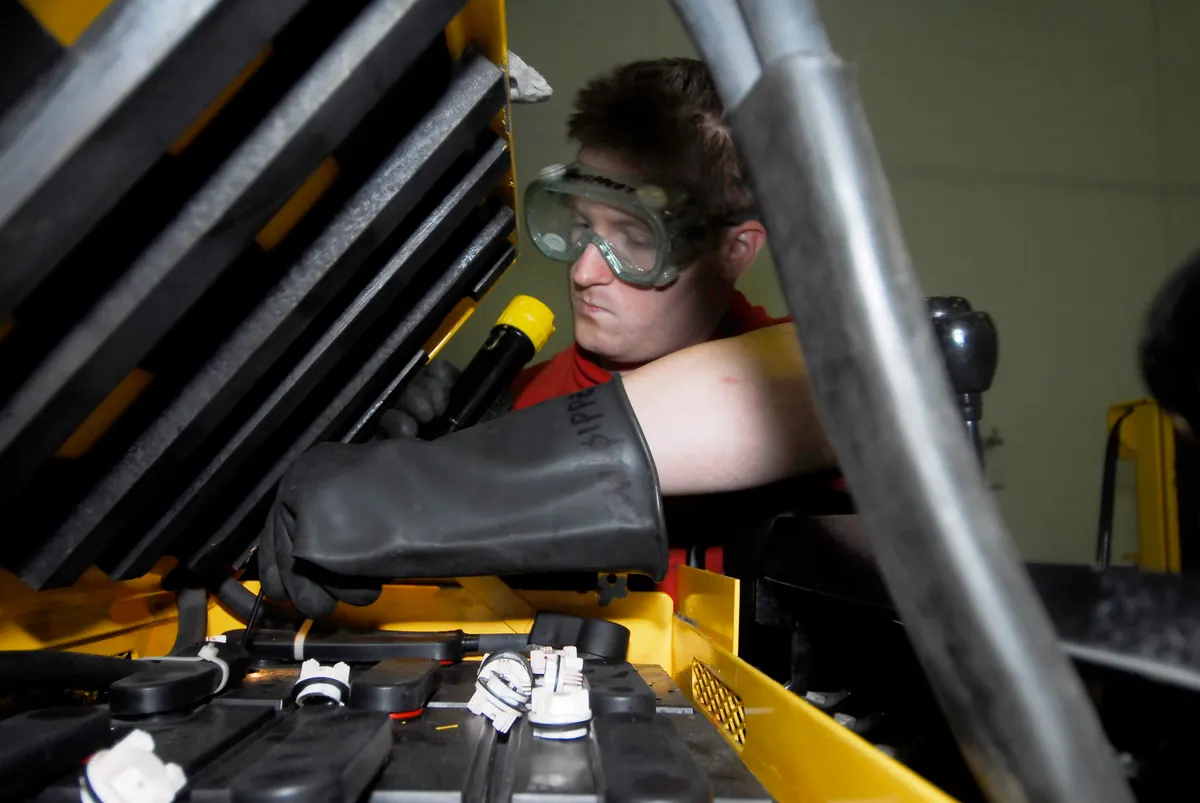
In Dubai, the RTA's forklift operator handbook tells operators that batteries contain sulphuric acid, lists protective clothing for handling them (eye protection, gloves, acid-resistant boots, face mask and apron), and says to recharge only in designated, well-ventilated areas, keep flames and sparks away, and open the circuit with the isolation switch before disconnecting battery terminals.
We did not find UAE civil defence or Saudi civil defence requirements specific to forklift charging rooms or lithium-ion forklift batteries on official pages. Ask your fire consultant and the authority having jurisdiction before you design a charging area, for either technology.
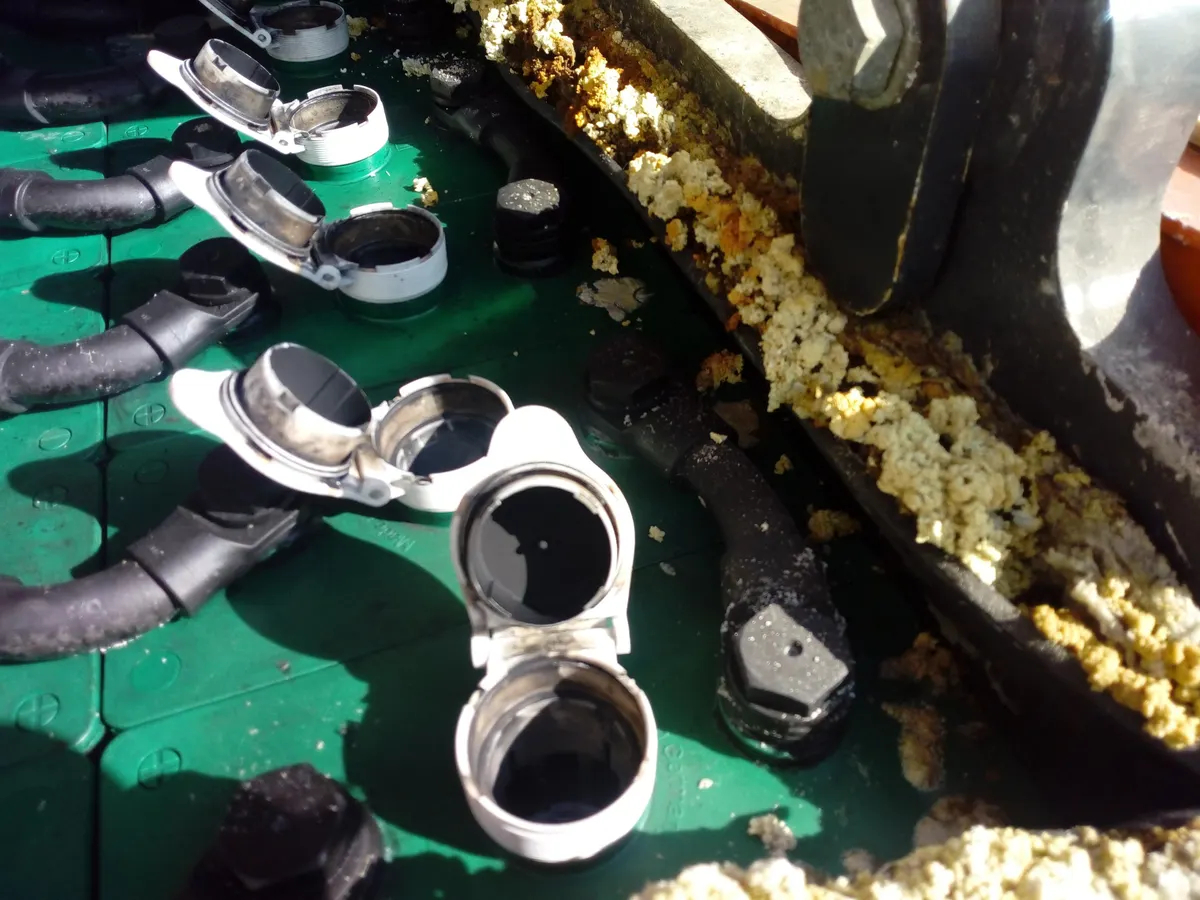
A damaged electric forklift battery with open cell caps and heavy corrosion along the case. Spilled electrolyte and corrosion are part of the upkeep of flooded lead-acid batteries. Photo: FalkorD, CC BY-SA 4.0, via Wikimedia Commons
Lithium-ion safety: what to ask for
Lithium-ion removes hydrogen and acid from the charging area, but it brings its own safety questions. Manufacturers address them through cell chemistry, enclosure and battery management:
Cell chemistry. Jungheinrich says it uses lithium iron phosphate (LiFePO4), which it describes as currently the safest cell chemistry.
Enclosure and protection. Jungheinrich gives its batteries an IP54 enclosure. Linde says its batteries are crash-tested and housed in 25 mm steel, and that its safety system works at cell, module and battery level.
Battery management. STILL's system protects against overpressure, overtemperature and deep discharge; Linde's against overpressure, overheating, over-charging and deep discharge.
System approval. Linde says the whole system of truck, battery and charger carries CE approval, and warns that this is generally not guaranteed when a battery is bought as a stand-alone component.
Transport and disposal. Jungheinrich notes that lithium-ion batteries are hazardous materials under international transport law, so returns and disposal need a specialist; Linde runs a recycling programme for batteries it supplies.
One STILL customer quoted on its lithium-ion page describes "an intensive fire protection planning and integration phase" before switching. Treat lithium-ion charging points as part of your fire strategy, and ask suppliers for the battery's test certificates, the BMS protections and the manufacturer's charging-location guidance.
What drives total cost of ownership
Compare the two on cost over the battery's life, not on purchase price. The manufacturers' own pages list the cost items to put side by side:
Number of batteries. Linde lists the cost of a second battery and battery replacement among the lead-acid costs that lithium-ion removes.
Labour. Watering, battery changes and cleaning; Linde and STILL both cite the time and personnel costs of changing and maintaining lead-acid batteries.
Infrastructure. Linde says lithium-ion removes the need for a separate battery room and gas extraction; for lead-acid, add the room, ventilation, wash facilities and changing equipment.
Energy. Linde says its lithium-ion battery and charger increase the energy yield by 30% compared with lead-acid; Jungheinrich cites around 21% lower CO2 emissions.
Battery life and warranty. STILL offers a battery quality promise of up to 5 years; Jungheinrich a performance guarantee of up to 8 years. Compare what each warranty covers (capacity retained, cycles or hours, temperature limits).
Utilisation. STILL grades its energy packages by annual operating hours (up to 1,000, 3,000 or 4,000 hours a year), with the lowest tier aimed at low acquisition cost. The more hours a truck works, the more the running-cost items above add up.
Run the comparison over the battery's expected life, with your shift pattern and hours, rather than comparing purchase prices. If you rent trucks, ask the same questions; our forklift rental guide covers what a rental should include.
Converting lead-acid trucks to lithium-ion
Retrofitting is possible, but the battery is not just an energy source. STILL calls the battery "an important counterweight element" and says its specific weight is of great importance to the truck's carrying capacity. The UK HSE's lift truck code (L117) says to use only batteries of the size and weight specified by the manufacturer, as they are part of the counterweight and an incorrect weight will affect stability, and SASO's forklift guide says the same about the battery weight on the truck's plate.
Before converting:
Ask the truck manufacturer or its authorised dealer whether a lithium-ion conversion is approved for that model, and whether ballast is needed to restore the specified battery weight.
Get written confirmation that the capacity plate remains valid, or a new plate.
Use a charger matched to the battery and its management system; Linde warns that system-level CE approval is not guaranteed with stand-alone batteries.
Check that the battery communicates with the truck's controller so low-charge warnings and power reduction work.
Jungheinrich, for example, says its lithium-ion advisers support retrofitting individual vehicles as well as converting whole fleets. Ask your truck's own maker first.
Which to choose
Choose lithium-ion for multi-shift work, sites with no space for a battery room, food and clean environments, and fleets where battery changing is a bottleneck. Confirm the temperature rating suits your building.
Choose lead-acid for single-shift, low-hour trucks where the lower purchase price matters more, and where a compliant, ventilated charging area already exists.
A mixed fleet is an option: lithium-ion on the hardest-worked trucks, lead-acid on occasional-use trucks until their batteries reach end of life.
Is lithium-ion or lead-acid better for forklifts in hot climates?
Heat shortens the life of both. Lithium-ion batteries carry a rated temperature range (STILL quotes 0 to +45 °C) and a battery management system that protects against overtemperature. Flooded lead-acid batteries tolerate heat reasonably well, according to Battery University, but need watering and ventilation. Ask each supplier for the rated range and what happens above it before deciding.
How long does a lithium-ion forklift battery last?
Manufacturers quote longer life than lead-acid: STILL says at least twice as long, with its batteries designed for up to 4,000 full charge cycles depending on model, and Jungheinrich says three times longer. Warranties run up to 5 years (STILL) and up to 8 years (Jungheinrich). Real life depends on hours, charging pattern and temperature.
How long does it take to charge a lithium-ion forklift battery?
It depends on battery size and charger. Jungheinrich says its 24 V battery reaches 50% in 30 minutes and full charge in 80 minutes; STILL says about 60 minutes gives about 60% charge, depending on charger and ambient temperature; Linde says its batteries can complete a full cycle within an hour. Short top-ups during breaks are allowed and preferred.
Do lithium-ion forklift batteries need a battery room?
Linde and STILL say no separate battery room or gas extraction is needed, because lithium-ion batteries give off no charging gases and chargers can be placed near work areas. You still need suitable electrical supply, charger locations agreed with your fire consultant, and the manufacturer's guidance on where to charge.
Can I convert a lead-acid forklift to lithium-ion?
Often, but only with the truck manufacturer's approval. The battery is part of the counterweight: HSE's L117 and SASO's forklift guide both say to use only the battery weight the manufacturer specifies. Get confirmation that the capacity plate remains valid, use a matched charger, and make sure the battery communicates with the truck's controller.
Are lithium-ion forklift batteries safe?
Makers design them with protective chemistry, enclosures and battery management: Jungheinrich uses lithium iron phosphate cells in an IP54 enclosure, and Linde crash-tests its batteries in 25 mm steel housings. Battery management systems guard against overcharging, overheating and deep discharge. They remove the hydrogen and acid risks of lead-acid, but plan charging locations as part of your fire strategy.
When a telehandler beats a forklift and when it does not: boom versus mast, load charts, stabilisers and load moment control, fixed and rotating models, attachments, operator training and Gulf rules.
How counterbalance forklifts, reach trucks, VNA turret trucks, order pickers, pallet trucks and stackers work, what lift heights makers publish, what VNA stores need from the floor, and which type fits which job.
Which licence and certificate a forklift operator needs in Dubai, Abu Dhabi, Sharjah, the other emirates and Saudi Arabia, according to official sources, and where no official rule could be found.