Forklift Types: Counterbalance, Reach Truck, VNA and Pallet Trucks
How counterbalance forklifts, reach trucks, VNA turret trucks, order pickers, pallet trucks and stackers work, what lift heights makers publish, what VNA stores need from the floor, and which type fits which job.
The main forklift types are the counterbalance forklift, the reach truck, the very narrow aisle (VNA) or turret truck, the order picker, and pallet trucks and stackers. They differ in how they carry the load, how narrow an aisle they can work in and how high they lift. Choose by your racking, aisle width and floor, then compare forklift and warehouse truck suppliers in the UAE on that layout.
This guide is for warehouse designers, logistics managers and buyers planning a new store or replacing a fleet. It explains how each warehouse truck works, the lift heights makers publish, what VNA trucks need from the floor and racking, and which type fits which operation. Power options in Gulf heat, capacity plates, brands and the rules on buying are covered in our forklift buying guide for the UAE and Saudi Arabia.
How forklift types are classified
There is no single global naming system, but two official references help when you read datasheets and safety rules.
The US Occupational Safety and Health Administration (OSHA) groups powered industrial trucks into seven classes in its forklift eTool. SASO's Arabic-language occupational safety guide for forklifts uses the same OSHA eTool as its reference for forklift types.
OSHA class
Name
Where you meet it in a Gulf warehouse
Class I
Electric Motor Rider Trucks
Electric counterbalance forklifts on docks and in general storage
Class II
Electric Motor Narrow Aisle Trucks
Reach trucks, order pickers and VNA trucks in racked aisles
OSHA notes that this classification does not include every powered industrial truck its standard covers. The UK Health and Safety Executive's warehousing guide (HSG76) uses a more detailed list of truck types, including straddle trucks, man-up and man-down VNA trucks, pivot steer trucks and multi-directional trucks, which is useful when you compare inspection regimes.
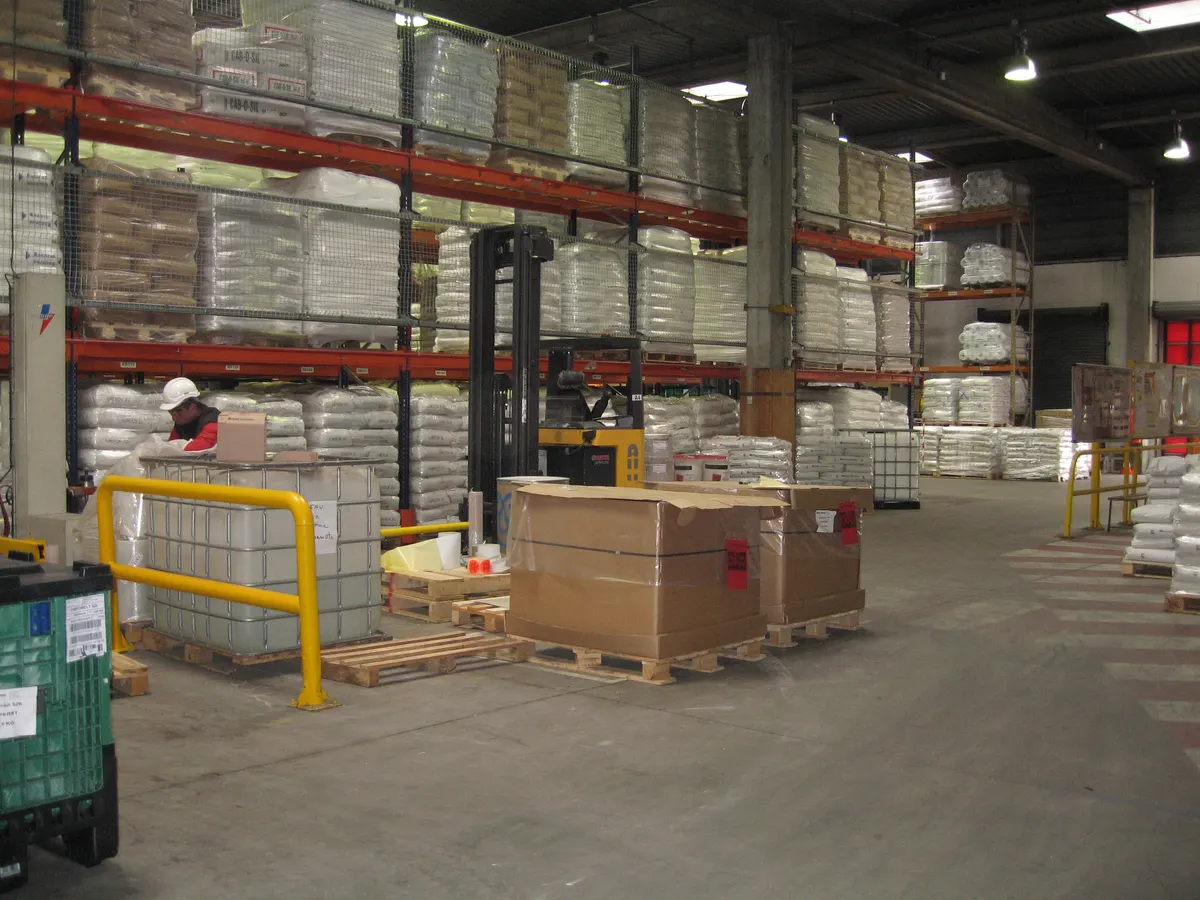
A reach truck working between pallet racks in a raw material warehouse for plastics manufacture. Reach trucks retract the load between their support legs to shorten the truck, which lets them turn in narrower aisles than a counterbalance forklift. Photo: Cjp24, CC BY-SA 3.0, via Wikimedia Commons
Counterbalance forklift: the general-purpose truck
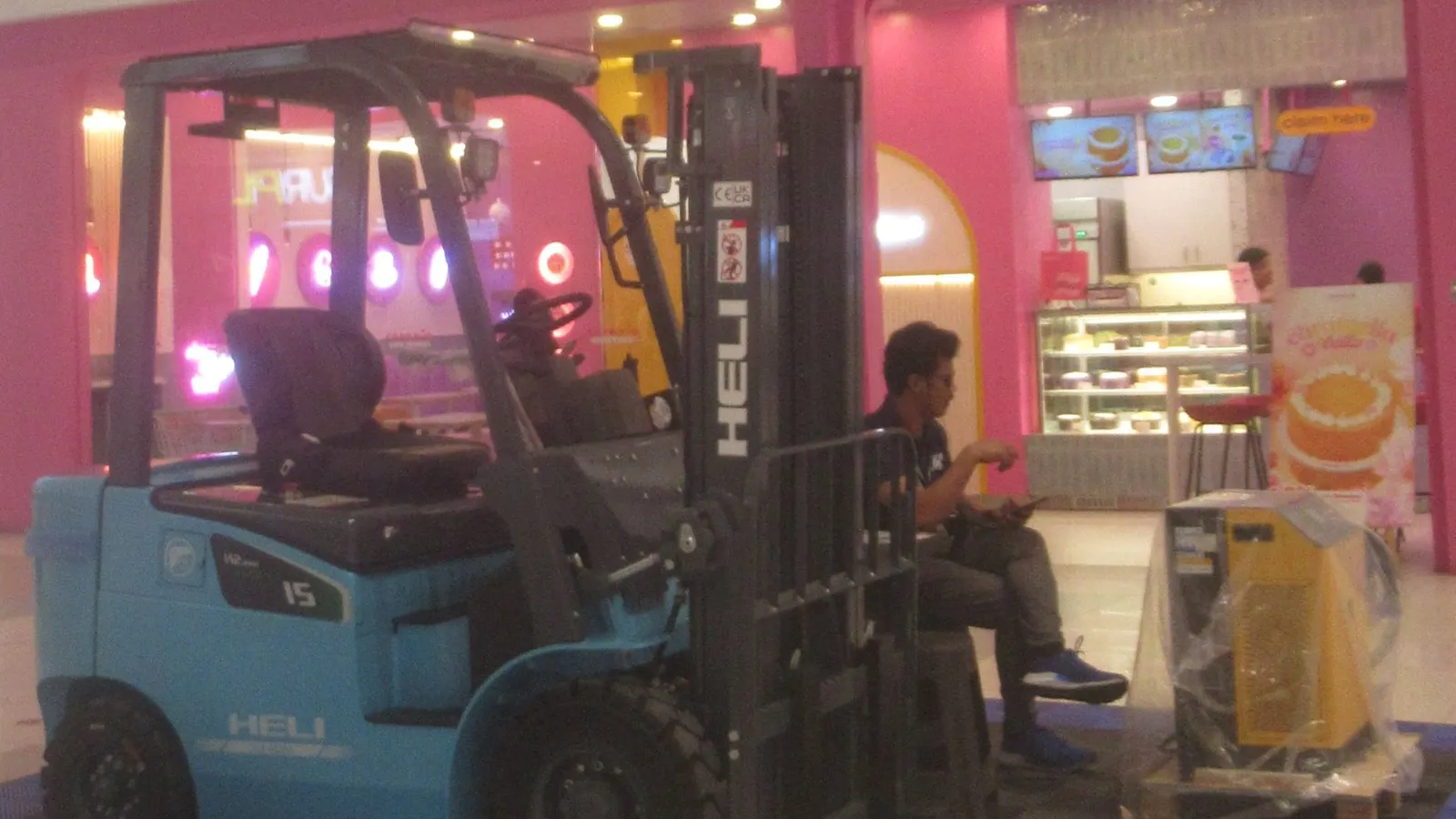
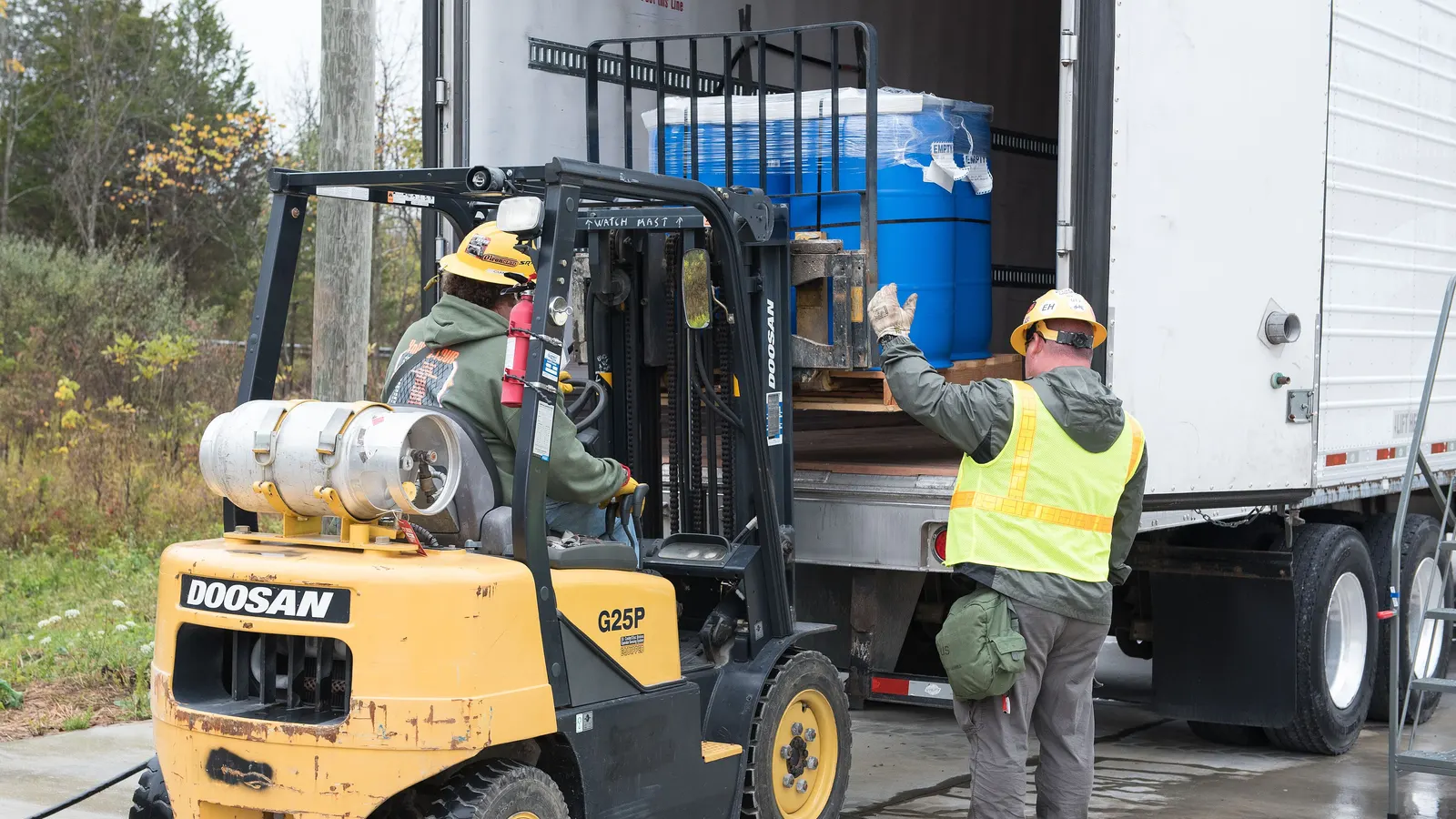
A counterbalance forklift carries the load on forks ahead of its front wheels and balances it with weight at the back. That makes it long, so it needs wide aisles to turn into racking, but it needs no support legs under the load and can drive straight up to a trailer or container. That is why it remains the standard truck for loading and unloading, yard work and mixed indoor and outdoor jobs. It comes in electric (OSHA Class I) and engine (Class IV and V) versions; our main guide covers that choice.
In a racked warehouse, the counterbalance truck usually works the dock and the marshalling area while narrow aisle trucks work the racking.
Reach truck: narrower aisles, higher racking
A reach truck is built to store and retrieve pallets in racking. Jungheinrich describes the principle: when picking up a load, the truck moves its mast forward, guiding the forks into the pallet ("forward reach"); the mast then retracts, pulling the goods back between the support arms for transport. Carrying the load within the wheelbase shortens the truck, so it turns in narrower aisles than a counterbalance forklift of similar capacity.
Published figures show how high reach trucks go. Jungheinrich's UK range lists electric reach trucks handling loads of up to 2.5 tonnes with lift heights up to 14,000 mm; its ETV 2i is rated for up to 1,600 kg and 10,700 mm, and the ETV 3i and 4i for up to 2,500 kg and 14,000 mm. Linde Material Handling offers reach truck options for refrigerated warehouses and outdoor use, 360° steering for tight spaces, and four-way reach trucks (its R20 to R25 F series) that carry bulky loads in narrow aisles forwards, backwards, left and right. Jungheinrich also says cabins are available for cold store or outdoor use.
What a reach truck needs:
A smooth, level floor to the flatness the truck supplier specifies; HSE's warehousing guide asks for this wherever lift trucks operate.
Racking and truck specified together. Give the truck supplier your racking drawing, bottom beam height and pallet size so they can confirm the truck works with the bottom level and the aisle.
Residual capacity at height. The capacity at the top beam is lower than the headline rating; get the capacity chart for your lift height from the maker.
Very narrow aisle trucks put away and retrieve pallets without turning in the aisle. Jungheinrich says its VNA trucks are "also known as turret trucks or high rack stackers", that the truck, racking and guidance system work together, and that mechanical rail or inductive wire guidance lets the truck travel close to the racking with precision. Its UK range lists the EKX series (described as an electric order picker and tri-lateral stacker) for lift heights from 3,000 to 18,000 mm and loads of 1.0 to 1.6 tonnes, and the EFX front-seat tri-lateral stacker for 3,000 to 9,000 mm and 1,100 to 1,360 kg.
Linde says its VNA trucks can move and lift at the same time, and that at an assumed shelf height of seven metres they process up to 30 pallets per hour, which it says is substantially more than counterbalanced forklifts or reach trucks.
Guidance: rail, wire or free-ranging
The UK HSE's warehousing guide describes three modes of operation for these trucks:
Free-ranging: steered by the operator at all times, and not normally intended for aisles with less than at least 300 mm clearance either side of the truck width.
Rail-guided: rollers on the truck engage guide rails, normally floor mounted in the aisles; the truck can range freely in open areas.
Wire-guided: guided by a signal from a wire buried in the floor while in the aisle, and steered by the operator elsewhere.
HSE adds that travel speed is normally controlled automatically depending on lift height and whether the truck is in or out of the aisle.
What a VNA store needs from the building
HSE's guide says the floor in areas where trucks operate should have the flatness specified by the truck supplier, and that this is particularly relevant in very narrow aisle applications, where unsuitable floors can reduce operating speed, damage loads and racking, and cause operator discomfort. In practice, decide the VNA truck before the floor slab is poured or refurbished, and get the floor flatness, rail or wire layout and racking tolerances from the truck and racking suppliers together.
Man-up and man-down
In a man-down VNA truck the operator stays at floor level. In a man-up truck the cab rises with the forks, so the operator can also pick cases. HSE describes man-up machines as those that raise the operator to 1,200 mm or more above ground, used in narrow or VNA applications, and lists special requirements: means to keep the operator within the operating position (for example two-handed control), an emergency lowering control operable from floor level for trucks that raise the operator more than 3,000 mm, slack chain detection where chains lift the operator, and a rescue procedure if the operator is stuck at height. Its inspection table gives man-up VNA trucks a maximum thorough examination interval of 6 months, against 12 months for man-down VNA trucks, under UK rules.
Order pickers: lifting the person, not just the pallet
An order picker lifts the operator to the shelf so they can pick individual cases or items. Low-level order pickers work at the first or second level; high-level ones reach much higher. Jungheinrich says its high-level order pickers pick at heights of up to 14 metres, and Linde says its V-model offers a maximum picking height of twelve metres, with contact sensors so that the truck responds only when both of the operator's hands are on the controls. Crown Equipment lists man-up order pickers alongside its reach trucks, stackers and pallet trucks.
Because the operator works at height, these trucks carry the same fall and entrapment risks as man-up VNA trucks. The HSE guide notes that low-level order pickers built to EN 1726 Parts 1 and 2 do not require fall protection where the platform cannot rise more than 1,200 mm.
Pallet trucks and stackers: short moves and low stacking
Pallet trucks lift a pallet just enough to move it. Hand pallet trucks are pushed and pulled; electric pallet trucks (pedestrian or rider) do the walking for the operator and suit docks, cross-docking and feeding production lines. Pallet trucks are the cheapest way to move pallets horizontally, but they do not stack.
Stackers add a mast. Jungheinrich describes its electric pallet stackers as lifting to up to 4,700 mm, and explains that the tipping point lies on the drawbar, which is why these high-lift trucks are also called pedestrian stackers. They suit low racking, block stacking and small stores where a reach truck would be over-specified.
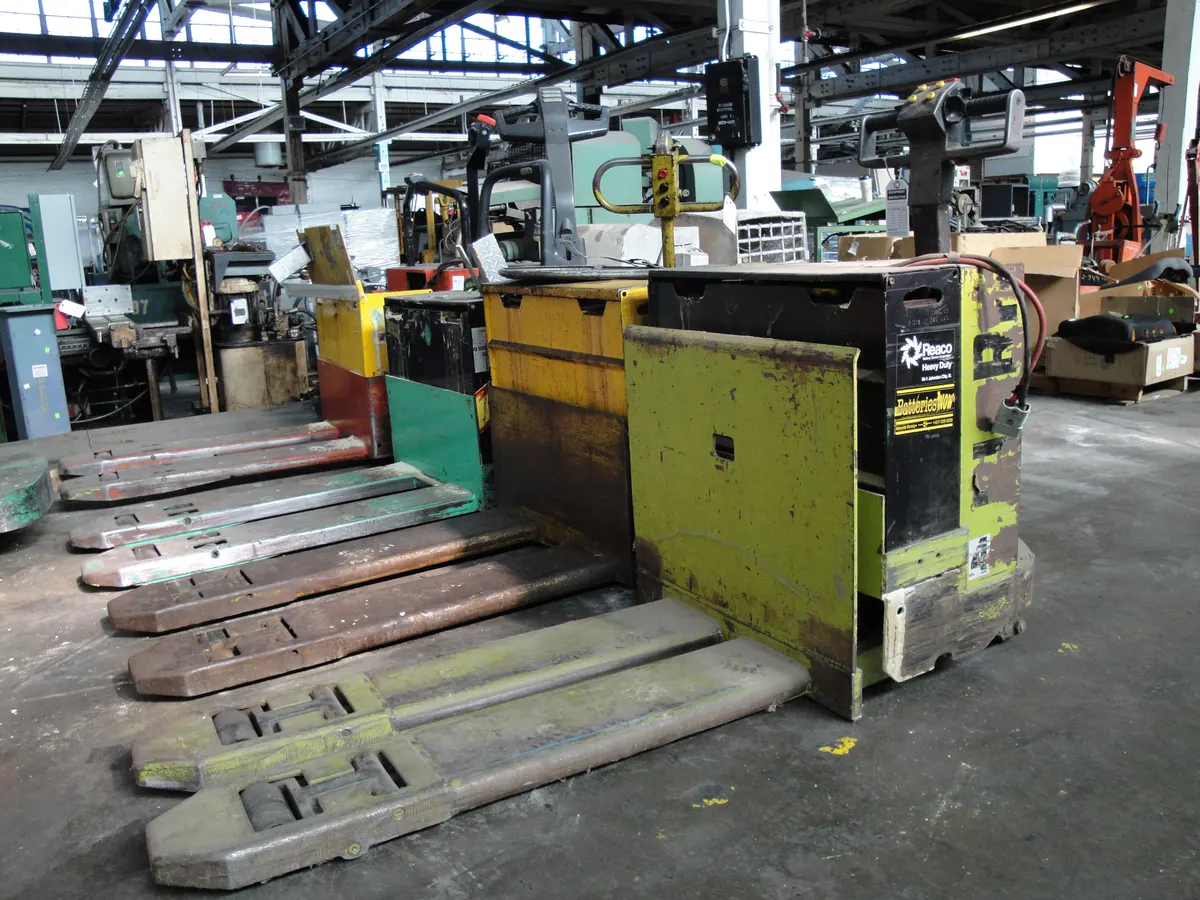
Electric pallet trucks parked in a workshop, one with its recharging lead connected. Pallet trucks lift loads only enough to travel, so they move pallets across docks and floors but do not stack. Photo: Three-quarter-ten, CC BY-SA 3.0, via Wikimedia Commons
Which type fits which operation
Operation
Usual main truck
Why
Watch for
Truck and container loading, yard
Counterbalance forklift
No support legs; drives up to trailers; outdoor tyre and engine options
Wide turning space; exhaust indoors for engine trucks
Selective pallet racking, medium height
Reach truck
Narrower aisles than counterbalance; lifts high
Floor quality; racking and truck specified together
High-bay, maximum pallet positions
VNA or turret truck
Narrowest aisles; travels and lifts together
Floor flatness, rail or wire guidance
Case and item picking from racking
Order picker (low or high level)
Lifts the operator to the pick face
Fall and entrapment controls; operator training
Docks, cross-dock, line feeding
Electric pallet truck
Fast horizontal moves at low cost
No stacking
Small stores, low racking, block stacking
Pedestrian or ride-on stacker
Simple, compact, cheaper than a reach truck
Limited lift height and travel distance
Long loads (pipe, timber, profiles) in aisles
Multi-directional reach truck
Carries long loads sideways down narrow aisles
Specialist training; aisle and racking design
Most warehouses run a mix: counterbalance trucks on the dock, reach or VNA trucks in the racking, pallet trucks for staging. Design the pallet racking, aisle widths, floor and truck fleet as one project, because changing the truck type later usually means moving the racking.
Battery or engine for each type
Warehouse trucks (Class II and III) are electric; that is their design, not an option. SASO's forklift safety guide says electric forklifts should be used in poorly ventilated areas and that adequate ventilation is needed where diesel, petrol or gas forklifts are used, which settles the choice for enclosed stores. The real decisions for a warehouse fleet are the battery technology (see our comparison of lithium-ion and lead-acid forklift batteries) and the charging plan: one battery per truck with opportunity charging, or battery changes for multi-shift work. Jungheinrich lists lithium-ion pallet trucks and stackers alongside lead-acid models. Counterbalance trucks are the only type in this guide where you choose between electric forklifts and engine power.
Specifying the type in an RFQ
Racking drawing: beam levels, top beam height, bay width, pallet size and orientation.
Aisle width available, or the number of pallet positions you need if the layout is not fixed.
Floor: flatness specification or survey, joints, and whether guidance rails or wires can be installed.
Loads: heaviest pallet, load centre, and capacity needed at the top beam.
Operation: pallets in and out per hour, picking method, shifts per day.
Environment: ambient temperature, cold store sections, dust.
Operator: man-up or man-down, rescue arrangements, and type-specific training.
What is the difference between a counterbalance forklift and a reach truck?
A counterbalance forklift carries the load ahead of its front wheels, balanced by weight at the back, so it is long and needs wide aisles but can drive up to trucks and work outdoors. A reach truck moves its mast forward to pick a pallet, then retracts it between its support legs, so it is shorter, turns in narrower aisles and lifts higher, but needs smooth indoor floors.
What are the 7 classes of forklifts?
OSHA's eTool lists: Class I electric motor rider trucks; Class II electric motor narrow aisle trucks; Class III electric motor hand or hand/rider trucks; Class IV internal combustion trucks with solid or cushion tyres; Class V internal combustion trucks with pneumatic tyres; Class VI electric and internal combustion tractors; and Class VII rough terrain forklift trucks. OSHA notes the list does not cover every truck type.
What is a VNA forklift?
A very narrow aisle (VNA) truck, also called a turret truck, stores and retrieves pallets without turning in the aisle, so aisles can be much narrower than for a reach truck. Most use rail or wire guidance in the aisle. Published ranges reach high: Jungheinrich lists its EKX series for lift heights from 3,000 to 18,000 mm. VNA stores need very flat floors and racking designed with the truck.
How high can a reach truck lift?
It depends on the model and capacity. Jungheinrich's UK range, for example, lists reach trucks with lift heights up to 14,000 mm and loads up to 2.5 tonnes, with lighter-duty models to 10,700 mm. Capacity falls as the forks rise, so ask the maker for the capacity chart at your top beam height and load centre rather than relying on the headline figure.
What is the difference between man-up and man-down trucks?
In a man-down truck the operator stays at floor level while the forks rise. In a man-up truck the operator's cab or platform rises with the load, so they can pick cases at height. UK HSE guidance treats trucks that raise the operator to 1,200 mm or more as man-up and lists extra safeguards, such as emergency lowering from the floor and rescue procedures.
When should I use a stacker instead of a reach truck?
Use a stacker for low racking, block stacking and small stores with short travel distances, where its simplicity and lower cost win. Jungheinrich's electric stackers lift up to 4,700 mm. Choose a reach truck when racking is higher, throughput is greater, or the operator will travel long distances during a shift.
When a telehandler beats a forklift and when it does not: boom versus mast, load charts, stabilisers and load moment control, fixed and rotating models, attachments, operator training and Gulf rules.
Lithium-ion or lead-acid for electric forklifts in Gulf warehouses: opportunity charging, what heat does to each, charging room ventilation, lithium safety, total cost drivers and converting existing trucks.
Which licence and certificate a forklift operator needs in Dubai, Abu Dhabi, Sharjah, the other emirates and Saudi Arabia, according to official sources, and where no official rule could be found.