Forklifts in the UAE and Saudi Arabia: Electric vs Diesel, Brands and Operator Rules
How to choose a forklift for UAE and Saudi sites: truck types, capacity and load centre, lithium-ion vs lead-acid vs diesel in Gulf heat, brand groups, inspection and operator rules, and what to put in an RFQ.
To buy the right forklift in the UAE or Saudi Arabia, start from the load and the floor, not the brand: the heaviest pallet and its load centre, the highest rack level, aisle width, and whether the truck works indoors on concrete or outdoors on yards and docks. That decides electric or diesel, counterbalance or reach truck, and tyre type. Then check the rules where it will work, and compare forklift suppliers in the UAE and forklift suppliers in Saudi Arabia on the same specification.
This guide is for warehouse and logistics managers, plant engineers, procurement officers and contractors buying or hiring forklifts and warehouse trucks. It covers truck types, capacity and load centre, power options in Gulf heat and cold stores, tyres, the manufacturer groups behind the main brands, the inspection and operator requirements we could confirm from official UAE and Saudi sources, rent versus buy, and what to put in a request for quotation. We do not quote prices: they move with capacity, mast, battery and import terms, so the section on cost tells you what drives the figure instead.
Which type of forklift do you need?
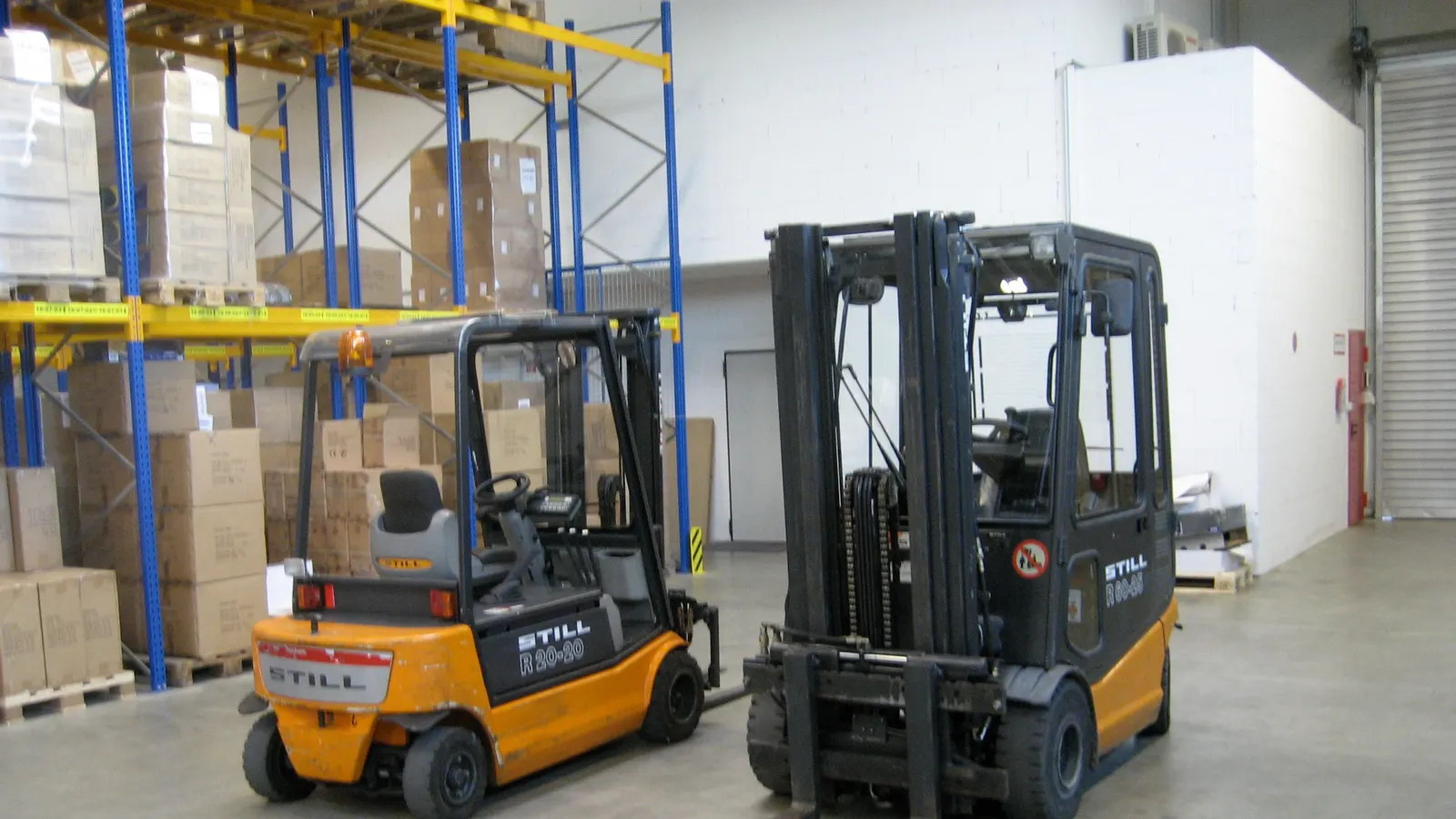
Most buyers choose between a counterbalance forklift, which carries the load in front of the wheels and balances it with weight at the back, and warehouse trucks built for narrow aisles and high racking. Match the truck to the job first.
Truck type
Typical job
Floor and environment
Power
Counterbalance forklift
Loading trucks and containers, yard work, general warehouse moves
Indoor concrete or outdoor yards, depending on tyres
Electric (lead-acid or lithium-ion), diesel or LPG
Reach truck
Putting pallets into and out of racking in narrower aisles
Smooth, level indoor floors
Electric
Very narrow aisle (VNA) truck
High-density racking with very narrow aisles
Smooth, level floors, often with guidance in the aisle
Electric
Order picker
Picking cases or items from racking, with the operator lifted to the shelf
Indoor floors
Electric
Pallet truck or stacker
Short horizontal moves, dock work, low-level stacking
Indoor floors and docks
Manual or electric
High-capacity forklift, container handler or reach stacker
Heavy loads, steel, timber, and containers in ports and terminals
Outdoor yards and quays
Usually internal combustion
If the job is loading and unloading trucks, moving goods across a yard and working a mix of indoor and outdoor ground, a counterbalance truck is usually the answer. If most of the work is storing and retrieving pallets in racking, look at reach trucks and narrow-aisle equipment, and design the trucks and the pallet racking together, because aisle width, beam heights and floor flatness depend on each other. For dock and short-distance moves, pallet trucks are often cheaper to buy and run than a forklift.
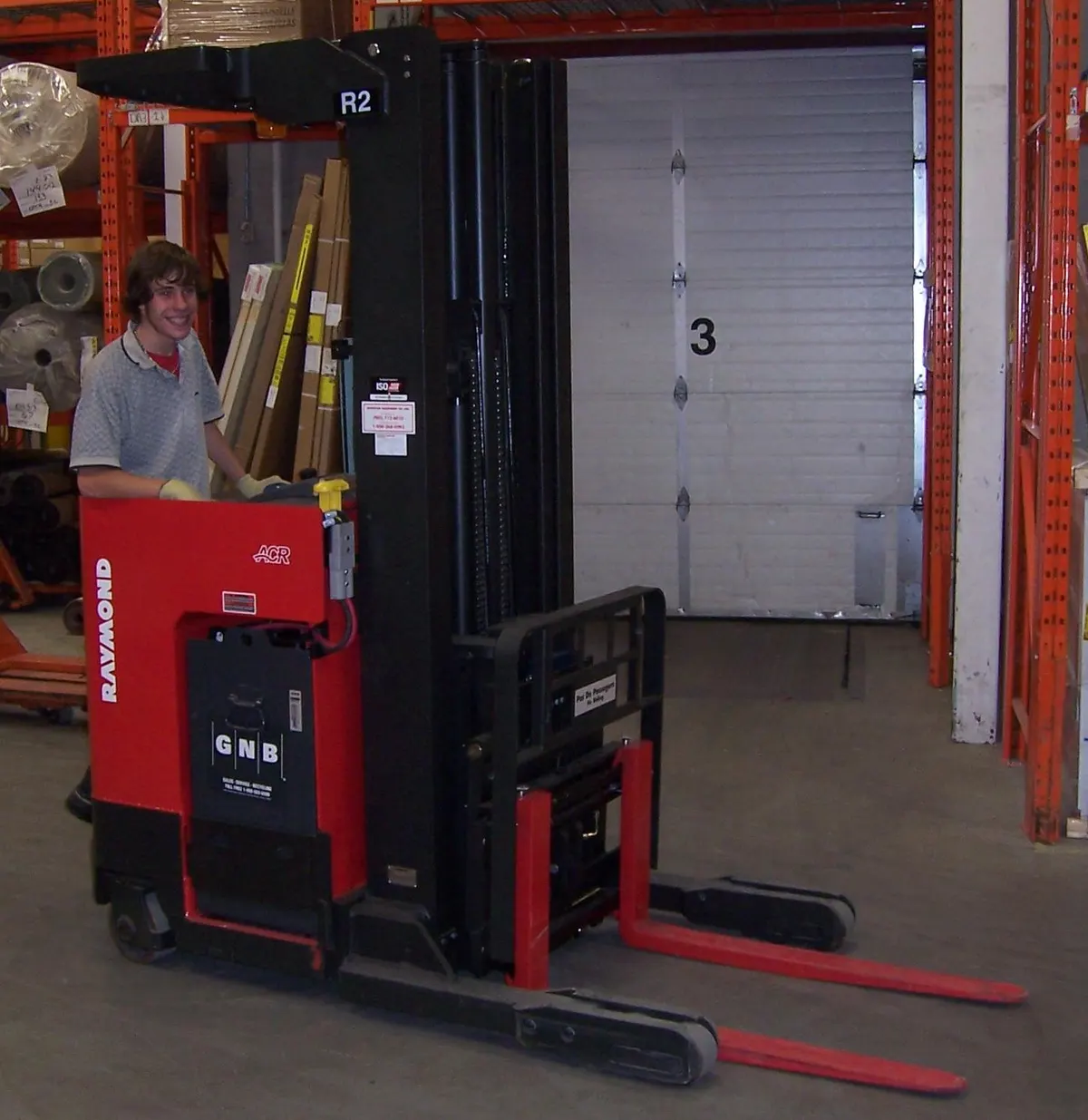
A narrow-aisle reach truck. Reach trucks move the mast or forks forward to place pallets in racking, so they work in narrower aisles than a counterbalance forklift. Photo: Yiddophile, CC BY 3.0, via Wikimedia Commons
Capacity, load centre and lift height
The capacity in a brochure is not the load the truck can carry in your warehouse. The UK Health and Safety Executive's code for rider-operated lift trucks (L117) defines the actual capacity, or safe working load, as the maximum load that can be carried at a set distance from the heels of the forks to a specified height, and says it should be stated on the truck's capacity plate or chart. That distance is the load centre. A deeper or unevenly loaded pallet moves the centre of gravity forward, and lifting higher reduces what the truck can safely hold.
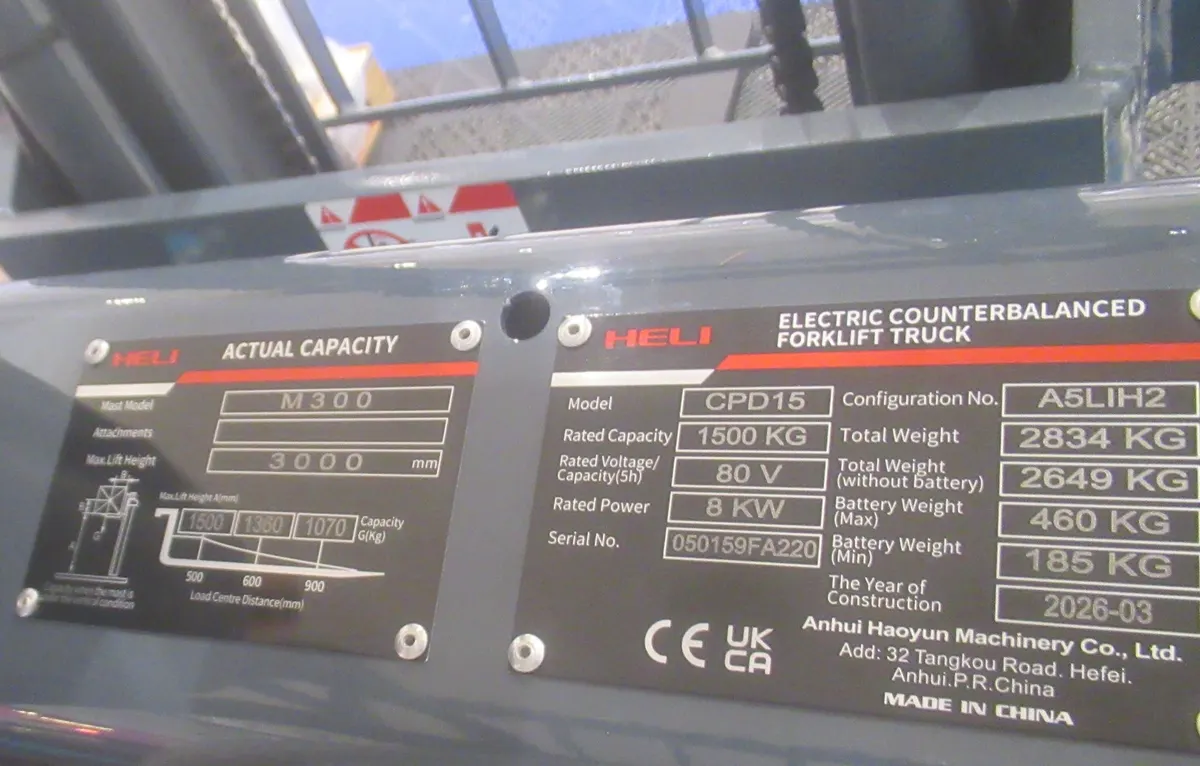
The data and capacity plates of a 1.5 tonne electric counterbalanced forklift. At 3,000 mm lift height the plate gives 1,500 kg at a 500 mm load centre, 1,380 kg at 600 mm and 1,070 kg at 900 mm. Photo: P1898, CC BY 4.0, via Wikimedia Commons
The plate above shows how quickly capacity falls: the same truck that carries 1,500 kg with the load centred 500 mm from the fork heels is rated for 1,070 kg when the load centre moves to 900 mm. So, when you specify a truck, give suppliers:
the heaviest load, its dimensions and where its centre of gravity sits;
the highest level the forks must reach (top beam height plus clearance), and the lowest door or roof height the mast must pass under when lowered;
any attachment you need, such as a side shift, fork positioner, clamp or rotator.
Attachments cost capacity. L117 says fitting an attachment requires a reduction in the truck's actual capacity, called derating, that the manufacturer or authorised supplier should be consulted on the derating, and that a new capacity plate for the attachment should be fitted before the truck is used with it. Ask for the residual capacity with the attachment, at your lift height and load centre, in writing.
Electric or diesel forklift?
Use electric trucks indoors and where exhaust, noise or product contamination matter; use diesel or LPG where the truck works long hours outdoors on rough ground or needs high capacity. Many Gulf sites run both.
Electric: lead-acid or lithium-ion
Electric forklifts produce no exhaust at the point of use, which is why they are the usual choice for warehouses and food handling. The battery is the main decision.
Lead-acid is the traditional choice. Linde advises starting only full charging cycles with lead-acid batteries to protect them, and lists water topping-up among their running costs. The UK HSE's battery safety guidance explains that lead-acid batteries give off hydrogen and oxygen while charging, faster as they approach full charge, and says to charge them in a dedicated, well-ventilated area away from ignition sources. Budget for that charging area, and for spare batteries if you run more than one shift.
Lithium-ion batteries can be charged during short breaks without a battery change. STILL says its lithium-ion batteries are maintenance-free, give off no battery gases, can recover about 60% of capacity in roughly 60 minutes depending on charger and ambient temperature, and are designed for up to 4,000 full charge cycles depending on model. Linde says lithium-ion removes the need for a separate battery room and highlights multi-shift work and refrigerated storage as applications where it helps most.
A heavy lead-acid battery also acts as part of the counterweight in an electric counterbalance truck; STILL notes that the battery's weight matters for the truck's carrying capacity. If you convert an existing truck to lithium-ion, have the manufacturer confirm the capacity plate still applies.
Diesel and LPG
Diesel forklifts suit yards, construction materials, steel, timber and port work, where trucks run long hours outdoors and refuelling is quicker than charging. They produce exhaust, so plan ventilation, or keep them out of enclosed spaces. LPG is the other internal combustion option; Linde, for example, lists gas forklifts alongside diesel. Ask suppliers for the engine model, the emissions standard it meets, and whether service parts and filters are stocked locally.
Gulf conditions: heat, cold stores and dust
Heat is the condition that changes the specification most in the Gulf, and it affects electric trucks through the battery.
Check the battery's rated temperature range against your site. STILL, for example, states that its lithium-ion batteries deliver their rated performance between 0 and +45 °C. Ask every supplier for the rated operating and charging range of the battery they quote, and what the truck does above it (for example, reduced performance or charging cut-off). If the warehouse or yard is not cooled, tell suppliers the summer temperatures the truck will see.
Charge somewhere cooler where you can. Charging location affects both battery life and, for lead-acid, the ventilation needed for hydrogen.
Cold stores need trucks built for them. STILL says use down to -28 °C is possible with an optional low-temperature protection package for its lithium-ion batteries. Trucks moving between a freezer and a hot dock also face condensation, so specify the cold store version rather than a standard truck.
Dust and sand load air filters and radiators on internal combustion trucks and get into electrical connectors. Ask what filtration and cooling options are available and how service intervals change in dusty work.
Tyres: pneumatic, solid or cushion
Choose tyres by the ground the truck runs on. Toyota describes its pneumatic-tyre internal combustion forklifts as "almost exclusively used outdoors", and suited to gravel, dirt and uneven surfaces. It describes cushion-tyre trucks, which have rubber treads on a metal band, as made for smooth indoor floors and not designed for rough outdoor terrain. Ask suppliers which tyre options, including solid tyres, the quoted model accepts.
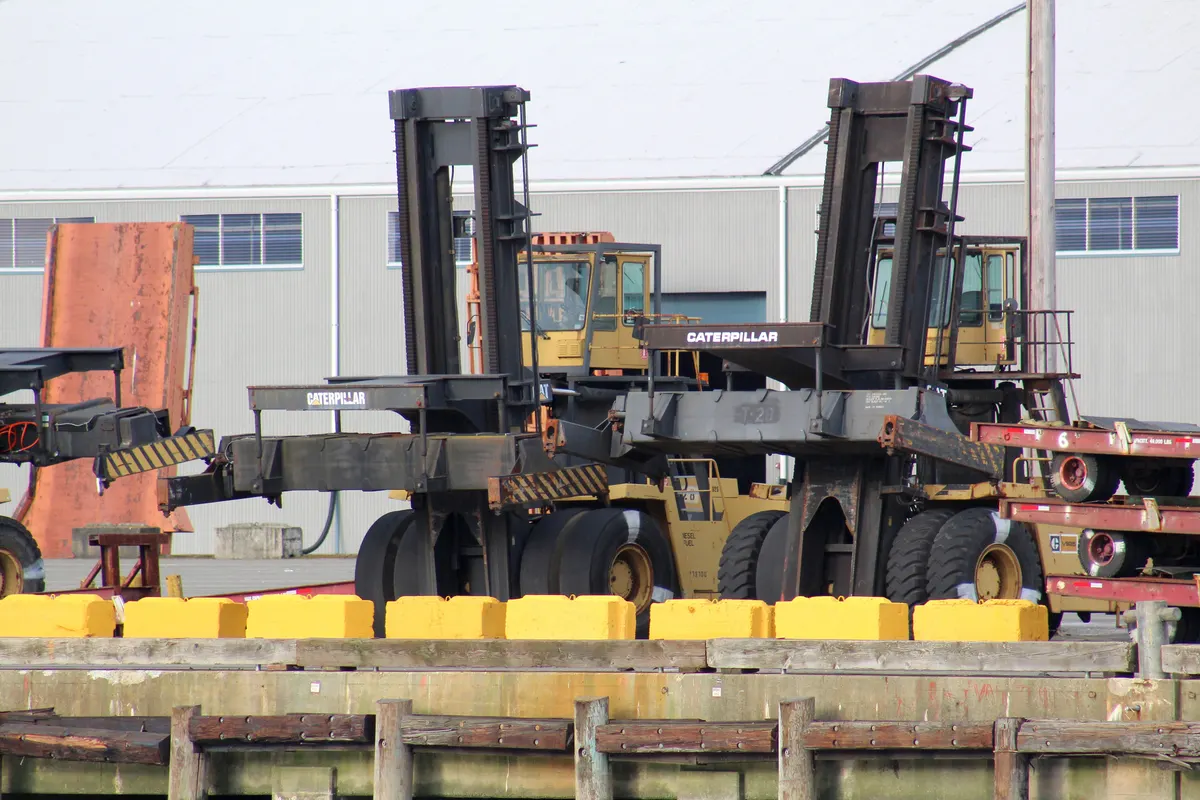
Heavy container-handling lift trucks on the quay at the Port of Tacoma, United States. Port and yard trucks like these are built for outdoor ground and heavy loads, with large tyres and engine power. Photo: Thorsten Lindner, CC BY-SA 4.0, via Wikimedia Commons
Forklift brands and the groups behind them
Several well-known forklift brands belong to the same groups, which matters when you compare quotes, standardise spare parts or deal with a dealer network.
Group
Forklift brands (from the group's own site)
Headquarters
KION Group
Linde Material Handling, STILL, Baoli, Fenwick, OM
Toyota Material Handling is the materials handling business of Toyota Industries, which lists Toyota and Raymond as its materials handling brands. Toyota's range includes pneumatic and cushion tyre internal combustion forklifts, with pneumatic models it rates from 3,000 to 125,000 lb (roughly 1.4 to 57 tonnes). It suits buyers who want one maker for counterbalance and warehouse trucks.
Linde Material Handling and STILL
Linde Material Handling and STILL are both KION Group brands. KION describes Linde as one of the world's leading makers of forklift and warehouse trucks; Linde's own range covers electric, diesel, gas and heavy-duty forklifts, reach trucks, VNA trucks, order pickers, pallet trucks and explosion-proof trucks. KION says STILL makes forklifts and warehouse equipment and has a strong presence in Europe, the Middle East, Africa and South America, and STILL's website lists both Saudi Arabia and the United Arab Emirates among its country sites.
Hyster and Yale
Hyster and Yale are brands of Hyster-Yale Materials Handling. Hyster's range runs from pallet trucks, reach trucks and VNA trucks to high-capacity forklifts and the container handlers and reach stackers it builds for ports and terminals, with lead-acid, lithium-ion, hydrogen fuel cell and internal combustion power. Yale offers a similar spread, with a strong warehouse range (reach trucks, order pickers, VNA and pallet trucks) plus internal combustion, high-capacity and rough-terrain trucks.
Mitsubishi Forklift Trucks and Cat Lift Trucks
Mitsubishi Forklift Trucks and Cat Lift Trucks are both brands of Logisnext, the Japanese company formerly called Mitsubishi Logisnext, which relaunched under its new name on 30 April 2026 under the investment firm Japan Industrial Partners. Logisnext says it sells and services forklifts in over 100 countries from 12 factories, and lists its Netherlands company as the sales contact for Europe, the CIS and the Middle East for both brands.
Jungheinrich
Jungheinrich, headquartered in Hamburg, makes industrial trucks and warehouse automation, including electric counterbalance forklifts, and says it helped shape the move to lithium-ion batteries in material handling. It suits warehouse operators who want trucks, automation and services from one supplier.
Crown
Crown Equipment makes pallet trucks, stackers, sit-down and stand-up electric counterbalance forklifts, internal combustion counterbalance forklifts, reach trucks and man-up order pickers including turret trucks, and sells its own batteries and chargers.
Heli
Heli is a Chinese forklift brand. The capacity plate shown earlier in this guide is from a Heli CPD15, a 1.5 tonne electric counterbalanced forklift with an 80 V lithium-ion system, made in Hefei, Anhui province.
Other brands with ListGCC supplier pages include Komatsu, Hyundai, Doosan, Clark and Hangcha. Whatever the brand, compare the dealer's workshop, parts stock and response time in your city.
Forklift rules in the UAE
Workplace safety rules for forklifts in the UAE are set at emirate level, and we could only confirm published codes for Sharjah. Do not assume Sharjah's rules apply in Dubai, Abu Dhabi or the northern emirates.
Sharjah
The Sharjah Prevention and Safety Authority publishes codes of practice that set the minimum acceptable requirements of Sharjah's occupational safety and health system. Two are relevant to forklift users:
OSHJ-CoP-10, Safe Selection and Use of Lifting Equipment (Version 2, July 2024) requires lifting equipment to be thoroughly examined and tested by a third party before first use and at least every 12 months; periodically at least every 6 months for equipment lifting people and every 12 months for equipment lifting goods, or under an examination scheme by a competent person. It also requires pre-use checks as per the manufacturer's manual, recorded inspections, and records of operator certificates and third-party certification. The code defines lifting equipment as equipment used to lift and lower loads but does not name forklifts, so confirm with your HSE adviser how your trucks are treated.
OSHJ-CoP-21, Mobile Plant (Version 2, September 2024) covers self-propelled equipment controlled by an operator, whether owned or leased. It tells entities to validate operators' training certification when recruiting and periodically afterwards, to provide medical examinations including eyesight, to separate people and plant on travel routes, and says plant not designed, licensed and insured for public roads must not be used on them.
Dubai, Abu Dhabi and the other emirates
We could not confirm forklift inspection or operator licensing requirements for Dubai, Abu Dhabi or the other emirates from an official source for this guide. Job adverts often ask for a particular local forklift licence, but adverts are not regulations. Before you put a truck or an operator to work, ask the relevant authority, your free zone or your client's HSE team which inspection certificate and operator certificate they accept. If you buy cranes as well, our overhead crane buying guide covers lifting equipment inspection in more detail.
Forklift rules in Saudi Arabia
In Saudi Arabia forklifts are regulated products. SASO's Technical Regulation for Machinery Safety, Part 3: Lifting Equipment (approved 14 October 2021, published in the Official Gazette on 17 December 2021) lists "fork-lift trucks, trucks fitted with lifting or handling equipment" under customs code 8427 among the products it covers, and notes that the product list on the SABER platform is the updated version. Under the regulation:
the supplier placing equipment on the market must obtain a certificate of conformity issued by SASO or a body it authorises;
a supplier of used lifting equipment must obtain an inspection certificate from a SASO-approved notified body;
an inspection certificate from a SASO-approved notified body is required after installation and before the equipment is put into service, and periodic examinations and inspections must be carried out while it is in use;
labels and data must be in Arabic, with another language optional;
operators must have the expertise and competence to operate the equipment, keep documents that prove it, and obtain the necessary licences from the competent authorities.
The regulation does not name the authority that issues operator licences, so confirm that with your employer, client or a training provider before deployment. Its Annex 1 references the industrial truck standards suppliers must meet, including the ISO 22915 series on stability (Part 2 covers counterbalanced trucks with mast, Part 3 reach and straddle trucks), ISO 2330 on fork arms and ISO 5057 on inspection and repair of fork arms in service. Only the Arabic text is legally authentic. Importers and dealers handle the SABER certificates, but as a buyer you should ask to see them before delivery, especially for used trucks.
Inspection and operator training: practical steps for both countries
Where the local rules are not spelled out, many sites work to the same principles. The UK's L117 code, for example, says a lift truck should be thoroughly examined by a competent person within the previous 12 months (6 months for equipment used to lift people), that the examiner would be a qualified engineer or similar, and that operators need basic training, job-specific training and familiarisation with the truck they will use. It also notes there is no fixed period after which refresher training must be given. Use it as a reference for good practice, not as the law in the Gulf.
Keep the capacity plate, operator manual and inspection certificate with each truck.
Run documented pre-use checks every shift.
Book periodic third-party examinations, and an examination after major repairs or changes such as a new attachment.
Train operators on the specific truck type: a counterbalance forklift licence does not prepare someone for a reach truck or order picker.
Separate pedestrians from trucks with marked routes and barriers.
Should you rent or buy a forklift?
Rent when the need is short or uncertain: a project, a seasonal peak, a new site whose volumes are unknown, or while you wait for a new truck. Forklift rental usually bundles maintenance and replacement trucks, and moves inspection and breakdown risk to the rental company; confirm that in the contract and ask who provides the operator. Buy when the truck will work most shifts for years, when you need a specific mast, attachment or cold store build, or when you want to control the fleet. Long-term rental and lease agreements sit in between.
What drives the purchase price: capacity and mast height; power type, with lithium-ion batteries and chargers adding cost but removing spare batteries and charging rooms; attachments; cab, cooling or cold store packages; warranty and service contract length; and import duties and certification. Compare quotes on total cost over the expected life, including energy or fuel, tyres, batteries, service and downtime, not purchase price alone.
Forklift RFQ checklist
Application: indoor, outdoor or both; floor type; ramps; container or truck loading; cold store or hazardous area.
Load: maximum weight, dimensions, load centre, pallet type.
Lift: maximum fork height, lowered mast height limit, free lift needed (for containers and doorways).
Truck type and capacity at your load centre and lift height, plus residual capacity with each attachment.
Power: electric (lead-acid or lithium-ion, with charger, battery temperature range and expected shifts) or diesel/LPG (engine model and emissions standard).
Tyres: pneumatic, solid or cushion, and non-marking if required.
Gulf options: cab and cooling, filtration, lighting, warning devices.
Compliance: in Saudi Arabia, SASO/SABER conformity and inspection certificates; in the UAE, the inspection certificate your emirate, free zone or client requires; operator training offered.
Service: warranty, preventive maintenance plan, parts availability, response time, replacement truck during repairs.
Commercial: purchase, rental or lease terms, delivery time, training and handover.
Forklift Types: Counterbalance, Reach Truck, VNA and Pallet Trucks: How counterbalance forklifts, reach trucks, VNA turret trucks, order pickers, pallet trucks and stackers work, what lift heights makers publish, what VNA stores need from the floor, and which type fits which job.
Telehandler vs Forklift: Which for Construction Sites and Yards?: When a telehandler beats a forklift and when it does not: boom versus mast, load charts, stabilisers and load moment control, fixed and rotating models, attachments, operator training and Gulf rules.
Lithium-Ion vs Lead-Acid Forklift Batteries in Hot Warehouses: Lithium-ion or lead-acid for electric forklifts in Gulf warehouses: opportunity charging, what heat does to each, charging room ventilation, lithium safety, total cost drivers and converting existing trucks.
Frequently asked questions
How much does a forklift cost in the UAE or Saudi Arabia?
Price depends on capacity, mast height, power type, battery, attachments, cab and cooling options, warranty, service package and import costs, so a 3 tonne diesel truck and a 3 tonne lithium-ion electric truck can differ widely. Ask several suppliers to quote the same specification, and compare total cost over the truck's working life, including fuel or electricity, tyres, batteries, service and downtime, rather than the purchase price alone.
Is an electric or diesel forklift better for Gulf conditions?
Electric forklifts are the usual choice indoors, in food handling and in cold stores, because they produce no exhaust at the point of use. Diesel suits long outdoor shifts on rough ground, ports and heavy loads. In hot sites, check the battery's rated temperature range: STILL, for example, rates its lithium-ion batteries for 0 to +45 °C. Ask each supplier what happens above the rated range.
Do forklifts need SASO certification in Saudi Arabia?
Yes. SASO's Technical Regulation for Machinery Safety, Part 3: Lifting Equipment lists fork-lift trucks (customs code 8427) among covered products. The supplier must obtain a certificate of conformity from SASO or a body it authorises, used equipment needs an inspection certificate from a SASO-approved notified body, and equipment needs an inspection certificate before being put into service, with periodic inspections after that.
Do forklift operators need a licence in the UAE?
It depends on the emirate, and we could only confirm published rules for Sharjah. Sharjah's Mobile Plant code requires employers to validate operators' training certification when recruiting and periodically afterwards, and its lifting equipment code requires records of operator certificates. For Dubai, Abu Dhabi and the other emirates, confirm the accepted certificate with the relevant authority, your free zone or your client before work starts.
How often must a forklift be inspected?
In Sharjah, the lifting equipment code requires third-party thorough examination before first use and at least every 12 months for equipment lifting goods, or every 6 months for equipment lifting people, unless an examination scheme by a competent person sets other intervals. Saudi Arabia's SASO regulation requires periodic examinations and inspections but the regulation text does not fix an interval. Daily pre-use checks apply everywhere.
What is a forklift load centre?
The load centre is the distance from the heels of the forks to the load's centre of gravity. A truck's actual capacity is stated at a specific load centre and lift height on its capacity plate. Move the load centre further out, lift higher or fit an attachment and the safe load falls, so always check the plate, not the headline capacity.
What is the difference between a forklift and a reach truck?
A counterbalance forklift carries the load ahead of its front wheels, balanced by weight at the rear, and can work indoors and, with the right tyres, outdoors. A reach truck is an electric warehouse truck that moves its mast or forks forward to reach into racking, so it turns in narrower aisles and lifts high, but it needs smooth, level indoor floors.
Should I rent or buy a forklift?
Rent for short projects, seasonal peaks or uncertain volumes, since rental usually includes maintenance and replacement trucks. Buy when a truck will work most shifts for several years or needs a special mast, attachment or cold store build. Long-term rental or leasing suits fleets that want fixed monthly costs without owning the trucks.
When a telehandler beats a forklift and when it does not: boom versus mast, load charts, stabilisers and load moment control, fixed and rotating models, attachments, operator training and Gulf rules.
Lithium-ion or lead-acid for electric forklifts in Gulf warehouses: opportunity charging, what heat does to each, charging room ventilation, lithium safety, total cost drivers and converting existing trucks.
How counterbalance forklifts, reach trucks, VNA turret trucks, order pickers, pallet trucks and stackers work, what lift heights makers publish, what VNA stores need from the floor, and which type fits which job.