Home Lifts for Villas: Types, Space, Approvals and Cost Drivers
How to choose a home lift for a villa in the UAE or Saudi Arabia: compact traction lifts versus platform lifts, shaft, pit and power needs, the rules that apply and what drives the cost.
A home lift for a villa is either a compact traction lift (a small version of a building elevator, travelling faster than 0.15 m/s in its own shaft) or a platform lift (slower, often self-supporting, built for short rises and step-free access). In Dubai, a villa lift must follow the Dubai Building Code's lift safety and energy clauses; in Saudi Arabia, check which SASO regulation covers the model. Installers and service companies are listed under elevator and escalator maintenance.
This spoke is for villa owners, developers, architects and fit-out contractors choosing a lift for a private house in the UAE or Saudi Arabia. It covers the two lift families, the space each needs, power supply, the rules in Dubai and Saudi Arabia, maintenance and the cost drivers. For lift types in larger buildings, codes and the main manufacturers, see our main guide to elevators and escalators in the UAE and Saudi Arabia. ListGCC has not tested any of the products named; specifications come from the makers' own pages.
Traction home lift or platform lift: which do you need?
The answer depends mostly on how many floors you serve, how fast you want to travel and whether you can build a pit and a full shaft.
Compact traction home lift
Platform lift (home lift under EN 81-41)
Standard family
Passenger lift rules (EN 81-20, now EN ISO 8100-1), which apply above 0.15 m/s
EN 81-41:2024, vertical lifting platforms, speed not above 0.15 m/s
Car
Fully enclosed car with doors
Carrier not completely enclosed; the liftway is enclosed
Typical maker figures
TK Elevator enta villa: 400 kg, 0.4 m/s, up to 18 m, 6 cm pit. KONE MonoSpace Home: up to 30 m travel and 6 floors
TK Elevator H100 homelift: 50 mm floor recess, 2,430 mm height. Aritco HomeLift Compact: 2 persons or 250 kg, 2 to 6 floors
Shaft
Builder's shaft (masonry or concrete) sized to the lift
Can be installed with or without a builder's shaft (TK Elevator homelifts)
Power
Some run on household single-phase supply (enta villa at 220 V)
Check the maker's requirement
Best fit
Villas with several floors, daily use by the whole family, faster trips
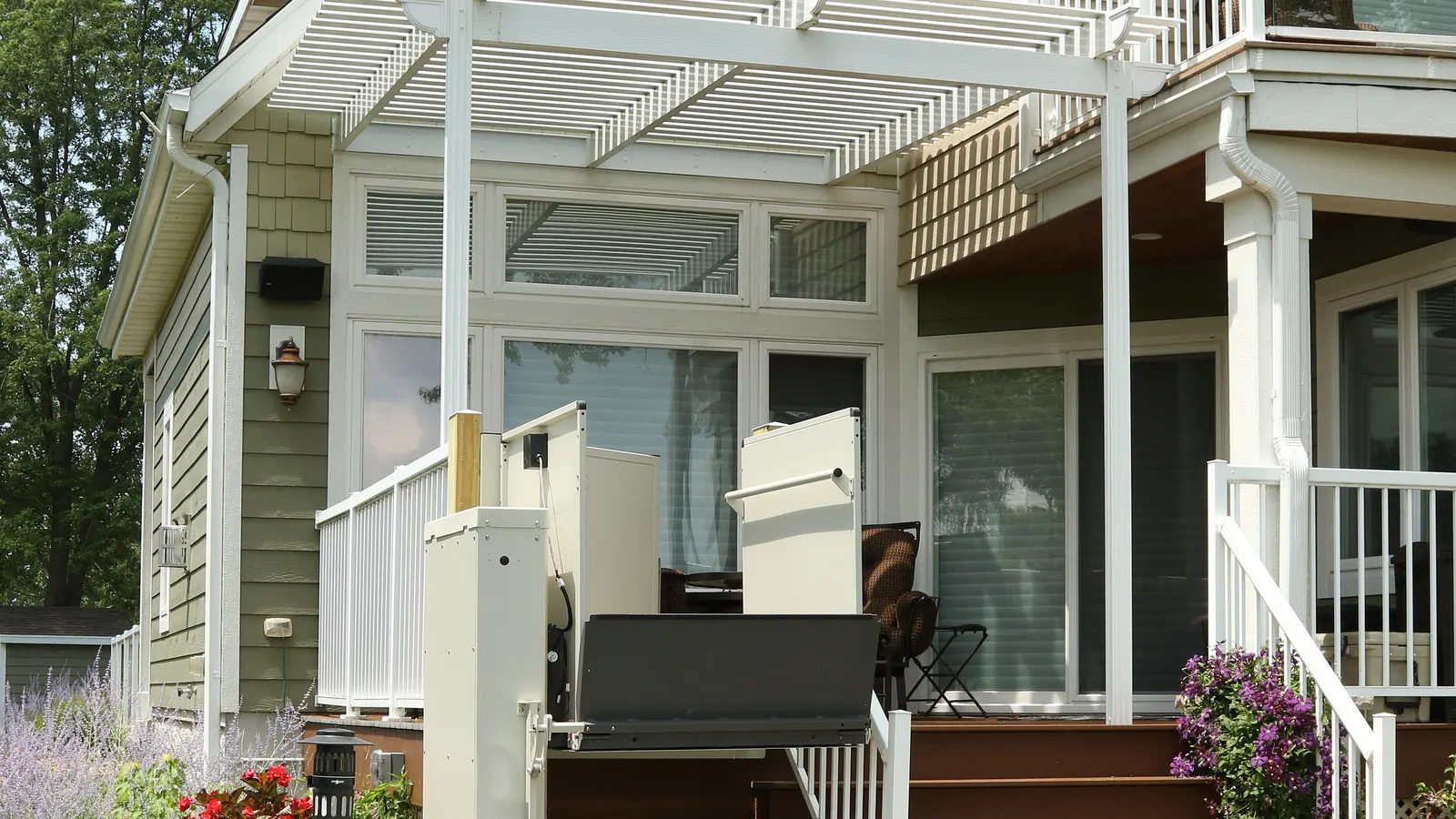
Short rises, retrofits, step-free access for a wheelchair user
Both are legitimate home lifts; the difference is the standard they are built to. EN 81-41:2024 defines a vertical lifting platform as an electrically powered platform fixed to a building, intended for persons with impaired mobility with or without a wheelchair, moving between set levels along a guided path inclined no more than 15 degrees from the vertical, at a speed not greater than 0.15 m/s. Anything faster is a passenger lift: ISO 8100-1:2026 applies to lifts with a rated speed above 0.15 m/s.
The speed difference is easy to underestimate. A platform at 0.15 m/s takes 20 seconds to rise 3 m; a traction home lift at 0.4 m/s takes under 8 seconds. For a two-storey villa the slower lift may be fine; for a basement-to-roof trip across five levels the faster lift saves real time every day.
KONE lists the MonoSpace Home on its UAE site as a machine-room-less home elevator for residences and villas, with up to 30 m of travel and up to 6 floors. KONE says it runs on standard household power and includes a backup power function, with the electrical requirements confirmed by a KONE specialist during planning.
TK Elevator enta villa and homelifts
TK Elevator UAE lists the enta villa for multi-floor houses and villas: maximum load 400 kg, maximum speed 0.4 m/s, maximum height 18 m, a pit of just 6 cm and a 220 V single-phase household supply. Its separate homelift range, which includes the H100 with a 50 mm floor recess and a height of 2,430 mm, can be fitted with or without an elevator shaft and is offered for indoor or outdoor use.
Otis, Schindler and Mitsubishi Electric
Otis has a Gen2 Home model; a Sobha Realty order for Dubai announced through Zawya included 52 Gen2 Home units. Schindler's group site lists the Schindler X8 home elevator. Mitsubishi Electric makes elevators and escalators for buildings through Mitsubishi Electric Building Solutions; ask its local partner whether a villa model is offered in your country.
Platform lift specialists
Specialist home lift makers build platform lifts to EN 81-41. Aritco, for example, lists the HomeLift Compact for 2 persons or 250 kg, serving 2 to 6 floors, with a smallest outer footprint of 840 x 880 mm, and the HomeLift Access for loads up to 500 kg. It quotes a 5-year warranty on residential indoor lifts and 10 years on the screw and nut assembly, which indicates a screw and nut drive rather than ropes.
How much space does a villa lift need?
Plan for four dimensions before the structure is fixed:
Shaft plan size. Set by the car size, the door and the drive. Platform lifts can be very compact (Aritco's smallest outer size is 840 x 880 mm); a wheelchair needs more. Dubai's accessibility part sets a minimum platform access width of 900 mm and a clear landing of 1,500 x 1,500 mm in front of a lift platform.
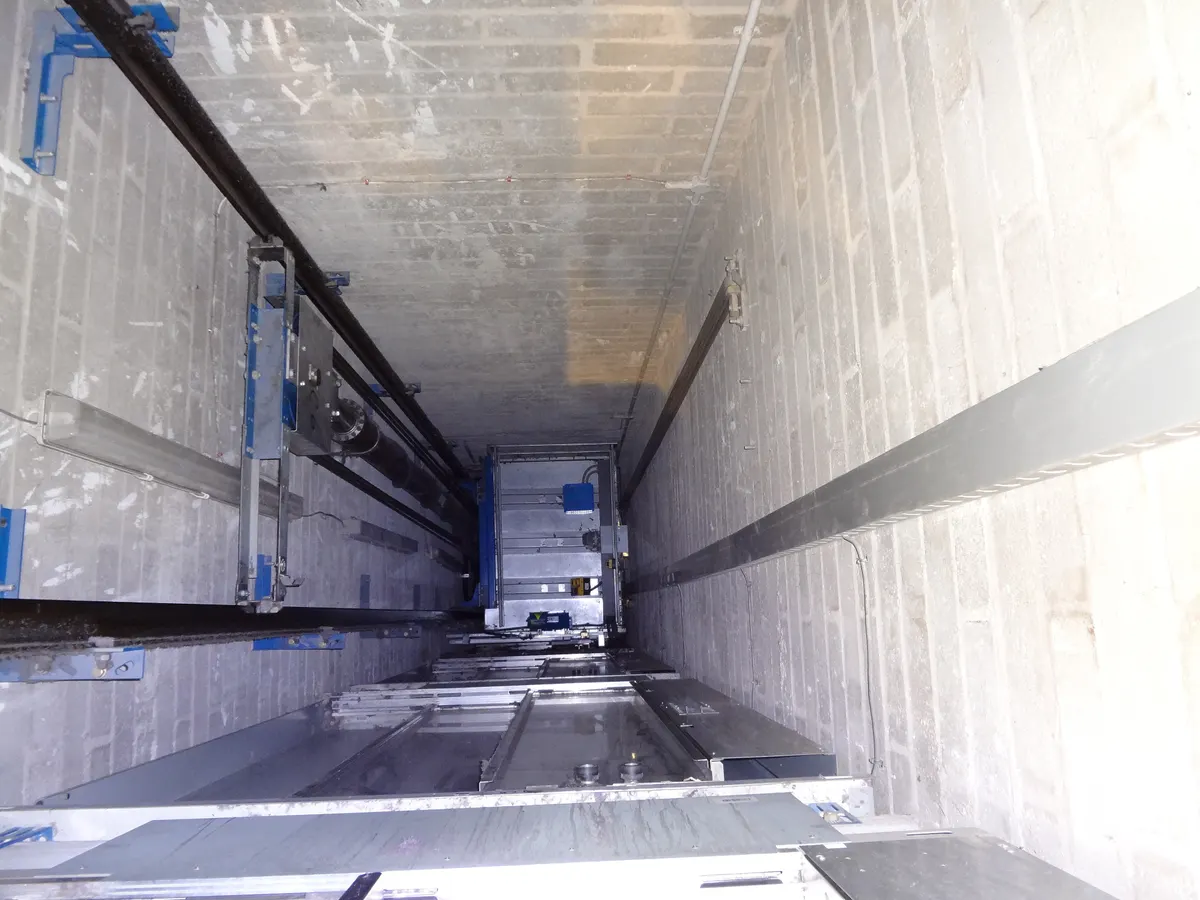
Pit. The depth below the lowest floor. Some villa products need almost none: TK Elevator quotes 6 cm for the enta villa and a 50 mm floor recess for the H100. Ask for the pit drawing, because a deeper pit means waterproofing and structural work in the basement slab.
Headroom. The clear height above the top floor. A roof-level lift room in a Dubai villa is excluded from the 1.5 m roof setback, but it counts towards the rule that roof structures cannot exceed 50 percent of the roof area (Dubai Building Code, Part K).
Travel and stops. Count every level including basement and roof. KONE lists up to 6 floors for the MonoSpace Home; Aritco lists 2 to 6 floors for the HomeLift Compact.
For an open or half-height platform (one whose enclosure reaches only halfway up the cabin), Dubai's lift platform rules cap the travel at 3,000 mm in private housing and 2,000 mm in public buildings. Above that, specify a fully enclosed platform or a traction home lift.
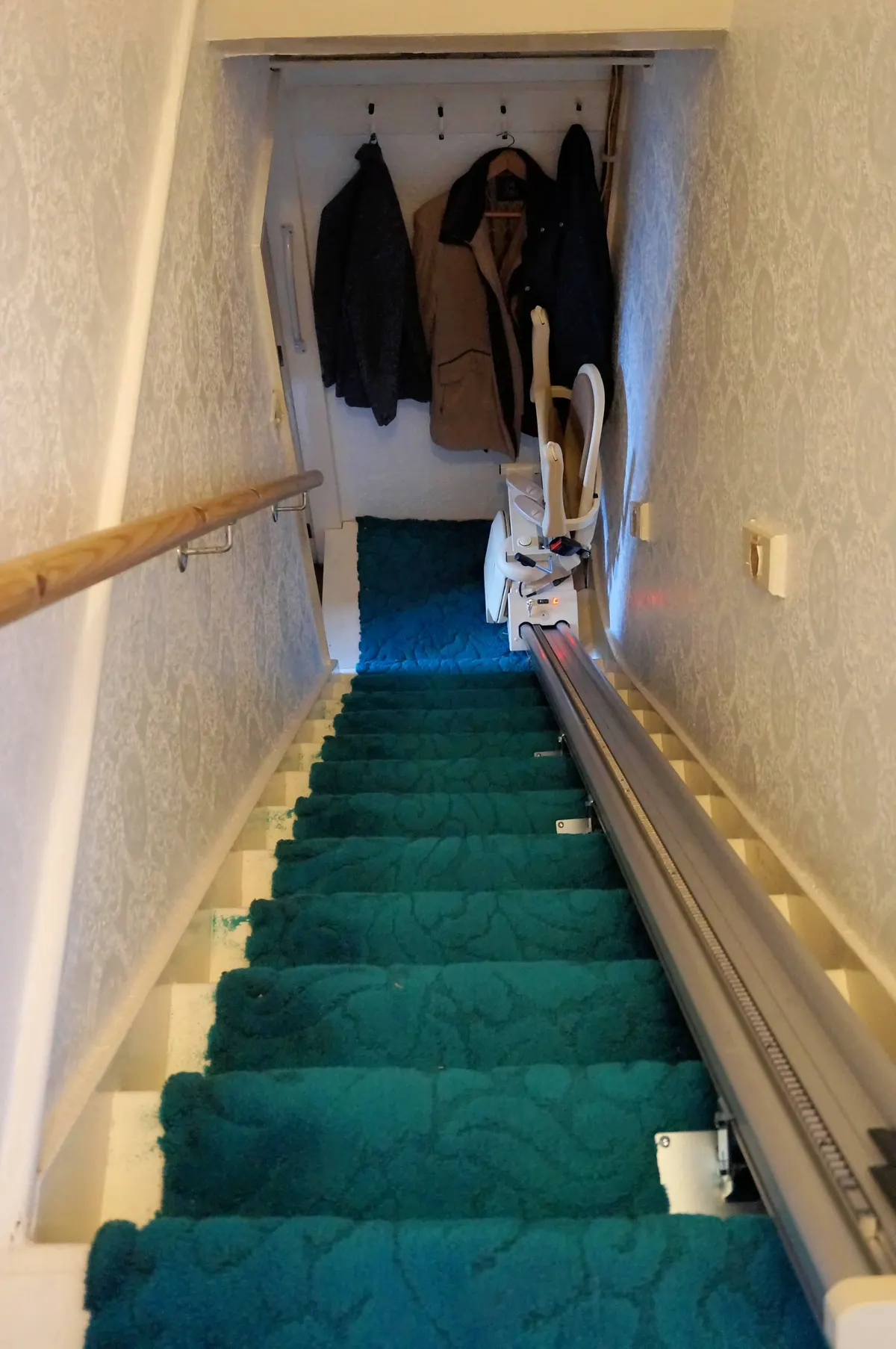
For one person who has difficulty with stairs in an existing house, a stairlift or inclined platform can avoid building a shaft. These products are covered by EN 81-40 (stairlifts and inclined lifting platforms intended for persons with impaired mobility), which the Dubai Building Code lists among its references. They suit a single flight and a single user; they do not replace a lift for a family moving between several floors.
What rules apply to a home lift in the UAE?
Dubai design rules. Part K of the Dubai Building Code (Villas) says: "If elevators are provided, their design shall conform to D.5 and D.6." D.5 requires the lift to be designed, installed, tested, commissioned and maintained to either the ASME A17 suite or the BS EN 81 suite, chosen once for the project. D.6 sets energy features for traction lifts in new buildings: a VVVF drive, lighting that switches off after no more than 5 minutes of inactivity and a standby mode.
Building permit. The lift shaft, any pit and any roof lift room are part of the villa drawings, so the consultant should show them in the permit submission.
Accessibility rules in Part C govern multi-occupancy buildings and state that they do not apply to individual villas, though the lift platform travel limit above names private housing.
Maintenance. Abu Dhabi Civil Defence's AED 5,000 fine for lifts without an accredited maintenance contract, reported in August 2026, excludes independent private houses. That is not a reason to skip maintenance; it only means the fine does not apply to a private villa.
Dubai Municipality's annual third-party lift certification rule (DM-HSD-GU48-ECLA2) is written for factories, construction sites, hotels and other workplaces. For a private villa, ask the installer what inspection it arranges at handover and how often it recommends a third-party check.
What rules apply to a home lift in Saudi Arabia?
SASO's Technical Regulation for Electrical Lifts Used in Buildings and Facilities applies to "electrical lifts prepared for public use in buildings and facilities" and excludes "lifts with controlled speed which equals or less than 0.15 meter/ second". Two consequences:
A platform lift at 0.15 m/s or less sits outside that regulation. Ask the supplier which SASO technical regulation and SABER certificate the product is imported under, and keep the certificate.
A faster traction home lift is the kind of product the regulation governs, with a Certificate of Conformity for the lift and its safety components, a technical file, labels in Arabic or Arabic and English, an installation inspection by a SASO-accepted inspection body and annual inspection for lifts within scope. Whether a private villa lift counts as "prepared for public use" is a question to put to the supplier and the competent authority in writing before you order.
Whatever the scope, the regulation's safety content is a sensible minimum for a home: a device that stops the car from falling or moving uncontrolled on a power failure, buffers, a means of releasing trapped occupants, two-way communication with a rescue service, emergency lighting that works without mains power, and ventilation for a prolonged stop. Put these in the specification. Saudi buyers can find installers and service companies under elevator and escalator maintenance in Saudi Arabia.
Power supply and backup
Ask for the electrical requirement before the villa's distribution board is designed. TK Elevator states 220 V single-phase for the enta villa; KONE says the MonoSpace Home runs on household power, with specifics confirmed at planning. For any home lift, ask what happens in a power cut: whether the car returns to a floor on battery and opens its doors, how long the alarm and lighting run, and who answers the alarm call. If the villa has a standby set, coordinate the lift's supply with the diesel generator or UPS design.
What drives the cost of a villa lift?
Makers do not publish UAE or Saudi price lists, and quotes vary with scope, so compare like with like. The main cost drivers:
Lift family: platform lift or traction home lift.
Number of stops, travel height and speed.
Car size, especially if it must take a wheelchair and an attendant.
Shaft: builder's work shaft versus a self-supporting enclosure, glass or panoramic finishes.
Pit and headroom works, waterproofing and any structural changes in an existing villa.
Indoor or outdoor installation and its weather protection.
Doors (manual swing or automatic sliding) and car finishes.
Backup power, remote alarm connection and monitoring.
Warranty length and the maintenance contract after handover.
Maintenance for a home lift
A home lift still has safety gear, doors, a drive and an alarm that need regular service. Ask for the visit frequency, what each visit checks, the entrapment response time and the price of the contract from year two, before you sign the supply contract. Our spoke on elevator maintenance contracts lists what a good AMC covers. Villa owners who already use a facilities company may find lift cover offered within building maintenance services.
Villa lift RFQ checklist
Number of stops, floor-to-floor heights and total travel, including basement and roof.
Users: family, elderly residents, wheelchair user, domestic staff; required car size and load.
Lift family required (EN 81-41 platform or EN 81-20 / EN ISO 8100-1 traction lift) and the certificate offered.
Available pit depth, headroom and shaft plan size, with drawings.
Indoor or outdoor, and exposure to sun, dust and rain.
Power supply available (single-phase or three-phase) and backup arrangement.
Door type, finishes and any glass shaft.
For Saudi Arabia: the SASO regulation and SABER certificate the product is supplied under.
Handover inspection, warranty, maintenance price and response time.
What is the difference between a home lift and a platform lift?
A platform lift is one kind of home lift. It is built to EN 81-41, travels at no more than 0.15 m/s and has a carrier that is not completely enclosed. A traction home lift is a small passenger lift built to the passenger lift standard, which applies above 0.15 m/s, with a fully enclosed car. TK Elevator's enta villa, for example, travels at up to 0.4 m/s.
How deep does the pit need to be for a villa lift?
It depends on the model. TK Elevator quotes a pit of just 6 cm for its enta villa and a 50 mm floor recess for its H100 homelift, so some products need almost no pit. Others need a deeper pit with waterproofing. Ask each bidder for the pit, headroom and shaft drawing before the villa structure is designed, because changing the slab later is expensive.
Do I need approval to install a lift in a Dubai villa?
The Dubai Building Code says that if elevators are provided in a villa, their design shall conform to its lift safety and energy clauses (D.5 and D.6). The shaft, pit and any roof lift room form part of the villa drawings submitted for the building permit, so include the lift from the design stage. Ask your consultant how the lift appears in the submission.
Can a home lift run on a normal household electricity supply?
Some can. TK Elevator says the enta villa uses a 220 V single-phase household supply, and KONE says the MonoSpace Home operates on standard household power, with the exact requirements confirmed during planning. Always get the electrical requirement in writing before the distribution board and cabling are designed, and ask how the lift behaves during a power cut.
Is a maintenance contract required for a lift in a private villa?
Abu Dhabi Civil Defence's fine for buildings without an accredited lift maintenance contract excludes independent private houses, according to August 2026 reports. Even where no fine applies, a home lift has safety gear, doors and an alarm that need regular checks, so most makers offer a service contract. Agree its price and response time before you buy the lift.
How many floors can a villa lift serve?
Maker figures vary. KONE lists up to 6 floors and 30 m of travel for the MonoSpace Home; TK Elevator lists a maximum height of 18 m for the enta villa; Aritco lists 2 to 6 floors for its HomeLift Compact. In Dubai, an open or half-height platform lift in private housing is limited to 3,000 mm of travel.
Five elevator makers side by side for Gulf buyers: origin, product lines from villa lifts to super high-rise, escalators, UAE and Saudi entities, maintenance and modernisation offers.
A buyer guide to elevators and escalators in the UAE and Saudi Arabia: lift types, EN 81 and the 2026 EN ISO 8100 change, Dubai and SASO rules, firefighting lifts, the main makers and maintenance.
What to put in an elevator AMC in the UAE and Saudi Arabia: contract levels, legal maintenance and inspection duties, response times, spare parts, records, KPIs and handover terms.