Elevator Codes in the UAE and Saudi Arabia: EN 81-20, Fire Lifts and Inspections
The lift standards and approvals that apply in the UAE and Saudi Arabia: EN 81-20 and the move to EN ISO 8100, firefighting lifts, accessibility, Dubai and SASO certification and inspection.
Elevators in the UAE and Saudi Arabia are built to the European EN 81 suite (or, in Dubai, optionally the American ASME A17 suite). EN 81-20 is the core passenger lift standard, EN 81-72 covers firefighters lifts and EN 81-70 accessibility. Dubai adds the Dubai Building Code and the UAE Fire and Life Safety Code; Saudi Arabia adds SASO's lift regulation with certification and yearly inspection. Inspection and certification work is arranged through providers of elevator and escalator maintenance.
This spoke is for MEP consultants, vertical transportation designers, contractors and owners who need to know which lift standard and which approval steps apply to a project. It covers the EN 81 parts, the 2026 move to EN ISO 8100, Dubai, Abu Dhabi and Saudi rules, firefighting lifts and the inspection cycle. For lift types, the main makers and maintenance, see our main guide to elevators and escalators in the UAE and Saudi Arabia. Standards titles below come from the Dubai Building Code's reference list, the SASO regulation and standards catalogues; buy the standard itself from your national body before designing to it.
Which EN 81 parts matter for a Gulf project?
Standard
Subject
Current status (as of November 2026)
EN 81-20
Passenger and goods passenger lifts
EN 81-20:2020; withdrawn by CEN in favour of EN ISO 8100-1:2026. Gulf adoption GSO EN 81-20:2025
EN 81-50
Design rules, calculations, examinations and tests of lift components
EN 81-50:2020; succeeded by EN ISO 8100-2:2026
EN 81-21
New passenger and goods passenger lifts in existing buildings
Listed in the Dubai Building Code
EN 81-28
Remote alarm on passenger and goods passenger lifts
Listed in the Dubai Building Code
EN 81-41
Vertical lifting platforms for persons with impaired mobility
EN 81-41:2024, replacing the 2010 edition
EN 81-58
Landing doors fire resistance test
Listed in the Dubai Building Code
EN 81-70
Accessibility to lifts, including persons with disability
EN 81-70:2021+A1:2022
EN 81-71
Vandal resistant lifts
Listed by Dubai and by SASO
EN 81-72
Firefighters lifts
EN 81-72:2020; a revision (prEN 81-72) is in development
EN 81-73
Behaviour of lifts in the event of fire
Listed by Dubai and by SASO
EN 81-76
Evacuation of persons with disabilities using lifts
Listed in the Dubai Building Code
EN 81-77
Lifts subject to seismic conditions
Listed in the Dubai Building Code
EN 81-80 and EN 81-82
Improving safety and accessibility of existing lifts
Listed in the Dubai Building Code
EN 115-1
Escalators and moving walks, construction and installation
EN 115-1:2017
What changes with EN ISO 8100-1 and EN ISO 8100-2?
In March 2026 ISO published ISO 8100-1:2026 (safety rules for the construction and installation of passenger and goods passenger lifts) and ISO 8100-2:2026 (design rules, calculations, verifications and tests of lift components). CEN adopted both as European standards, and catalogue listings now show EN 81-20:2020 (withdrawal effective 17 June 2026) and EN 81-50:2020 as withdrawn, with EN ISO 8100-1:2026 and EN ISO 8100-2:2026 as their successors.
What this means for a project starting now:
There is a transition. Lift certifier Liftinstituut wrote in March 2026 that a 36-month transition period was expected from publication, and that lift and component certifications would continue to be based on EN 81-20/-50 until then.
Scope is unchanged in substance. ISO 8100-1:2026 covers traction, positive drive and hydraulic lifts with an enclosed car, serving defined landings, faster than 0.15 m/s, with guide rails within 15 degrees of vertical. It says it adds no requirements for firefighter-controlled lifts, accessibility, vandal resistance, seismic zones or fire recall, so the particular EN 81-7x parts still apply on top.
Existing lifts are not affected. The standard does not apply to lifts installed before its publication.
Gulf references lag. The SASO regulation lists SASO-EN-81-20 and SASO-EN-81-50, and the Dubai Building Code lists BS EN 81-20 and BS EN 81-50. Until those references are updated, specify EN 81-20/-50 compliance (or the Gulf adoption) and ask for a statement of EN ISO 8100 conformity as well.
In your tender, ask each maker you shortlist, for example KONE or Mitsubishi Electric, which standard and edition its type-examination certificate covers, which notified or approved body issued it, and when it expects to reissue under EN ISO 8100-1.
Dubai: the Dubai Building Code and Dubai Municipality
Part D (Vertical transportation) of the Dubai Building Code is the design rule for elevators, escalators and moving walks in Dubai.
Clause D.5, safety and reliability. Vertical transportation "shall be designed, installed, tested, commissioned and maintained" to either the ASME A17 suite or the BS EN 81 suite. One suite is selected per project and they "shall not be used interchangeably". Escalators and moving walks also need enhanced handrail protection at the entry.
Clause D.6, energy. Traction lifts in new buildings need VVVF drives (on non-hydraulic lifts), efficient car lighting with an average efficacy above 70 lumens per circuit watt that switches off after no more than 5 minutes of inactivity, and a standby mode. Escalators and moving walks slow down after 3 minutes without traffic and shut down after 15 minutes, with photocells at both landings.
Numbers of lifts. Clause D.8 gives prescriptive tables for passenger and service elevators by building type; D.9 sets parameters for a performance design by a vertical transportation consultant.
Accessibility. Part C requires at least one accessible elevator or lift platform in every building with more than one floor, apart from listed exemptions, with cabins of at least 1,200 x 1,500 mm (1,500 x 1,500 mm recommended) and stretcher cabins of at least 1,100 x 2,100 mm.
For operation, Dubai Municipality's Health and Safety Department guideline DM-HSD-GU48-ECLA2 (version 5, issued 29 January 2025) requires cranes, hoists, lifts and other lifting equipment used in factories, construction sites, hotels and other workplaces to be tested and certified once every 12 months by a third party accredited by the Emirates International Accreditation Center (EIAC). Only persons qualified through EIAC may examine and certify; the certificate records the serial number, technical details, tests and safe working load; repairs must be done immediately; unsafe equipment is taken out of use and reported to the department; and the certificate is kept on site.
Firefighting lifts in the UAE
The Dubai Building Code points to the UAE Fire and Life Safety Code of Practice (UAE FLSC, 2018, Ministry of Interior General Command of Civil Defence) for firefighting elevators. As summarised in Part D:
Section 2.9 of Chapter 2 of the UAE FLSC requires at least one firefighting elevator in a mall, a multi-storey amusement park and any building that is high-rise (23 m to 90 m), super high-rise (over 90 m) or high-depth (more than 7 m or more than two basements below the exit level).
Each firefighting elevator must serve every floor of the building.
Per Table 1.9 of Chapter 1, either the firefighting elevator is in its own fire-rated reinforced concrete shaft, or every elevator in a common reinforced concrete shaft is designed as a firefighting elevator.
A firefighting elevator may serve as a passenger elevator if it has its own dedicated concrete shaft and sits in a passenger group, and may serve as a service elevator, but not as a goods lift.
In super high-rise buildings it needs a firefighters' lobby of at least 9 m2 gross area with direct access to a fire-rated exit stair.
The lift itself is built to EN 81-72 (or the ASME equivalent if that suite is chosen), and its behaviour in a fire to EN 81-73. Coordinate the recall and firefighter switch with the fire alarm system, and plan the lift into the Civil Defence submission; our guide to UAE Civil Defence approval explains that process.
Abu Dhabi and the other emirates
The Abu Dhabi Civil Defence Authority said in August 2026 that building owners face a fine of AED 5,000 if a lift has no maintenance contract with an accredited maintenance entity, under Cabinet Resolution No. 24 of 2012 on civil defence services; independent private houses are excluded. Firefighting lift rules follow the UAE FLSC across the UAE. This guide did not find published lift inspection rules for the other emirates, so confirm with the local municipality and Civil Defence at design stage which suite of standards and which inspection regime they expect.
Saudi Arabia: SASO's lift regulation
SASO's Technical Regulation for Electrical Lifts Used in Buildings and Facilities (05-07-17-161) was approved by the SASO board on 18 July 2017, published on 29 September 2017 and amended on 7 December 2018. Only the Arabic text is legally authentic.
Scope
It applies to electrical lifts for public use in buildings and facilities, and excludes cable cars and steep railways, military and security lifts, mine lifts, construction-site hoists, lifts with a speed of 0.15 m/s or less, and escalators and moving walks.
Approval steps
Certificate of Conformity. The supplier obtains a certificate from an approved body for the lift and its safety components, following the conformity assessment form in the regulation's Annex 4. Components bearing the Saudi Quality Mark are deemed compliant.
Technical file. Supplier declaration of conformity, risk assessment and certificate of origin.
Building checks. The competent authority checks that the shaft dimensions meet the standards in Annex 1; the owner must meet shaft and space requirements of the Saudi Building Code.
Inspection before service. An inspection body accredited to ISO 17020 and accepted by SASO inspects and tests the installed lift and reports to the competent authority.
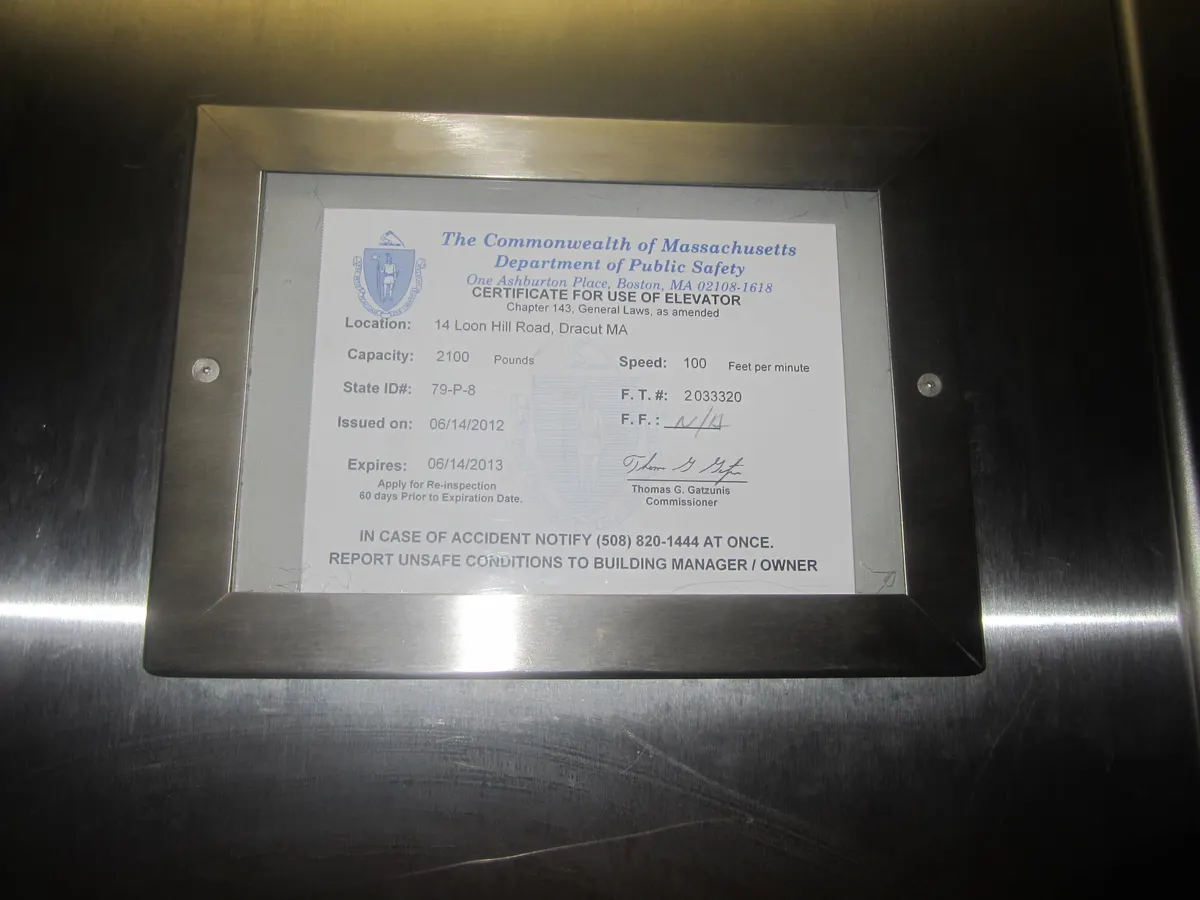
Registration and certificate. The lift is registered with the competent authority; the inspection certificate, with its validity period, is posted on the ground floor outside the car.
Annual cycle. Inspection at least once a year, with registration renewed annually after the result. Re-inspection after any major modification.
Annex 1 lists the standards, including SASO 466, 467 and 468 (general, safety and installation requirements), SASO 584 (periodic maintenance), SASO 978 (installation, periodic checks and approval of inspection bodies), SASO-EN-81-20, SASO-EN-81-50, SASO-ISO-4190-1 and -2 (lift installation dimensions), SASO GSO EN 81-71, 81-72 and 81-73, and SASO EN 81-70. Labels and the manual must be in Arabic or Arabic and English. SABER is the platform through which SASO certificates are issued; see our guide to SASO and SABER certificates.
Firefighting lifts in Saudi Arabia
Article 11 requires all buildings more than 23 m above ground to have at least one lift for firefighters and rescue at the main entrance, "or as defined in the regulations of the General Directorate of Civil Defense in KSA and the Saudi Building Code", and the lift must meet the relevant standards in Annex 1 (SASO GSO EN 81-72 and 81-73).
Escalators and moving walks
SASO's separate Technical Regulation for Escalators and Moving Walkways (published 20 May 2022) requires a certificate of conformity from a notified body (Type 1a under ISO/IEC 17067), an inspection certificate before use, periodic inspection at least once a year and proof of inspection displayed with the next inspection date. Its standards list includes SASO-EN 115-1 and 115-2.
An elevator inspection certificate displayed in a lift, here a United States state certificate. Saudi Arabia requires a similar certificate posted outside the car with its validity period. Photo: NWRGeek, CC0, via Wikimedia Commons
UAE and Saudi rules side by side
Dubai / UAE
Saudi Arabia
Design standard
ASME A17 or BS EN 81 suite, one per project (Dubai Building Code D.5)
Standards in Annex 1 of the SASO lift regulation, including SASO-EN-81-20/50
Product approval
Per the chosen suite and authority submission
Certificate of Conformity from an approved body, technical file
Firefighting lift trigger
Malls, multi-storey amusement parks, high-rise (from 23 m), super high-rise, high-depth (UAE FLSC)
Buildings over 23 m, or as Civil Defense and SBC define
Periodic inspection
Every 12 months by an EIAC-accredited third party for workplace lifts (Dubai Municipality)
At least once a year by a SASO-accepted ISO 17020 inspection body
Maintenance contract
Required in Abu Dhabi (AED 5,000 fine if missing)
Required while the lift is in service
Language
Not specified in the documents reviewed
Arabic, or Arabic and English
Compliance checklist for a lift package
Fix the suite of standards (Dubai: ASME A17 or BS EN 81; Saudi Arabia: SASO Annex 1) and the editions, including the EN ISO 8100 transition.
Identify every lift with a special duty: firefighting, evacuation, accessible, stretcher, vandal resistant, and the standard part for each.
Confirm shaft construction and lobby requirements for firefighting lifts with the fire engineer.
Ask for type-examination certificates for the lift and its safety components, and the Saudi Certificate of Conformity where relevant.
Agree who arranges the commissioning inspection and the first certificate, and who renews it every year.
Coordinate fire alarm interfaces, recall and secondary power with the fire and electrical designers.
Keep the technical file, test reports and certificates in the building's handover documents.
EN 81-20 is the European standard for the construction and installation of passenger and goods passenger lifts; the 2020 edition replaced EN 81-20:2014. In 2026 CEN replaced it with EN ISO 8100-1:2026, with a transition period expected. Saudi Arabia lists SASO-EN-81-20 in its lift regulation, the Dubai Building Code lists BS EN 81-20, and the GCC approved GSO EN 81-20:2025.
What replaces EN 81-20 and EN 81-50?
EN ISO 8100-1:2026 replaces EN 81-20, and EN ISO 8100-2:2026 replaces EN 81-50. Both were published by ISO in March 2026 and adopted by CEN. Liftinstituut expected a 36-month transition during which certification on EN 81-20/-50 continues. The new standards do not apply to lifts installed before their publication.
Does Dubai accept ASME A17 elevators?
Yes. The Dubai Building Code allows vertical transportation to be designed, installed, tested, commissioned and maintained to either the ASME A17 suite or the BS EN 81 suite. One suite must be chosen for the project, and the two cannot be used interchangeably. Firefighting elevators must also meet the UAE Fire and Life Safety Code.
What is EN 81-72?
EN 81-72 is the European standard for firefighters lifts: new passenger and goods passenger lifts that can be used for firefighting and evacuation under firefighters' control. It adds to or modifies the requirements of EN 81-20. The current edition is EN 81-72:2020, and a revision is in development. Saudi Arabia lists it as SASO GSO EN 81-72.
When is a firefighting lift required in Saudi Arabia?
SASO's lift regulation requires at least one lift for firefighters and rescue at the main entrance of every building more than 23 m above ground level, or as defined by the General Directorate of Civil Defense and the Saudi Building Code. The supplier and owner must follow Civil Defense instructions, and the lift must meet the standards listed in the regulation's Annex 1.
Who inspects lifts in Saudi Arabia?
An inspection body accredited to ISO 17020 and accepted by SASO. It inspects and tests a lift after installation and before use, then at least once a year, and reports to the competent authority. Its certificate is posted on the ground floor outside the car, and the lift's registration is renewed annually after the periodic inspection.
Five elevator makers side by side for Gulf buyers: origin, product lines from villa lifts to super high-rise, escalators, UAE and Saudi entities, maintenance and modernisation offers.
How to choose a home lift for a villa in the UAE or Saudi Arabia: compact traction lifts versus platform lifts, shaft, pit and power needs, the rules that apply and what drives the cost.
A buyer guide to elevators and escalators in the UAE and Saudi Arabia: lift types, EN 81 and the 2026 EN ISO 8100 change, Dubai and SASO rules, firefighting lifts, the main makers and maintenance.