GRP Sectional Panel Water Tanks: Panels, Assembly, Insulation and BS EN 13280
How GRP sectional (panel) water tanks are made and assembled, what BS EN 13280 covers, how internal tie rods and external bracing work, what insulated panels offer on a Gulf roof, and the specification points to check.
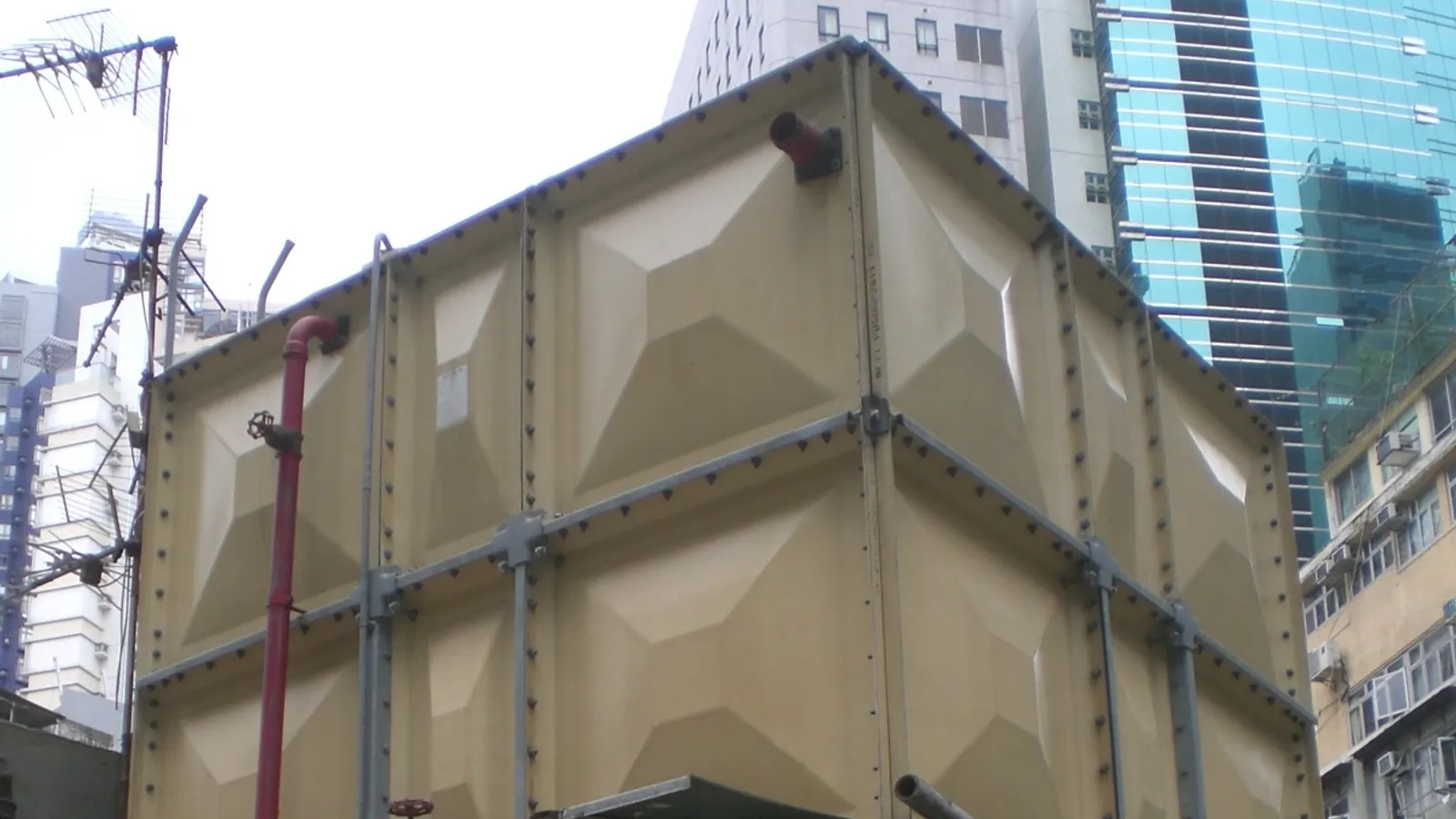
A GRP sectional water tank is built on site from moulded glass reinforced plastic panels bolted together through flanges, sealed at every joint and held in shape by internal tie rods and external steel bracing. It suits building storage where a one-piece tank cannot be delivered or will not fit. Specify panels to BS EN 13280, potable approval for panels and seals, and insulated panels for roofs, then compare makers of water tanks and reservoirs.
This explainer is for MEP consultants, contractors and facility managers specifying or receiving a panel tank. It covers what the panels are made of, how the tank is braced and assembled, what the standard covers, insulation for Gulf roofs and the points to check at handover. For choosing between GRP, polyethylene and steel, and for the rules on sizing and cleaning, see our main guide to water tanks in the UAE and Saudi Arabia. ListGCC has not tested any panel tank; manufacturer details below come from Balmoral Tanks' published product page, used as a worked example of a full specification.
What BS EN 13280 covers
BS EN 13280:2001 is the "Specification for glass fibre reinforced cisterns of one-piece and sectional construction, for the storage, above ground, of cold water". BSI lists it as current and under review, published 22 October 2001, identical to EN 13280:2001. Three points follow from the title:
It covers both sectional (panel) and one-piece GRP cisterns.
It is for above ground storage. A buried GRP tank needs a different design basis.
It is for cold water. Hot water storage is outside it.
The standard covers the tank. Potable suitability of the materials is shown separately, typically by a WRAS approval or a BS 6920 test report; UL describes BS 6920 as testing odour and flavour, appearance, microbial growth, cytotoxicity and metal extraction. No Saudi or UAE standard specific to GRP sectional tanks was found during research, so BS EN 13280 is the reference most Gulf specifications cite.
What the panels are made of
Panels are moulded GRP: a thermoset resin reinforced with glass fibre. Balmoral's page is a useful template of what a full material declaration looks like:
Hot press moulded panels in isophthalic unsaturated polyester resin with electrical grade glass fibre reinforcement.
Glass content above 30%, specific gravity 1.8 and tensile strength 110 MPa.
Manufacture certified to BS EN ISO 9001:2015.
WRAS approval for potable water storage, with the page stating tank compliance to WRAS Section 0135 and fittings to Water Regulation 16 (Byelaw 30) for tanks up to 4 m deep.
Ask any GRP panel supplier for the same set of facts: resin type, moulding method, glass content, mechanical properties, quality certification and the potable approval, with the approval covering the actual panel range and sealant offered. General GRP fabricators are listed under fibreglass reinforced plastic.
Panel sizes and tank geometry
Sectional tanks are modular. Balmoral says its GRP sectional tanks are erected to a height of 4 m in 1 m and 0.5 m increments and that the flexibility of panel sizes allows connections to be agreed on site to suit the actual tank location. Its page does not list panel dimensions, so ask each supplier for:
The panel module (length and height) and the plan sizes available.
The maximum height for the panel range, and the water depth at the overflow for the height offered.
The net capacity of the exact configuration quoted, since tank volume steps with the module.
Whether the tank can take an internal partition to form two compartments.
The modular plan is what makes panel tanks practical on existing roofs: panels go up a stair or a small hoist and the tank is built to the space. For working out the volume, see how to calculate water tank size.
Bracing: internal tie rods and external steel
A tall tank full of water pushes hard on its side walls, so panel tanks are braced. Balmoral describes its panels as rigidly supported by a combination of stainless steel tie rods internally and galvanised box sections externally. Points to check:
Internal tie rods and brackets are in contact with drinking water, so ask for the stainless grade and confirm they are covered by the potable approval.
External steel sits in Gulf sun, humidity and, near the coast, salt. Ask how it is protected (galvanising, coating) and how cut ends and bolt holes are treated.
Bolts and nuts on the flanges: ask for the material and finish.
Wind and hold-down: on a roof, ask the supplier to confirm the bracing and anchorage design for the site's wind load.
Dubai Municipality's Legionella guideline says water temperatures of 20 °C to 45 °C seem to favour Legionella growth and that cold water should be kept below 20 °C. On a Gulf roof in summer, an uninsulated panel tank gains heat all day. Insulated panels slow that gain.
Balmoral's insulated panel data is a fair example of what to ask for: 40 mm of expanded polystyrene with a pentane expansion agent, CFC and HCFC free, behind an ABS insulation cover, giving a stated U value of 0.6 W/m²K, and described as suitable for water storage up to 38 °C. When you compare quotes, compare the U value and the insulation material and how the insulation is protected from sun and damage, not just the word "insulated". Insulate the roof panel too, and shade the tank where you can.
Light is the other reason to insulate and cover. Light through the walls supports algae growth; ask for the panel's opacity or light transmission result, and make sure insulation covers and roof panels leave no translucent gaps.
Seals and leak paths
Every panel joint is sealed with a gasket or sealant strip clamped between flanges. These seals are the most likely leak path in a panel tank and they touch the water, so:
Ask what the sealant is and confirm it is covered by the potable certificate.
Ask whether seals are internal or external flange type and how a seal is replaced on a full tank.
Keep spare seals and a few spare panels with the handover documents.
Assembly and handover checks
Base. A level, load-bearing base or steel skid designed for the full weight of water. The structural engineer should sign it off with the filled weight.
Panel layout. Check the panel arrangement against the approved drawing, including the position of the partition, hatches, ladders and nozzles.
Connections. Inlet, outlet, overflow, drain, vent and level indicator. Connections are usually flanged panels or bulkhead fittings; confirm the flange standard matches the pipework, whether that is steel, PPR or uPVC from makers such as Cosmoplast, which lists those pipe systems and manufactures in the UAE and in Saudi Arabia (Cosmoplast in Saudi Arabia).
Bolt torque. Ask for the torque values and a record that every flange bolt was tightened.
Leak test. Fill to the overflow and hold, checking every joint and connection.
Disinfection. In Dubai, the Legionella guideline lists completion of a new water system as a case for disinfection, and tanks must be cleaned and disinfected by a Dubai Municipality approved company. Get the certificate and the laboratory report before the tank goes into service.
Covers and vents. Dubai requires coverings to be intact and firmly in place and tanks inspected at least monthly. Check hatches seal and lock, and vents and overflows are screened.
It is a water tank assembled on site from moulded glass reinforced plastic panels bolted together through flanges, with a seal at each joint and internal tie rods and external steel bracing to resist water pressure. Because it arrives as panels, it can be built on roofs and in plant rooms that a one-piece tank cannot reach.
Which standard applies to GRP sectional tanks?
BS EN 13280:2001 covers glass fibre reinforced cisterns of one-piece and sectional construction for the above-ground storage of cold water. BSI lists it as current and under review. Potable suitability is shown separately, usually by WRAS approval or a BS 6920 test report covering the panels and seals.
How tall can a GRP panel tank be?
It depends on the panel range and bracing. Balmoral, for example, says its GRP sectional tanks are erected to a height of 4 m in 1 m and 0.5 m increments. Ask each supplier for the maximum height of its range and the water depth at the overflow for the height you are buying.
Do GRP panel tanks need insulation in the UAE?
For roof and outdoor locations, yes in practice. Dubai Municipality's guideline asks for cold water below 20 °C and notes that 20 °C to 45 °C favours Legionella. Insulated panels slow heat gain; Balmoral's insulated panels, for instance, use 40 mm of expanded polystyrene with a stated U value of 0.6 W/m²K. Shade the tank as well.
Can a GRP sectional tank be installed underground?
Not one built to BS EN 13280, which is for above-ground storage. A buried tank needs a product designed and certified for burial, or a concrete tank with an approved lining. Panel tanks are often installed in basements or plant rooms instead, standing on a base with access all round.
How are leaks in a GRP panel tank repaired?
Most leaks are at panel joints, where the seal is clamped between flanges. The usual repair is to drain the affected section, replace the seal and re-torque the bolts; a damaged panel can be replaced. Ask the supplier for the procedure, torque values and spare seals at handover.
How to choose a water tank in the UAE or Saudi Arabia: GRP sectional, polyethylene and steel compared, potable approvals, sizing from DEWA demand figures, Gulf heat, cleaning rules and what to put in an RFQ.
A step by step method for sizing water storage in the UAE and Saudi Arabia, using DEWA per capita demand ranges and its 24-hour rule, with worked examples for villas, apartments, labour camps and hotels.
How often water tanks must be cleaned in Dubai and Abu Dhabi, who is allowed to clean them, the chlorine disinfection steps Dubai Municipality sets out, the records to keep, and what applies in Saudi Arabia.