CCTV in the UAE and Saudi Arabia: SIRA Rules, Camera Types and Brands
A buyer's guide to CCTV in the UAE and Saudi Arabia: SIRA and MCC rules, the Saudi surveillance cameras law, IP systems and storage, Gulf heat ratings, US restrictions and the main brands.
To buy a CCTV system for a commercial site in the UAE or Saudi Arabia, start with the regulator, not the camera. In Dubai, security devices and the companies that trade, install and inspect them are licensed by SIRA; in Abu Dhabi, the Monitoring and Control Centre sets the rules; in Saudi Arabia, a 2022 law makes cameras compulsory for many facilities. Then pick CCTV and IP surveillance cameras rated for the heat, choose the recorder and storage, and only then compare brands.
This guide is for facility managers, ELV contractors, security managers and procurement teams buying surveillance for commercial and residential buildings, hotels, warehouses and plants. It covers the Dubai, Abu Dhabi and Saudi rules, IP systems and storage, Gulf enclosure ratings, cybersecurity, privacy, US restrictions on some brands, the main brands and an RFQ checklist.
What are the legal requirements for CCTV in Dubai?
The short answer: in Dubai, CCTV is a regulated security activity. Both the equipment and the people who sell, install, inspect and monitor it need a licence from the Security Industry Regulatory Agency (SIRA), and many types of premises must meet SIRA's technical requirements.
The law and the bylaw
Law No. (12) of 2016 Regulating the Security Industry in the Emirate of Dubai establishes SIRA as the government entity responsible for regulating the security industry. Under Article 7, SIRA sets and updates the specifications, standards and requirements of the industry, licenses the security devices and equipment named in the implementing bylaw, and ensures that preventive systems are in place in vital sectors, major compounds and public events. Article 17 says no person may provide security services in the emirate without first obtaining a licence. Article 21 sets fines of no less than AED 10,000 and up to AED 500,000 per violation, doubled for a repeat within one year, to a maximum of AED 1,000,000.
Who must comply. Article 24 requires vital sectors, major compounds and public events to meet the security requirements in SIRA's Preventive System Manual. The vital sectors listed include hotels, financial institutions, shopping malls, shopping and entertainment centres, restaurants, nightclubs and gas stations, among others.
Licensed activities. Article 3 lists trading in alarm and surveillance equipment, installing security devices, security system inspection, command and control (including CCTV monitoring of subscriber premises) and manufacturing security devices as separate licensed activities. Inspection cannot be combined with other activities except consultancy, so your inspector should not be your installer.
Licensed devices. Under Article 21, surveillance devices need a licence before they are imported, exported, moved in transit or traded.
Handling footage. Article 23 makes copying, displaying or sending data or pictures from security systems to unauthorised persons a special activity that needs its own licence.
What about retention period and resolution?
Neither the 2016 law nor the 2018 bylaw states a retention period or a minimum resolution for CCTV. The figures are in SIRA's Preventive Systems Guide, approved in 2025, which requires recordings to be kept for no less than 31 days at no less than 10 frames per second, and for 75 days for cameras covering ATMs; our guide to SIRA CCTV approval covers the details. SIRA sets those technical requirements in its manuals and approvals, and they can differ by premises type. Installer websites quote figures we could not find in SIRA's published text, so we do not repeat them. Have your SIRA-licensed installer state the retention, image and coverage requirements for your premises in writing, and make them part of the contract.
SIRA's website, sira.gov.ae, has a search for licensed security companies: check that your providers of CCTV installation services, and your inspection company, appear there before you sign.
In Abu Dhabi, the authority is the Abu Dhabi Monitoring and Control Centre (MCC). The Abu Dhabi Media Office describes the MCC as part of the Supreme Council for National Security, developing the rules for monitoring and control systems used by public and private entities. An MCC official told Khaleej Times in November 2019 that there were 301,798 certified cameras installed at 7,029 entities in the emirate; the MCC issues permits and approvals for camera installation, and its officials visit facilities to recommend camera locations.
In March 2026 Abu Dhabi Police, working with the MCC, ran an awareness campaign reported by Gulf News. The advice: use licensed companies to install and maintain systems, do not post footage on social media, do not point cameras at neighbours' homes or private areas, store recordings securely, and protect and regularly change system passwords. On a commercial project, appoint an MCC-approved contractor; do not assume Dubai approvals carry over.
Other emirates have their own authorities; check locally before you award a contract.
Saudi Arabia: the security surveillance cameras law
Saudi Arabia regulates CCTV through a dedicated law. The Saudi Central Bank rulebook cites it as the law on the use of surveillance cameras, Royal Decree No. (M/34) dated 7/3/1444 H, with implementing regulations issued by the Ministry of Interior under Resolution No. (22688) dated 3/11/1444 H. The Ministry of Interior also published a document on security conditions and requirements for installing surveillance systems and general technical specifications for camera systems, as Ajel reported in June 2023.
Who must install. Entities in many sectors, including ministries and public institutions, power and desalination plants, oil and petrochemical facilities, commercial complexes, residential buildings, banks, mosques, healthcare facilities, schools, fuel stations and public transport. The Ministry of Interior can add others. Cameras must be installed before an activity licence is granted or renewed.
What is excluded. Cameras inside private residential units and complexes.
Where cameras are banned. Operating rooms, medical examination and inpatient rooms, physiotherapy rooms, changing rooms, toilets, women's salons and clubs, and residential units in tourist accommodation, plus any places added by the regulations.
Signage. Covered areas must carry a visible sign saying security cameras are in use.
Recordings. When an incident is reported, recordings must be kept unaltered until the investigation is complete. Recordings may only be transferred or published with approval of the Ministry of Interior or the Presidency of State Security, under a court order, or at the request of the investigating authority.
Suppliers. Manufacturing, importing, selling, installing, operating and maintaining security cameras all need prior approval from the Ministry of Interior.
The penalties are per device, which adds up quickly on a large site: SAR 500 for each camera or device that does not meet the technical specifications, SAR 1,000 for each camera not installed to the specification, up to SAR 5,000 for failing to keep recordings, and up to SAR 20,000 for transferring or publishing recordings unlawfully or damaging equipment or recordings. In January 2025 the Ministry of Interior restated the ban on transferring or publishing recordings and the SAR 20,000 fine, as Arab News reported.
Banks have an extra layer: SAMA classes financial institutions as highly sensitive entities, requires cameras according to each site's sensitivity classification, and adds its own security and safety guide for the financial sector on top of the law and the Ministry's documents.
The law summary gives no fixed number of days for routine retention: take retention, camera positions and recording specifications from the Ministry's requirements document for your facility type. Suppliers of CCTV cameras in Saudi Arabia and installers should be able to show their Ministry of Interior approval.
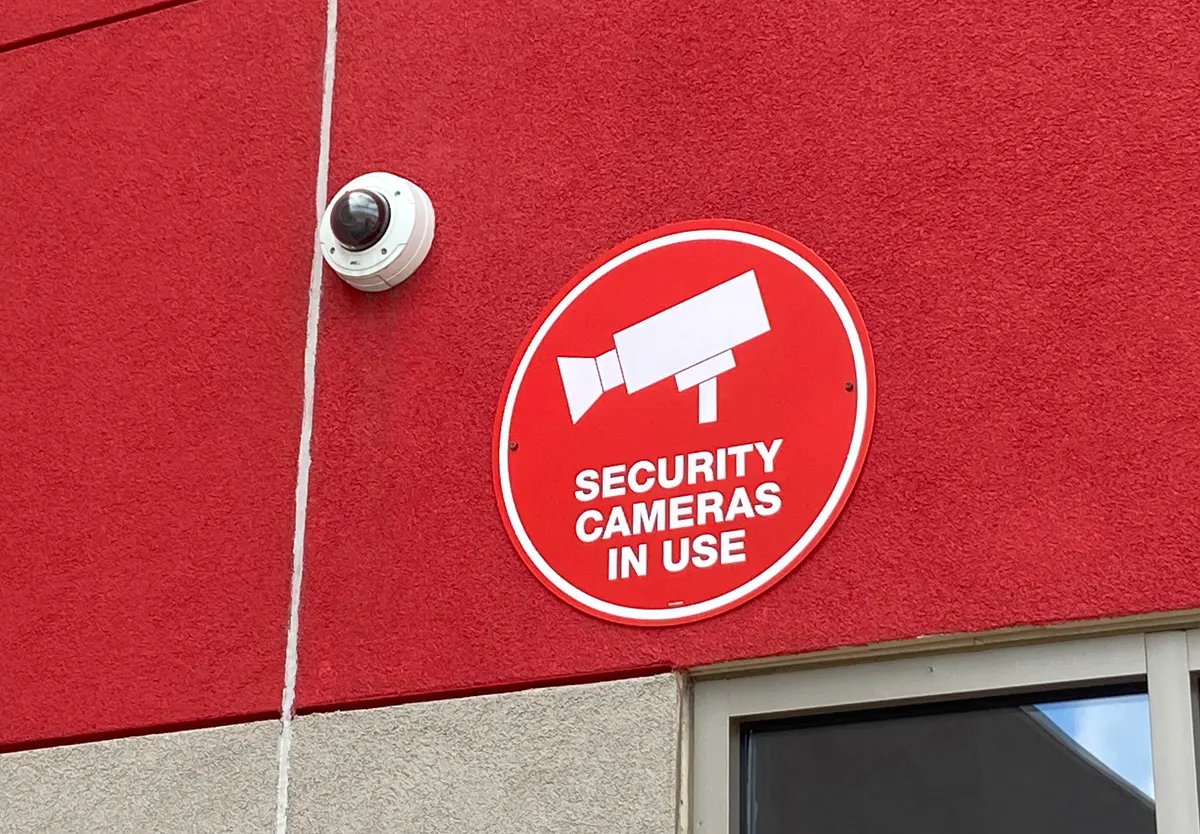
An exterior vandal-resistant dome camera next to a "security cameras in use" sign, at a store in Minnesota, United States. Saudi law requires visible signs in covered areas. Photo: Myotus, CC BY-SA 4.0, via Wikimedia Commons
Privacy law: PDPL in both countries
CCTV footage of identifiable people is personal data. In the UAE, Federal Decree-Law No. 45 of 2021 on personal data protection came into force on 2 January 2022, with the UAE Data Office as the federal regulator; the DIFC has its own Data Protection Law (DIFC Law No. 5 of 2020). In Saudi Arabia, the Personal Data Protection Law issued by Royal Decree M/19 on 16 September 2021 and amended in March 2023 came into force on 14 September 2023, with the transition period ending on 14 September 2024 and SDAIA as regulator, according to Morgan Lewis.
In practice: control and log who views and exports footage, and check where any cloud service stores it, since both laws regulate transfers abroad.
IP or analogue cameras?
For new commercial projects, IP is the default: each camera streams over the network to a network video recorder (NVR) or video management system (VMS), takes power over Ethernet and can run analytics. Analogue HD over coax still suits upgrades on sites with good existing coax.
Option
How it works
Suits
Watch for
IP camera + NVR
Cameras stream over the LAN to a recorder with built-in disks
Shops, offices, residential compounds, small warehouses
Camera count and bitrate limits of the NVR; same-brand lock-in
IP camera + VMS on servers
Software on standard servers records and manages many cameras, often from mixed brands
Licences per camera, server and storage sizing, IT support
Analogue HD + DVR
Cameras send video over coax to a digital video recorder
Retrofits on existing coax
Fewer analytics, longer cable runs need checking, limited future growth
Cloud or hybrid
Footage or management in a hosted service, sometimes with local storage
Distributed small sites
Data location under PDPL, internet bandwidth, whether the regulator accepts it
If you want to mix camera brands with one VMS, specify ONVIF conformance. ONVIF lists Profiles S, T and G for video systems (a camera with local storage can conform to both T and G), and Profile M for metadata and events for analytics applications. Profile Q was deprecated in April 2022, so do not write it into new specifications.
Fixed domes for ceilings, corridors, lobbies and lift lobbies.
Bullet and box cameras for perimeters, car parks and long views.
PTZ (pan-tilt-zoom) for large open areas where an operator follows events, alongside fixed cameras, since a PTZ records only where it points.
Thermal cameras for perimeter detection in darkness, dust or across open ground.
Explosion-protected cameras for hazardous areas in oil, gas and petrochemical plants; specify the hazardous-area classification and certification your client requires.
Resolution is only useful if it gives enough pixels on the target. Decide what each camera must do (detect a person, recognise a known person, identify a stranger, read a plate) and ask the designer to show pixel density at the required distance for each view.
Recorder and storage sizing
The arithmetic: storage per camera = average bitrate × seconds recorded ÷ 8. A camera averaging 4 Mbit/s and recording continuously writes 4 × 86,400 ÷ 8 = 43,200 megabytes, about 43 GB a day. Over a 30-day period that is about 1.3 TB per camera, and 32 such cameras need about 41 TB before any RAID overhead.
The bitrate depends on resolution, frame rate, compression codec, scene activity and night-time noise, so take it from the manufacturer's calculator for your cameras and settings. Size for the retention period the regulator sets for your premises, add redundancy (RAID or failover recorders), and protect the recorder with a UPS.
The UAE's National Center of Meteorology recorded 51.8 °C in Sweihan, Al Ain, on 1 August 2025, as Gulf News reported. That is shade air temperature; a camera on a sun-facing wall or pole runs hotter.
The upper operating limit varies between models from the same maker. Axis, for example, rates its P3277-LVE dome for -40 °C to 50 °C and its P1387-LE box camera for -40 °C to 60 °C. Both carry IP66, IP67 and IK10 ratings. Read the operating range on every datasheet, ask for sunshields on exposed cameras, and put recorders and switches in cooled rooms or cabinets.
Two enclosure ratings matter:
IP code (IEC 60529). A first digit of 6 means dust-tight. A second digit of 6 means protected against powerful water jets; 7 means protected against temporary immersion. A camera rated IPX7 is not automatically protected against jets, which is why good outdoor cameras state both, such as IP66/IP67. Ask for IP66 as the outdoor minimum.
IK code (IEC 62262). IK10 means the enclosure withstands an impact energy of 20 joules; IK11, at 50 joules, was added in a 2021 amendment. Specify IK10 for cameras within reach of people.
On coastal sites, ask how housings and brackets resist salt, and use stainless fixings.
Cybersecurity basics
A networked camera is a computer on your network. Put the following into the specification, not into a later change order:
Change every default password at installation and hand over a credential list.
Put cameras and recorders on a separate VLAN or physical network, with no direct internet exposure.
Remote viewing through the VMS or a VPN, not port forwarding to cameras.
Current firmware at handover, and a named party responsible for updates.
Individual user accounts with roles, an audit log of footage exports, and time sync across devices.
US restrictions on Hikvision and Dahua: when they matter
If your project has a US government link, or a client whose procurement policy follows US rules, check two restrictions before you specify Hikvision or Dahua.
First, Section 889 of the US National Defense Authorization Act for fiscal year 2019, implemented in FAR clause 52.204-25. Its definition of covered equipment includes video surveillance and telecommunications equipment produced by Hytera, Hikvision or Dahua (and their subsidiaries and affiliates) for the purpose of public safety, security of government facilities and other national security purposes. From 13 August 2019, US executive agencies may not buy such equipment as a substantial or essential component of any system; from 13 August 2020, they may not contract with an entity that uses it.
Second, the US Federal Communications Commission's Report and Order of 25 November 2022, summarised by the Congressional Research Service: the FCC stopped issuing new equipment authorisations for Hikvision and Dahua video surveillance equipment unless the companies submit an approved plan showing it will not be marketed or sold for those security purposes. The order did not revoke earlier authorisations.
These are US rules, not UAE or Saudi ones; locally, the regulator's approval is what counts.
CCTV brands with pages on ListGCC
Brands are listed alphabetically, not ranked. The right one depends on the regulator's approvals, the client's vendor list, the VMS and local support.
Avigilon
Avigilon describes itself as a Motorola Solutions company. Its range covers dome, bullet, PTZ and 360-degree cameras, Avigilon Unity on-premises and Avigilon Alta cloud security software, access control and analytics. Its customer stories include Deep Dive Dubai and Moro Hub.
Axis Communications
Axis is headquartered in Lund, Sweden, was founded in 1984 and has been part of the Canon Group since 2015, according to its own company page, which also says it launched the world's first network camera in 1996. It makes network video, access control, intercom and audio products and works with third-party VMS platforms.
Bosch
Bosch's security and communications product business, including its intelligent video systems, was sold to the investment firm Triton and became independent as KEENFINITY Group on 1 July 2025, according to KEENFINITY's press release. Products continue under the Bosch brand alongside Electro-Voice, Dynacord, RTS and Telex, and manufacturing sites are in Germany, Portugal, Mexico and China. Confirm the current product line and support channel with the supplier.
Dahua Technology
Dahua (Zhejiang Dahua Technology) describes itself as a video-centric AIoT solution and service provider and dates its in-house technology development to 1993, in its 30th anniversary release from Hangzhou. See the US restrictions above if your project has a US link.
Genetec
Genetec is a software-first company: founded in 1997 and headquartered in Montreal, its Security Center platform unifies video surveillance, access control, licence plate recognition and communications, according to its corporate fact sheet, which lists Dubai among its experience centres. Choose it as the VMS layer when you want to run cameras from several makers on one platform.
Hanwha Vision
Hanwha Vision is the former Hanwha Techwin, which changed its name on 1 March 2023 in an announcement from Seongnam, South Korea, describing itself as a video surveillance company expanding into vision solutions.
Hikvision
Hikvision was founded in 2001, is based in Hangzhou and has been listed on the Shenzhen Stock Exchange since 2010, according to its Wikipedia entry. It is the most searched CCTV brand name on Google in both countries, and its range covers cameras, recorders and integrated security products. See the US restrictions above for US-linked projects.
Pelco
Pelco lists dome, bullet, PTZ, panoramic and specialty cameras, with capabilities including thermal, explosion-proof, extreme-weather and licence plate recognition, and its VideoXpert video management software. Its explosion-proof and heavy-duty lines are relevant to oil, gas and industrial sites.
Uniview (UNV)
Uniview was founded in 2011, according to its company profile, which lists network, analogue, PTZ, thermal and explosion-proof cameras, recorders, storage, VMS, access control and intelligent traffic products.
CCTV RFQ checklist
Site, emirate or Saudi region, type of premises, and the regulator whose rules apply (SIRA, MCC, other emirate authority, or Saudi Ministry of Interior).
The applicable requirement document and the retention period, coverage and image requirements it sets for your premises, confirmed by the bidder.
Bidder's licence or approval number (SIRA company search in Dubai, MCC approval in Abu Dhabi, Ministry of Interior approval in Saudi Arabia), and the licensed engineer and technicians named.
Camera schedule: location, purpose (detect, recognise, identify, read plates), camera type, lens, and pixel density at the target distance.
Environmental ratings for outdoor cameras: IP66 minimum, IK10 where reachable, stated upper operating temperature, sunshields, coastal corrosion protection.
Recording: NVR or VMS, ONVIF profiles required, bitrate assumptions, storage calculation, RAID or failover, UPS runtime.
Network and cybersecurity: cabling, PoE switches, racks, VLAN separation, remote access, passwords, firmware, user roles, audit log.
Privacy and signage: signage plan, banned locations excluded, footage export procedure and log.
Integrations (access control, alarms, monitoring centre) and any client procurement restriction, such as US Section 889.
What are the legal requirements for CCTV systems in Dubai?
Dubai regulates CCTV under Law No. 12 of 2016 and its implementing bylaw, Resolution No. 1 of 2018. SIRA licenses surveillance devices and the companies and people that trade, install, inspect and monitor them. Vital sectors such as hotels, banks, malls, restaurants and fuel stations must meet SIRA's Preventive System Manual. Sending footage to unauthorised persons needs a special licence. Fines run from AED 10,000 up to AED 500,000, doubled for repeats.
How long must CCTV footage be kept in Dubai?
The retention period is not written in Dubai's 2016 security industry law or its 2018 bylaw. SIRA's 2025 Preventive Systems Guide sets it: at least 31 days at 10 frames per second or more, and 75 days for ATM cameras. It is a technical requirement that SIRA sets for each type of premises through its manuals and approvals. Ask your SIRA-licensed installer to confirm the period that applies to your premises in writing, size storage for it, and test retrieval of the oldest footage at handover.
Which places must have CCTV in Saudi Arabia?
The Saudi surveillance cameras law covers government bodies, power and desalination plants, oil and petrochemical facilities, commercial complexes, residential buildings, banks, mosques, healthcare facilities, schools, fuel stations and public transport, and the Ministry of Interior can add more. Cameras must be in place before an activity licence is issued or renewed. Cameras inside private residential units and complexes are excluded.
Where are cameras banned in Saudi Arabia?
The law bans cameras in operating rooms, medical examination and inpatient rooms, physiotherapy rooms, changing rooms, toilets, women's salons and clubs, and residential units in tourist accommodation, and the implementing regulations can add more places. Publishing or transferring recordings without approval from the authorities, a court order or an investigator's request can bring a fine of up to SAR 20,000.
Which brand of CCTV camera has the best quality?
No brand is best for every job. Compare models on the job they must do: pixel density at the target distance, low-light performance, operating temperature, IP and IK ratings, ONVIF support and firmware support. Then check regulator approval for that model, your client's vendor list and any procurement restriction, such as US Section 889.
Are Hikvision and Dahua cameras allowed in the UAE and Saudi Arabia?
US restrictions on Hikvision and Dahua apply to US federal procurement and to new US FCC equipment authorisations; they are not UAE or Saudi rules. In both countries, what counts is approval of the model and the installer by the local regulator. If your client, funder or end user follows US procurement rules, Section 889 compliance may still be required,.
Steel and composite toe caps pass the same 200 joule test. The choice comes down to heat, weight, metal detectors, electrical work, bulk, cost and cap quality. A buyer's comparison for UAE and Saudi sites.
The Saudi surveillance cameras law in practice: which spots must be covered, sensitivity classes and deadlines, the Public Security certificate, privacy masks, audio and thermal limits, recordings and fines.
Ladies' safety shoes carry the same EN ISO 20345 ratings as men's. What a women's last changes, how to size and trial, which class suits healthcare, labs, logistics and sites, and what employers must provide.